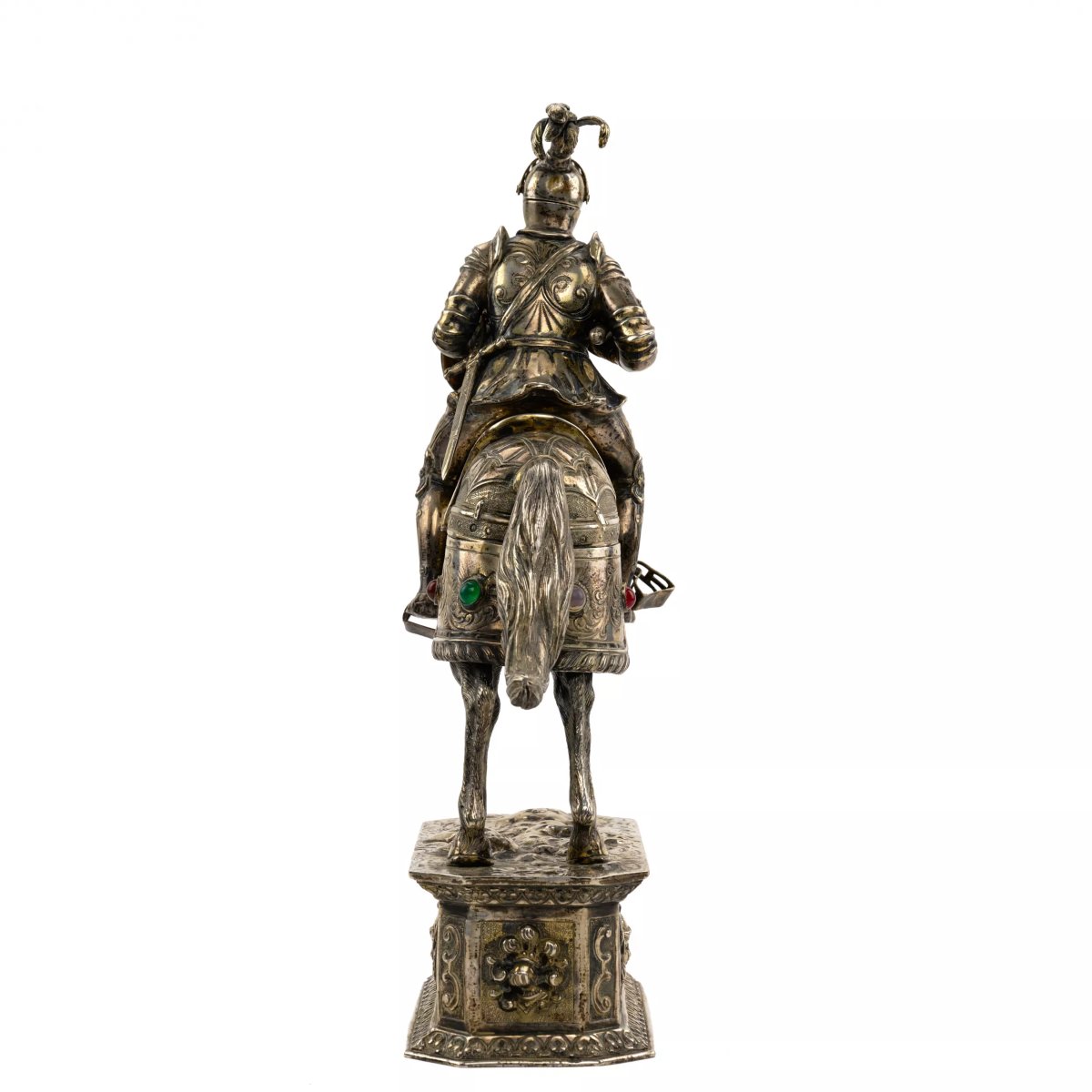
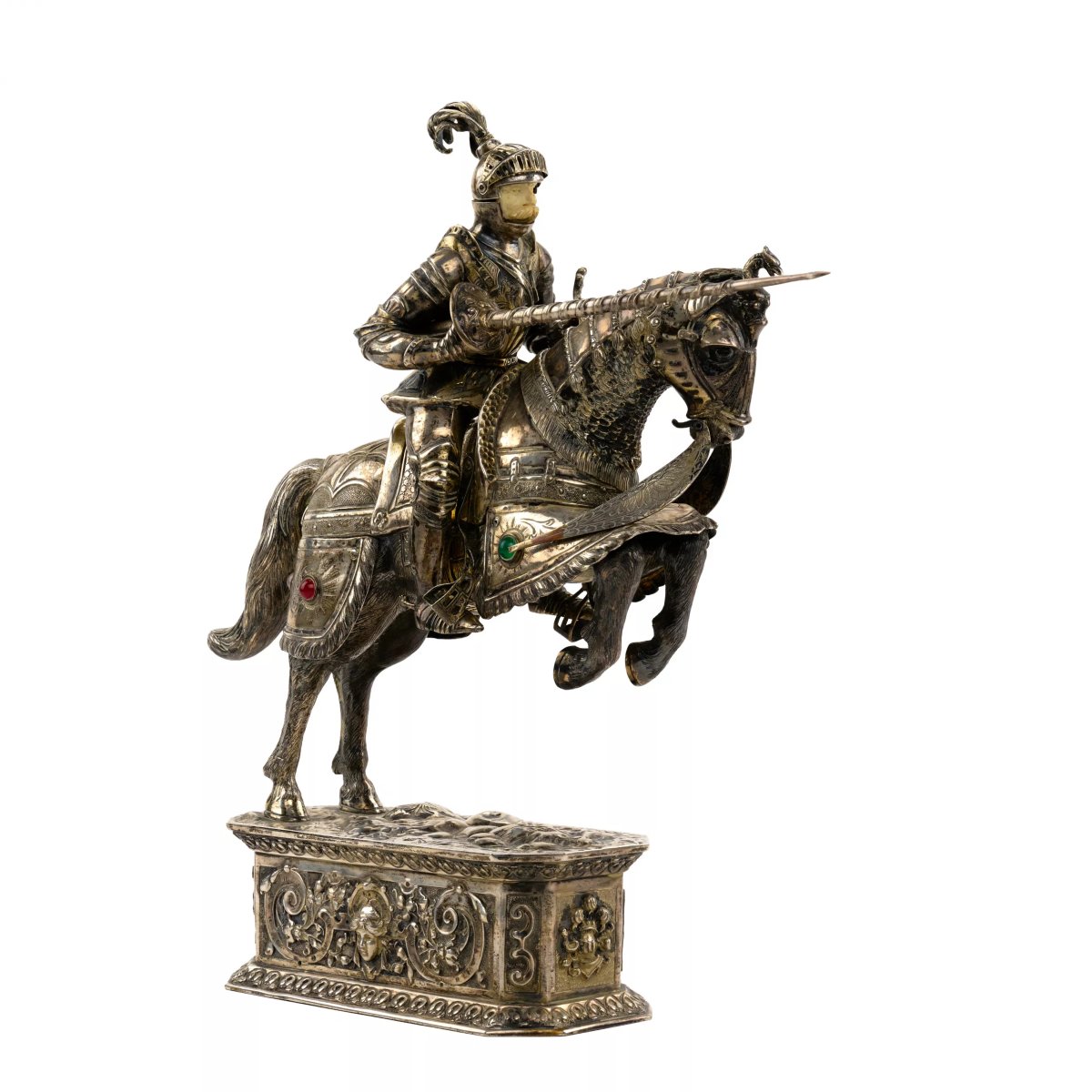
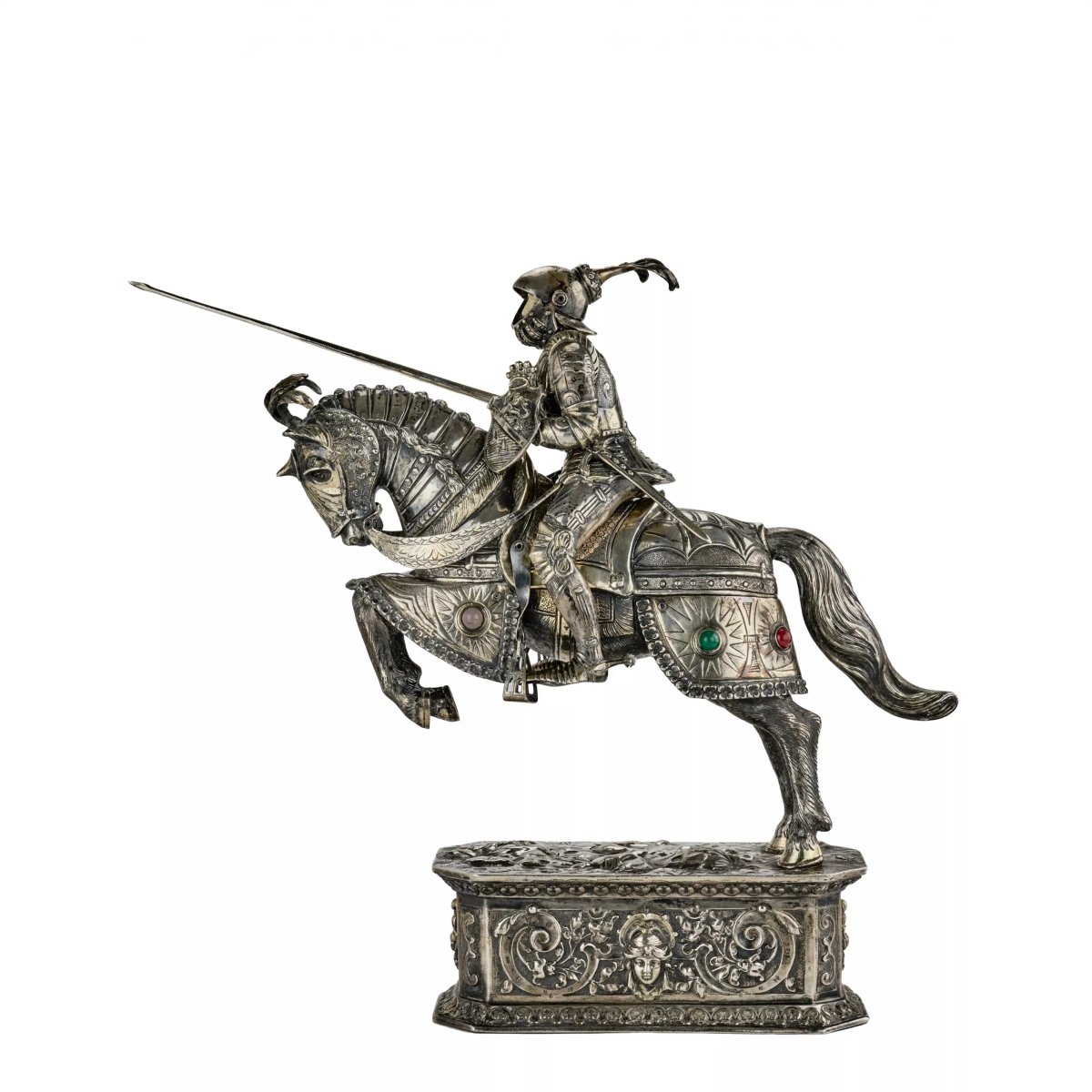
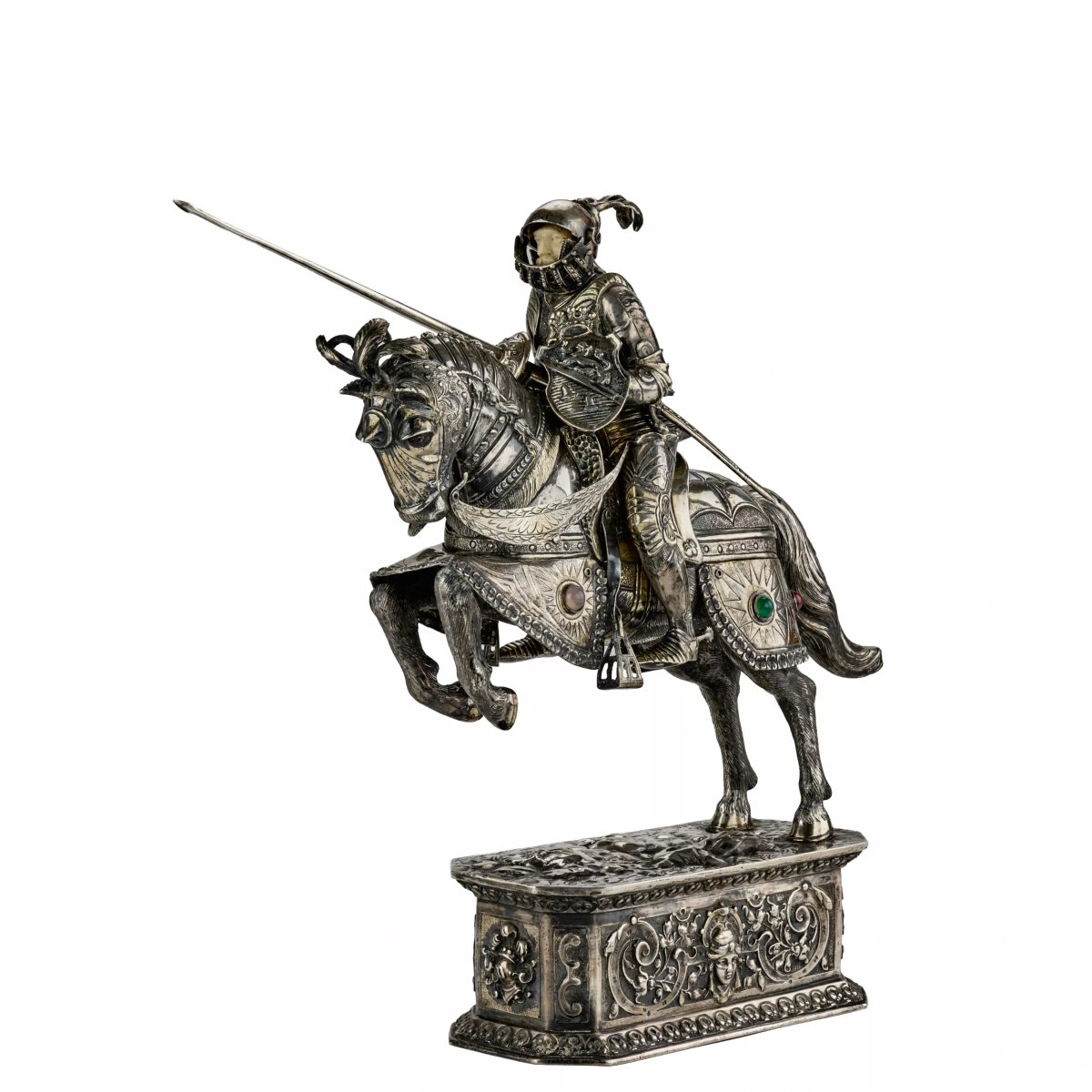
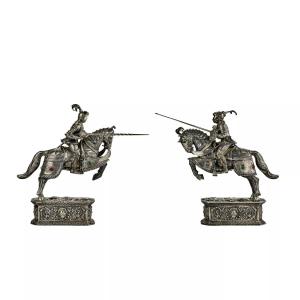


Pair Of Silver Sculptures, “knights On Horseback,” Germany, Hanau.
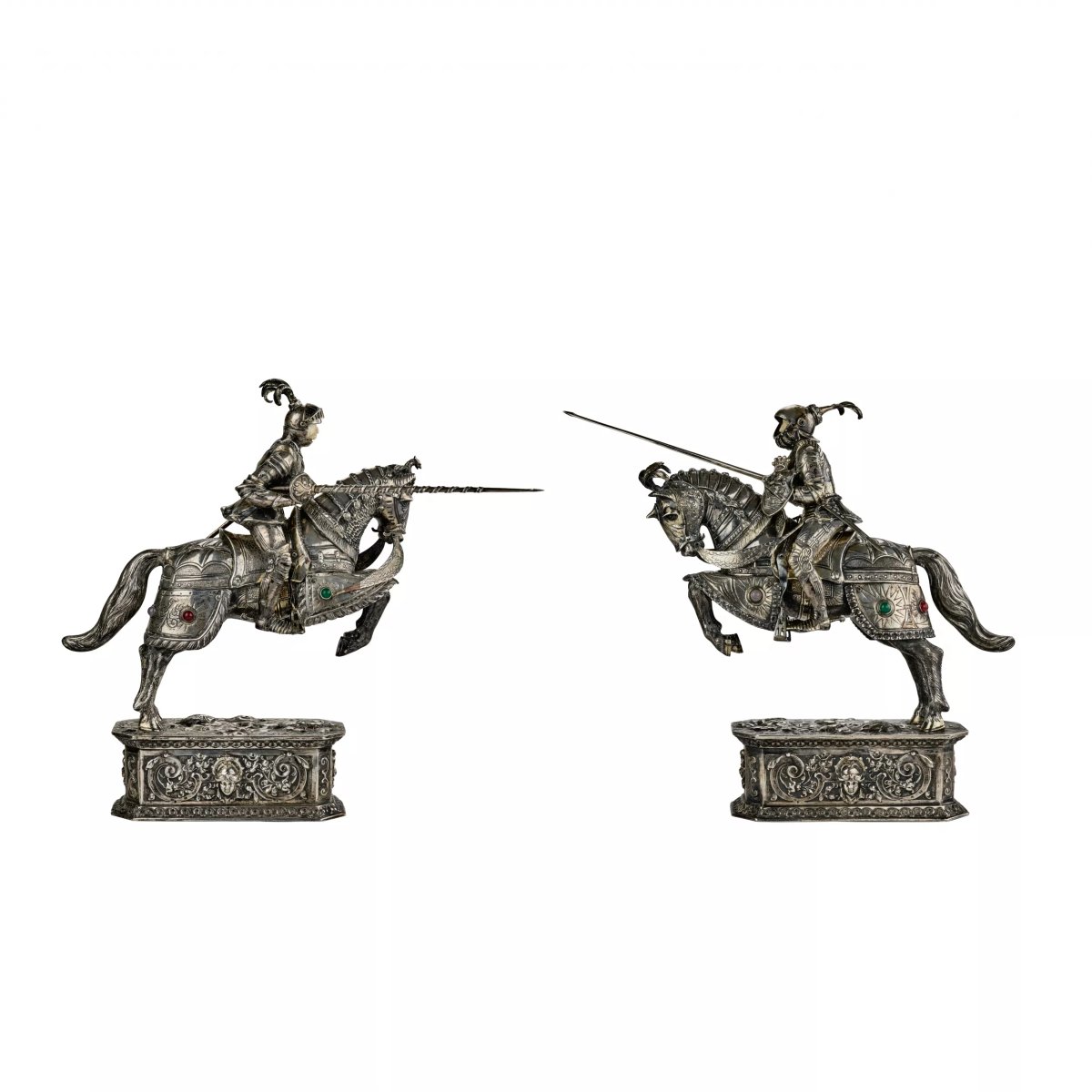
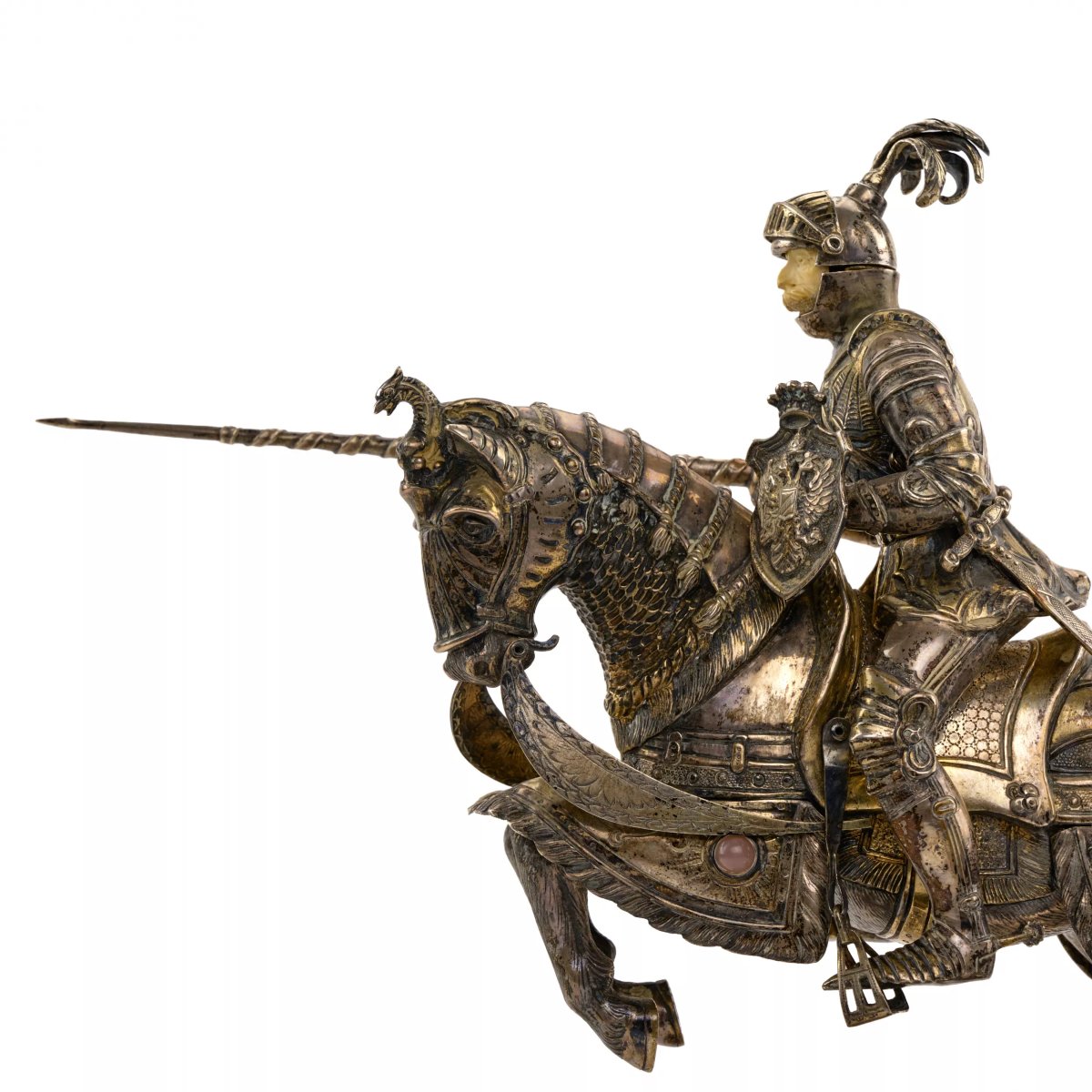
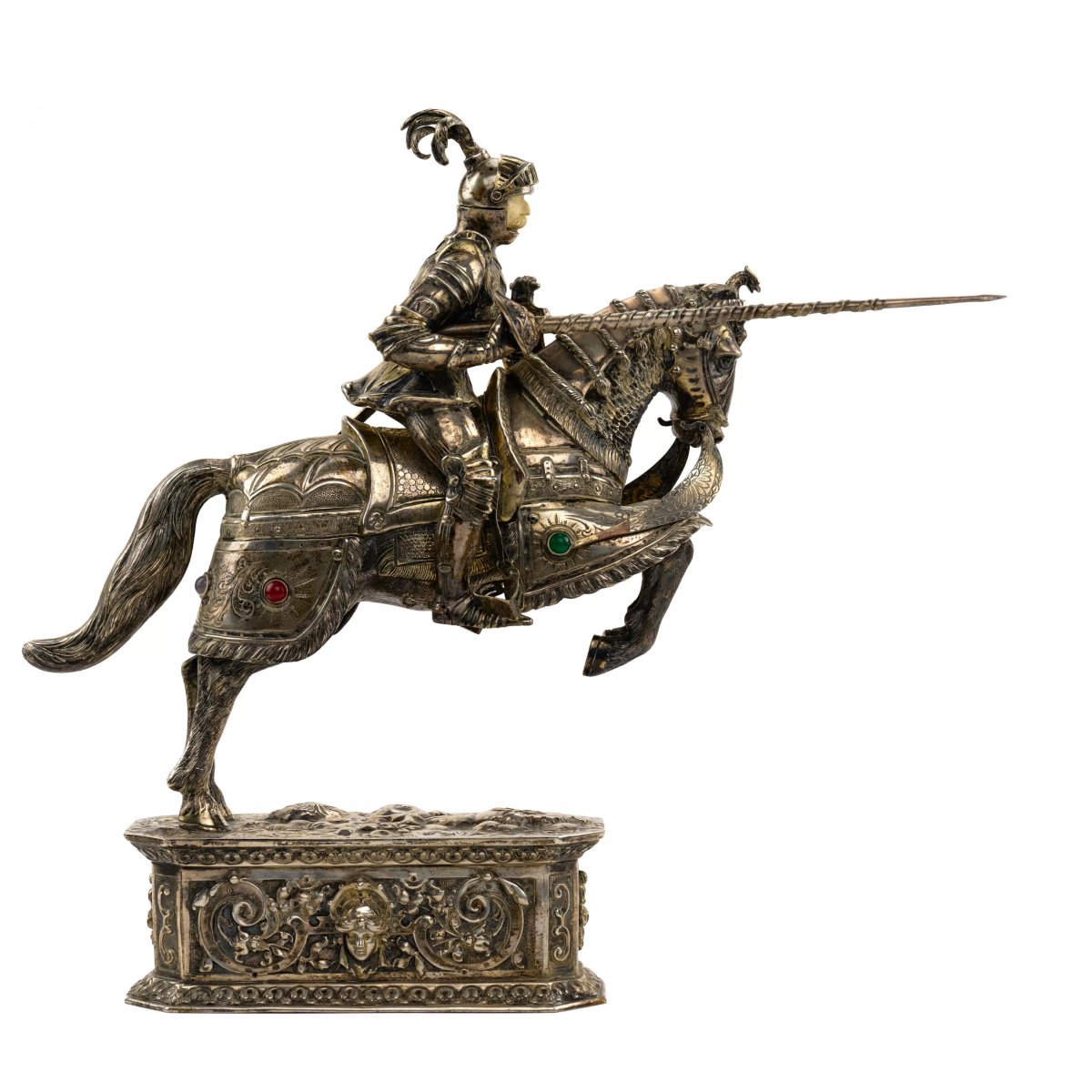
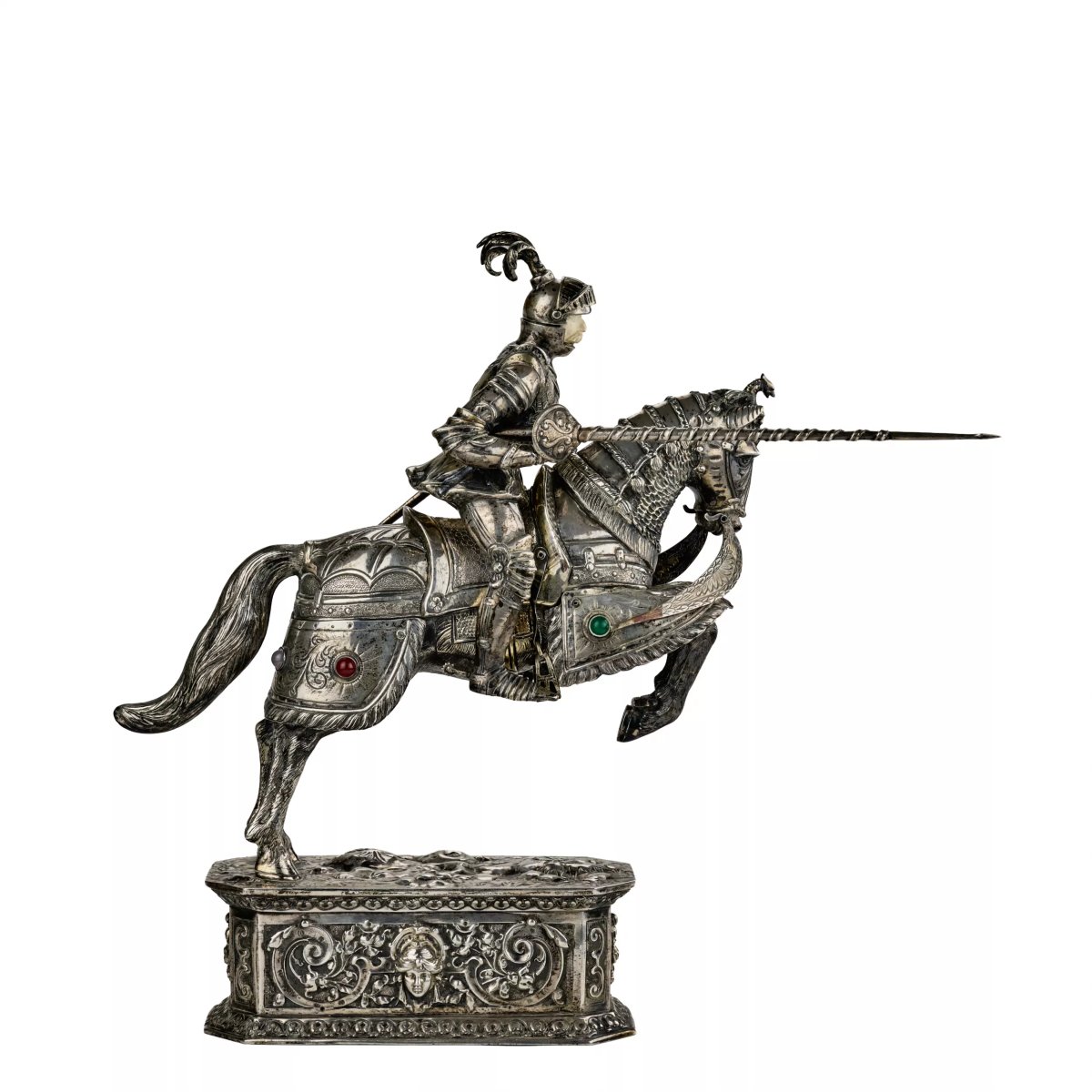
An important pair of silver cabinet sculptures depicting two knights in armor mounted on rearing horses. The compositions follow the tradition of German Historicism and the Neo-Renaissance style, which flourished in the Hanau silversmith workshops at the turn of the 19th and 20th centuries. The sculptures demonstrate remarkable quality in casting, chasing, and engraving. The tournament armor, horse cloaks, tack, and weapons are executed with exceptional precision, as are the rich decorative details on the bases.
The horsemen embody the ideal of the European knight of the late Middle Ages and early Renaissance. Their iconography appears to draw inspiration from the tournament armor of the era of Emperor Maximilian I (1459–1519), whose reign is considered the height of chivalric culture in the Holy Roman Empire. The closed helmets, lances, and ornate horse tack evoke the image of the perfect knight, widely celebrated in 19th-century German art.
The dynamism of the composition is enhanced by the horses rearing on their hind legs, evoking the moment of a tournament charge. The knights’ faces are made of a light-colored material, likely bone or imitation ivory, using a technique frequently employed by German workshops of this period. The armor is embellished with inlays of semiprecious stones in various colors, highlighting the decorative and prestigious nature of the ensemble. The bases feature a Neo-Renaissance-style relief decoration adorned with mascarons and plant motifs.
Intended to adorn the cabinets, libraries, and reception rooms of the European aristocracy and major collectors, these sculptures rank among the most remarkable examples of artistic metalwork produced in Hanau around 1890–1910.
Hallmarks: Model number “4835”; internal assembly mark “3”; oval manufacturer’s mark. Based on their technical and stylistic characteristics and their marking system, these sculptures can be attributed to the production of the goldsmith workshops in Hanau (Germany) around 1890–1910. An attribution to the Neresheimer & Söhne circle or to a related workshop appears particularly likely.
Dimensions: Height 30 cm. Length 28 cm. Width 9 cm.
Weight: Total weight of the pair: 3,450 g.
Condition: Good collector’s condition. Shows a natural patina from age and uniform oxidation of the silver. The structure is intact with no significant loss of decorative elements.
Provenance: Private European collection.
ID-ANTQ-16498
Period: 20th century
Style: Other Style
Condition: Good condition
Material: Sterling silver
Width: 28
Diameter: 9
Height: 30
Reference (ID): 1835814
Availability: In stock