

Antoine-claude Ponthus-cinier (1812–1885) Banyuls
Artist: Antoine-claude Ponthus-cinier
Antoine-Claude PONTHUS-CINIER
(Lyon, 1812 – Lyon, 1885)
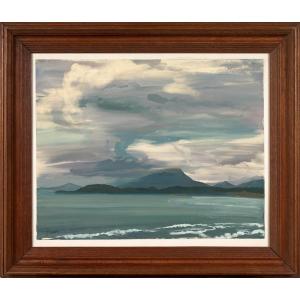
Banyuls harbour
Oil on paper mounted on cardboard
H. 36 cm; W. 52 cm
Provenance:
- B.R. Collection, Lyon
Ponthus-Cinier belongs to what might be defined as the third (and, so to speak, last) generation of neoclassical or historical landscape painters, born in the 1810s and 1820s, such as Félix Lanoüe, Achille Bénouville, Paul Flandrin, Eugène Ferdinand Buttura, and Alfred de Curzon. More specifically, he is considered the leading and most popular representative of the Lyon school of landscape painters around the mid-19th century.
A generous, honest man and pleasant company, Ponthus-Cinier came from a family of merchants on his mother’s side and magistrates on his father’s; though his parents intended him for a career in business, he preferred the artistic path; after enrolling at the École des Beaux-Arts in Lyon in 1829 and training in Paris under Paul Delaroche, he exhibited his first works at the 1839 Lyon Salon, before participating in the Paris Salon in 1841.
That same year, he received the Second Prize of Rome for historical landscape painting (won by Buttura in 1837 and Bénouville in 1845), finishing second to Lanoüe of Versailles. To hone his skills, Ponthus-Cinier decided to travel to Italy, alone and at his own expense, for a single stay between 1842 and 1844; he explored the Ligurian coast, Tuscany, Naples, and, of course, Rome and its surroundings, and produced a considerable number of studies (painted sketches or pen-and-ink drawings) that he used to compose views of Italy throughout his career.
Ponthus-Cinier’s principal qualities likely lie in “the art of illuminating a canvas,” as A. Jouve wrote in the 19th century, and in his sense of perspective, which is at times truly extraordinary; however, he seems, for the most part, somewhat less brilliant when it comes to figures and the rendering of details.
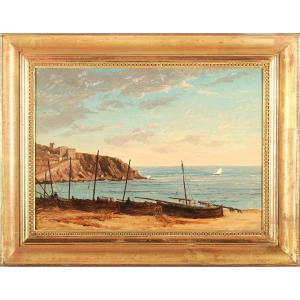
Our painting shows a tranquil view of the small port of Banyuls around 1850, before its massive urbanization. On the beach, beached fishing boats await departure, their sails folded. A few fishermen are busy at work, while a solitary sail cuts across the horizon. In the background, the village and its cliffs are bathed in the soft morning light.
(Lyon, 1812 – Lyon, 1885)
Banyuls harbour
Oil on paper mounted on cardboard
H. 36 cm; W. 52 cm
Provenance:
- B.R. Collection, Lyon
Ponthus-Cinier belongs to what might be defined as the third (and, so to speak, last) generation of neoclassical or historical landscape painters, born in the 1810s and 1820s, such as Félix Lanoüe, Achille Bénouville, Paul Flandrin, Eugène Ferdinand Buttura, and Alfred de Curzon. More specifically, he is considered the leading and most popular representative of the Lyon school of landscape painters around the mid-19th century.
A generous, honest man and pleasant company, Ponthus-Cinier came from a family of merchants on his mother’s side and magistrates on his father’s; though his parents intended him for a career in business, he preferred the artistic path; after enrolling at the École des Beaux-Arts in Lyon in 1829 and training in Paris under Paul Delaroche, he exhibited his first works at the 1839 Lyon Salon, before participating in the Paris Salon in 1841.
That same year, he received the Second Prize of Rome for historical landscape painting (won by Buttura in 1837 and Bénouville in 1845), finishing second to Lanoüe of Versailles. To hone his skills, Ponthus-Cinier decided to travel to Italy, alone and at his own expense, for a single stay between 1842 and 1844; he explored the Ligurian coast, Tuscany, Naples, and, of course, Rome and its surroundings, and produced a considerable number of studies (painted sketches or pen-and-ink drawings) that he used to compose views of Italy throughout his career.
Ponthus-Cinier’s principal qualities likely lie in “the art of illuminating a canvas,” as A. Jouve wrote in the 19th century, and in his sense of perspective, which is at times truly extraordinary; however, he seems, for the most part, somewhat less brilliant when it comes to figures and the rendering of details.
Our painting shows a tranquil view of the small port of Banyuls around 1850, before its massive urbanization. On the beach, beached fishing boats await departure, their sails folded. A few fishermen are busy at work, while a solitary sail cuts across the horizon. In the background, the village and its cliffs are bathed in the soft morning light.
3 800 €
Period: 19th century
Style: Louis Philippe, Charles 10th
Condition: Perfect condition
Material: Oil painting on paper
Length: 36 cm hors cadre
Width: 52 cm hors cadre
Reference (ID): 1819792
Availability: In stock
Print