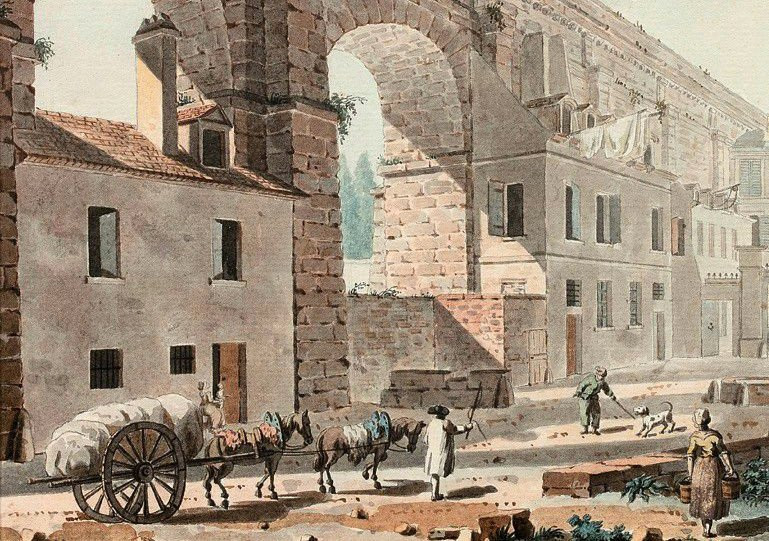
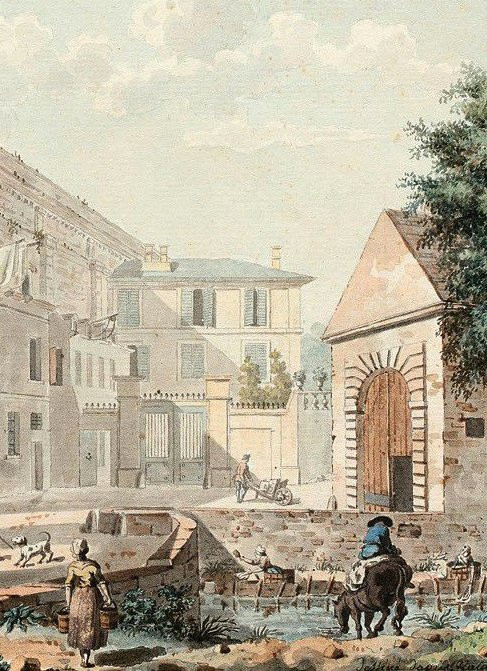
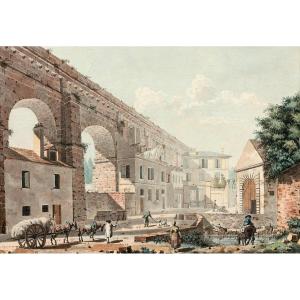


Att. To Jacques Swebach-desfontaines (1769-1823) Arcueil: The Médicis Bridge-aqueduct
Artist: Attribuée à Jacques Swebach-desfontaines
Attributed to Jacques SWEBACH-DESFONTAINES
(Metz 1769 - Paris 1823)
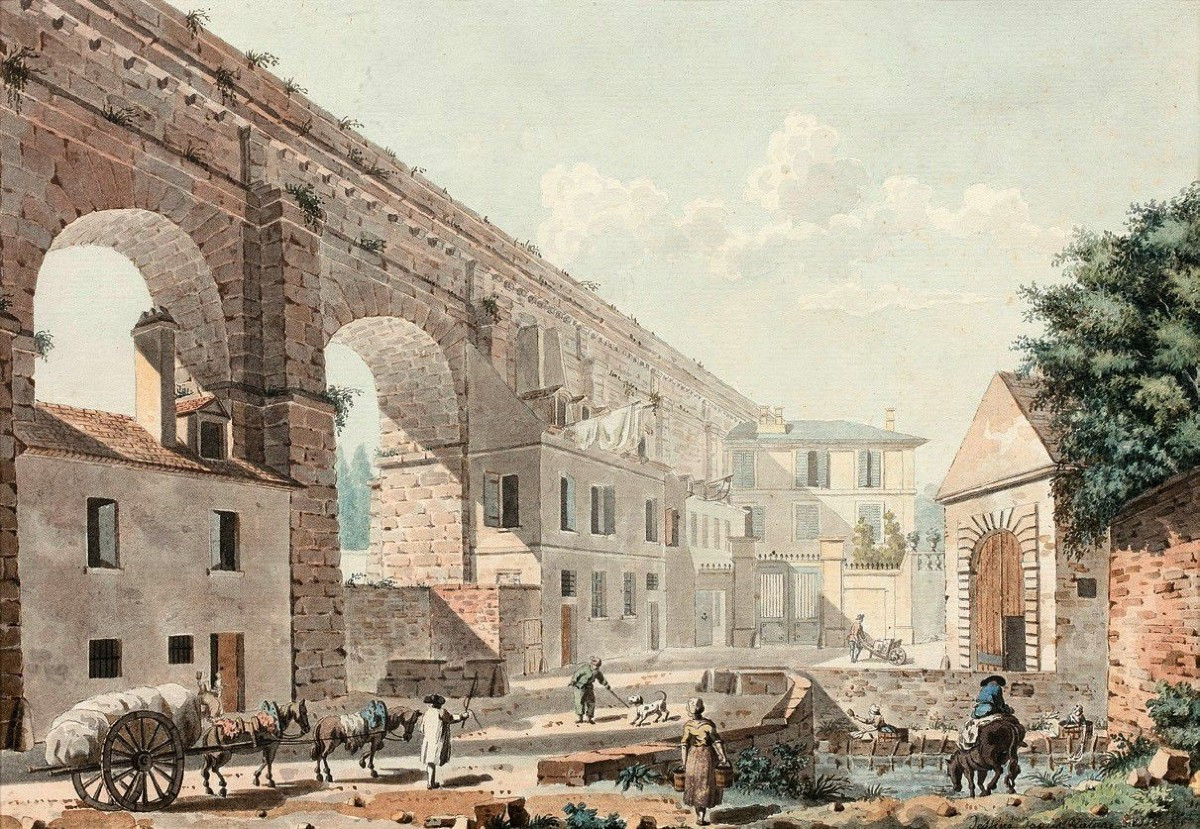
Arcueil : le pont-aqueduc Médicis et la Faisanderie
Watercolor on pen strokes
H. 21.5 cm; L. 31 cm
Described "dessiné d'après nature" lower right
Circa 1790
Provenance:
- Sale March 22, 1995, Drouot, Pescheteau-Badin-Godeau et Leroy, N°116 of the catalog (reproduced), titled Lavoir près d'un aqueduc.Hammer price (excluding fees): 68,000 Francs (€10,367 at constant rate)
- Private collection
This fine watercolor offers us a rare view of the pont-aqueduc at Arcueil, a few kilometers south of Paris, since looking east with the structure on the left, whereas the vast majority of existing views are with the bridge on the right. If its luminosity and picturesqueness make it highly desirable, its topographical accuracy makes it a true historical document. You can clearly see the dwellings that were built between the arches in the 18th century, when the aqueduct was no longer maintained, as well as the house known as the Faisanderie (with its blue shutters). This latter building is one of the few remaining vestiges of the Arcueil estate, which belonged to the Prince de Guise in the early 18th century and later to the Prince de Beauveau. The path to the right of the bridge, which passes in front of the Faisanderie and then climbs to the right (to the heights of Cachan), corresponds to the present-day Rue de la Citadelle.
This bridge-aqueduct, listed since 1991, was built to cross the Bièvre valley, of which the watercolor shows a dead branch, used as a washhouse. Built of ashlar from the Arcueil quarries, it is 379 meters long, with a maximum height of almost 19 meters, resting in the central section on 17 spans, 9 of which are open arcades (over a length of 209 meters).
It is the only visible element of the Médicis aqueduct, or aqueduct des eaux de Rungis, whose construction was supervised by Marie de Médicis between 1613 and 1623, and whose purpose was to supply water to her Luxembourg palace and its fountains. The city of Paris appointed Jean Coing as master builder of the aqueduct, but it was the architects of Henri IV and Marie de Médicis, Thomas Francine (of Florentine origin) and Louis Métezeau (1560-1615), who were responsible for creating the bridge itself. Around 1870, the bridge served as the base for another aqueduct, the Vanne, built by Belgrand, which carried water from Burgundy to Paris, and can still be seen today.
After Jean-Baptiste Oudry (who concentrated more on the park and château), the grounds were depicted by a number of artists in the late 18th and early 19th centuries, in etchings, watercolors and paintings, the most famous perhaps being that by Danish master Eckersberg (1783-1853) in 1812. Jean-Victor Bertin depicted the bridge's arcades with tight framing, but we also know him for a Vue de la Faisanderie. In this painting, the Faisanderie has lost its 2nd floor, visible in our watercolor, replaced by a steeper roof.
Oldly attributed to Jean-Thomas Thibault (1757-1826), our drawing seems more in keeping with the picturesque, "northern" style of Swebach-Desfontaines, known for his usual scenes of hunting, battles, bivouacs, military convoys, horse races...Swebach-Desfontaines also produced topographical views of architecture (Tuileries, Porte Saint-Denis, Boulevard du Temple, etc.), which bear several stylistic similarities to our drawing: treatment of the figures and their cast shadows, of the ground with small, rather typical pebbles, way of drawing the windows.
The handwritten note "drawn after nature" in the lower right-hand corner of the drawing can also be compared with Swebach's handwriting.
(Metz 1769 - Paris 1823)
Arcueil : le pont-aqueduc Médicis et la Faisanderie
Watercolor on pen strokes
H. 21.5 cm; L. 31 cm
Described "dessiné d'après nature" lower right
Circa 1790
Provenance:
- Sale March 22, 1995, Drouot, Pescheteau-Badin-Godeau et Leroy, N°116 of the catalog (reproduced), titled Lavoir près d'un aqueduc.Hammer price (excluding fees): 68,000 Francs (€10,367 at constant rate)
- Private collection
This fine watercolor offers us a rare view of the pont-aqueduc at Arcueil, a few kilometers south of Paris, since looking east with the structure on the left, whereas the vast majority of existing views are with the bridge on the right. If its luminosity and picturesqueness make it highly desirable, its topographical accuracy makes it a true historical document. You can clearly see the dwellings that were built between the arches in the 18th century, when the aqueduct was no longer maintained, as well as the house known as the Faisanderie (with its blue shutters). This latter building is one of the few remaining vestiges of the Arcueil estate, which belonged to the Prince de Guise in the early 18th century and later to the Prince de Beauveau. The path to the right of the bridge, which passes in front of the Faisanderie and then climbs to the right (to the heights of Cachan), corresponds to the present-day Rue de la Citadelle.
This bridge-aqueduct, listed since 1991, was built to cross the Bièvre valley, of which the watercolor shows a dead branch, used as a washhouse. Built of ashlar from the Arcueil quarries, it is 379 meters long, with a maximum height of almost 19 meters, resting in the central section on 17 spans, 9 of which are open arcades (over a length of 209 meters).
It is the only visible element of the Médicis aqueduct, or aqueduct des eaux de Rungis, whose construction was supervised by Marie de Médicis between 1613 and 1623, and whose purpose was to supply water to her Luxembourg palace and its fountains. The city of Paris appointed Jean Coing as master builder of the aqueduct, but it was the architects of Henri IV and Marie de Médicis, Thomas Francine (of Florentine origin) and Louis Métezeau (1560-1615), who were responsible for creating the bridge itself. Around 1870, the bridge served as the base for another aqueduct, the Vanne, built by Belgrand, which carried water from Burgundy to Paris, and can still be seen today.
After Jean-Baptiste Oudry (who concentrated more on the park and château), the grounds were depicted by a number of artists in the late 18th and early 19th centuries, in etchings, watercolors and paintings, the most famous perhaps being that by Danish master Eckersberg (1783-1853) in 1812. Jean-Victor Bertin depicted the bridge's arcades with tight framing, but we also know him for a Vue de la Faisanderie. In this painting, the Faisanderie has lost its 2nd floor, visible in our watercolor, replaced by a steeper roof.
Oldly attributed to Jean-Thomas Thibault (1757-1826), our drawing seems more in keeping with the picturesque, "northern" style of Swebach-Desfontaines, known for his usual scenes of hunting, battles, bivouacs, military convoys, horse races...Swebach-Desfontaines also produced topographical views of architecture (Tuileries, Porte Saint-Denis, Boulevard du Temple, etc.), which bear several stylistic similarities to our drawing: treatment of the figures and their cast shadows, of the ground with small, rather typical pebbles, way of drawing the windows.
The handwritten note "drawn after nature" in the lower right-hand corner of the drawing can also be compared with Swebach's handwriting.
12 000 €
Period: 18th century
Style: Louis 16th, Directory
Condition: Perfect condition
Material: Water color
Length: 21,5 cm hors cadre
Width: 31 cm hors cadre
Reference (ID): 1740843
Availability: In stock
Print