

Simon Saint-jean (1808-1860) Imperial Crown Flowers And Lyon Bindweed
Artist: Simon Saint-jean
Simon SAINT-JEAN
(Lyon, 1808 - Ecully, 1860)
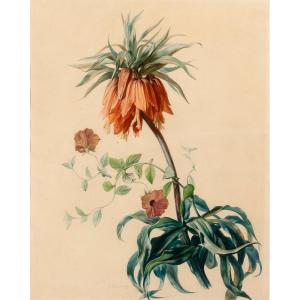
Imperial crown (Fritillaria imperialis) and bindweed (Convolvulus)
Watercolor
H. 48 cm; W. 38 cm
Signed and dated lower center
1839
Simon Saint-Jean is a major figure in 19th-century Lyon and French flower painting. His training, which began in 1822 at the Beaux-Arts in Lyon, was twofold: figure painting in Révoil's studio, and floral painting with Thierriat, whose teaching he assiduously followed. He began his career modestly in 1826 as a designer of church ornaments and liturgical banners for the silk artist Didier Petit in Lyon. After first participating in the Paris Salon in 1834, he decided in 1836 to open his own studio and embark on an independent career, consecrated by rapid and resounding successes. The following year, the Musée des Beaux-Arts de Lyon acquired Fleurs et Fruits at the Paris Salon. A few years later, in 1843, Saint-Jean achieved a real triumph with the presentation of the Virgin of the Offering, preserved in the collections of the same museum, which earned him the Legion of Honor and which well sums up the often symbolic and mystical connotation of his works. His influence then went beyond the Lyon circle. Scipion Corvisart, a loyal admirer and supporter, introduced him to important collectors such as the Duke of Morny, but also to wealthy foreigners such as Lord Hertford. He achieved a form of consecration with his reception in 1855 at the Academy of Brussels in the chair of Van Huysum (which he had particularly studied during a trip to Belgium and Holland in 1840). His most famous and talented student was Jean-Pierre Lays (1825-1887).
Very rare in his work, the known botanical plates represent flowering roses, dated 1839 (like our drawing) and 1848. Is this a work that can be considered as study sheets that Saint-Jean then used in his studio? Works dedicated to a botanist? Perhaps they should be linked, in order to demonstrate his skills, with his attempt, around 1839-1840, to succeed Redouté as drawing master at the Museum? Knowing that he had already visited the Jardin des Plantes in the years 1830-32 and carried out botanical studies in the greenhouses and collections of the Museum.
(Lyon, 1808 - Ecully, 1860)
Imperial crown (Fritillaria imperialis) and bindweed (Convolvulus)
Watercolor
H. 48 cm; W. 38 cm
Signed and dated lower center
1839
Simon Saint-Jean is a major figure in 19th-century Lyon and French flower painting. His training, which began in 1822 at the Beaux-Arts in Lyon, was twofold: figure painting in Révoil's studio, and floral painting with Thierriat, whose teaching he assiduously followed. He began his career modestly in 1826 as a designer of church ornaments and liturgical banners for the silk artist Didier Petit in Lyon. After first participating in the Paris Salon in 1834, he decided in 1836 to open his own studio and embark on an independent career, consecrated by rapid and resounding successes. The following year, the Musée des Beaux-Arts de Lyon acquired Fleurs et Fruits at the Paris Salon. A few years later, in 1843, Saint-Jean achieved a real triumph with the presentation of the Virgin of the Offering, preserved in the collections of the same museum, which earned him the Legion of Honor and which well sums up the often symbolic and mystical connotation of his works. His influence then went beyond the Lyon circle. Scipion Corvisart, a loyal admirer and supporter, introduced him to important collectors such as the Duke of Morny, but also to wealthy foreigners such as Lord Hertford. He achieved a form of consecration with his reception in 1855 at the Academy of Brussels in the chair of Van Huysum (which he had particularly studied during a trip to Belgium and Holland in 1840). His most famous and talented student was Jean-Pierre Lays (1825-1887).
Very rare in his work, the known botanical plates represent flowering roses, dated 1839 (like our drawing) and 1848. Is this a work that can be considered as study sheets that Saint-Jean then used in his studio? Works dedicated to a botanist? Perhaps they should be linked, in order to demonstrate his skills, with his attempt, around 1839-1840, to succeed Redouté as drawing master at the Museum? Knowing that he had already visited the Jardin des Plantes in the years 1830-32 and carried out botanical studies in the greenhouses and collections of the Museum.
6 000 €
Period: 19th century
Style: Louis Philippe, Charles 10th
Condition: Perfect condition
Material: Paper
Length: 48 cm à vue
Width: 38 cm à vue
Reference (ID): 1636677
Availability: In stock
Print