

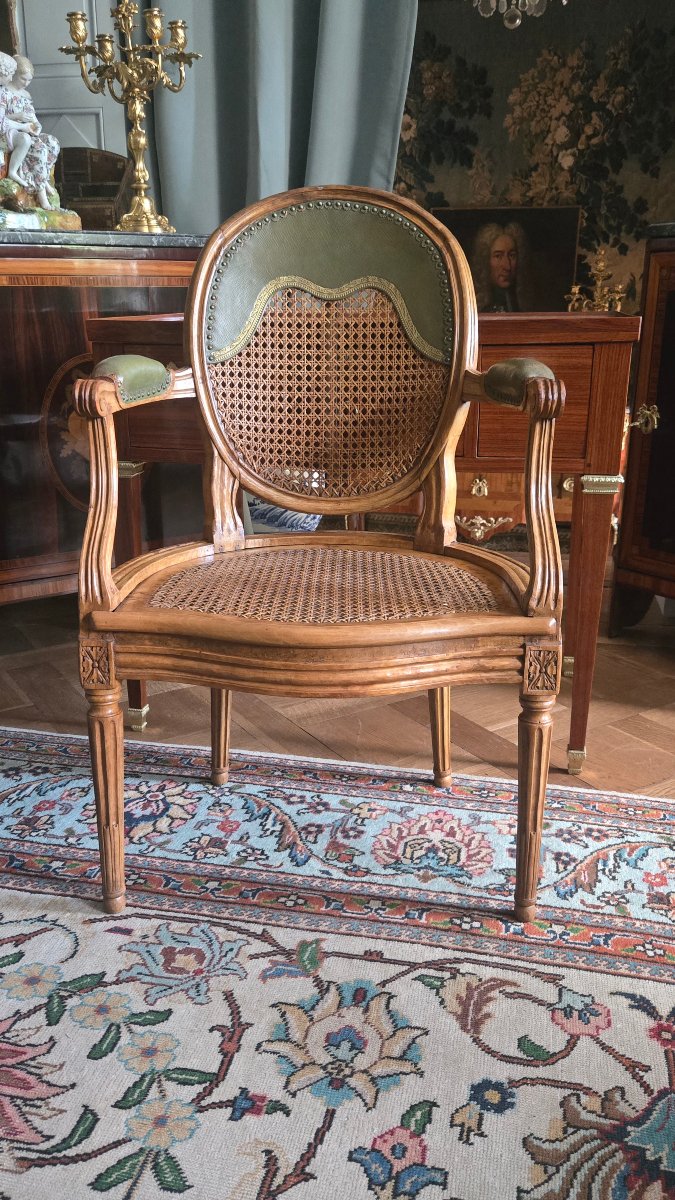


Rattan-backed Armchair Stamped "nicolas Toussaint Porrot," Louis XVI Period.
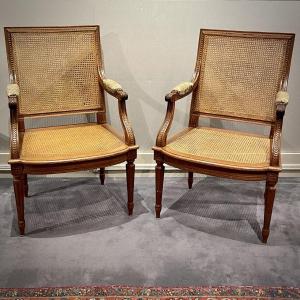
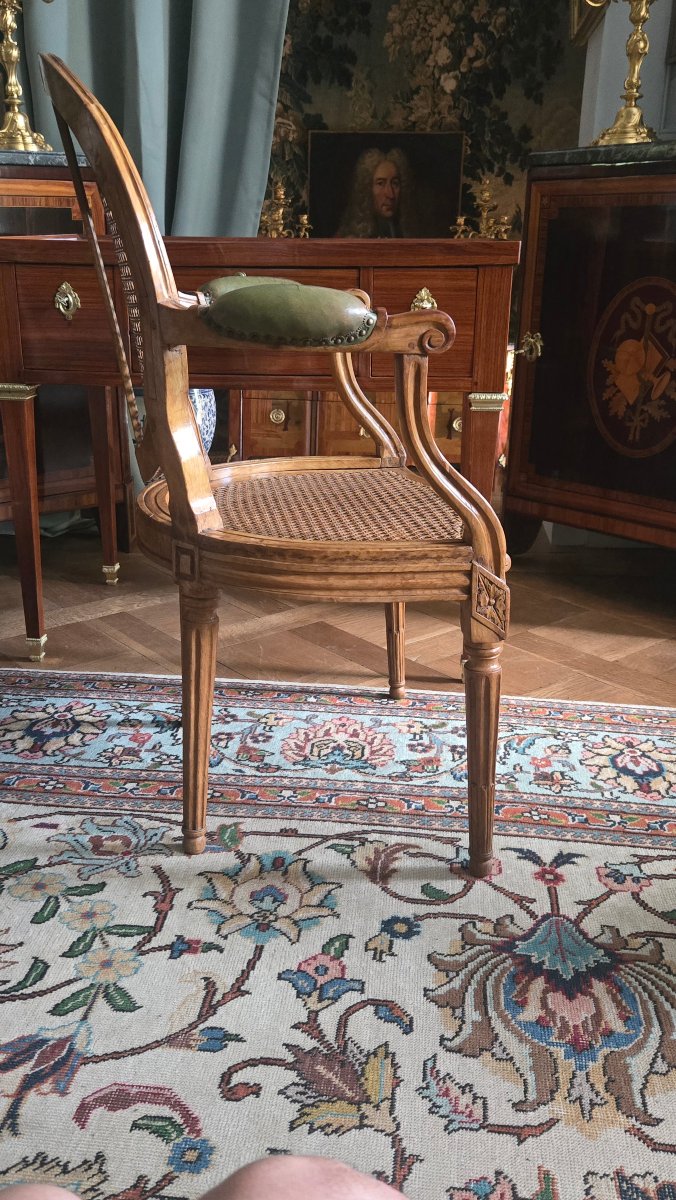
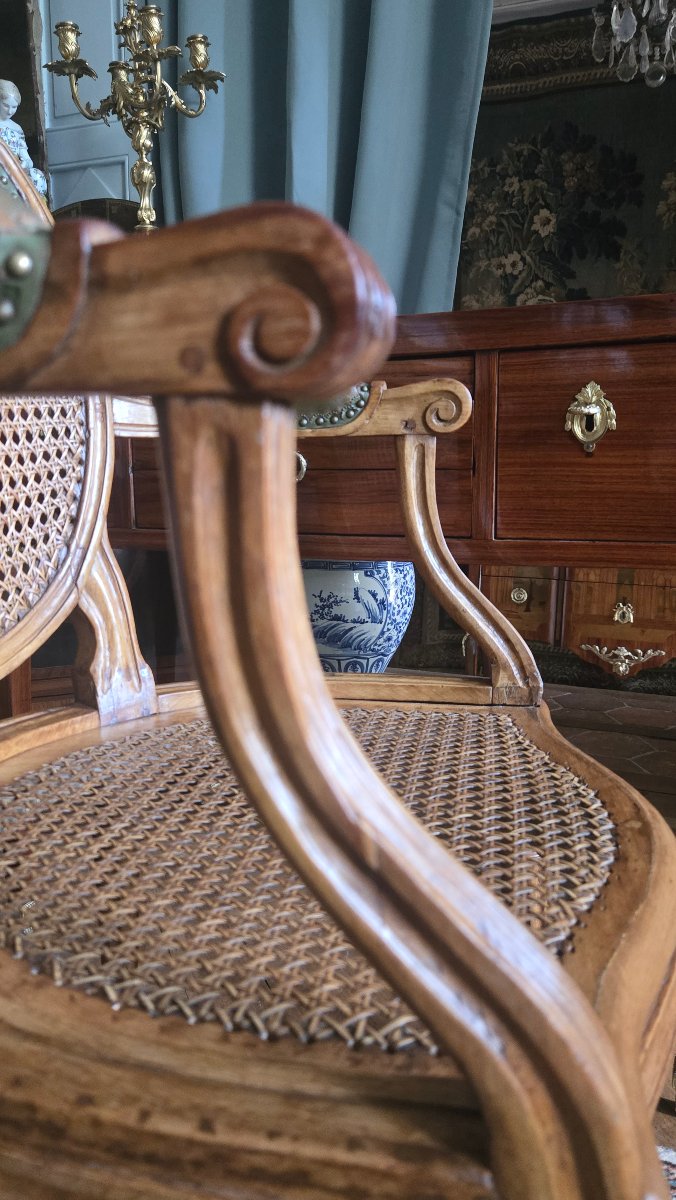
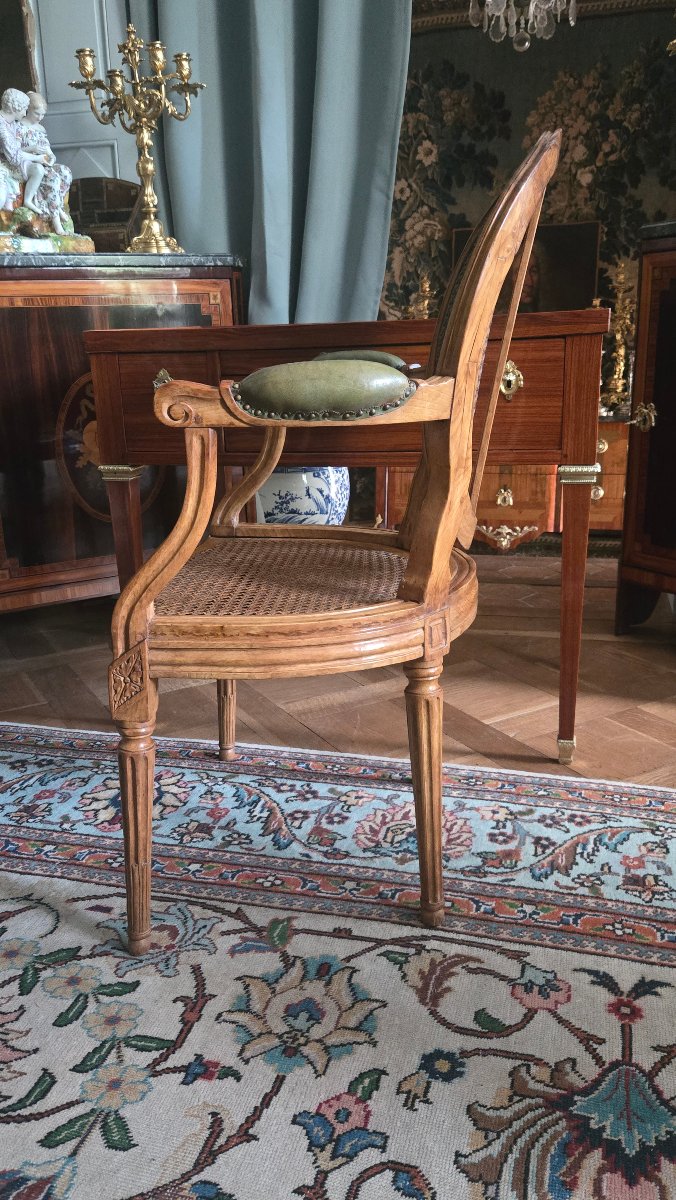
An interesting Louis XVI-period armchair in molded and carved beech, stamped by Nicolas Toussaint Porrot, who was certified as a master cabinetmaker in Paris on July 22, 1761. It features a medallion-shaped backrest and a seat with a cane-woven base. The armrests are fitted with green leather-covered cuffs, while the top of the backrest is adorned with a leather band cut in an accolade pattern, accented with braid and seed-of-wheat decoration. Originally painted, this armchair was stripped during a previous restoration and now appears in its natural wood finish, simply waxed, allowing the quality of the beech wood, its moldings, and its carving to shine through.
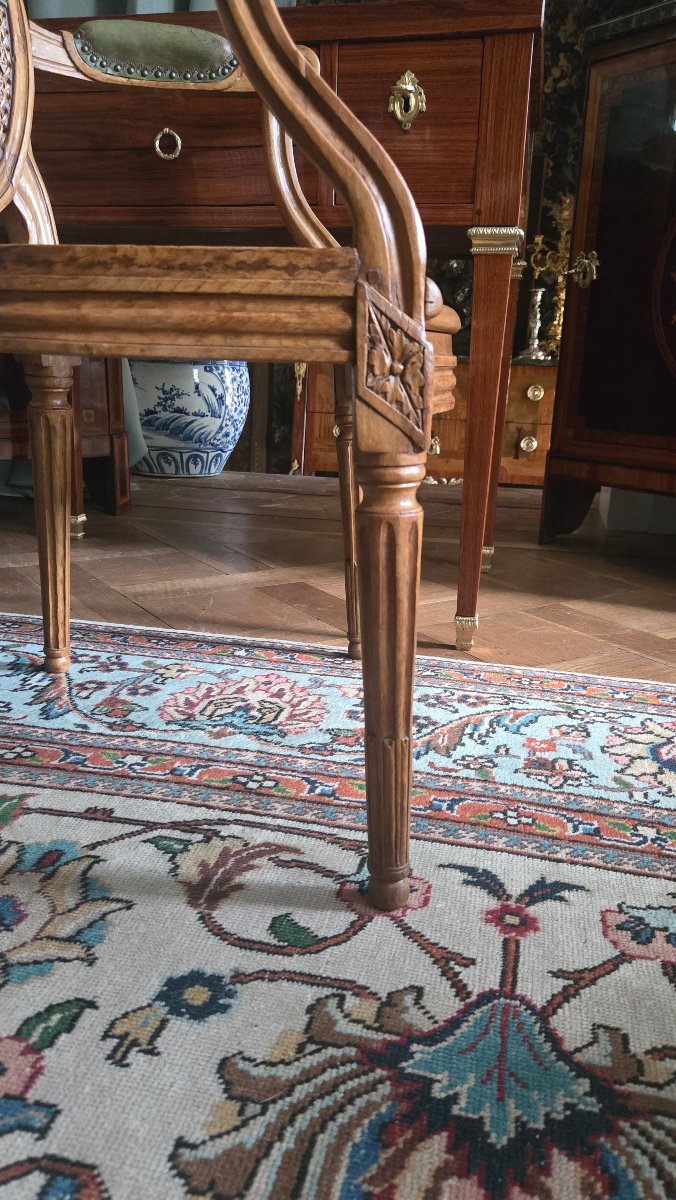
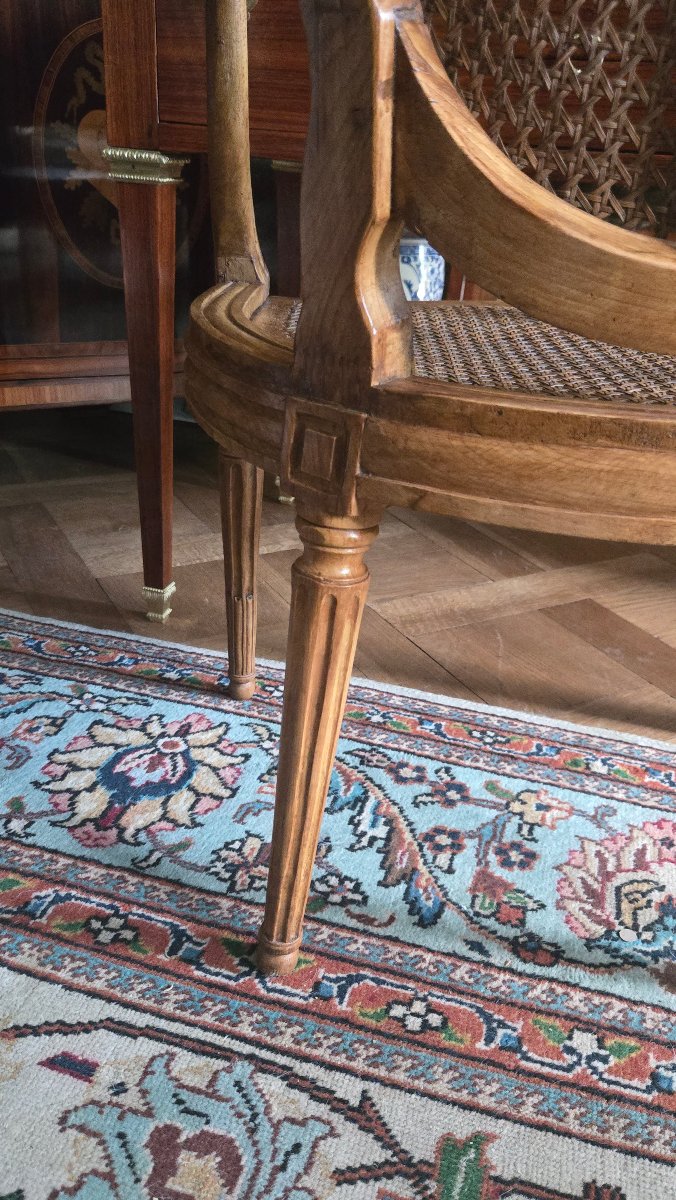
The seat rests on four tapered, fluted legs. The front legs are rudenté, with the spindles emerging from the base of the flutes, while the rear legs, set at a slight angle, provide excellent stability to the entire piece. The armrests, finished with a curled edge characteristic of the Louis XVI style, fit into brackets shaped like inverted consoles. These consoles are adorned with a flute on each side and two flutes on the front. They originate from connecting blocks carved with a rosette. On the front, the rosette is set within a square, while on the side panels it is set within a square positioned on its tip, thus accommodating the difference in height between the front crossbar and the side crossbars. This treatment, rarely seen, contributes significantly to the quality of craftsmanship and the character of the chair.
The maker’s mark, stamped beneath the back crossbar, is now very faint but remains identifiable. Several letters are still discernible and allow the chair to be attributed with certainty to Nicolas Toussaint Porrot.
The construction of the seat is one of the main points of interest in this armchair. Nicolas Toussaint Porrot employs the same assembly principle here as seen in several of his office chairs. The side rails and the back rail—positioned higher than the front rail—are grooved to accommodate a separate caning panel. The grooves extend all the way to the armrest brackets, where they remain clearly visible. This mechanism allowed the caning panel to slide out from the front so that it could be easily removed for repair or replacement, without having to dismantle the armrest brackets. More complex than a traditional assembly, this design demonstrates the cabinetmaker’s genuine technical ingenuity. This same architectural approach can also be found on several well-known office chairs by Nicolas Toussaint Porrot, which feature identical treatment of the connecting blocks, armrest brackets, and the seat plate guide system.
The chair’s history is also evident in its frame. Numerous old seed plugs are visible all around the seat’s rebate. They bear witness to an earlier alteration, during which the seat was fitted with a fully upholstered fixed cushion to replace its cane seat. During its most recent restoration, this modification was removed in order to restore the original design conceived by Nicolas Toussaint Porrot. The cane work was thus completely redone, while the wooden seat, the frame, and all the joints remain original.
The armchair is currently in excellent condition. The wood is perfectly sound, with no signs of wood-boring insect damage. The structure is rigid and perfectly stable. The cane work is in very good condition. The restoration faithfully respects the original design and now offers an accurate representation of Nicolas Toussaint Porrot’s work.
Nicolas Toussaint Porrot worked on Rue du Pont-aux-Choux until the Revolution. He was admitted as a master craftsman in 1761 and is renowned for the quality of his Louis XV and Louis XVI chairs. Pierre Kjellberg highlights the originality of his designs, their balanced proportions, and the finesse of their carving. He is also noted for having supplied chairs for the Château de Montgeoffroy and, more exceptionally, for having crafted a few pieces of fine cabinetry.
Thanks to the quality of its craftsmanship, the presence of its maker’s mark, and the technical ingenuity of its design, this armchair stands as a remarkable testament to the expertise of the finest Parisian chairmakers of the second half of the 18th century.
Dimensions:
- Overall height: 91 cm
- Seat height: 40 cm
- Overall width: 58.5 cm
- Overall depth: 55 cm
The seat rests on four tapered, fluted legs. The front legs are rudenté, with the spindles emerging from the base of the flutes, while the rear legs, set at a slight angle, provide excellent stability to the entire piece. The armrests, finished with a curled edge characteristic of the Louis XVI style, fit into brackets shaped like inverted consoles. These consoles are adorned with a flute on each side and two flutes on the front. They originate from connecting blocks carved with a rosette. On the front, the rosette is set within a square, while on the side panels it is set within a square positioned on its tip, thus accommodating the difference in height between the front crossbar and the side crossbars. This treatment, rarely seen, contributes significantly to the quality of craftsmanship and the character of the chair.
The maker’s mark, stamped beneath the back crossbar, is now very faint but remains identifiable. Several letters are still discernible and allow the chair to be attributed with certainty to Nicolas Toussaint Porrot.
The construction of the seat is one of the main points of interest in this armchair. Nicolas Toussaint Porrot employs the same assembly principle here as seen in several of his office chairs. The side rails and the back rail—positioned higher than the front rail—are grooved to accommodate a separate caning panel. The grooves extend all the way to the armrest brackets, where they remain clearly visible. This mechanism allowed the caning panel to slide out from the front so that it could be easily removed for repair or replacement, without having to dismantle the armrest brackets. More complex than a traditional assembly, this design demonstrates the cabinetmaker’s genuine technical ingenuity. This same architectural approach can also be found on several well-known office chairs by Nicolas Toussaint Porrot, which feature identical treatment of the connecting blocks, armrest brackets, and the seat plate guide system.
The chair’s history is also evident in its frame. Numerous old seed plugs are visible all around the seat’s rebate. They bear witness to an earlier alteration, during which the seat was fitted with a fully upholstered fixed cushion to replace its cane seat. During its most recent restoration, this modification was removed in order to restore the original design conceived by Nicolas Toussaint Porrot. The cane work was thus completely redone, while the wooden seat, the frame, and all the joints remain original.
The armchair is currently in excellent condition. The wood is perfectly sound, with no signs of wood-boring insect damage. The structure is rigid and perfectly stable. The cane work is in very good condition. The restoration faithfully respects the original design and now offers an accurate representation of Nicolas Toussaint Porrot’s work.
Nicolas Toussaint Porrot worked on Rue du Pont-aux-Choux until the Revolution. He was admitted as a master craftsman in 1761 and is renowned for the quality of his Louis XV and Louis XVI chairs. Pierre Kjellberg highlights the originality of his designs, their balanced proportions, and the finesse of their carving. He is also noted for having supplied chairs for the Château de Montgeoffroy and, more exceptionally, for having crafted a few pieces of fine cabinetry.
Thanks to the quality of its craftsmanship, the presence of its maker’s mark, and the technical ingenuity of its design, this armchair stands as a remarkable testament to the expertise of the finest Parisian chairmakers of the second half of the 18th century.
Dimensions:
- Overall height: 91 cm
- Seat height: 40 cm
- Overall width: 58.5 cm
- Overall depth: 55 cm
750 €
Period: 18th century
Style: Louis 16th, Directory
Condition: Good condition
Material: Solid wood
Reference (ID): 1786145
Availability: In stock
Print