






Kabuto And Menpo In Top-quality Samurai Armour
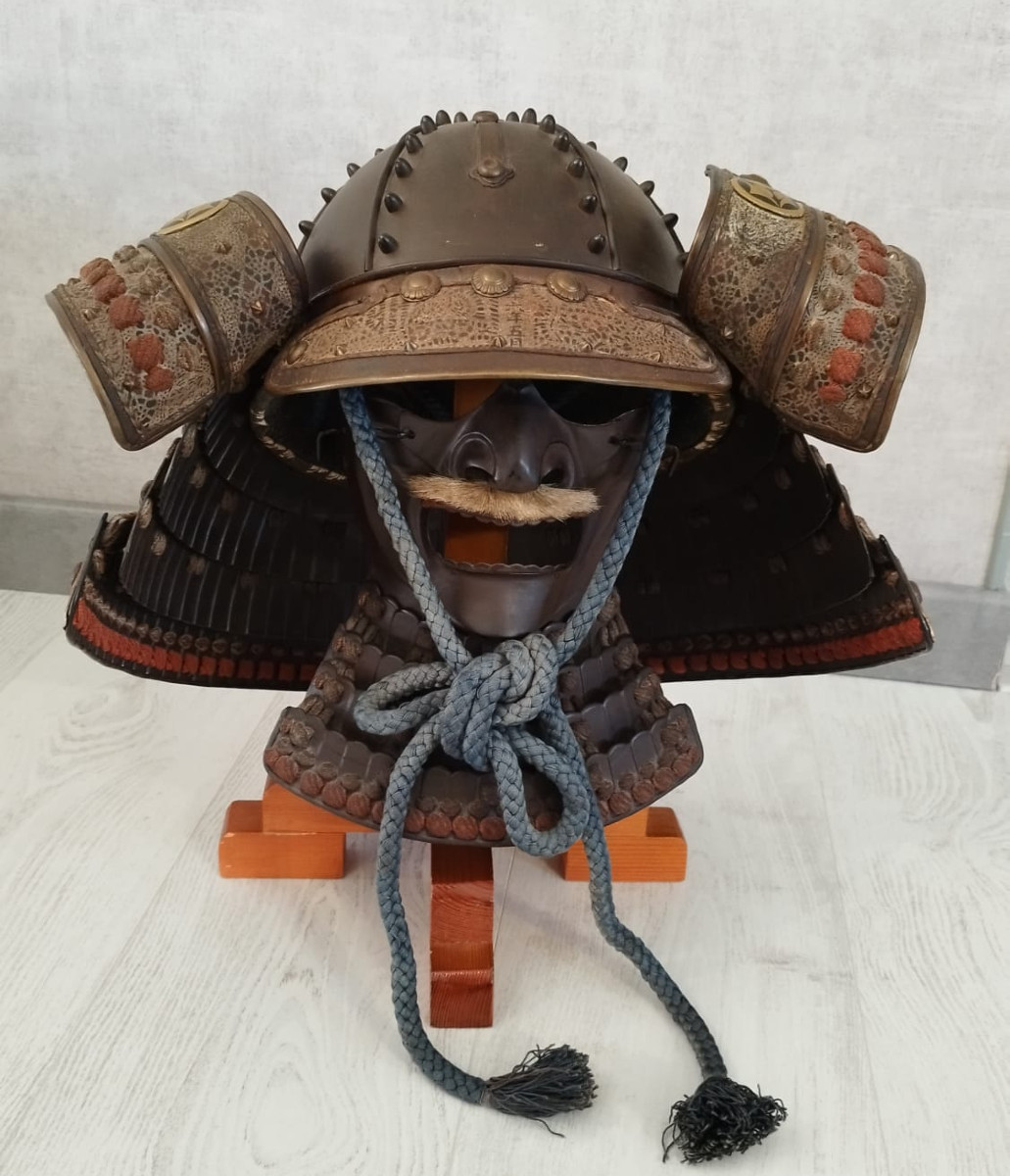
This Kabuto/Menpo set was manufactured in May 1994. It is a luxury handcrafted decorative piece. Although it is not an Edo period antique, it respects all the traditional codes of Japanese armory (the Suji-bachi style, the Mitsu-uo crest, and Urushi lacquer). This is a magnificent collector's item designed to celebrate a birth or a family lineage.
Type: Prestige protection set.
Dating: May 1994 (平成六年五月 - Heisei Roku-nen Go-gatsu).
Style: High-quality ceremonial replica, late Edo period style.
Craftsmanship: The quality of the black lacquer (Kuro urushi) on the lamellae and the finesse of the metalwork at the apex (Hachimanza) indicate that this style of set would have belonged to a Samurai of intermediate or superior rank.
In Japan, the month of May is crucial for armor. May 5th is Children's Day (Kodomo no Hi), formerly called Tango no Sekku (Boy's Day). On this occasion, Japanese families display high-quality Kabuto and Menpo sets in their homes to wish strength and health to their sons.
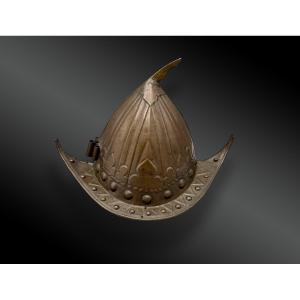
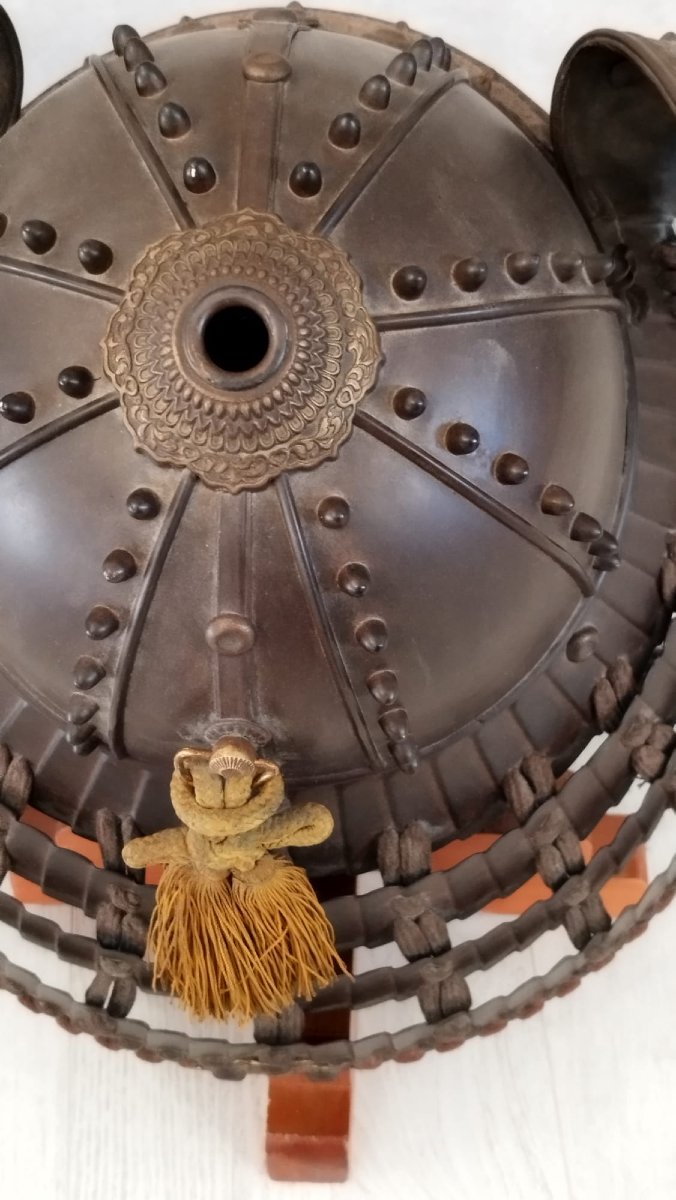
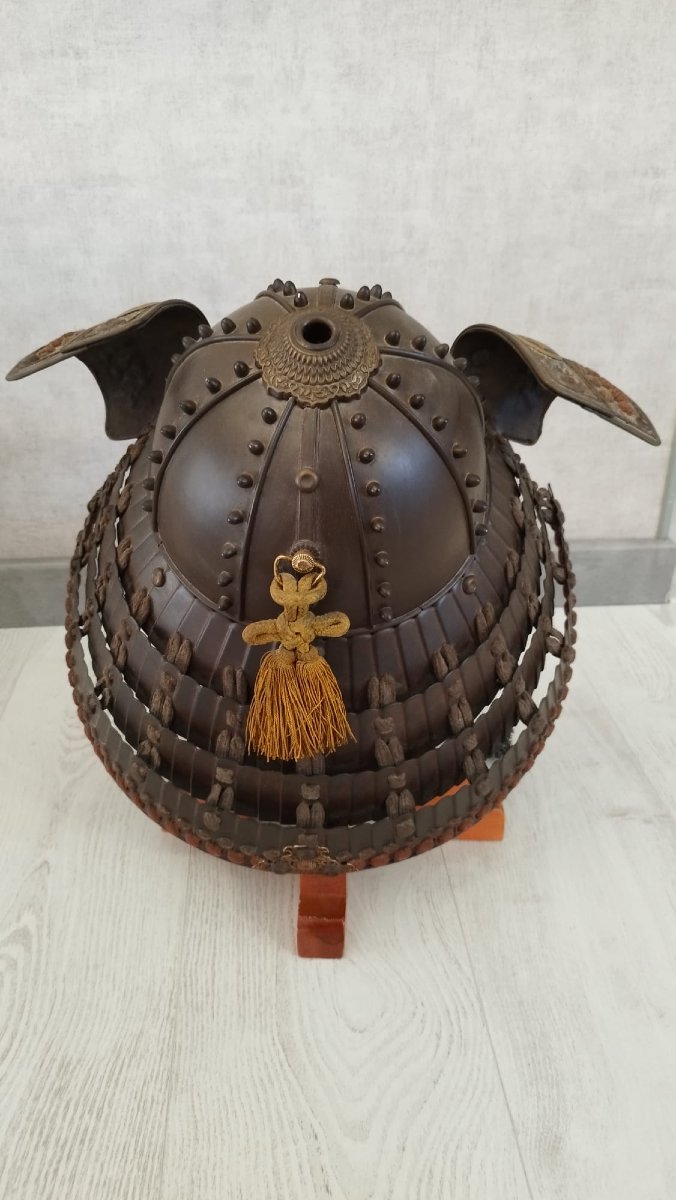
1. The Kabuto (Helmet)Type: This is a Suji-bachi kabuto. It is recognized by the riveted iron plates whose edges form protruding ridges (Suji). The number of plates (often 16, 32, or 62) determined the complexity and price of the object.
Tehen-no-ana: The hole at the top of the helmet (surrounded by a worked brass rosette called Hachimanza) originally served to let the warrior's hair bun pass through and provide ventilation.
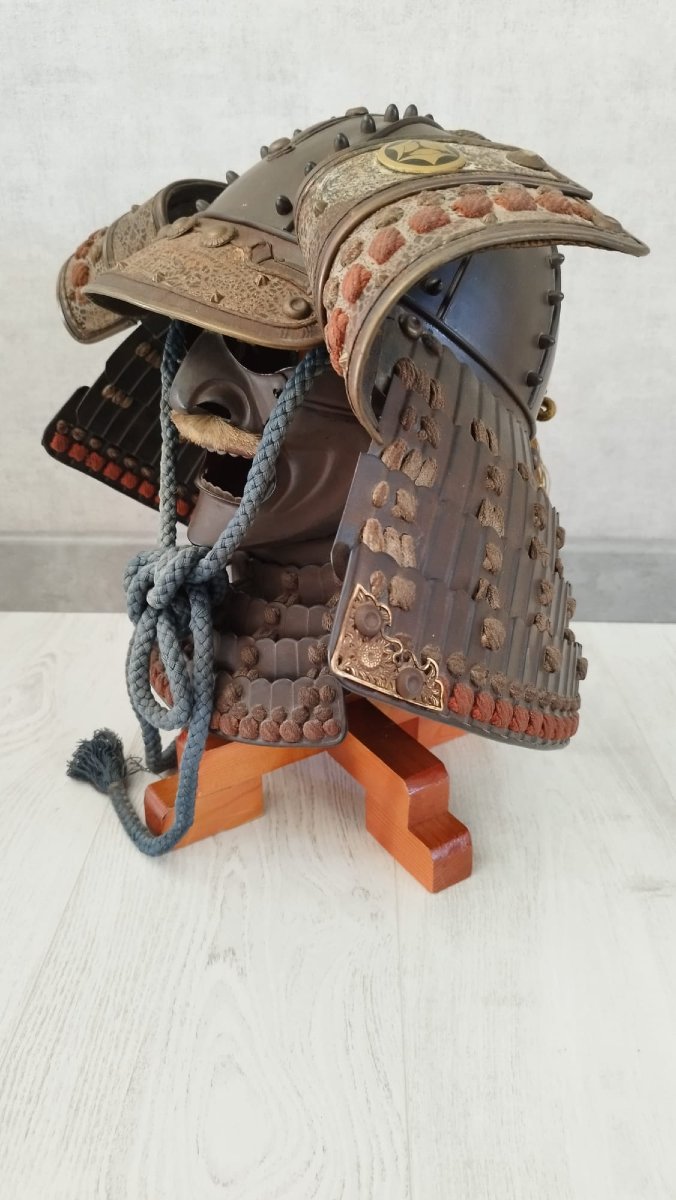
Shikoro (Neck Guard): The articulated plates at the back are connected by silk laces. The weaving appears to be in the Sugake odoshi style (spaced lacing), typical for mobility.
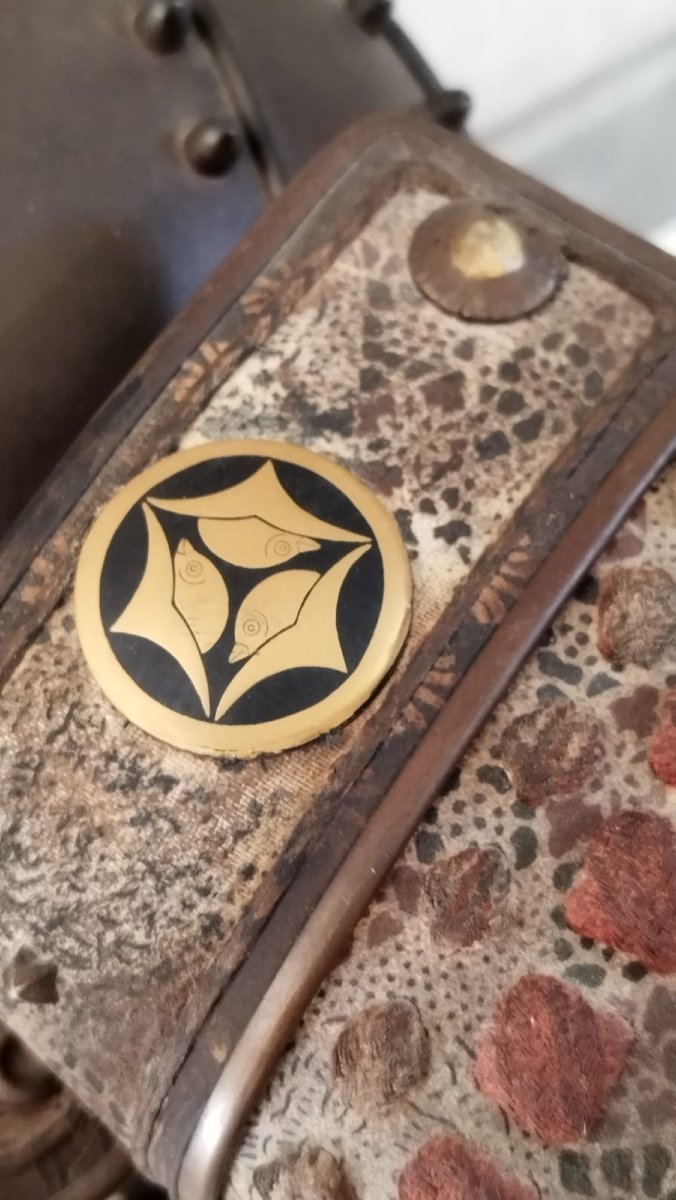
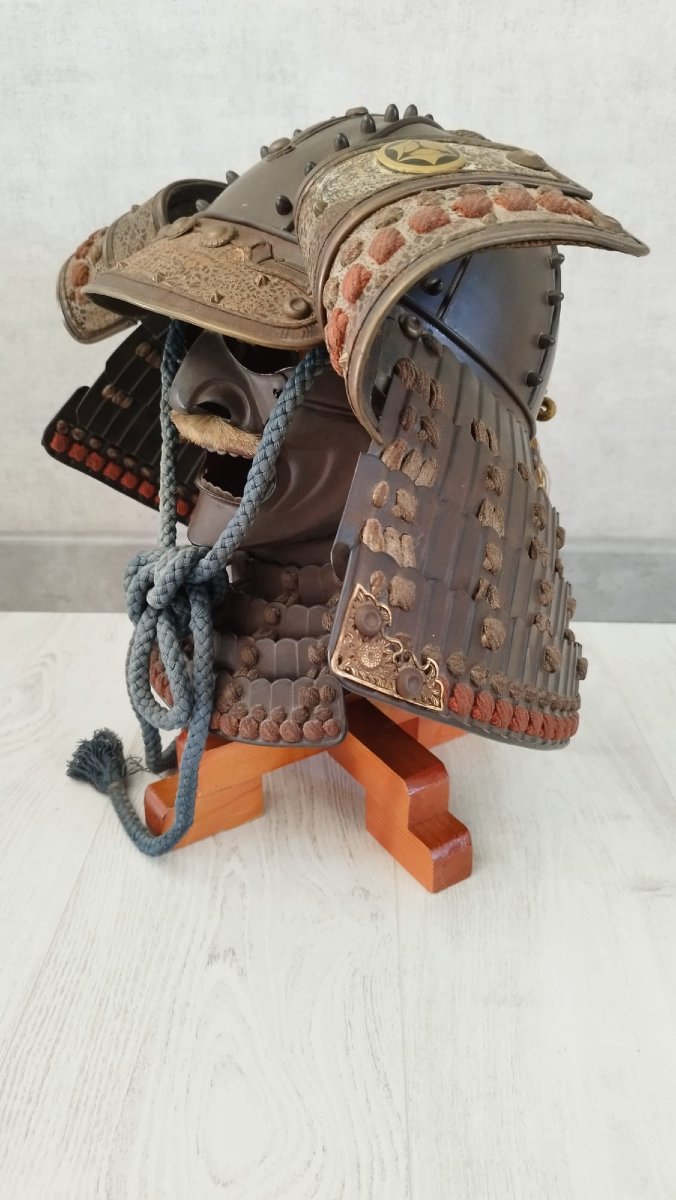
Fukigaeshi (Lateral Winglets): These are the curved parts on the sides. They serve to protect the face from lateral sword strikes. They are covered with printed leather (Egawa) and display the family crest.
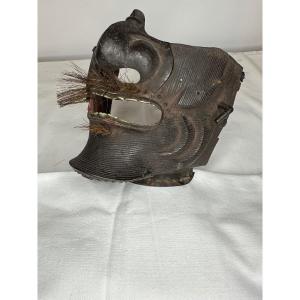
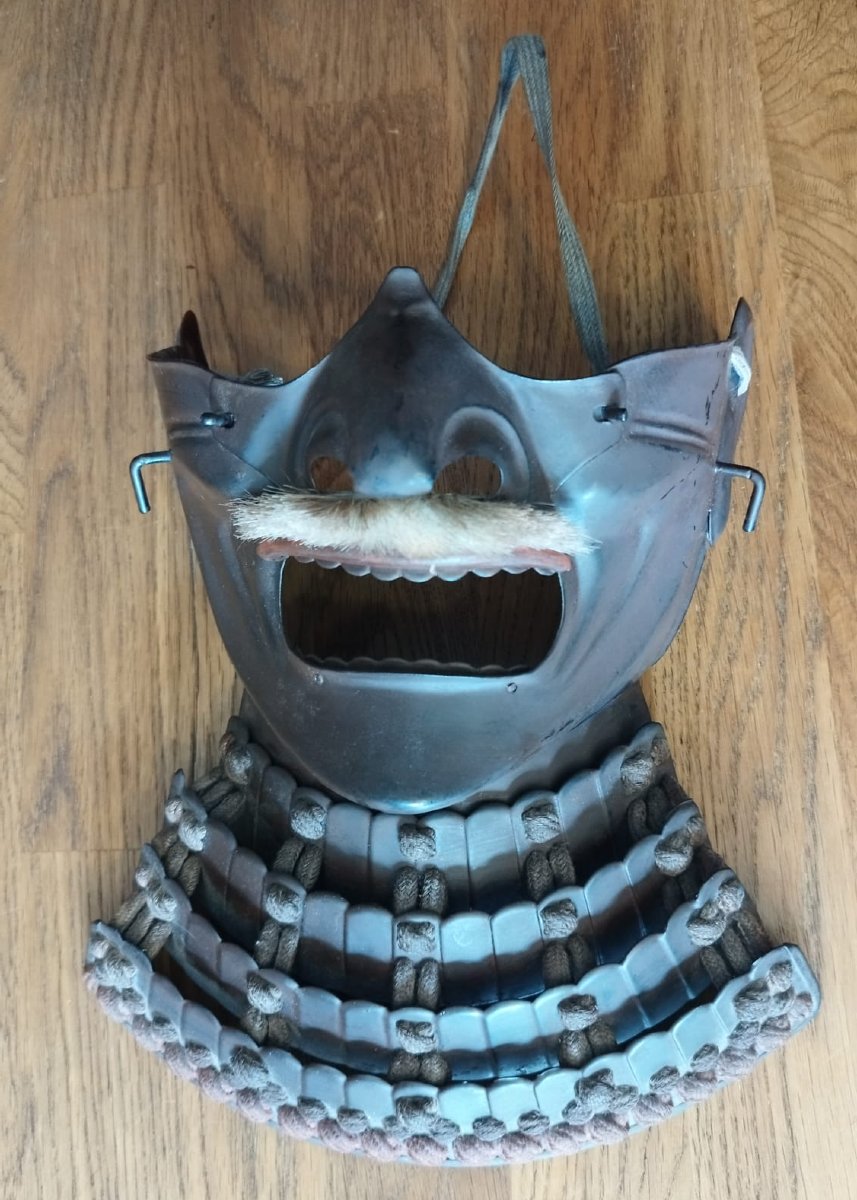
Type: A Ressei men, characterized by a fierce expression, deep wrinkles, and an open mouth revealing the teeth.
Mustache: It is made of natural hair (often horsehair or wild boar hair). It served to provide a more intimidating and virile appearance on the battlefield.
Interior: Photos showing the back of the mask reveal red lacquer (Urushi). This was a common practice to reflect a warrior's glow onto the Samurai's face and protect the metal from perspiration.
Yodare-kake: The throat protection suspended from the mask.
Identification of the Kamon: "Mitsu-uo" (Three Fish)The crest (Kamon) on the Fukigaeshi of this helmet is a rare and fascinating variant. The motif represents three fish (generally sea breams or Tai in Japanese) arranged in a circle.
Significance: The sea bream (Tai) is a symbol of luck and celebration in Japan, as the word rhymes with Omedetai (congratulations / joyous).
Associated Families: This crest does not belong to one of the "great" ultra-famous clans (like the Tokugawa or Oda), which makes your piece even more authentic and specific. It is historically worn by branches of the Abé family or certain Samurai clans from coastal regions such as Kyushu Island or the Bizen province.
Variant: Your model is a Mitsu-maru-uo (three fish within a circle). The fact that the fish converge toward the center symbolizes unity and protection.
Cords: The thick light blue cord (Shinobi-no-o) is used to firmly secure the helmet to the head by passing under the chin of the mask.
Agemaki: The butterfly knot at the back of the helmet is not merely decorative; it served to stabilize the helmet and prevent the neck guard from lifting while running.
The Kanji and their translation:
平 (Heï): Beginning of the era name.
成 (Seï): Completes the era name Heisei (平成).
六 (Roku): The number 6.
年 (Nen): Year.
五 (Go): The number 5.
月 (Gatsu): Month.
The inscription reads 平成六年五月 (Heisei Roku-nen, Go-gatsu). This corresponds to the month of May 1994.
Period: 20th century
Style: Asian art
Condition: Perfect condition
Material: Wrought iron
Reference (ID): 1734289
Availability: In stock