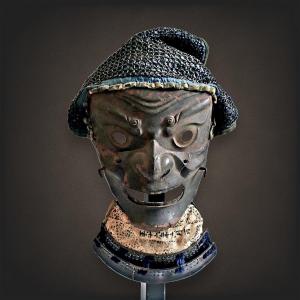
Japanese Armor – Edo Period (18th Century)
This 18th-century Japanese armor illustrates the refinement and ingenuity of Edo-period armorers, during an era of relative peace under the Tokugawa shogunate.
Although it is composite—assembled from elements of different origins or periods—it maintains remarkable aesthetic and functional coherence.
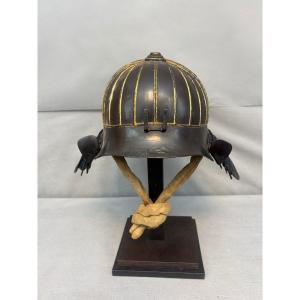
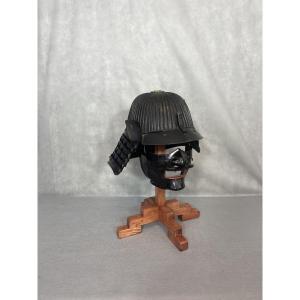
A form inspired by the European morion helmet, characterized by a smooth curved line resembling a halved peach, designed to deflect blows efficiently.
Brown lacquer applied to the bowl, offering both protection and understated elegance.
Neck guard (shikoro): four tiers of articulated plates; from the second tier downward, divided into three sections. Black lacquer with blue lacing, providing both flexibility and protection.
Turnbacks (fukigaeshi): decorated with a mari basami crest in metal, indicating the samurai’s clan affiliation.
Visor (mabisashi): covered with printed leather—an uncommon and decorative feature that marks the armor as a high-quality piece.
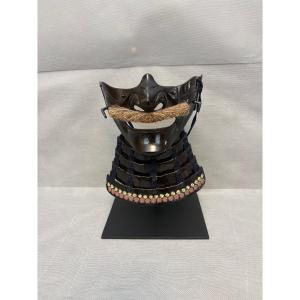
An expressive iron mask lacquered brown, featuring stern, intimidating facial traits.
Brown horsehair moustache, enhancing its fearsome appearance.
Interior lacquered red, both protective against corrosion and symbolic of courage.
Throat guard (yodarekake): four brown-lacquered iron plates laced in blue for visual harmony.
Mogamidō type: six interlocking plates lacquered black, offering flexibility and lightness while providing strong protection.
Skirt (kusazuri): five black-lacquered plates, laced in tricolored blue and faded orange, protecting the lower torso and hips.
Shoulder guards (sode): black-lacquered metal, six plates laced in tricolored blue and faded orange.
Arm guards (kote): shino type, made of black-lacquered iron combined with reinforced fabric, protecting the arms without restricting movement.
Thigh guard (haidate): kawara plates in black lacquer mounted on rich blue brocade, providing elegant protection for the thighs.
Shin guards (suneate): six black-lacquered metal plates, with no fabric backing.
Storage box (yoroi bitsu) in wood, used to store and transport the armor.
(Some visible wear and small damages attest to the armor’s age and authentic use.)
Characteristics and SymbolismThis armor reflects a balance between practical function and refined aesthetics, typical of the Edo period:
The use of brown and black lacquer combined with blue lacing creates a sober, elegant appearance.
Gold details and brocade fabrics denote the high social status of the wearer.
The clan crest (môn) marks the samurai’s identity and allegiance.
Despite being composite, the armor harmoniously combines defensive technology with refined artistry—representative of a time when armor had become not only practical equipment but also a work of art and a symbol of prestige.
Additional photos available upon request by email.Period: 18th century
Style: Asian art
Condition: Good condition
Reference (ID): 1654227
Availability: In stock