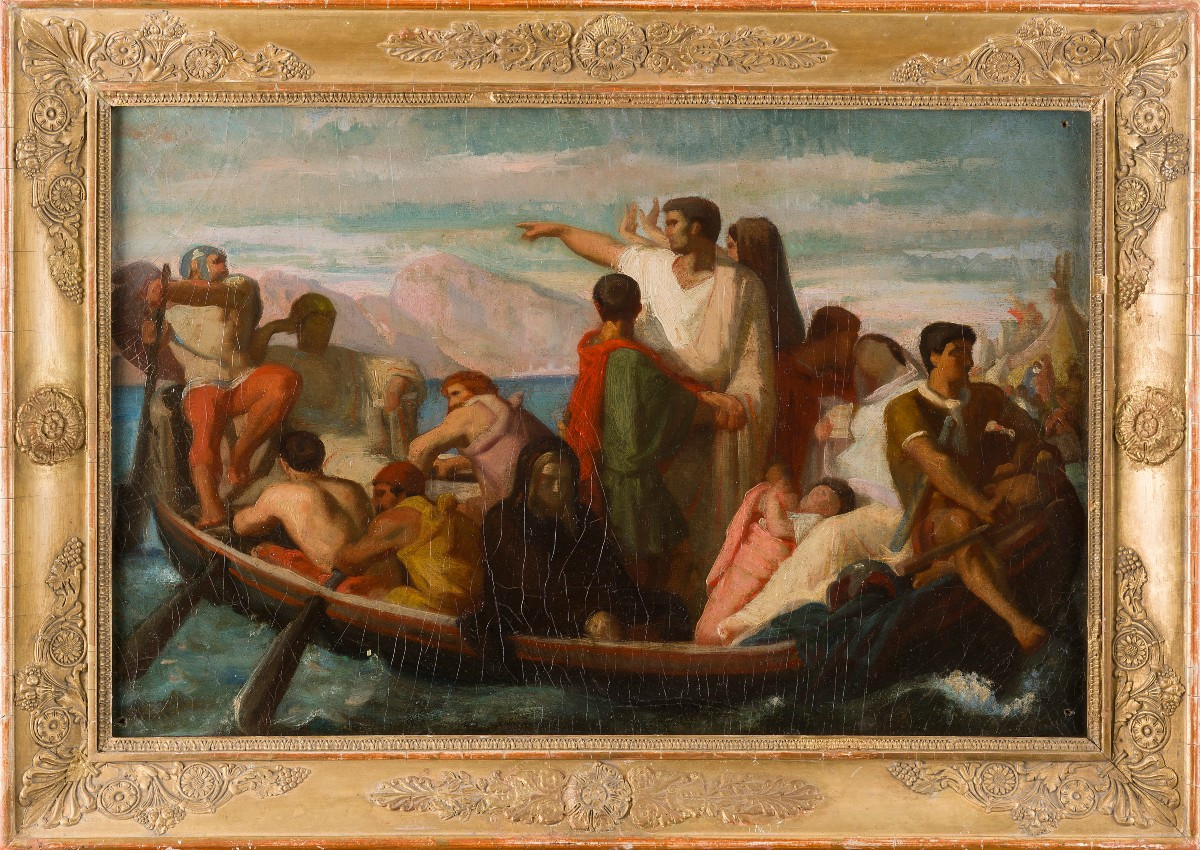
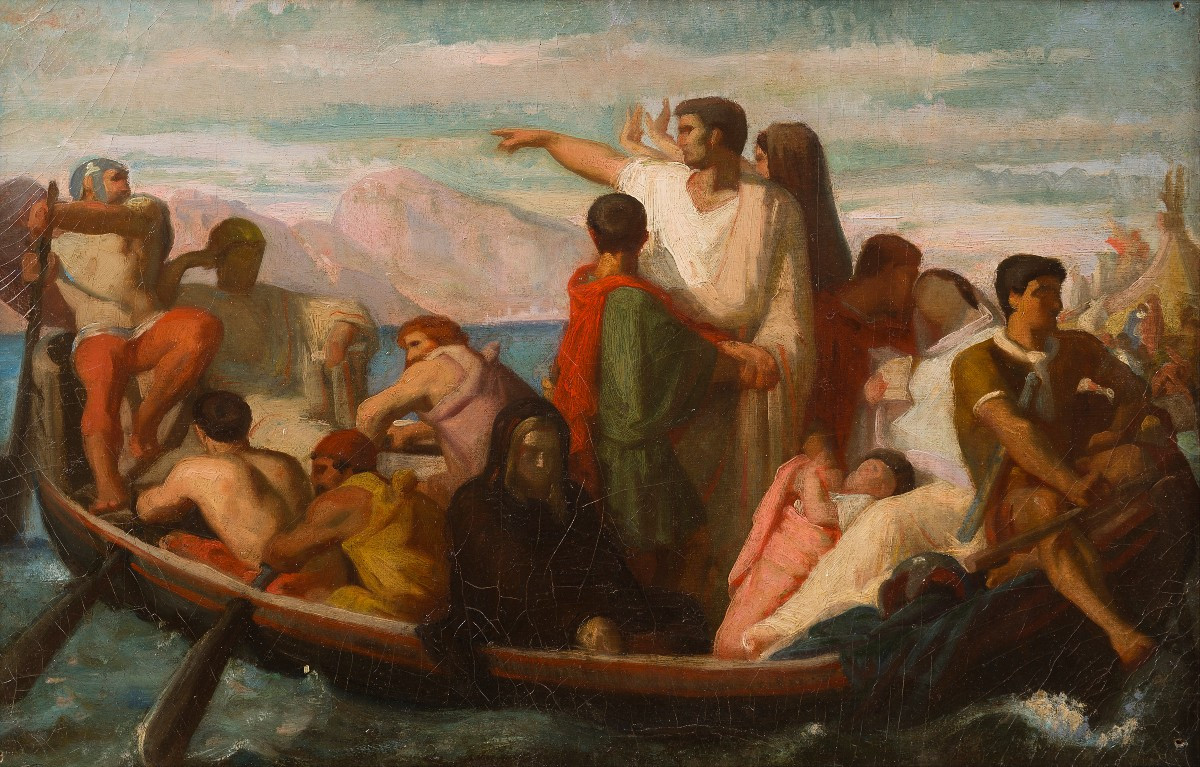

Felix-joseph Barrias, "the Exiles Of Tiberius", Circa 1849
“Tiberius, withdrawn to Capri, indulged in every kind of depravity. Not a single day passed, not even feast days, without being marked by executions. He included in the same condemnation the wives and children of the accused. They were transported to islands where fire and water were forbidden.”
Suetonius, The Twelve Caesars
This was one of the largest Roman submissions ever painted: more than four meters long! Exhibited in Rome, then in Paris in the aftermath of the Revolution of 1848, at a time when France had once again become a Republic, the work appeared as a manifesto against tyrants and a moral tribute to the persecuted Roman republicans.
With this striking achievement, the young Félix Barrias immediately won one of the three first-class medals at the Salon, and his Exiles were honored by being displayed at the Universal Exhibition of 1855. A student of Léon Cogniet, the artist had won the Prix de Rome in 1844 for Cincinnatus Receiving the Deputies of the Senate. He was at the dawn of a brilliant career that would lead him to receive numerous commissions for mural decorations, such as the west salon of the foyer of the Paris Opera or chapels in Parisian churches. Awarded a gold medal at the Salon of 1889 and made a Knight of the Legion of Honour in 1897, he also ran a highly reputed private studio attended, among others, by Edgar Degas.
Between Delacroix’s Barque of Dante and that of Lost Illusions by Charles Gleyre, this boat loaded with exiles, brought ashore by galleys, seems to be heading toward the rocks of Capri. A villa perched atop a cliff must be that of Tiberius. Certain figures stand out for their poignant beauty, such as the woman veiled in black, the husband leaning toward the face of his perhaps ill wife, or their little daughter dressed in pink lying in her mother’s dress.
Already close to the final composition, our study nevertheless differs from it in several details, just as it differs from a larger modello preserved at the Musée de la Loire. These differences are not only due to the elliptical brushwork and the non finito characteristic of a sketch. Thus, the clothing of one of the rowers is pinkish rather than bronze green. The dignified senator pointing toward the grim destination has brown hair that will later turn gray. The ship in the background does not yet have the mast and sail seen in the final composition. Several faces are barely sketched, and one must know the painting to recognize that the beige patch between the spouses is an altar of the Lares, which they have taken with them in the hope of preserving the protection of the gods.
Executed with a synthetic and vigorous brushstroke, in strongly asserted colors, this canvas, more than a first idea, seems to be an initial synthesis of the multiple ideas conceived by Barrias for the most ambitious of his compositions.
Good overall condition (four thumbtack holes in the corners indicate that the canvas was fixed and painted without a stretcher on a board)
Circa 1849
Provenance: Denis Coeckelberghs Collection, Brussels
Related work:
- Félix-Joseph Barrias, Les Exilés de Tibère. Oil on canvas, 253 x 416 cm, painted in Rome as a fifth-year consignment, exhibited at the Villa Medici in April 1850, then at the Salon of 1850; acquired by the State for the Musée du Luxembourg. Paris, Musée d'Orsay.
- Sketch for The Exiles of Tiberius. Oil on wood, 57 x 73.3 cm. Cosne-Cours-sur-Loire, Musée de la Loire.
Period: 19th century
Style: Other Style
Condition: Good condition
Length: 31,5
Width: 48,5
Reference (ID): 1733742
Availability: In stock