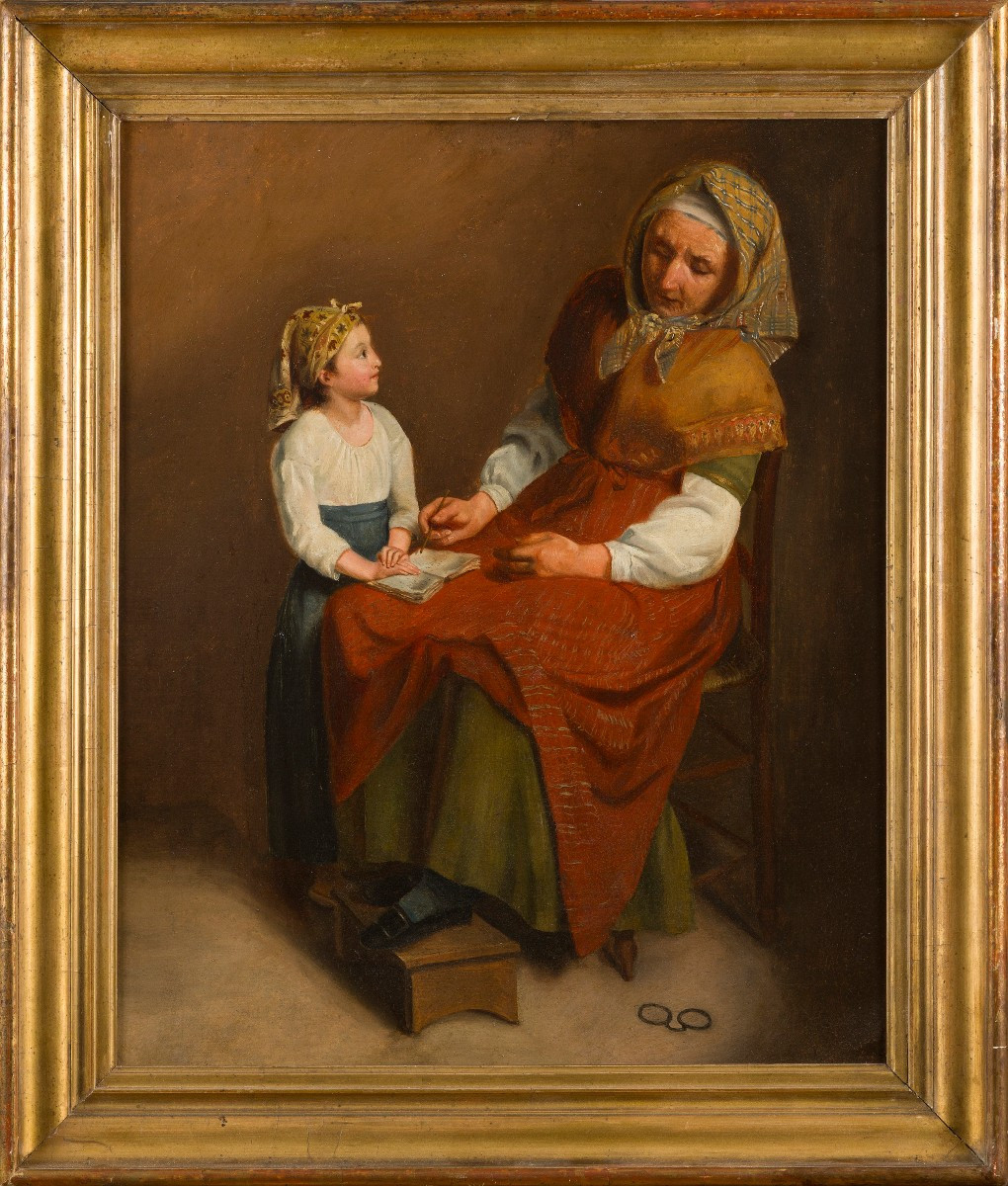
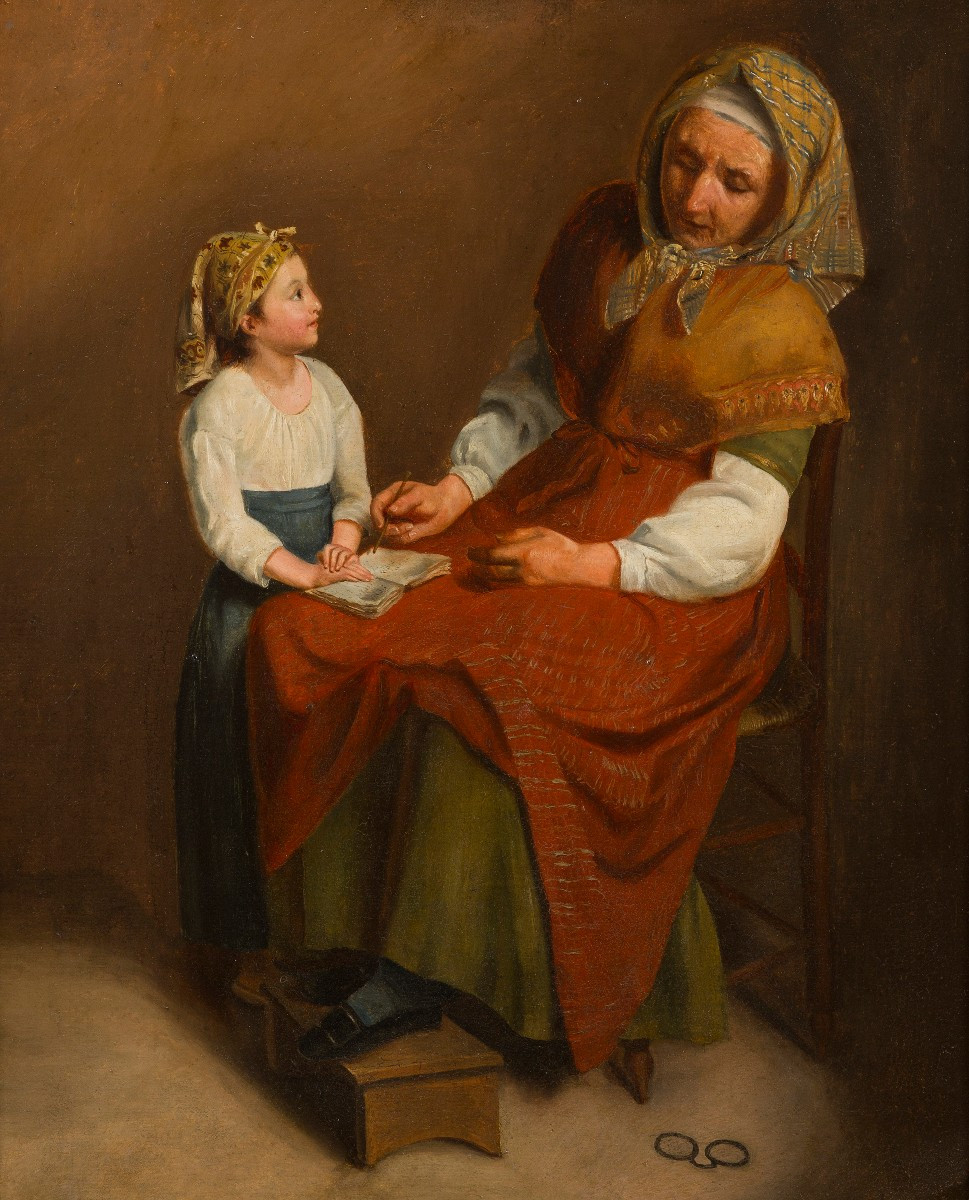


Study For “the Good Old Woman” (salon Of 1836), Jean-augustin Franquelin (paris, 1798-1839)
Jean-Augustin Franquelin (Paris, 1798 – 1839)
An old woman who has just dozed off while giving a writing lesson to a young girl.
Oil on paper, mounted on canvas in the mid-19th century
45 x 37 cm
Beautiful period gilded frame
Related work: Jean-Augustin Franquelin, The Reading Lesson. Oil on canvas, 61 x 50 cm, presented on May 16, 2014, in a sale by Dobiachofsky Auktionen in Bern (Switzerland).
Jean-Augustin Franquelin’s main misfortune was to die young, barely forty years old, likely carried off by stomach cancer that marred his final years. As a result, he was quickly forgotten, yet he had been a well-regarded artist during his lifetime, exhibiting nearly ten paintings each year at the Salon, where he won a gold medal in 1827. The great collector Du Sommerard, as well as the dealers Alphonse Giroux and Durand-Ruel senior, were among his clients. After his death, Franquelin received a laudatory entry in the Biographie des hommes du jour, which provides valuable information. More recently, he has been championed by Gérald Schurr, who praises the “strength in the contrast of planes and the clarity of his execution, which are those of a true painter.” Several museums hold works by Franquelin, including those in Amiens, Douai, Dunkirk, Grenoble, Versailles, Bourg-en-Bresse, Kaliningrad, and Leipzig.
Born into a poor family—his father was a café owner in the Marais—Franquelin entered the studio of Jean-Baptiste Régnault at the age of thirteen. He showed such remarkable talent that he was admitted to compete for the Prix de Rome as early as seventeen. On several occasions, he narrowly missed winning the grand prize. Lacking financial means, he quickly entered the profession and exhibited at the Salon of 1819 a Christ Driving the Money Changers from the Temple and a Death of Malvina, after Ossian. The State purchased the first for the cathedral of Tours, and the second for the palace of Fontainebleau. Encouraged by these early successes, Franquelin continued to paint large religious compositions. His Baptism of Christ was acquired in 1824 for the church of Saint-Philippe-du-Roule. However, he failed to sell Christ Raising Jairus’s Daughter, a monumental painting he presented in 1822, which had cost him a year of work and a thousand francs.
Moreover, the artist was burdened with a certain rigidity of character that deprived him of many commissions and honors he might have deserved: “Not seeking favors,” wrote Germain Sarrut, his first biographer, “he obtained little; not troubling the all-powerful bureaucrats with his requests, they gave little thought to him.” (Biographie des hommes du jour, 1840). He therefore turned to easel paintings intended for a private clientele who preferred pleasing subjects, treated with a skillful and precise brush— a genre in which Franquelin excelled.
Aside from a few historical paintings and a large number of portraits, the subjects of his works depict a world of everyday life in the Romantic era: The Happy Household, The Reply to the Letter, The Cook, The Doll’s Lesson, The Worker’s Saturday, The Workers’ Toilette (Do Not Enter), The Disguise of the Grisettes, The Horoscope, The Sleeping Maid, etc. This production, estimated by Germain Sarrut at 120 to 130 works, was so appreciated that the painter often had to produce copies of his most requested paintings himself. This is not the case with our oil on paper, one of his rare surviving studies, intended for one of those tender and familiar scenes characteristic of Franquelin.
Period: 19th century
Style: Other Style
Condition: Excellent condition
Material: Oil painting on paper
Length: 45
Width: 37
Reference (ID): 1738232
Availability: In stock