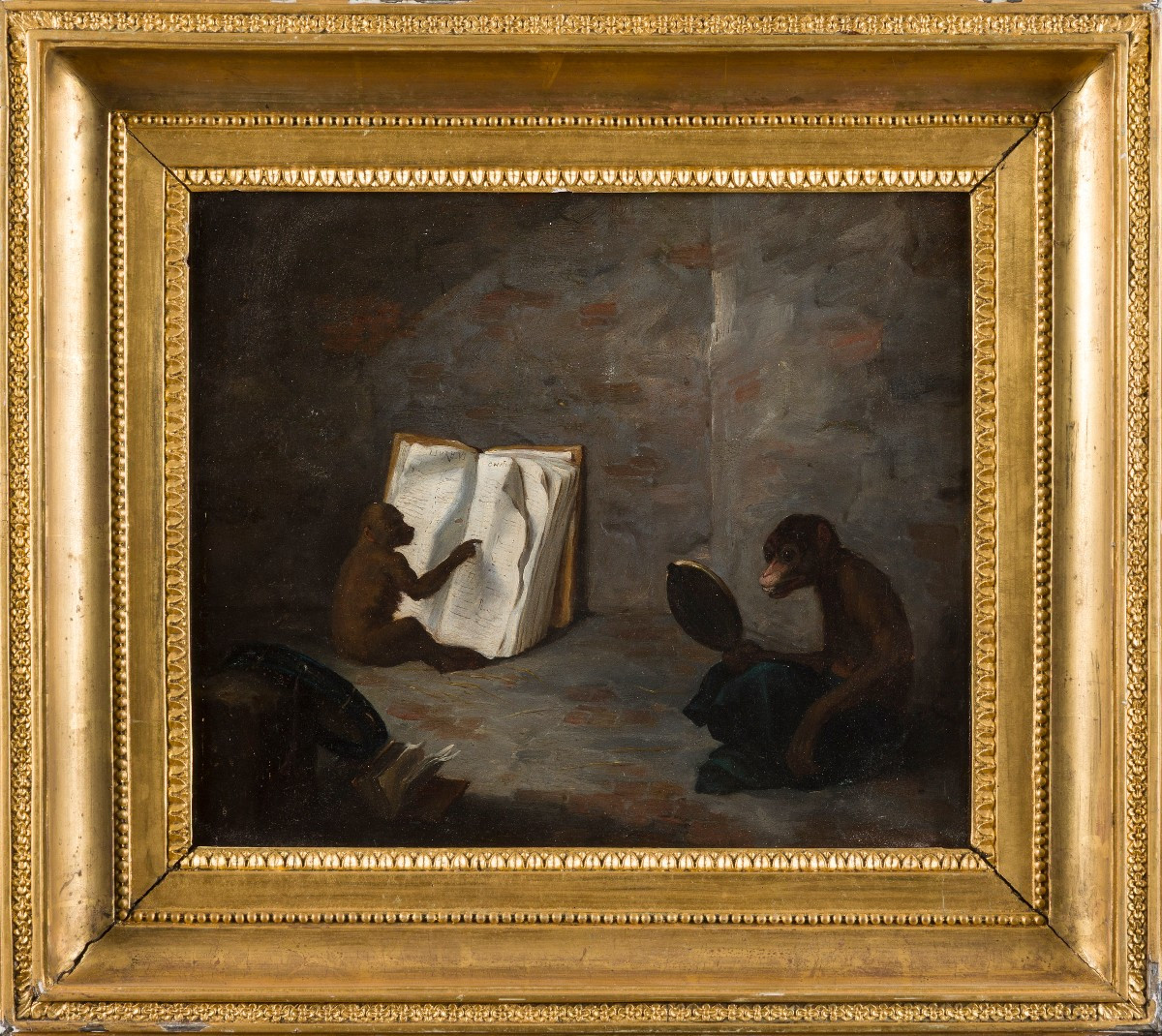
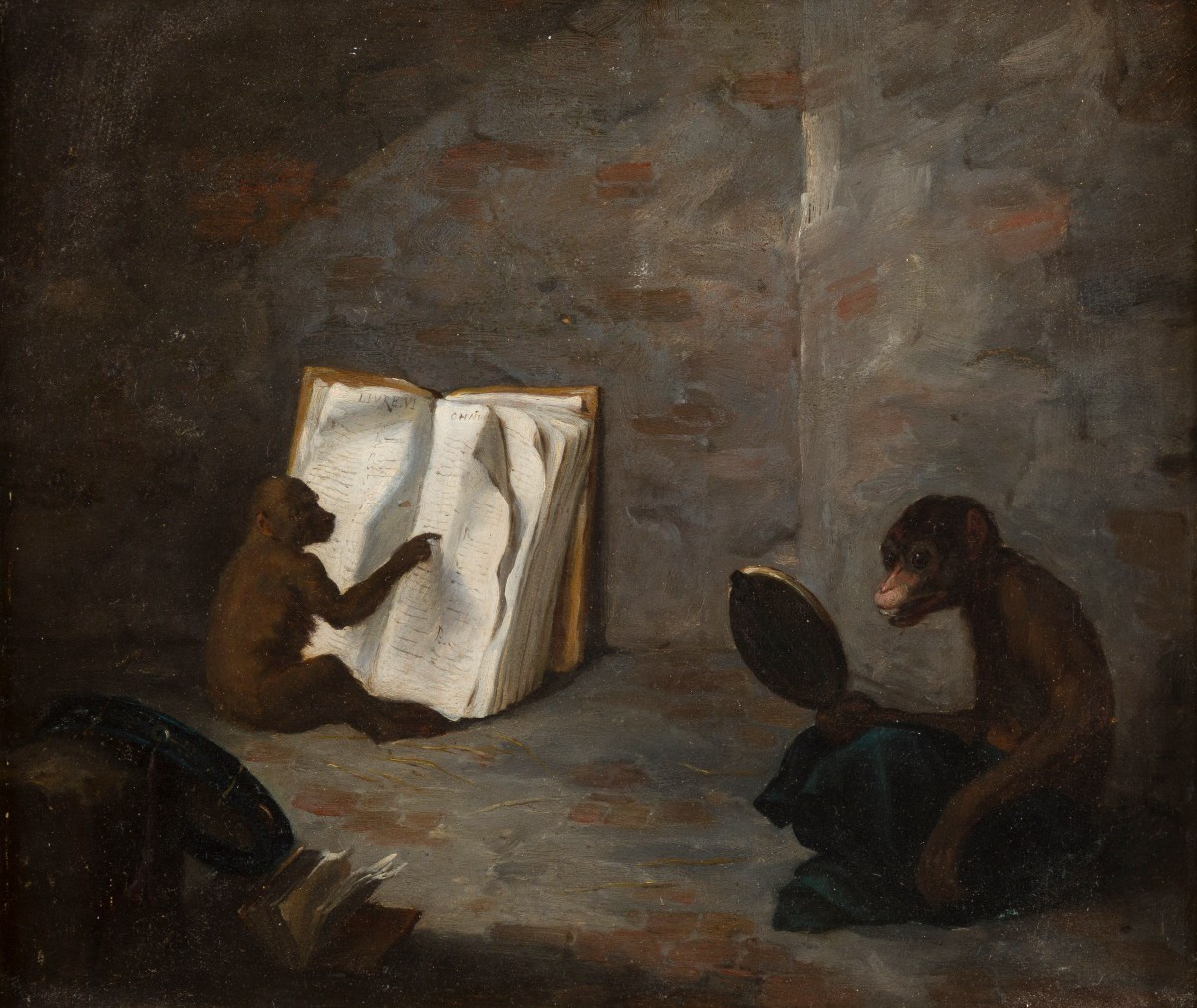

Charles Monginot, "singerie", Circa 1850, In A Beautiful Early 19th-century Gilt Frame
Charles Monginot was one of the most talented pupils of Thomas Couture. Couture held his student in high regard, painting his portrait and owning several of his works. It was in Couture’s studio, in fact, that Monginot met Édouard Manet, who would become one of his closest friends. He supplied him with studio accessories and often saw him at the Café Guerbois, while Manet included him in Music in the Tuileries in 1860 alongside Baudelaire, Offenbach, Théophile Gautier, and others. Our painter was also a companion of Eugène Boudin, who sent the young Claude Monet to him in Paris—Monet being delighted by Monginot’s warm reception, during which he met Manet for the first time. Despite these close biographical ties, however, Charles Monginot did not align himself with the experiments of the Impressionists, remaining closer to Couture’s style. From 1850 to 1881, he exhibited almost every year at the Salon, presenting genre scenes, anecdotal subjects, animal paintings, and flowers, all executed with a skill that avoided vulgarity and displayed a genuine sense of humor.
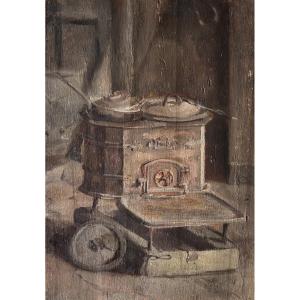
Present in art since the 16th century, notably illustrated by David Teniers and Jean-Baptiste Chardin—not to mention the famous decorations by Christophe Huet at the Château de Chantilly—singeries (monkey scenes) were both a delightful fantasy and a philosophical parody of human behavior. During the wave of “animal mania” that swept through the Romantic era—whose peak can be seen in Grandville’s Scenes from the Public and Private Life of Animals—it was Gabriel-Alexandre Decamps who revived the tradition of paintings depicting monkeys imitating humans. Such works likely carried the underlying idea that one is no less ridiculous than the other! Our painting was inevitably attributed to Decamps (whose hand we do not recognize here) through an inappropriate signature. This overlooks the fact that Charles Monginot was also a prolific creator of singeries. Sculptor monkey, painter monkey, cook monkey, concierge monkey, night watchman monkey, monkey admiring itself in a silver dish—these figures abound in his work and foreshadow our Darwinian kinship. Monginot revisited several times the theme of a monkey seated before a large, crumpled grimoire, its finger resting on lines it pretends to understand. An engraving of one of his paintings shows this monkey instructing its young in front of the said grimoire, in an attic cluttered with old books and musical instruments. Our painting reprises this central monkey and its large book, but adds, to the side, a lady monkey admiring herself in a mirror. The artist draws the scene toward mystery rather than comedy by immersing it in a subtle chiaroscuro, where the monkeys blend into the shadows. The dazzling whiteness of the pages cuts through the grey-blue monochrome of the surrounding attic.
Period: 19th century
Style: Other Style
Condition: Excellent condition
Material: Oil painting
Length: 33
Width: 37
Reference (ID): 1732545
Availability: In stock