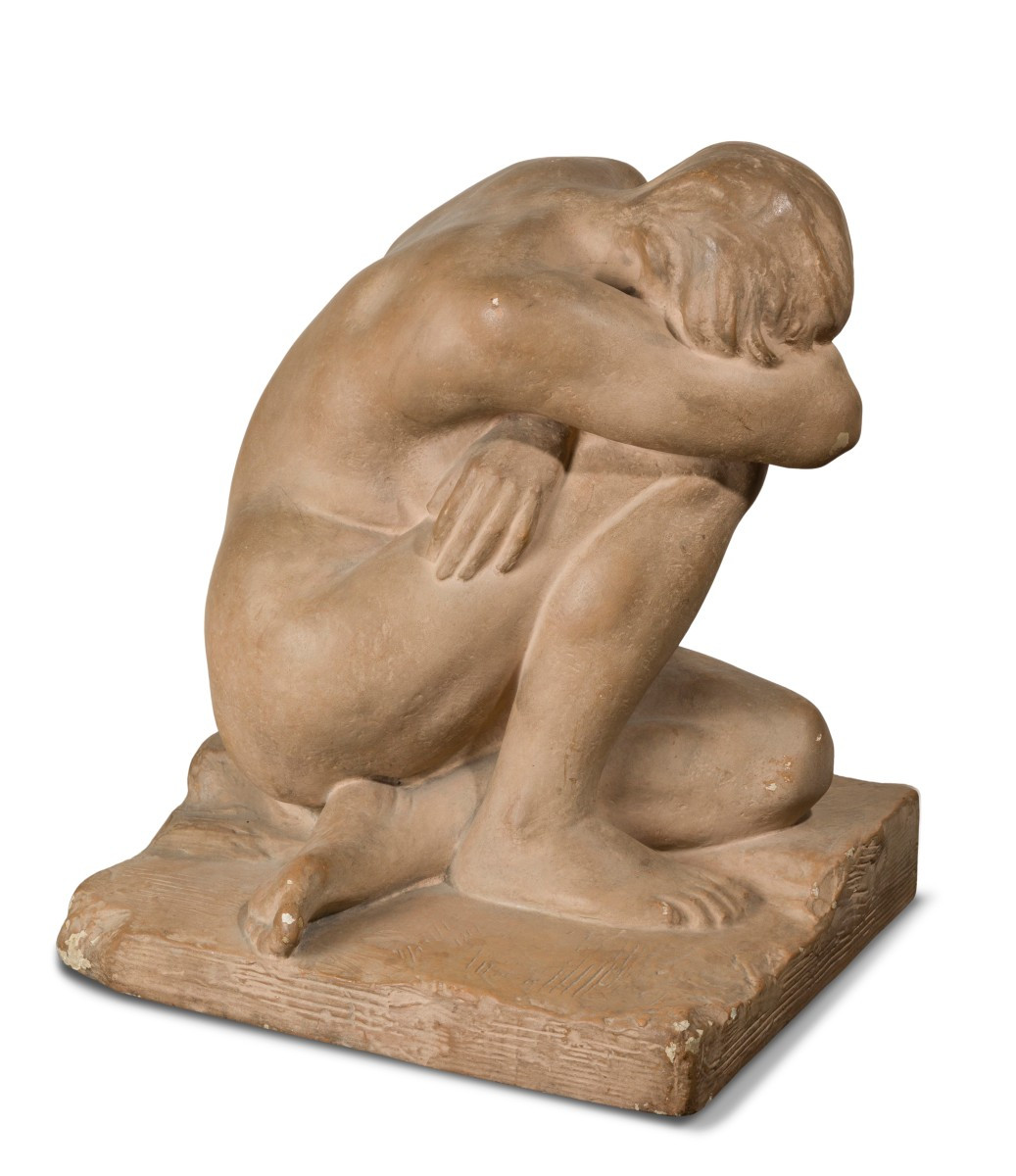
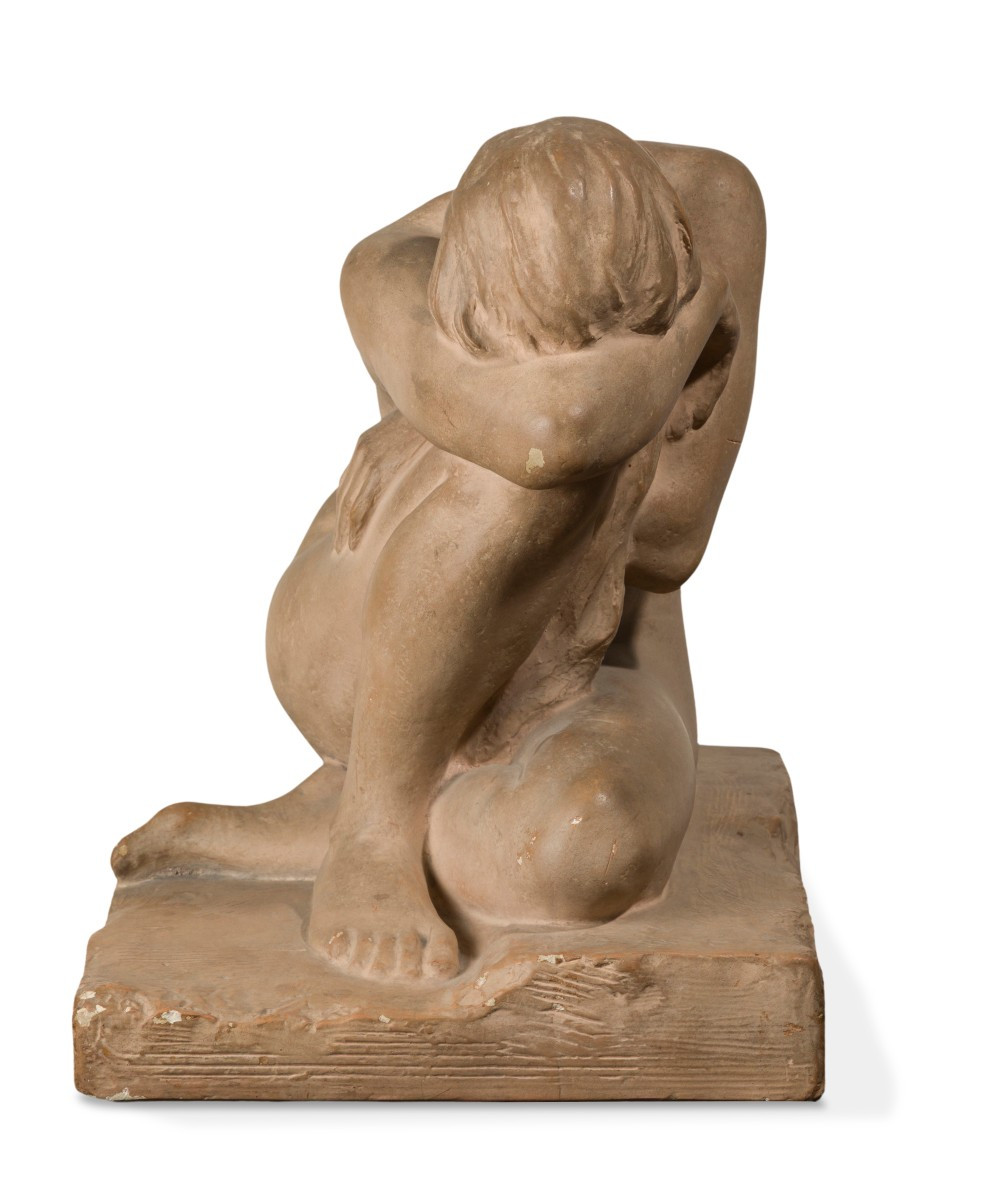

"grieving Woman", Constantin Dimitriadis, 20th-century Sculpture In Patinated Terracotta Plaster
Artist: Constantin Dimitriadis (assénovgrad, Ex-stanimaka, Bulgarie, 1879 - Athènes, 1943)
Grieving Woman
Original studio proof in terracotta-patinated plaster
Provenance: From a group of works originating from the artist’s studio in Paris in the 1990s
Related work: Constantin Dimitriadis, Crying Woman, bronze-tinted plaster, height 38 cm. Sold on April 29, 2009 at Vergos Auctions (Athens) for €10,620, including fees.
Constantin Dimitriadis was a major figure in Greece during the first half of the 20th century. He initially studied sculpture in Athens in the open studio of Georgios Vroutos. A scholarship enabled him to complete his training in Paris, where he attended the École des Beaux-Arts, the Académie de la Grande Chaumière, and the Académie Julian. As early as 1907, he exhibited two sculptures at the Salon des Artistes Français, at which time he was living on Rue de Bagneux. He received an honorable mention in 1908 and a third-class award in 1909 with a highly symbolist group entitled “To Ignored and Vanquished Dreams.”
Acquired at a Parisian market some thirty years ago, our Grieving Woman belongs to this early period. This sensuously folded figure, turned inward and absorbed in its sorrow, reduced to the simplicity of a timeless posture, stands apart from the smiling frivolities of Art Nouveau or the carnal extravagances of Rodin. It instead evokes the contemplative sculptures of Albert Bartholomé. During his years in France, Dimitriadis was supported by influential figures of Greek origin, such as the symbolist poet Jean Moréas, the philologist Jean Psichari—who contributed to the reform of modern Greek—and even the controversial arms dealer Basil Zaharoff.
In 1924, Dimitriadis curiously won a gold medal at the Paris Olympic Games with a statue of a discus thrower, The Finnish Discobolus, which was later installed in the Olympic Park in Lausanne. Pierre de Coubertin had indeed sought to integrate artistic and literary works into the Olympic movement, leading to several competitions between 1912 and 1948. Upon returning to Greece, he played a key role in the creation and modernization of Greek artistic institutions, notably serving as director of the Athens School of Fine Arts from 1930 until his death. In 1936, he was elected a member of the Academy of Athens.
Works by Constantin Dimitriadis are rare on the market.
Original studio proof in terracotta-patinated plaster
Provenance: From a group of works originating from the artist’s studio in Paris in the 1990s
Related work: Constantin Dimitriadis, Crying Woman, bronze-tinted plaster, height 38 cm. Sold on April 29, 2009 at Vergos Auctions (Athens) for €10,620, including fees.
Constantin Dimitriadis was a major figure in Greece during the first half of the 20th century. He initially studied sculpture in Athens in the open studio of Georgios Vroutos. A scholarship enabled him to complete his training in Paris, where he attended the École des Beaux-Arts, the Académie de la Grande Chaumière, and the Académie Julian. As early as 1907, he exhibited two sculptures at the Salon des Artistes Français, at which time he was living on Rue de Bagneux. He received an honorable mention in 1908 and a third-class award in 1909 with a highly symbolist group entitled “To Ignored and Vanquished Dreams.”
Acquired at a Parisian market some thirty years ago, our Grieving Woman belongs to this early period. This sensuously folded figure, turned inward and absorbed in its sorrow, reduced to the simplicity of a timeless posture, stands apart from the smiling frivolities of Art Nouveau or the carnal extravagances of Rodin. It instead evokes the contemplative sculptures of Albert Bartholomé. During his years in France, Dimitriadis was supported by influential figures of Greek origin, such as the symbolist poet Jean Moréas, the philologist Jean Psichari—who contributed to the reform of modern Greek—and even the controversial arms dealer Basil Zaharoff.
In 1924, Dimitriadis curiously won a gold medal at the Paris Olympic Games with a statue of a discus thrower, The Finnish Discobolus, which was later installed in the Olympic Park in Lausanne. Pierre de Coubertin had indeed sought to integrate artistic and literary works into the Olympic movement, leading to several competitions between 1912 and 1948. Upon returning to Greece, he played a key role in the creation and modernization of Greek artistic institutions, notably serving as director of the Athens School of Fine Arts from 1930 until his death. In 1936, he was elected a member of the Academy of Athens.
Works by Constantin Dimitriadis are rare on the market.
5 000 €
Period: 20th century
Style: Art Nouveau
Condition: Perfect condition
Material: Plaster
Height: 38 cm
Reference (ID): 1733129
Availability: In stock
Print