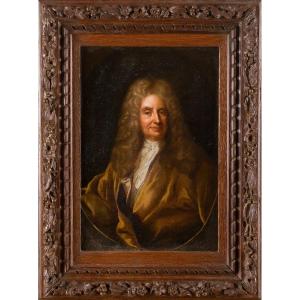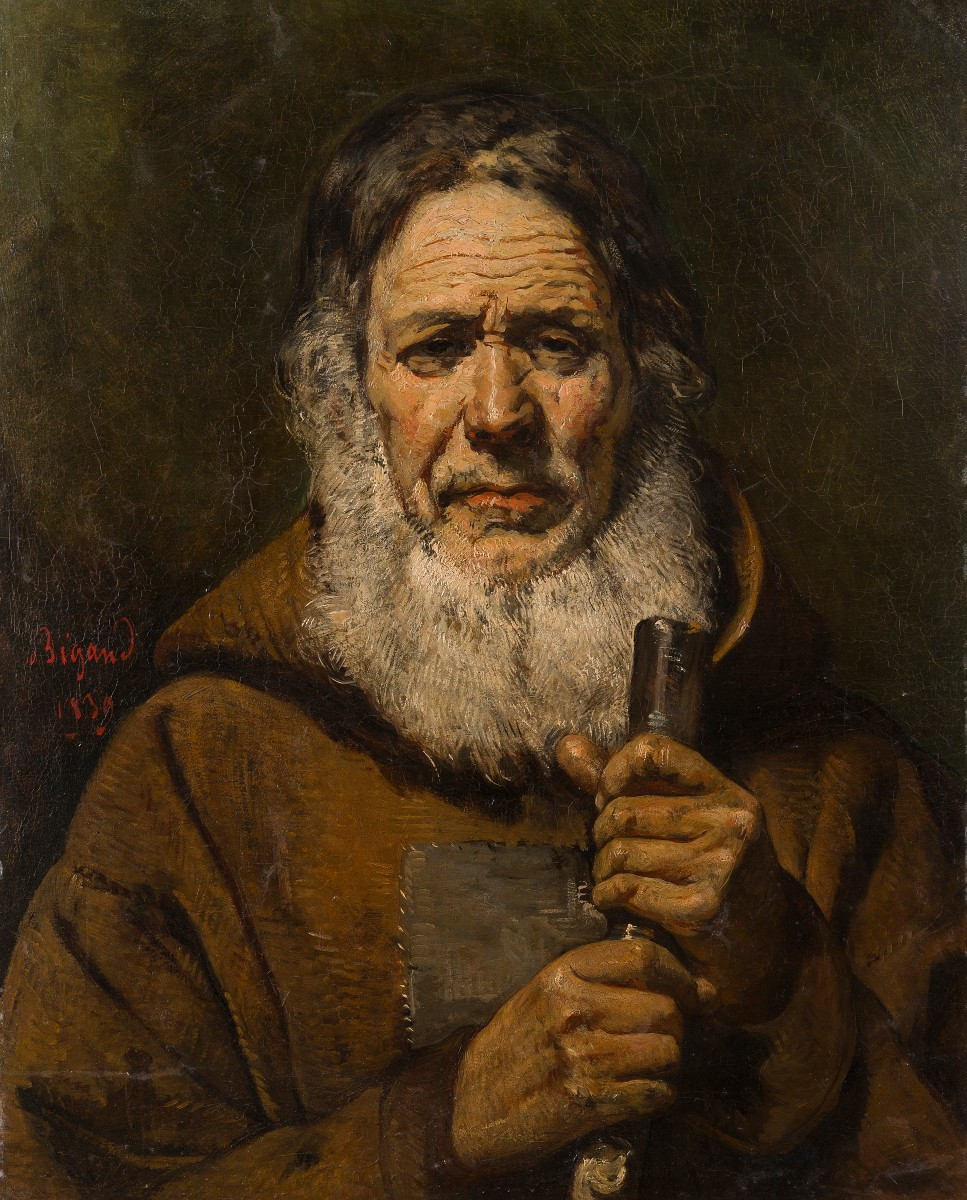
Portrait Of A Hermit, Auguste Bigand, Oil On Canvas Pasted On Panel, Dated 1839
Auguste Bigand (Champlan, 1803 – Versailles, 1875)
Portrait of a Hermit
Oil on canvas, mounted on panel
64 × 51.5 cm
Signed on the left and dated 1839
In fine condition
Here we invite the viewer to discover a painter of strong temperament. When he composed a work entitled Michelangelo Merisi da Caravaggio in His Studio, Auguste Bigand endowed Caravaggio with his own features. Was this a way of aligning himself with the ranks of the great, tempestuous geniuses? Admitted to the École des Beaux-Arts in 1822, he studied under Pierre-Narcisse Guérin—whom he would meet again during a journey to Italy—and later under Louis Hersent. In his youth, Bigand also worked with Merry-Joseph Blondel, assisting him on a ceiling at the Louvre.
From 1834 onwards, he exhibited at the Salon, presenting history paintings and religious subjects, with a marked predilection for saints and hermits (Saint Paul the Hermit Refusing the Visit of Saint Anthony the Solitary). A substantial portion of his oeuvre is preserved at the Musée Calvet in Avignon, to which the artist bequeathed numerous canvases. Bigand maintained close ties with the Avignon naturalist Esprit Requien, likely introduced through Horace Vernet. Dividing his time between Versailles and the City of the Popes, he thus secured important commissions from the General Council of Vaucluse.
Considering its date (1839), this bust-length portrait of a monk—or hermit—deserves close attention. Executed without concession, it is built up with thick, impastoed paint, vigorously worked by an expressive brush. The man’s face, furrowed by age and privation, his weary eyes, and his dense grey beard emerge starkly against a uniform dark background. One is reminded of the Spanish or Neapolitan painters of the seventeenth century, who so often depicted wrinkled saints immersed in shadow—Ribera comes to mind. It is likely that this painting constitutes an early testament to the Spanish influence that would affect many French painters of the nineteenth century, beginning with Manet (an influence that would later verge on pastiche in Théodule Ribot).
Here, Bigand recaptures the tones of the Spanish Golden Age to convey all the mystery of an old man who has turned away from the world in order to stand alone before God.
Period: 19th century
Style: Other Style
Condition: Excellent condition
Material: Oil painting
Length: 64
Width: 51,5
Reference (ID): 1745364
Availability: In stock