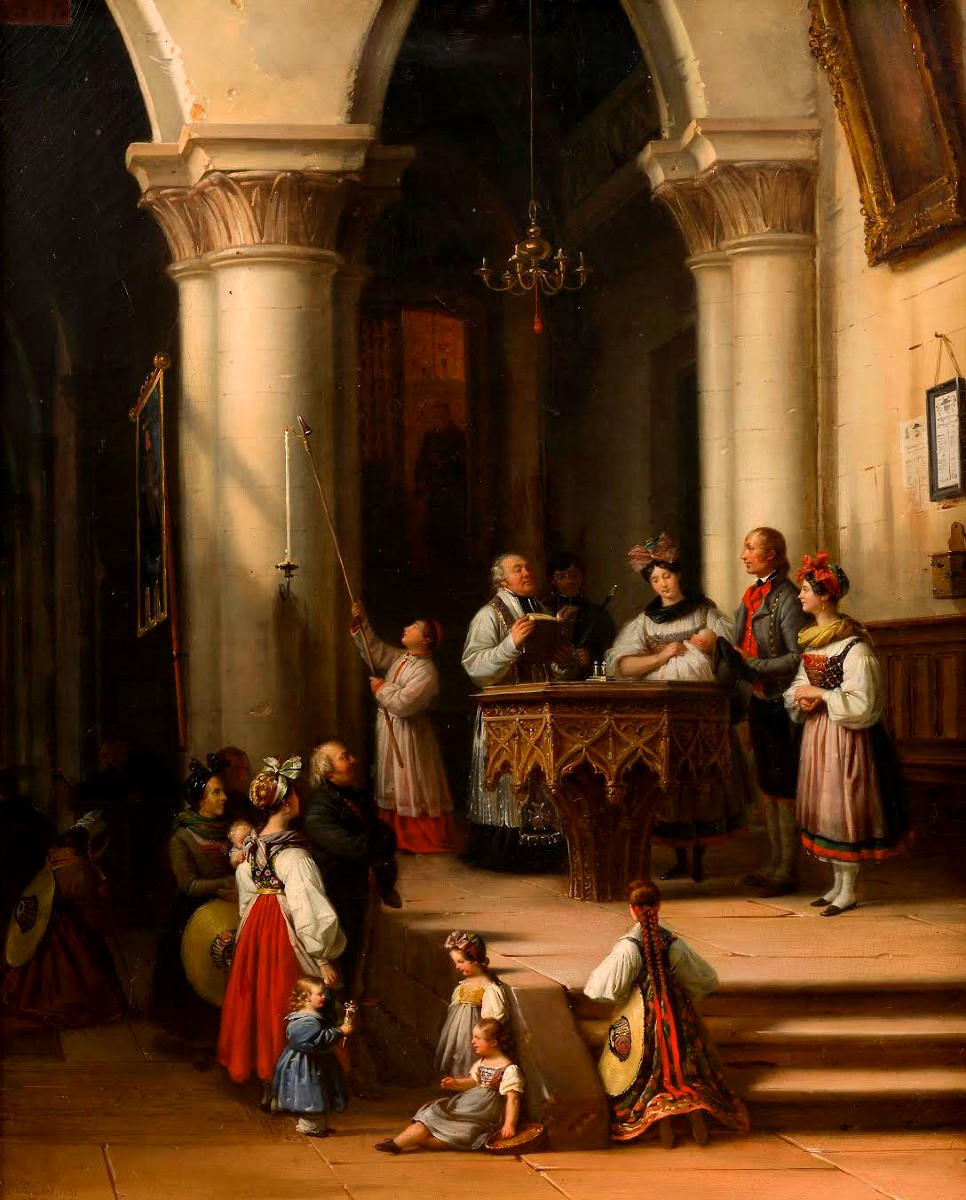

"a Baptism, Alsatian Costumes", Edouard Pingret (1788-1875), Oil On Canvas
Artist: Edouard Henri Théophile Pingret (saint-quentin, 1788 - Paris, 1875)
Edouard Henri Théophile Pingret (Saint-Quentin, 1788 – Paris, 1875)
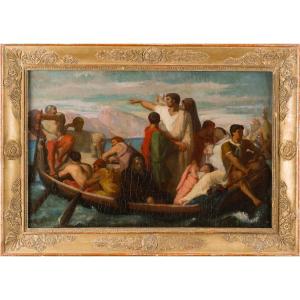
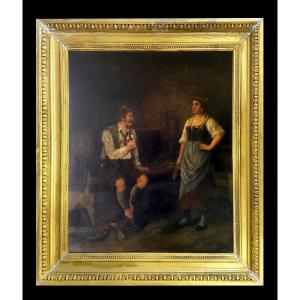
A Baptism; Alsatian Costumes
Oil on canvas, with its original stretcher
101 × 81 cm
Signed lower left and dated 1831
Very well-preserved surface condition
Exhibited: Paris, Salon of 1831, no. 1683
Provenance: Collection of Father Mathieu, parish priest of Parempuyre (Gironde), mid-20th century
Born into a fairly well-to-do Protestant family in Saint-Quentin, Edouard Pingret trained in painting in Paris under Jacques-Louis David, and later Jean-Baptiste Régnault. After a stay in Rome, he began a career as a portraitist and genre painter. From 1810 onwards, he participated in the Salon, where he exhibited numerous works until 1867, distinguished by genuine skill and precise execution, making him something of an heir to Boilly. Under the July Monarchy, he became a fashionable artist. The royal family supported him, and he received commissions for paintings for the historical galleries of Versailles. In 1843, he illustrated in a luxurious album the meeting between Louis-Philippe and Queen Victoria at Windsor Castle. High society frequented his picturesque studio, a veritable temple of collecting, cluttered with Haute Époque furniture and exotic curiosities.
However, the fall of the regime in 1848 deprived him of his clientele, and he left for Mexico to restart his career. There, he gained fame as a pioneer in depicting local costumes, trades, and customs—painting both Mexican peons and California Indians. Yet he was a hot-tempered man: quick to quarrel, entangled in lawsuits, he even struck the British ambassador and ended up in prison. Upon returning to France, he attempted to sell to the Louvre the vast collection of pre-Columbian antiquities he had amassed in America; failing to do so, he publicly accused the Count of Nieuwerkerke, Superintendent of Fine Arts, of having ruined the Louvre’s Rubens through excessive restoration.
At the Salon of 1831—where he notably exhibited a portrait of Paganini—Pingret introduced, with this Alsatian Baptism, a genre that would become dear to him and later make his reputation in Mexico: the depiction of regional traditions and costumes. He returned to it at the following Salon in 1833 with A Wedding in Bordeaux, almost a counterpart to the Alsatian painting, as well as with A Peasant Woman from the Alps, Canton of Fribourg. In 1834, he published a collection titled Costumes of the Pyrenees (sic), comprising forty lithographs and enjoying great success.
At the time, the discovery of French provinces and their picturesque “customs” was part of Romantic modernity. The depiction of regional costumes formed the national counterpart to the pictorial fashion for Italian popular types, exemplified by Léopold Robert. It also coincided with the exploration of a “picturesque France,” as revealed through Baron Taylor’s editorial enterprise, which showcased monuments and landscapes. Costumes were then strong markers of identity, indicating belonging to a social class, profession, region, or nation. The 19th century’s interest in provincial identities and popular traditions would moreover give rise to serious folkloristic studies, at the origin of French ethnography. As a painter, Pingret was among the first to grasp this. It is worth noting that he sharply criticized the dignitaries of the Mexican Academy of Fine Arts for focusing solely on Roman or biblical subjects, instead of drawing inspiration from the world around them.
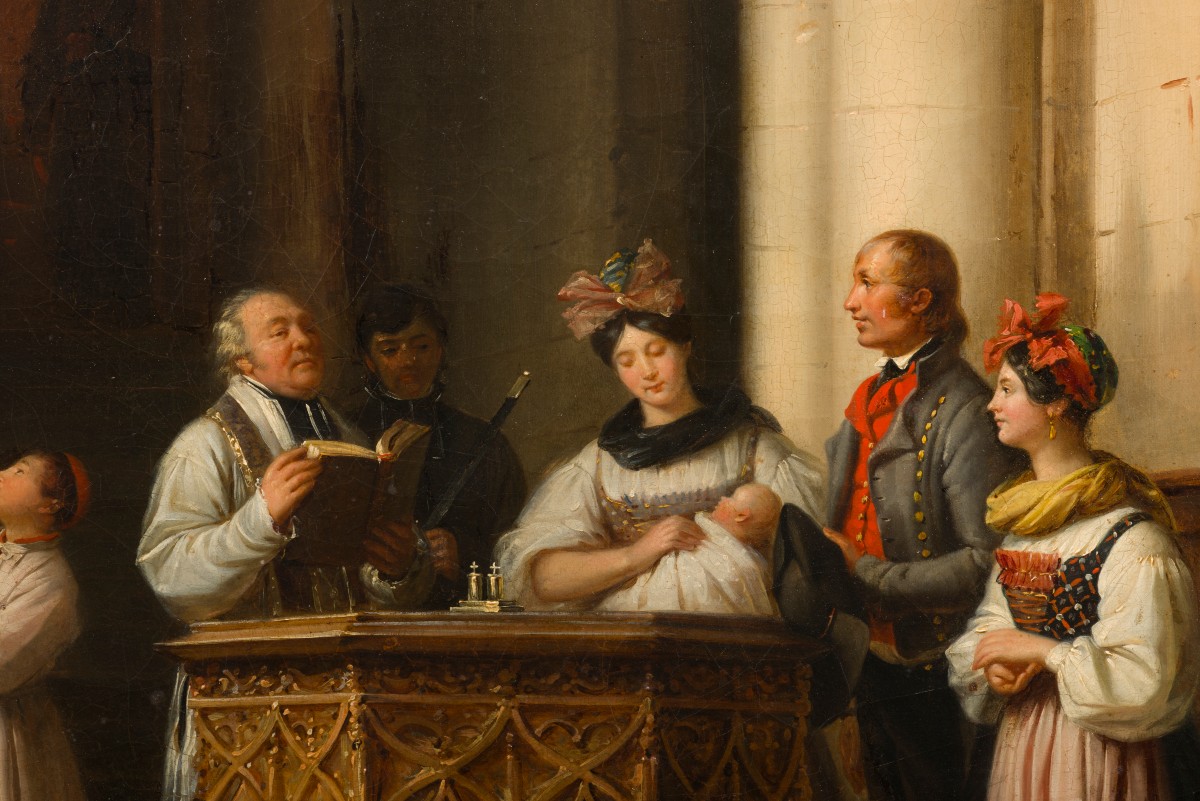
Far removed from the academic sphere, a painting such as A Baptism; Alsatian Costumes already represents, beneath its appealing appearance, a kind of sociological inquiry. It is also a valuable testimony to a period on the brink of change. At the time of this painting, regional traditions had not yet become fixed or fossilized into what we now narrowly call “folklore.” The Alsatian women attending this baptism wear local headdresses shaped like bow ties. However, these headdresses are brightly colored, as are the embroideries decorating their bodices, and they have not yet reached the exaggerated size of the large black fabric bows that would come to characterize Alsatian women—those depicted by Hansi—in the final decades of the 19th century.
A Baptism; Alsatian Costumes
Oil on canvas, with its original stretcher
101 × 81 cm
Signed lower left and dated 1831
Very well-preserved surface condition
Exhibited: Paris, Salon of 1831, no. 1683
Provenance: Collection of Father Mathieu, parish priest of Parempuyre (Gironde), mid-20th century
Born into a fairly well-to-do Protestant family in Saint-Quentin, Edouard Pingret trained in painting in Paris under Jacques-Louis David, and later Jean-Baptiste Régnault. After a stay in Rome, he began a career as a portraitist and genre painter. From 1810 onwards, he participated in the Salon, where he exhibited numerous works until 1867, distinguished by genuine skill and precise execution, making him something of an heir to Boilly. Under the July Monarchy, he became a fashionable artist. The royal family supported him, and he received commissions for paintings for the historical galleries of Versailles. In 1843, he illustrated in a luxurious album the meeting between Louis-Philippe and Queen Victoria at Windsor Castle. High society frequented his picturesque studio, a veritable temple of collecting, cluttered with Haute Époque furniture and exotic curiosities.
However, the fall of the regime in 1848 deprived him of his clientele, and he left for Mexico to restart his career. There, he gained fame as a pioneer in depicting local costumes, trades, and customs—painting both Mexican peons and California Indians. Yet he was a hot-tempered man: quick to quarrel, entangled in lawsuits, he even struck the British ambassador and ended up in prison. Upon returning to France, he attempted to sell to the Louvre the vast collection of pre-Columbian antiquities he had amassed in America; failing to do so, he publicly accused the Count of Nieuwerkerke, Superintendent of Fine Arts, of having ruined the Louvre’s Rubens through excessive restoration.
At the Salon of 1831—where he notably exhibited a portrait of Paganini—Pingret introduced, with this Alsatian Baptism, a genre that would become dear to him and later make his reputation in Mexico: the depiction of regional traditions and costumes. He returned to it at the following Salon in 1833 with A Wedding in Bordeaux, almost a counterpart to the Alsatian painting, as well as with A Peasant Woman from the Alps, Canton of Fribourg. In 1834, he published a collection titled Costumes of the Pyrenees (sic), comprising forty lithographs and enjoying great success.
At the time, the discovery of French provinces and their picturesque “customs” was part of Romantic modernity. The depiction of regional costumes formed the national counterpart to the pictorial fashion for Italian popular types, exemplified by Léopold Robert. It also coincided with the exploration of a “picturesque France,” as revealed through Baron Taylor’s editorial enterprise, which showcased monuments and landscapes. Costumes were then strong markers of identity, indicating belonging to a social class, profession, region, or nation. The 19th century’s interest in provincial identities and popular traditions would moreover give rise to serious folkloristic studies, at the origin of French ethnography. As a painter, Pingret was among the first to grasp this. It is worth noting that he sharply criticized the dignitaries of the Mexican Academy of Fine Arts for focusing solely on Roman or biblical subjects, instead of drawing inspiration from the world around them.
Far removed from the academic sphere, a painting such as A Baptism; Alsatian Costumes already represents, beneath its appealing appearance, a kind of sociological inquiry. It is also a valuable testimony to a period on the brink of change. At the time of this painting, regional traditions had not yet become fixed or fossilized into what we now narrowly call “folklore.” The Alsatian women attending this baptism wear local headdresses shaped like bow ties. However, these headdresses are brightly colored, as are the embroideries decorating their bodices, and they have not yet reached the exaggerated size of the large black fabric bows that would come to characterize Alsatian women—those depicted by Hansi—in the final decades of the 19th century.
12 000 €
Period: 19th century
Style: Other Style
Condition: Excellent condition
Material: Oil painting
Length: 101
Width: 81
Reference (ID): 1735123
Availability: In stock
Print