

COIN AVAILABLE — Payment methods are listed at the end of this description.
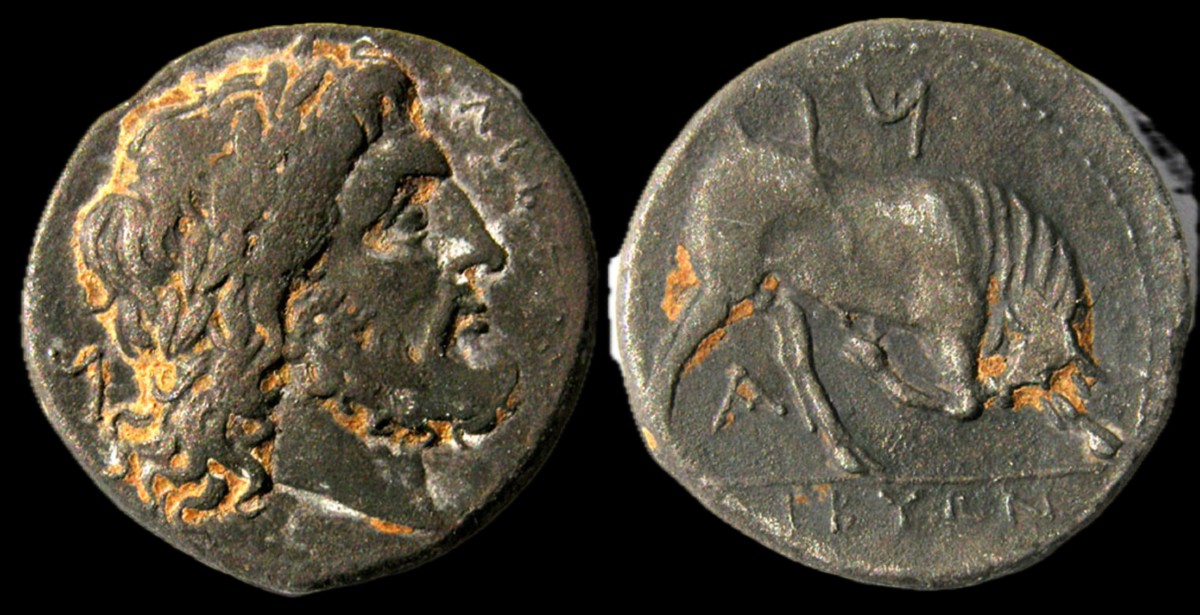
Analysis & ExpertiseThis silver double shekel (c. 241–238 BC) belongs to the North African coinage traditionally associated with Zeugitana and the context of the so-called “Libyan” Revolt / Mercenary War (Truceless War), a pivotal period immediately following the First Punic War. The legend LIBUWN (“the Libyans”, modern transcription) and the Punic letter M are well-established typological markers in modern numismatic literature.
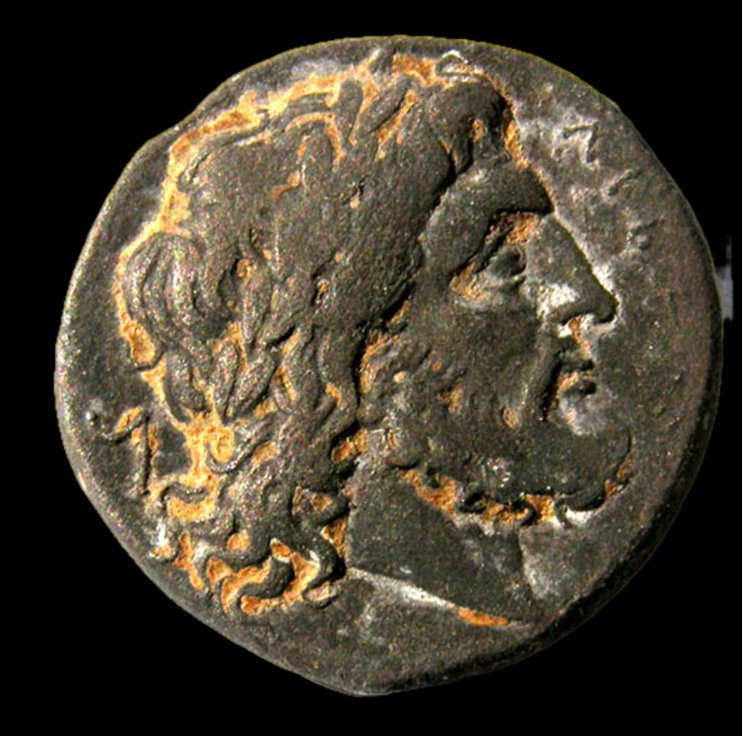
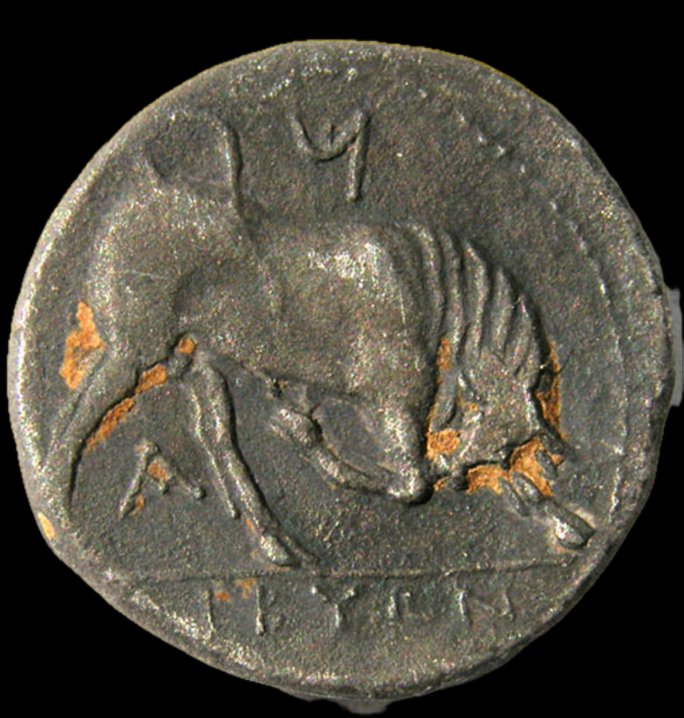
Close examination (×10 loupe, raking light): the specimen features a broad, thick, slightly irregular flan, with circulation wear consistent with use and relief that remains well structured. The surfaces show an old, dark patina (grey/black), with localized ochre-gold deposits (mineral/earthen residues and surface oxidations), most visible in the recesses and along the outlines of the portrait and the bull. Under raking light, a regular micro-granulation and diffuse contact marks are observable, with no “cast” appearance. The modelling of volumes (forehead, nose, laurel, bull’s neck) remains crisp and consistent with a hammered strike. Within the strict limits of visual examination, the coherence of metal–relief–style and the logic of the legends aligns with published examples of this type.
ObverseLaureate head of Zeus facing right, in Hellenistic style, with wavy locks and a clearly defined laurel wreath at the top of the head. Peripheral legend fragments are preserved; LIBUWN (common transliteration) is partially visible in front of the face depending on orientation. Behind the head, a Punic character attributed to the “M” group is identifiable despite strike weakness and deposits. Facial features (eye, nasal ridge, mouth) remain legible, giving the coin a notably “medallic” presence for the series.
ReverseCharging bull to the right, rendered with strong dynamic tension (lowered head, forelegs in motion, powerful hindquarters). Above the bull, the Punic letter M is visible. Between the hind legs, the letter A is reported for this type (often dependent on centering and preservation). The exergue bears LIBUWN. The entire composition is enclosed within a complete laurel wreath, particularly desirable here for the clarity with which it frames and visually stabilizes the reverse.
SpecificationsAuthority / Attribution: “LIBUWN” issue (Libyan Revolt / Mercenary War), Zeugitana (Carthaginian sphere in the broad sense)
Denomination: Double shekel (AR)
Date: c. 241–238 BC
Obverse: Laureate head of Zeus right; LIBUWN; Punic M behind
Reverse: Charging bull right; M above; A between the legs; LIBUWN in exergue; laurel wreath
Weight: 14.5 g
E.S.G. Robinson, “A Hoard of Coins of the Libyans”, Numismatic Chronicle (1953), no. 20, pl. III (different die noted)
J. Alexandropoulos, Les Monnaies de l’Afrique antique, no. 52c (series reference)
Museum comparisons: “Libya” double shekel Zeus/bull (known die and orientation variants)
After 241 BC, Carthage emerged exhausted from the First Punic War and faced a severe pay crisis with its troops. The mercenaries’ uprising escalated into a major conflict known as the Mercenary War or Truceless War, and also referred to as the “Libyan War” in part of the historiography. In this setting, coins were struck in the name of the “Libyans” (LIBUWN/ΛIBYΩN), with additional signs (including M) interpreted by some authors as faction or leadership markers (hypotheses involving Mathos or the “camp”).
Iconographically, the pairing of a “Hellenized” Zeus with a charging bull draws on a powerful Mediterranean visual language (sovereign divinity / animal force), while preserving Punic/Neo-Punic epigraphic signatures and the identity statement LIBUWN—making this coinage especially significant for the political and monetary history of ancient North Africa.
Cultural ValueFor collectors, this piece concentrates key strengths:
A historically event-linked type, directly tied to a major crisis that nearly upended Carthaginian control in Africa.
Highly expressive, instantly recognizable iconography (Zeus / bull), bridging Punic and Hellenistic aesthetics.
Strong scholarly traceability through standard references (Robinson 1953; Alexandropoulos) and public-collection parallels, supporting comparison and documentation.
Overall, its presence and legibility place it naturally within a collection focused on Punic Africa / Punic Wars / crisis coinages, with substantial narrative power.
Traceability & GuaranteesIn accordance with our practices, each specimen is examined, described, and supplied with a certificate of authenticity consistent with art-market and heritage standards. The study is conducted via close observation under ×10 magnification and raking light, with non-destructive verification of key authentication criteria (typological coherence, epigraphy, style, metrology, strike structure, relief and surface reading).
Provenance is professional European. Acquisition derives from a specialized international transaction within a recognized numismatic network and has been validated by expert review in line with current numismatic-market standards.
Secure ShippingFrance: Colissimo, signature + insurance (€50)
International: UPS, signature + insurance (€85)
Accepted payments: cheque, bank transfer, bank payment link (Card, Visa, Mastercard, American Express, Apple Pay).
Sales restriction — United States: we do not sell to the United States due to the complexity of import requirements for cultural goods, specific customs controls, and related insurance constraints.







 Le Magazine de PROANTIC
 TRÉSORS Magazine
 Rivista Artiquariato