

Toug « Tuğ » Ottoman, 17th - 18th Century. 32313
TUĞ "TUĞ" OTTOMAN, 17th - 18th century. 32313
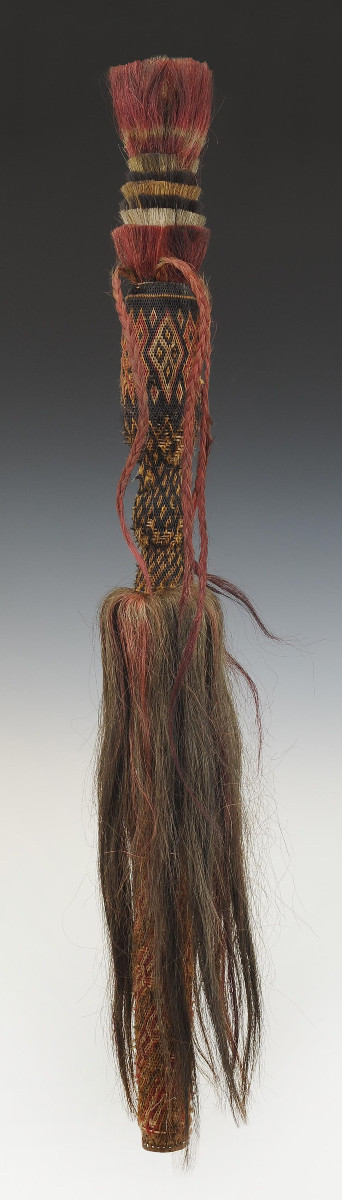
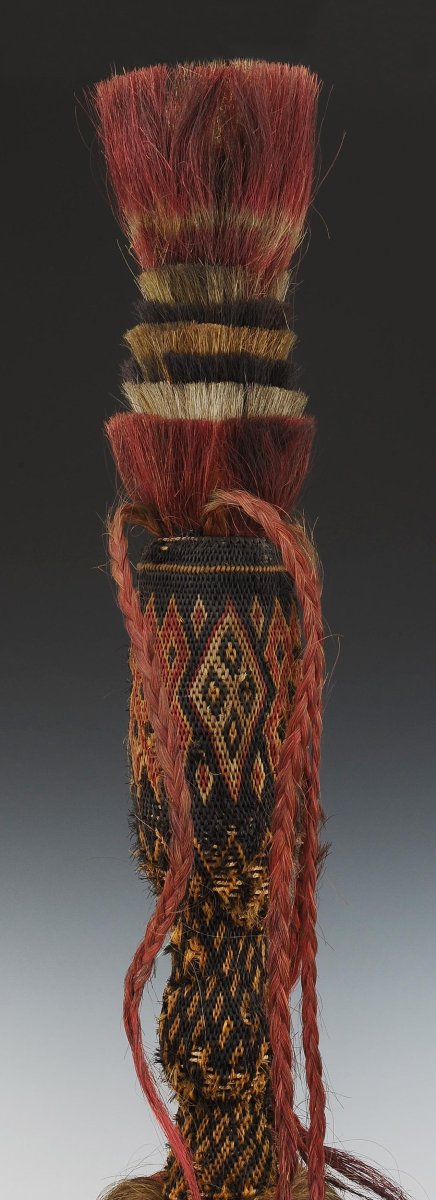
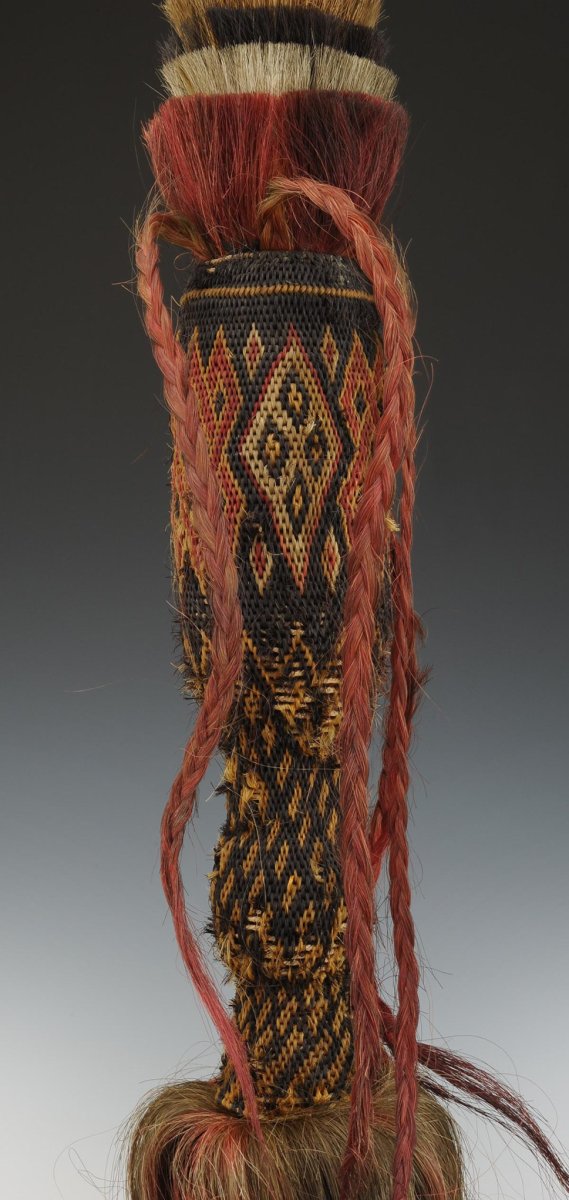
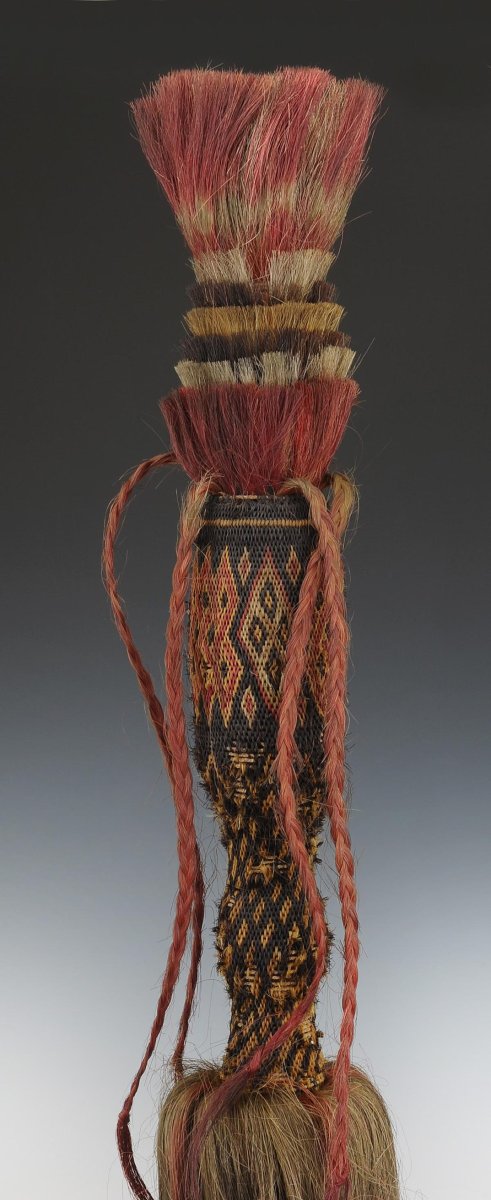
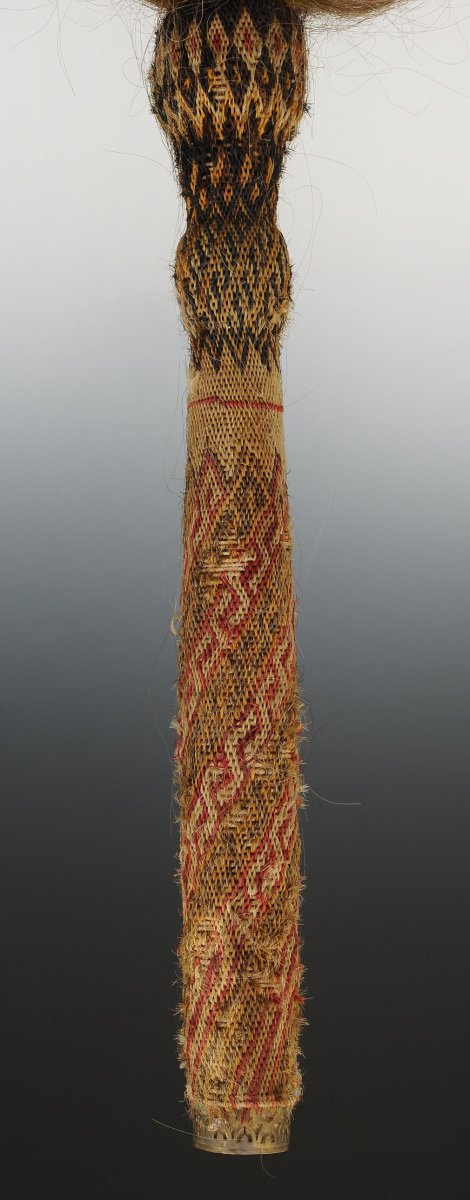
Hollow wooden staff with a brass ring at its base, decorated with openwork design, Ø 5.4 cm, entirely covered with a weave of horsehair in a repetitive geometric pattern, spiraling in the lower part. The upper part is adorned with tufts of horsehair dyed scarlet-white-yellow-black. At the base of these tufts, five cascading tresses of scarlet horsehair are attached. Halfway up the staff, hanging white and scarlet horsehair is fixed.
Height of the staff 101.5 cm. Height of the tuft 25.5 cm. Total height 127 cm.
Length of the cascading tresses approximately 40 cm.
Length of the hanging horsehair approximately 60 cm.
Ø of the tuft approximately 11 cm.
Ø of the staff between 9 and 5 cm, depending on the parts.
Ottoman Empire.
17th - 18th century.
Good condition, normal wear.
NOTE:
The tuğ (Ottoman Turkish: طوغ) is a banner made of horse tails attached to a staff, sometimes topped with a crescent or metal pommel. It was mainly carried by Ottoman cavalrymen and served as a sign of command, rallying point, and hierarchical status.
MAMELUKS OF THE IMPERIAL GUARD FIRST EMPIRE:
These models were used by the Mameluks of the Imperial Guard of the Consulate and the First Empire. In his work "GARDE IMPÉRIALE MAMELUKS" Collection Raoul and Jean Brunon (Marseille), "LES MAMELUKS D'ÉGYPTE - LES MAMELUKS DE LA GARDE IMPÉRIALE," Jean Brunon wrote in 1963, "The tuğ, a kind of banner used by the Mamelukes following the example of the Turks, was a symbol of war and command. It consisted of a horse tail generally white or red attached below a golden copper apple sometimes surmounted by a crescent; supporting the whole, a thick staff ended between the apple and the horse tail, with an ornament consisting of braided horsehair in white, red, and black colors; other tresses detached from the motif and hung around. The tuğ preceded a high-ranking figure, and their number was determined by the person's rank. In the army, seven or nine tuğs were carried in front of the Sultan during marches. The Grand Vizier had the privilege of having five; the bachaghas, who held the rank of vizier and resided in the capital cities of the kingdom, including the one in Cairo, were entitled to three tuğs. The pachas, governors of provinces, had two, and the beys had one. The deployment of the tuğ signaled the declaration of war; it was like the soul of the Turkish Army, respected and defended against enemy attacks. During halts, the tuğ was planted in front of the dignitary's tent. In a composition by Dutertre published in the Description de l'Egypte, the artist shows French troops arriving in Siout, Upper Egypt, after an expedition: a camel carries a bundle of tuğs on each side of the saddle pad (See page 38). The Army of the Orient conquered a large number of these trophies from the Mamelukes and the Turks; some of them are preserved in the Army Museum; two are in the Raoul and Jean Brunon Collection (plate opposite)."
SIMILAR OBJECT:
In the sale of the Islamic and Indian Art Collection of Philippe Missillier, on April 29, 2025, at the Sotheby's Auction House in London (United Kingdom), the following item was presented as lot No. 4:
SPELNDOUR - The Philippe Missillier Collection of -Islamic & Indian Armes & Armours
A RARE OTTOMAN BATTLE STANDARD (TUĞ), TURKEY OR BALKANS, 17TH CENTURY the hollow wooden pole with iron band with two suspension rings at the base, the length of the pole covered with a polychrome coarse woven textile, decorated in a repeating geometric spiral pattern, the top half with tufts of horsehair partially dyed red, attached at four points 110cm. PROVENANCE Taken as booty on the battlefield, siege of Vienna, 1683 House of the Duchy of Baden Sotheby’s Amsterdam, Property of a Princely Family, 19 December 2006, lot 409 Philippe Missillier Collection no.10C W £ 10,000-15,000 A tuğ standard is a type of traditional standard that consists of a wooden pole to which dyed horse or yak tail hair is attached. Its use on the Eurasian steppe is attested from as early as the fourteenth century but is likely much older. During the early modern period, the armies of the Ottoman empire also made use of the tuğ standard as a marker of rank, which was indicated by the number of tuğ placed outside the holder’s tent. The Sultan for instance had up to nine horsetail standards. (Holger Schuckelt (ed.), The Turkish Chamber: Oriental Splendour in the Dresden Armoury, Dresden: Staatliche Kunstsammlungen Dresden, 2010, p.71). Surviving tuğ, including the present example, form part of the booty (Turkenbeute) taken in the Turkish wars. The present standard is a rare survival of such standards captured during the 1683 Siege of Vienna. A tuğ in Karlsruhe came from the Türkische Cammer of Markgrafen (Margrave) Ludwig Wilhelm von BadenBaden (1655-1707). (Badisches Landesmuseum Karlsruhe, inv. no.D 30; see Ernst Petrasch et al, Die Karlsruher Turkenbeute, Munich: Hirmer Verlag, 1991, pp.77-78, no.17). Another tuğ likely looted during the 1683 Siege of Vienna is in the National Museum of Denmark (inv. No.Mb 2, Kjeld von Folsach et al., Fighting, Hunting, Impressing: Arms and Armour from the Islamic World 1500-1850, Copenhagen: David Collection, 2021, p.110) and maintains its original tombak finial. Two further tuğ standards were captured by the later Ferdinand II of Austria, in 1556 during a campaign against Ottoman Hungary (W. Boeheim, Handbuch der Waffenkunde, Leipzig, 1890, p.511)
Hollow wooden staff with a brass ring at its base, decorated with openwork design, Ø 5.4 cm, entirely covered with a weave of horsehair in a repetitive geometric pattern, spiraling in the lower part. The upper part is adorned with tufts of horsehair dyed scarlet-white-yellow-black. At the base of these tufts, five cascading tresses of scarlet horsehair are attached. Halfway up the staff, hanging white and scarlet horsehair is fixed.
Height of the staff 101.5 cm. Height of the tuft 25.5 cm. Total height 127 cm.
Length of the cascading tresses approximately 40 cm.
Length of the hanging horsehair approximately 60 cm.
Ø of the tuft approximately 11 cm.
Ø of the staff between 9 and 5 cm, depending on the parts.
Ottoman Empire.
17th - 18th century.
Good condition, normal wear.
NOTE:
The tuğ (Ottoman Turkish: طوغ) is a banner made of horse tails attached to a staff, sometimes topped with a crescent or metal pommel. It was mainly carried by Ottoman cavalrymen and served as a sign of command, rallying point, and hierarchical status.
MAMELUKS OF THE IMPERIAL GUARD FIRST EMPIRE:
These models were used by the Mameluks of the Imperial Guard of the Consulate and the First Empire. In his work "GARDE IMPÉRIALE MAMELUKS" Collection Raoul and Jean Brunon (Marseille), "LES MAMELUKS D'ÉGYPTE - LES MAMELUKS DE LA GARDE IMPÉRIALE," Jean Brunon wrote in 1963, "The tuğ, a kind of banner used by the Mamelukes following the example of the Turks, was a symbol of war and command. It consisted of a horse tail generally white or red attached below a golden copper apple sometimes surmounted by a crescent; supporting the whole, a thick staff ended between the apple and the horse tail, with an ornament consisting of braided horsehair in white, red, and black colors; other tresses detached from the motif and hung around. The tuğ preceded a high-ranking figure, and their number was determined by the person's rank. In the army, seven or nine tuğs were carried in front of the Sultan during marches. The Grand Vizier had the privilege of having five; the bachaghas, who held the rank of vizier and resided in the capital cities of the kingdom, including the one in Cairo, were entitled to three tuğs. The pachas, governors of provinces, had two, and the beys had one. The deployment of the tuğ signaled the declaration of war; it was like the soul of the Turkish Army, respected and defended against enemy attacks. During halts, the tuğ was planted in front of the dignitary's tent. In a composition by Dutertre published in the Description de l'Egypte, the artist shows French troops arriving in Siout, Upper Egypt, after an expedition: a camel carries a bundle of tuğs on each side of the saddle pad (See page 38). The Army of the Orient conquered a large number of these trophies from the Mamelukes and the Turks; some of them are preserved in the Army Museum; two are in the Raoul and Jean Brunon Collection (plate opposite)."
SIMILAR OBJECT:
In the sale of the Islamic and Indian Art Collection of Philippe Missillier, on April 29, 2025, at the Sotheby's Auction House in London (United Kingdom), the following item was presented as lot No. 4:
SPELNDOUR - The Philippe Missillier Collection of -Islamic & Indian Armes & Armours
A RARE OTTOMAN BATTLE STANDARD (TUĞ), TURKEY OR BALKANS, 17TH CENTURY the hollow wooden pole with iron band with two suspension rings at the base, the length of the pole covered with a polychrome coarse woven textile, decorated in a repeating geometric spiral pattern, the top half with tufts of horsehair partially dyed red, attached at four points 110cm. PROVENANCE Taken as booty on the battlefield, siege of Vienna, 1683 House of the Duchy of Baden Sotheby’s Amsterdam, Property of a Princely Family, 19 December 2006, lot 409 Philippe Missillier Collection no.10C W £ 10,000-15,000 A tuğ standard is a type of traditional standard that consists of a wooden pole to which dyed horse or yak tail hair is attached. Its use on the Eurasian steppe is attested from as early as the fourteenth century but is likely much older. During the early modern period, the armies of the Ottoman empire also made use of the tuğ standard as a marker of rank, which was indicated by the number of tuğ placed outside the holder’s tent. The Sultan for instance had up to nine horsetail standards. (Holger Schuckelt (ed.), The Turkish Chamber: Oriental Splendour in the Dresden Armoury, Dresden: Staatliche Kunstsammlungen Dresden, 2010, p.71). Surviving tuğ, including the present example, form part of the booty (Turkenbeute) taken in the Turkish wars. The present standard is a rare survival of such standards captured during the 1683 Siege of Vienna. A tuğ in Karlsruhe came from the Türkische Cammer of Markgrafen (Margrave) Ludwig Wilhelm von BadenBaden (1655-1707). (Badisches Landesmuseum Karlsruhe, inv. no.D 30; see Ernst Petrasch et al, Die Karlsruher Turkenbeute, Munich: Hirmer Verlag, 1991, pp.77-78, no.17). Another tuğ likely looted during the 1683 Siege of Vienna is in the National Museum of Denmark (inv. No.Mb 2, Kjeld von Folsach et al., Fighting, Hunting, Impressing: Arms and Armour from the Islamic World 1500-1850, Copenhagen: David Collection, 2021, p.110) and maintains its original tombak finial. Two further tuğ standards were captured by the later Ferdinand II of Austria, in 1556 during a campaign against Ottoman Hungary (W. Boeheim, Handbuch der Waffenkunde, Leipzig, 1890, p.511)
30 000 €
Period: 18th century
Style: Other Style
Condition: Good condition
Reference (ID): 1689107
Availability: In stock
Print