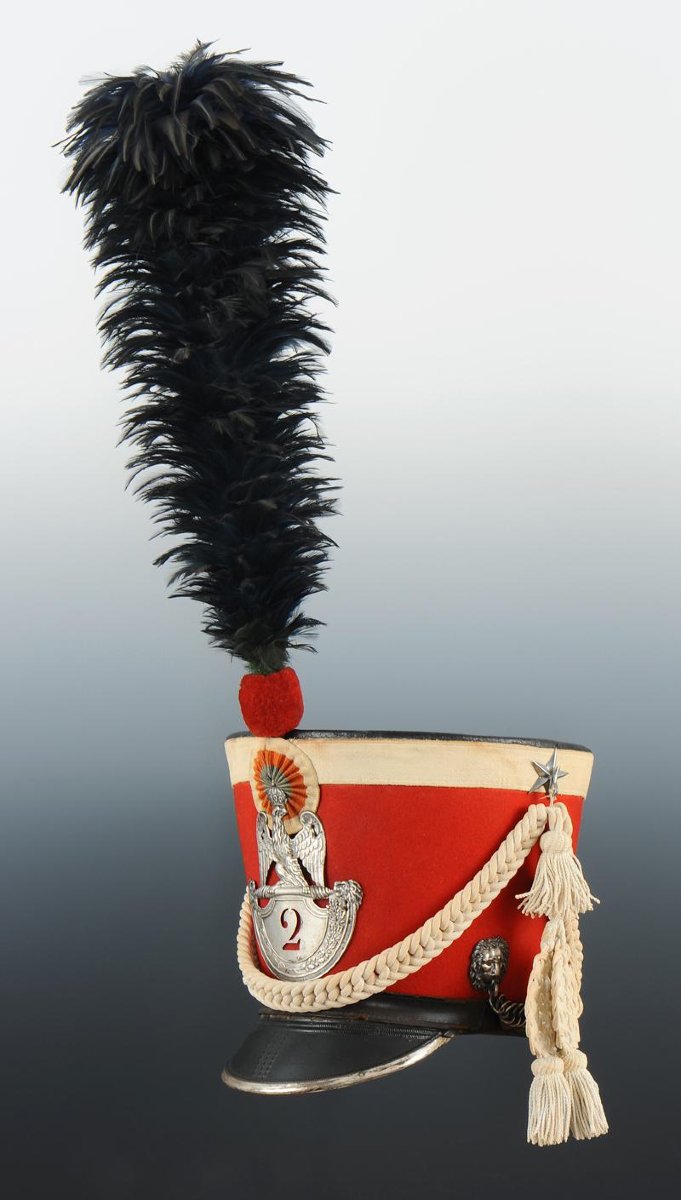
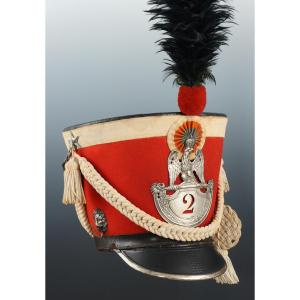


Shako Of The 2nd Regiment Of Honor Guards, Model 1813, First Empire.
SHAKO OF THE 2nd REGIMENT OF THE GUARDS OF HONOR, model 1813, First Empire. 33619(4310)
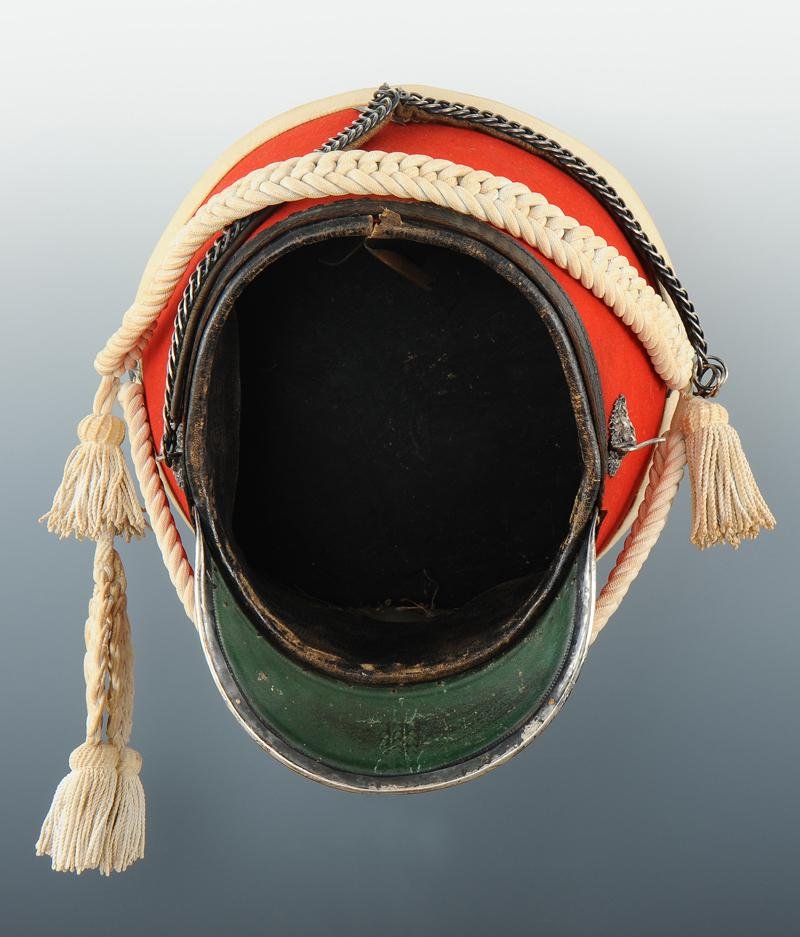
The shako body is composed of a cardboard covered with scarlet cloth (H 20,5 cm), covered by a very strong waxed black cow leather cap, with a diameter of 25,5 cm folded over the felt to a height of 1,8 cm. At the top, a 3,1 cm wide white cotton woven braid is sewn. At the bottom of the felt, a leather cap in solid cow leather, 2,2 cm wide, is sewn. The visor is made of strong varnished cow leather, embossed with a molded border with three vertical rods in the center imitating stylized foliage branches, attached to the front of the shako, width 5,5 cm. On its outer edge, a 6 mm wide silver braiding is bent over and riveted.
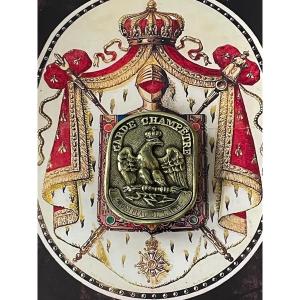
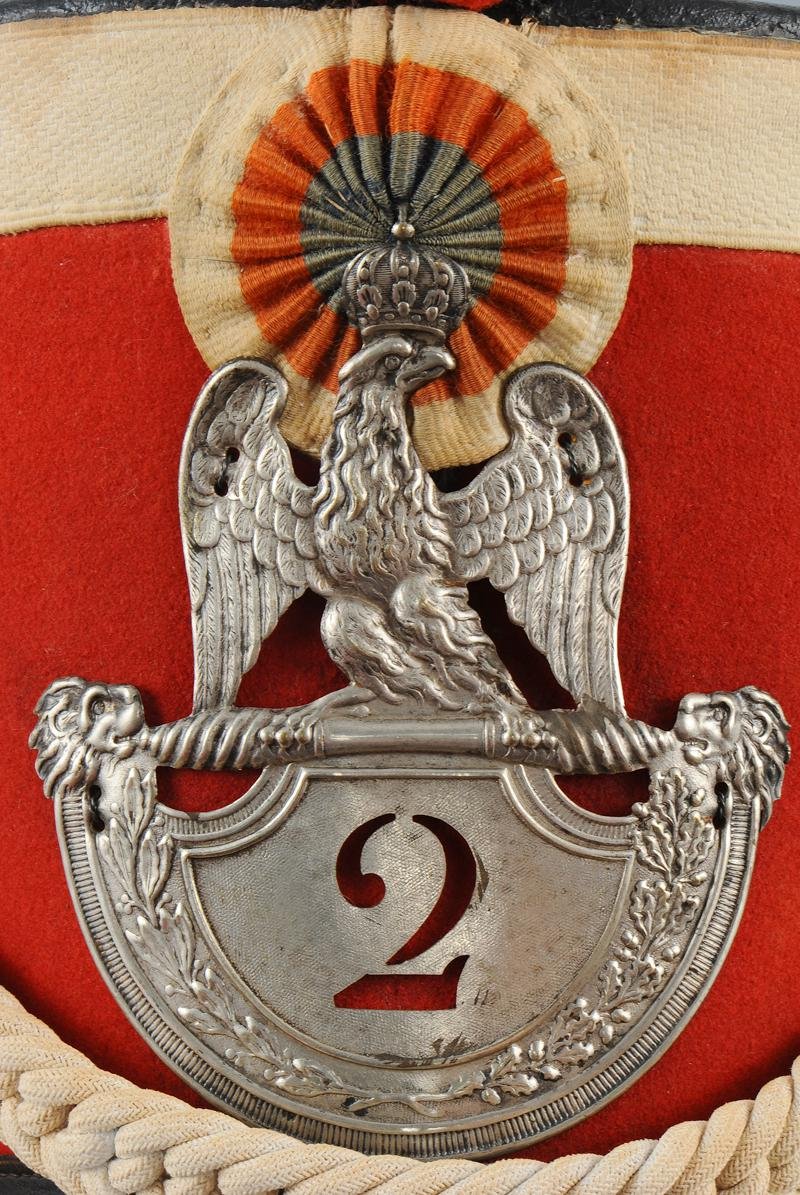
A silver-plated brass plate (or badge) is affixed to the front, representing a crowned imperial eagle holding in its claws Jupiter's thunderbolt resting on a base with a cutout figure "2" framed by two lion heads with branches of foliage and a striated lower molding, H 13,8 cm, width 11,2 cm.
Above the plate, a cockade made of tricolor woolen trim attached to the body by an outer seam, Ø 6,7 cm (white circle on the outside, then red and blue at the center). Below the cockade, a pocket for the plume, attached by a seam on the body.
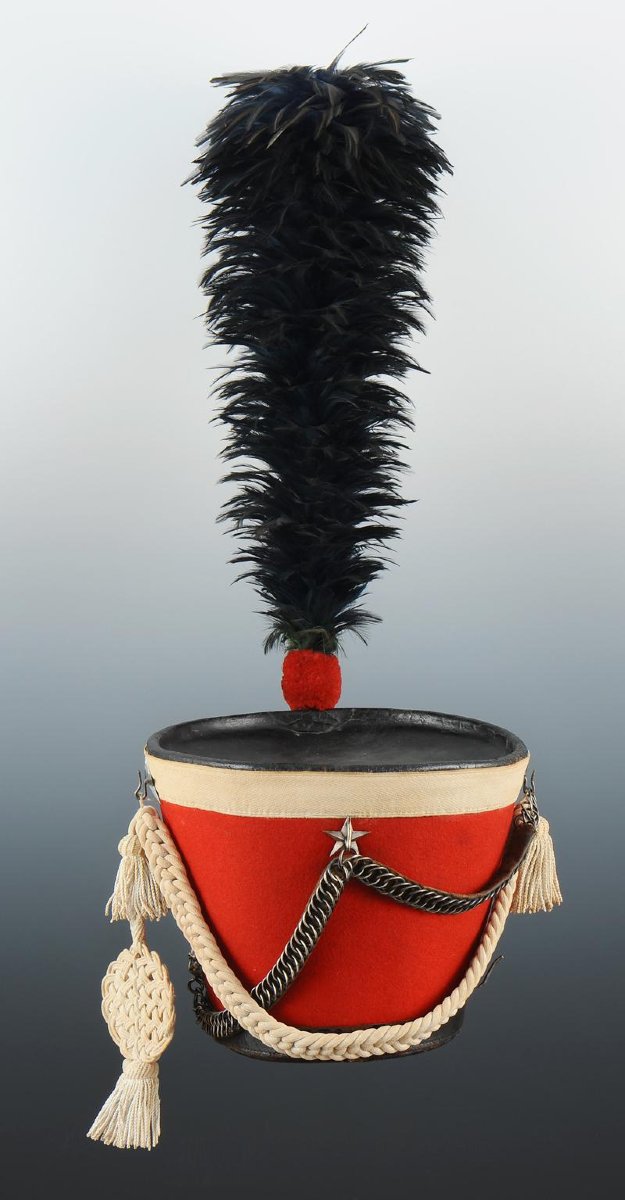
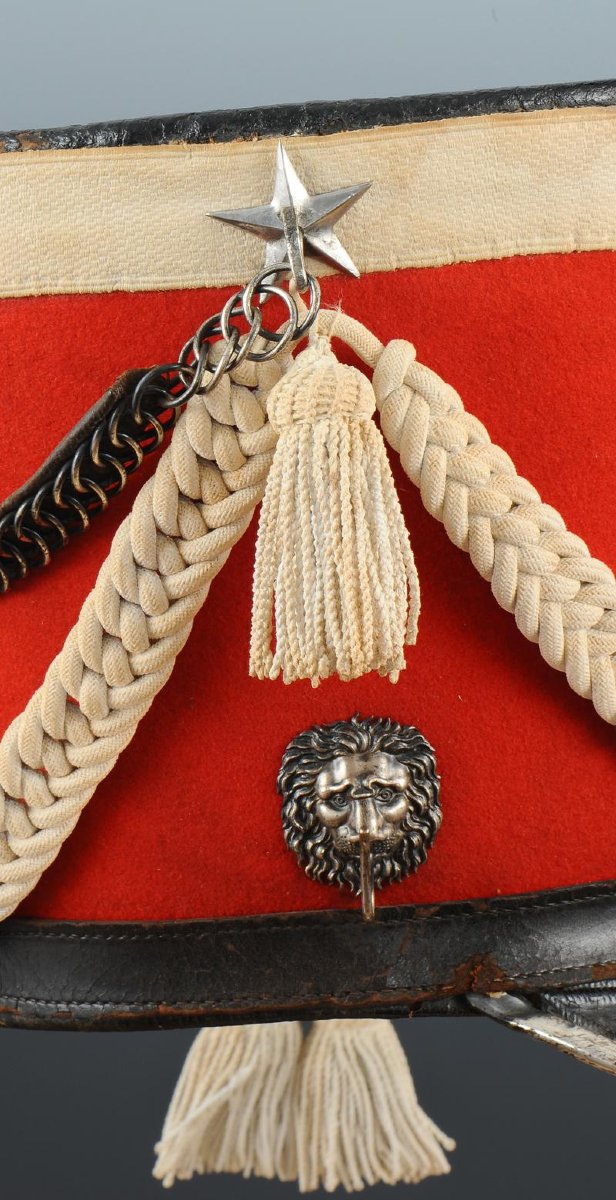
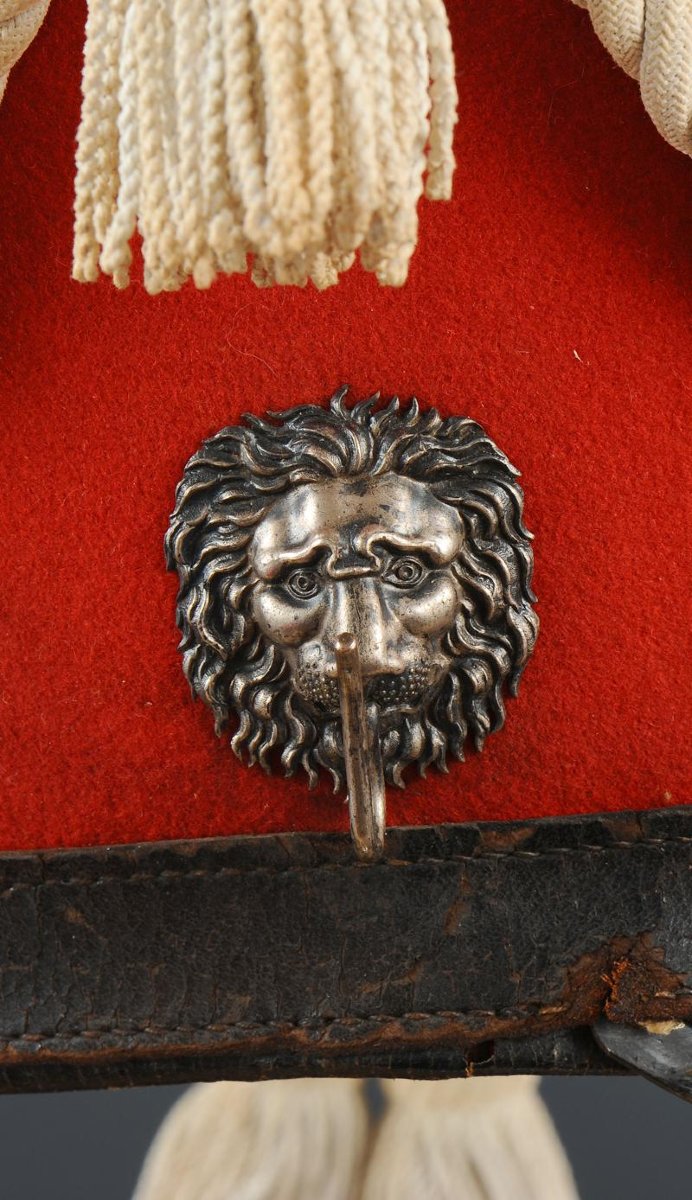
Chinstraps. On each side of the shako, a silver-plated stamped relief rosette in the shape of a lion's head is placed (H 4,1 cm, width 3,4 cm). The lion on the right rosette holds a ring in its mouth, and the one on the left rosette holds a 2,8 cm high suspension hook. The chinstrap is made of a silver curb chain mounted on a black velvet covered sheepskin, width 1,6 cm.
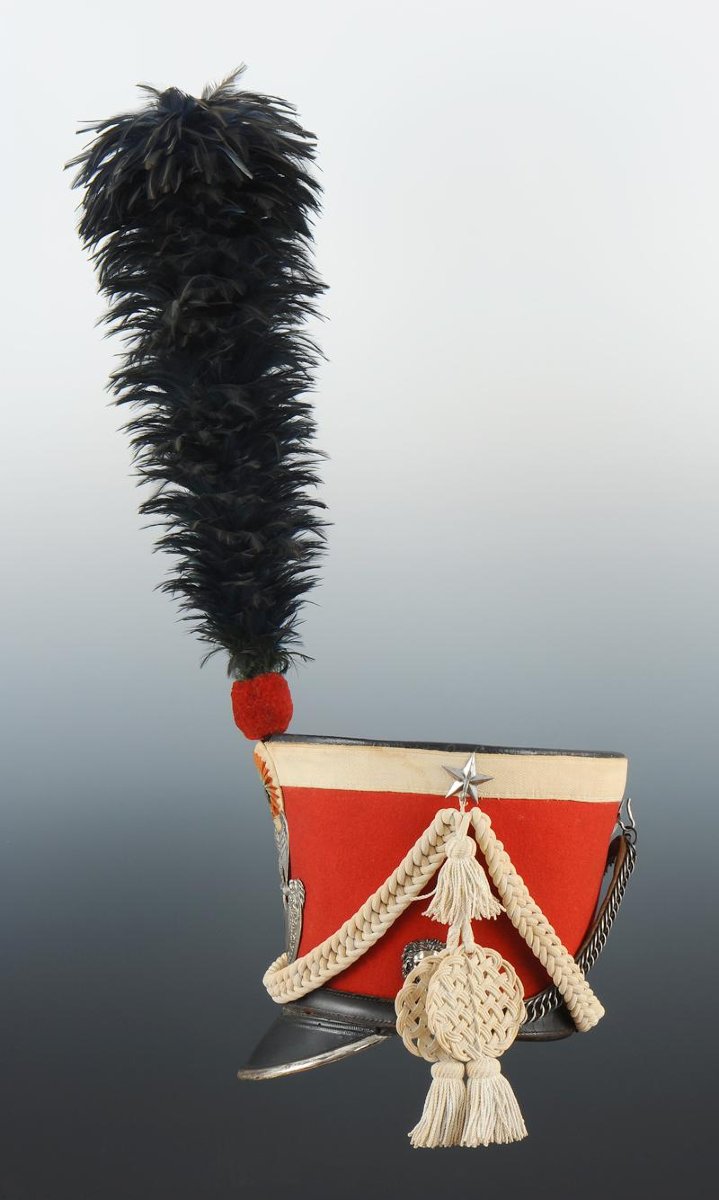
On the upper part, on each side of the body at the level of the upper braid, a five-pointed silver metal star (Ø 3,7 cm) with a welded suspension hook in the center (H 2,1 cm) is attached for securing the cord. A third star, identical to the ones on the sides but of smaller diameter (2,8 cm), is fixed beneath the upper braid at the back of the shako with a 2,2 cm high suspension hook to hold the chinstrap in place.
The interior lining consists of a black waxed sheepskin headband, 7,5 cm high.
The white braided cord (width 2,3 cm) attaching on each side with white thread and terminated on the right side by a cabochon (H 1,5 cm, Ø 2,2 cm) with soft fringes of 5,1 cm long. On the left side, an identical cabochon with soft fringes and two braided three-strand cords (H 7,9 cm, width 7,8 cm), each terminated by identical cabochons.
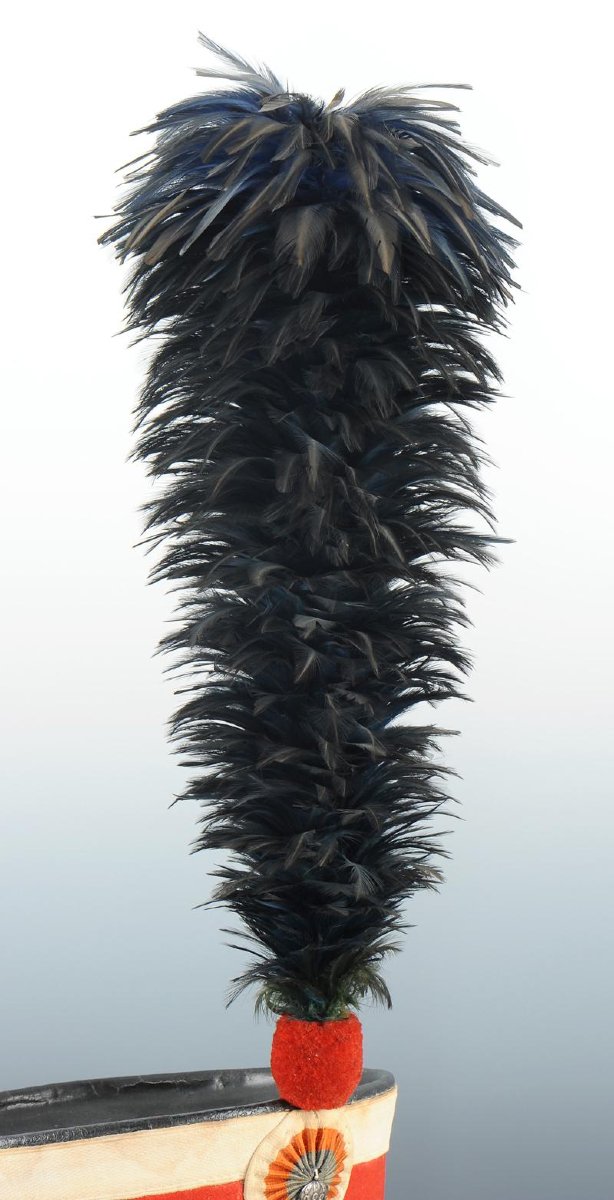
A scarlet woolen pompom of specific dimensions for the Guards of Honor shakos (smaller than in the line) H 4,3 cm, Ø 4,1 cm.
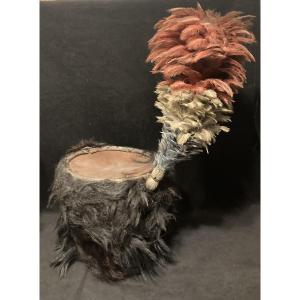
A plume mounted on a 54 cm long whalebone on vulture feather fan approximately 38 cm high, terminated at the top by a 7 cm high and 17 cm diameter summit in sky blue vulture feathers.
France.
First Empire (1813-1815).
Near mint condition, likely the finest specimen to have reached us, missing part of the interior headband, some stitching points on the visor damaged.
PROVENANCE:
This specimen comes from the former Saint-Aubin collection in Paris at the beginning of the 19th century, and then the Pierre-Maxime Glain collection, which was dispersed on Sunday, November 23, 1980 in Angers, by Masters Henri Martin and Jean-Philippe Courtois, No. 119 in the catalogue. This shako was reproduced in the September 1981 special issue of ABC Collections "Militaria - French 19th-century Equipment," page 7.
PROVENANCE:
Former Wurtz-Pees collection, then Saint-Aubin, and private collection.
Mr. Marcel Saint-Aubin, a collector turned antiquarian between the wars. To my knowledge, no biography or article has ever been published about this figure, although he is well known among collectors and often mentioned in the provenance of historical objects of high quality. That's why I will delve into my archives to shed more light on this great connoisseur:
"Mobilized during World War I along with his brother in the infantry, the latter was killed at Verdun. Both shared the same taste for military memorabilia; they both drew and published their drawings in the magazine 'La Giberne' before 1914.
After the war, he set up as an antiquarian. In 1926, he lived at 108 rue de Ménilmontant (Paris 20ᵉ), far from the preferred quarters of antiquarians. His choice focused on the specialty that had attracted him for a long time: military curiosities. The spark that led him to this specialty came from his first find: an officer's saber of light cavalry from the Consulate era, his first fine sword; he called it his 'lucky charm' and always kept it.
The antique dealer's profession allowed Saint-Aubin to see and possess these cherished objects for some time. A knowledgeable connoisseur, he never made a mistake, and his clients benefited from his expertise. A passionate researcher, everything he discovered in his life was remarkably diverse. Silent and modest, he had an art and manner that left an indelible impression on the enthusiasts who knew him.
Like most military objects dealers of that time, Marcel Saint-Aubin had no shop. He received visitors at his apartment, where few objects were displayed temporarily. Generally, like Paul Jean, he would fetch the items he wished to sell from the neighboring room and present them most often without saying anything, with a slight smile or, if the item presented was truly exceptional, he would simply say in a subdued tone 'It's the real deal...'.
In June 1940, during the occupation, he left for Guingamp. He returned to Paris where he resettled at the end of 1951, in the house he had acquired, 16 rue Henri Pape, in the 13th arrondissement, once again, far from the antiquarian district.
His love for the items he parted with was evident in the care he took in their packaging. Very skilled with his hands, he perfectly protected even the most modest piece.
Marcel Saint-Aubin passed away at the age of 83, taking with him the esteem of all who knew him, leaving behind a legacy of a man of great moral values."
The shako body is composed of a cardboard covered with scarlet cloth (H 20,5 cm), covered by a very strong waxed black cow leather cap, with a diameter of 25,5 cm folded over the felt to a height of 1,8 cm. At the top, a 3,1 cm wide white cotton woven braid is sewn. At the bottom of the felt, a leather cap in solid cow leather, 2,2 cm wide, is sewn. The visor is made of strong varnished cow leather, embossed with a molded border with three vertical rods in the center imitating stylized foliage branches, attached to the front of the shako, width 5,5 cm. On its outer edge, a 6 mm wide silver braiding is bent over and riveted.
A silver-plated brass plate (or badge) is affixed to the front, representing a crowned imperial eagle holding in its claws Jupiter's thunderbolt resting on a base with a cutout figure "2" framed by two lion heads with branches of foliage and a striated lower molding, H 13,8 cm, width 11,2 cm.
Above the plate, a cockade made of tricolor woolen trim attached to the body by an outer seam, Ø 6,7 cm (white circle on the outside, then red and blue at the center). Below the cockade, a pocket for the plume, attached by a seam on the body.
Chinstraps. On each side of the shako, a silver-plated stamped relief rosette in the shape of a lion's head is placed (H 4,1 cm, width 3,4 cm). The lion on the right rosette holds a ring in its mouth, and the one on the left rosette holds a 2,8 cm high suspension hook. The chinstrap is made of a silver curb chain mounted on a black velvet covered sheepskin, width 1,6 cm.
On the upper part, on each side of the body at the level of the upper braid, a five-pointed silver metal star (Ø 3,7 cm) with a welded suspension hook in the center (H 2,1 cm) is attached for securing the cord. A third star, identical to the ones on the sides but of smaller diameter (2,8 cm), is fixed beneath the upper braid at the back of the shako with a 2,2 cm high suspension hook to hold the chinstrap in place.
The interior lining consists of a black waxed sheepskin headband, 7,5 cm high.
The white braided cord (width 2,3 cm) attaching on each side with white thread and terminated on the right side by a cabochon (H 1,5 cm, Ø 2,2 cm) with soft fringes of 5,1 cm long. On the left side, an identical cabochon with soft fringes and two braided three-strand cords (H 7,9 cm, width 7,8 cm), each terminated by identical cabochons.
A scarlet woolen pompom of specific dimensions for the Guards of Honor shakos (smaller than in the line) H 4,3 cm, Ø 4,1 cm.
A plume mounted on a 54 cm long whalebone on vulture feather fan approximately 38 cm high, terminated at the top by a 7 cm high and 17 cm diameter summit in sky blue vulture feathers.
France.
First Empire (1813-1815).
Near mint condition, likely the finest specimen to have reached us, missing part of the interior headband, some stitching points on the visor damaged.
PROVENANCE:
This specimen comes from the former Saint-Aubin collection in Paris at the beginning of the 19th century, and then the Pierre-Maxime Glain collection, which was dispersed on Sunday, November 23, 1980 in Angers, by Masters Henri Martin and Jean-Philippe Courtois, No. 119 in the catalogue. This shako was reproduced in the September 1981 special issue of ABC Collections "Militaria - French 19th-century Equipment," page 7.
PROVENANCE:
Former Wurtz-Pees collection, then Saint-Aubin, and private collection.
Mr. Marcel Saint-Aubin, a collector turned antiquarian between the wars. To my knowledge, no biography or article has ever been published about this figure, although he is well known among collectors and often mentioned in the provenance of historical objects of high quality. That's why I will delve into my archives to shed more light on this great connoisseur:
"Mobilized during World War I along with his brother in the infantry, the latter was killed at Verdun. Both shared the same taste for military memorabilia; they both drew and published their drawings in the magazine 'La Giberne' before 1914.
After the war, he set up as an antiquarian. In 1926, he lived at 108 rue de Ménilmontant (Paris 20ᵉ), far from the preferred quarters of antiquarians. His choice focused on the specialty that had attracted him for a long time: military curiosities. The spark that led him to this specialty came from his first find: an officer's saber of light cavalry from the Consulate era, his first fine sword; he called it his 'lucky charm' and always kept it.
The antique dealer's profession allowed Saint-Aubin to see and possess these cherished objects for some time. A knowledgeable connoisseur, he never made a mistake, and his clients benefited from his expertise. A passionate researcher, everything he discovered in his life was remarkably diverse. Silent and modest, he had an art and manner that left an indelible impression on the enthusiasts who knew him.
Like most military objects dealers of that time, Marcel Saint-Aubin had no shop. He received visitors at his apartment, where few objects were displayed temporarily. Generally, like Paul Jean, he would fetch the items he wished to sell from the neighboring room and present them most often without saying anything, with a slight smile or, if the item presented was truly exceptional, he would simply say in a subdued tone 'It's the real deal...'.
In June 1940, during the occupation, he left for Guingamp. He returned to Paris where he resettled at the end of 1951, in the house he had acquired, 16 rue Henri Pape, in the 13th arrondissement, once again, far from the antiquarian district.
His love for the items he parted with was evident in the care he took in their packaging. Very skilled with his hands, he perfectly protected even the most modest piece.
Marcel Saint-Aubin passed away at the age of 83, taking with him the esteem of all who knew him, leaving behind a legacy of a man of great moral values."
38 000 €
Period: 19th century
Style: Consulat, Empire
Condition: Perfect condition
Reference (ID): 1707126
Availability: In stock
Print