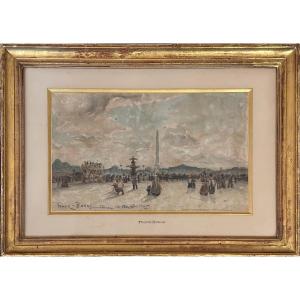
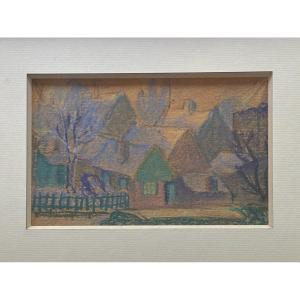
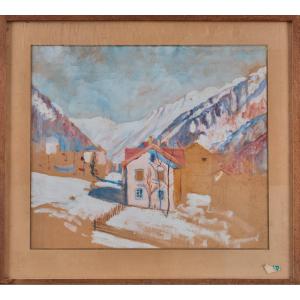
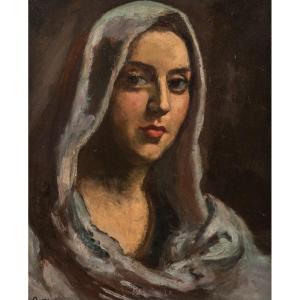
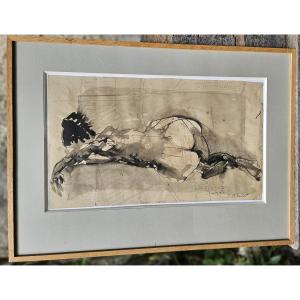
Sonia Lewintska 1882-1937 At The Café Watercolor Enhanced
Sonia Lewitska
is a painter, engraver, and illustrator of Ukrainian origin (often described as
Polish-Ukrainian), active in Paris within the circle of the School of Paris and the
avant-garde movements at the beginning of the 20th century. She developed a post-Impressionist style
infused with Fauvist touches, Cubist echoes, and Slavic folk motifs, with
a significant emphasis placed on illustrated books and wood engraving.
Sofia/Sonia Lewitska was born in 1874 or 1880, depending on the source, into a Ukrainian-Polish family, in what was then Russian territory (Podoli/the Zhytomyr or Lviv region; accounts differ), and died in Paris in 1937. She began her artistic training around 1894 in the private classes of T. Kazanovsky in Zhytomyr, then in the studio of the landscape painter Sergiy Svetoslavsky in Kyiv, who encouraged her to go to Paris. She settled in Paris in 1905, frequented the circles of Montparnasse, attended the École des Beaux-Arts, and took classes with Jean Marchand, whom she later married. From the 1910s onward, she exhibited regularly in major Parisian salons (Salon d’Automne, Salon des Indépendants) and became fully integrated into the School of Paris. Lewitska began with Cubist and Fauvist influences before developing a highly personal Post-Impressionist style, blending simplified forms, bold colors, and a decorative sense. Her painting remained marked by Ukrainian folklore and folk art (rural motifs, village scenes, bestiary), which gave it a poetic and “sophisticated naive” tone noted by critics of the time. Her work includes landscapes, still lifes (for example, still lifes with apples, which are still found in the market), scenes of figures and roadside walks or bridges, treated with simple composition and soft lighting. As an illustrator, she frequently practiced color wood engraving, using flat areas of color and graphic rhythms reminiscent of folk prints. Lewitska participated in the Section d’Or exhibition at the Galerie La Boétie in 1912, alongside the Cubists, and then presented her first solo exhibition at the Berthe Weill Gallery in 1913. She continued to exhibit throughout the 1920s and 1930s, notably with solo shows at the Berthe Weill Gallery (1925) and the Arthur Sambon Gallery (1930). Her work was shown in Moscow in 1912 in the “Modern Art” exhibition alongside Matisse, Marquet, and Delaunay, demonstrating early international recognition. In
1937, shortly before her death, she was included in the retrospective “Women Artists of Europe” at the Jeu de Paume museum, which confirmed her status in the
Parisian art scene. Her work as an illustrator is now considered an important part of her oeuvre, on par with her easel paintings. Her books and wood engravings are featured in various public collections, notably in Ukraine and France.
is a painter, engraver, and illustrator of Ukrainian origin (often described as
Polish-Ukrainian), active in Paris within the circle of the School of Paris and the
avant-garde movements at the beginning of the 20th century. She developed a post-Impressionist style
infused with Fauvist touches, Cubist echoes, and Slavic folk motifs, with
a significant emphasis placed on illustrated books and wood engraving.
Sofia/Sonia Lewitska was born in 1874 or 1880, depending on the source, into a Ukrainian-Polish family, in what was then Russian territory (Podoli/the Zhytomyr or Lviv region; accounts differ), and died in Paris in 1937. She began her artistic training around 1894 in the private classes of T. Kazanovsky in Zhytomyr, then in the studio of the landscape painter Sergiy Svetoslavsky in Kyiv, who encouraged her to go to Paris. She settled in Paris in 1905, frequented the circles of Montparnasse, attended the École des Beaux-Arts, and took classes with Jean Marchand, whom she later married. From the 1910s onward, she exhibited regularly in major Parisian salons (Salon d’Automne, Salon des Indépendants) and became fully integrated into the School of Paris. Lewitska began with Cubist and Fauvist influences before developing a highly personal Post-Impressionist style, blending simplified forms, bold colors, and a decorative sense. Her painting remained marked by Ukrainian folklore and folk art (rural motifs, village scenes, bestiary), which gave it a poetic and “sophisticated naive” tone noted by critics of the time. Her work includes landscapes, still lifes (for example, still lifes with apples, which are still found in the market), scenes of figures and roadside walks or bridges, treated with simple composition and soft lighting. As an illustrator, she frequently practiced color wood engraving, using flat areas of color and graphic rhythms reminiscent of folk prints. Lewitska participated in the Section d’Or exhibition at the Galerie La Boétie in 1912, alongside the Cubists, and then presented her first solo exhibition at the Berthe Weill Gallery in 1913. She continued to exhibit throughout the 1920s and 1930s, notably with solo shows at the Berthe Weill Gallery (1925) and the Arthur Sambon Gallery (1930). Her work was shown in Moscow in 1912 in the “Modern Art” exhibition alongside Matisse, Marquet, and Delaunay, demonstrating early international recognition. In
1937, shortly before her death, she was included in the retrospective “Women Artists of Europe” at the Jeu de Paume museum, which confirmed her status in the
Parisian art scene. Her work as an illustrator is now considered an important part of her oeuvre, on par with her easel paintings. Her books and wood engravings are featured in various public collections, notably in Ukraine and France.
850 €
Period: 20th century
Style: Modern Art
Condition: Perfect condition
Length: 24
Width: 31
Reference (ID): 1674720
Availability: In stock
Print