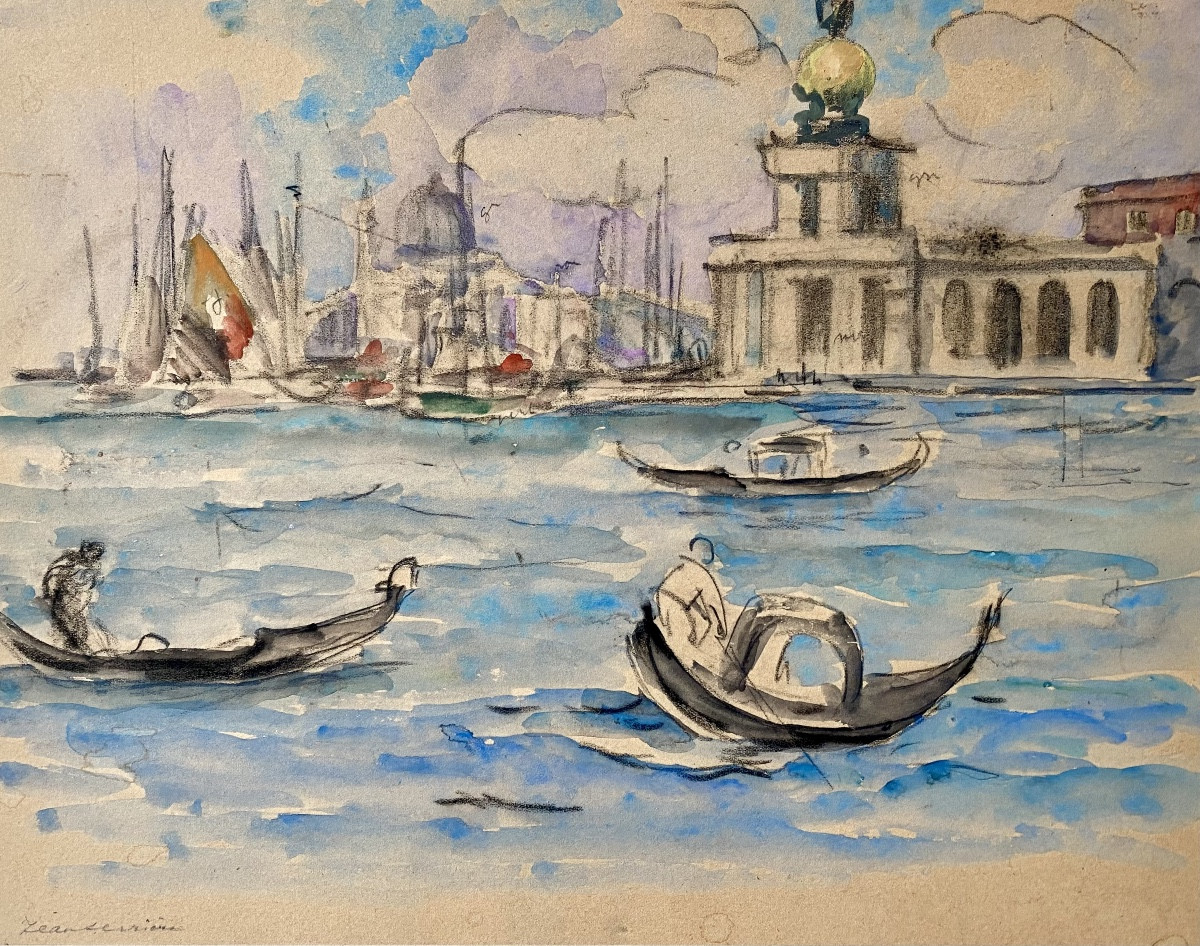
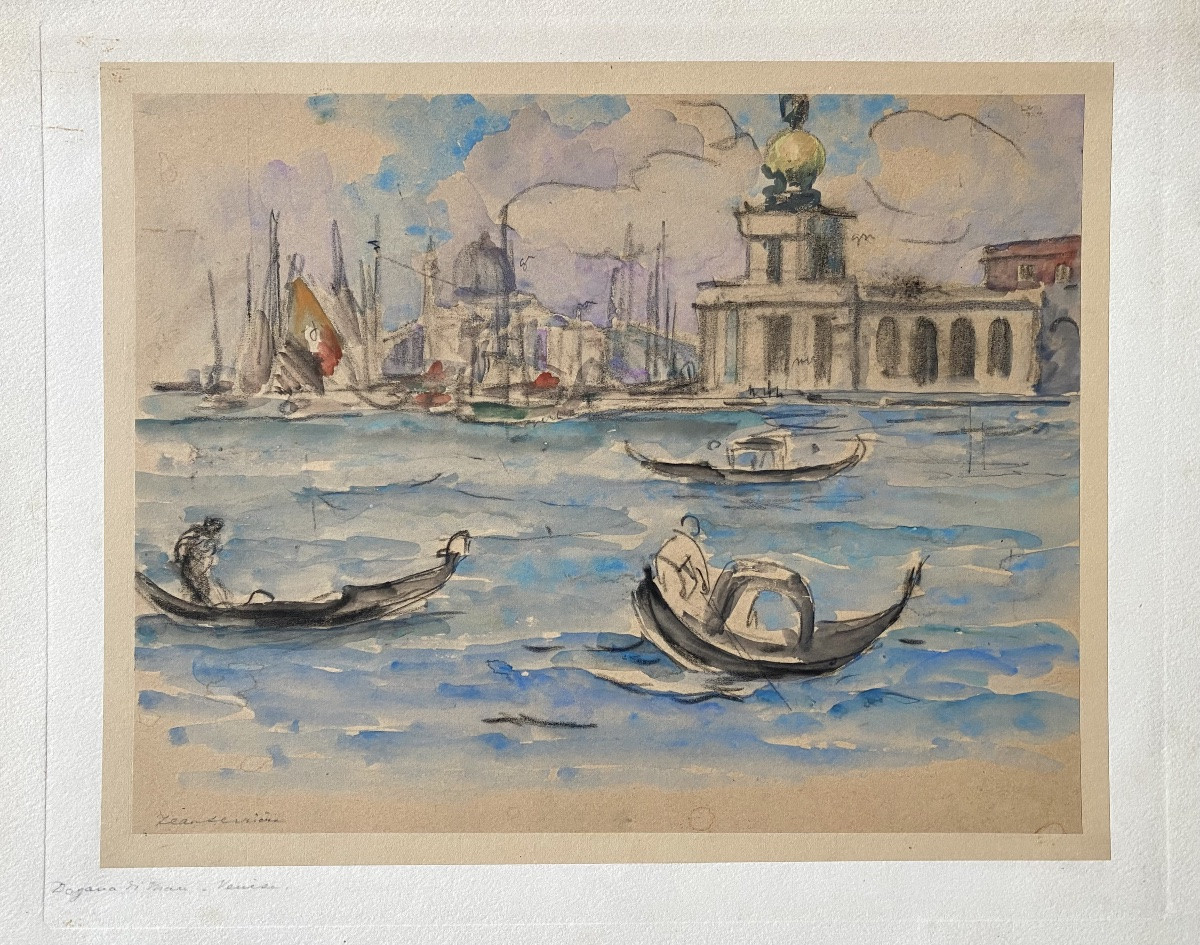
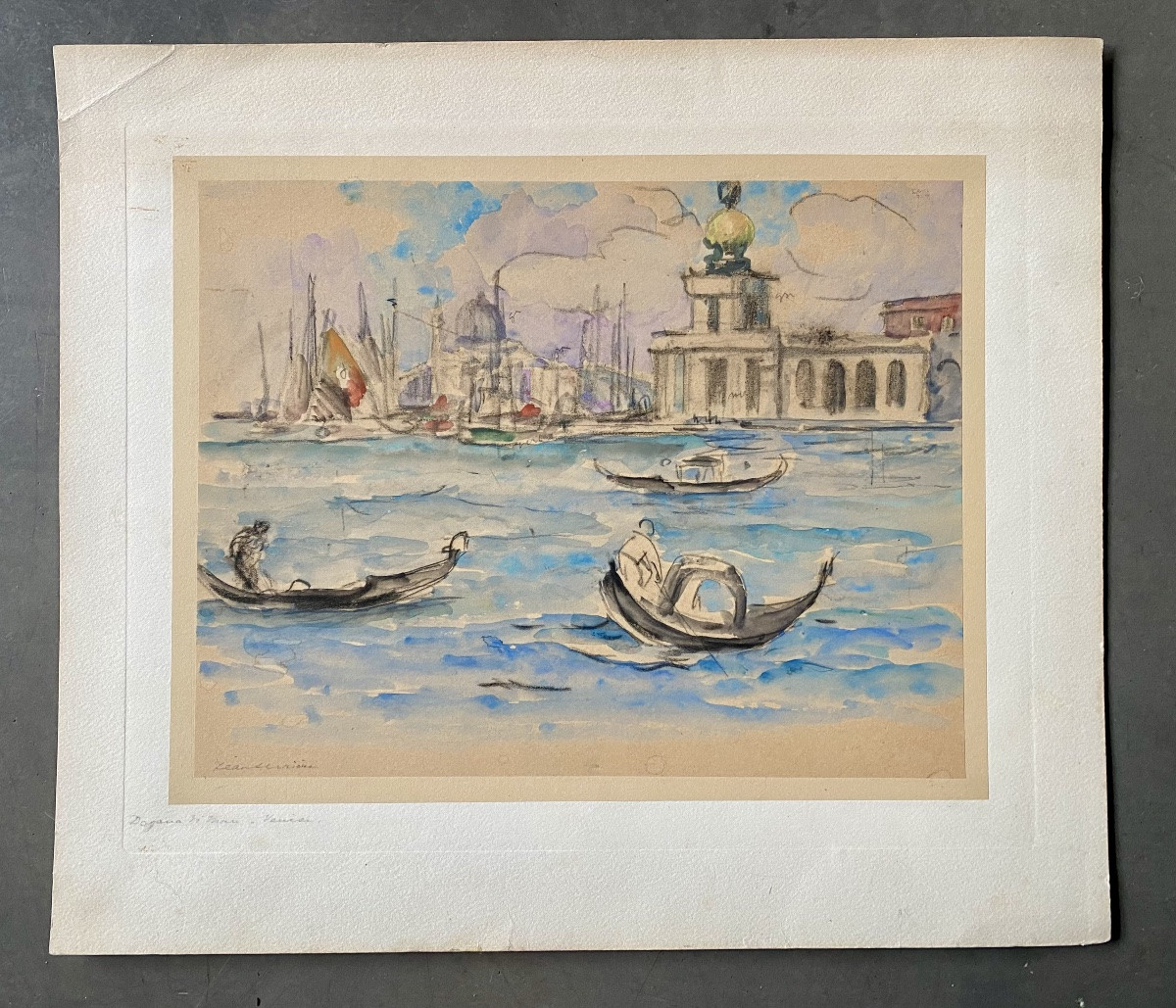


La Dogana Di Mare - Sea Customs In Venice - Jean Serrière
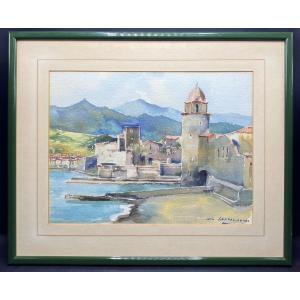
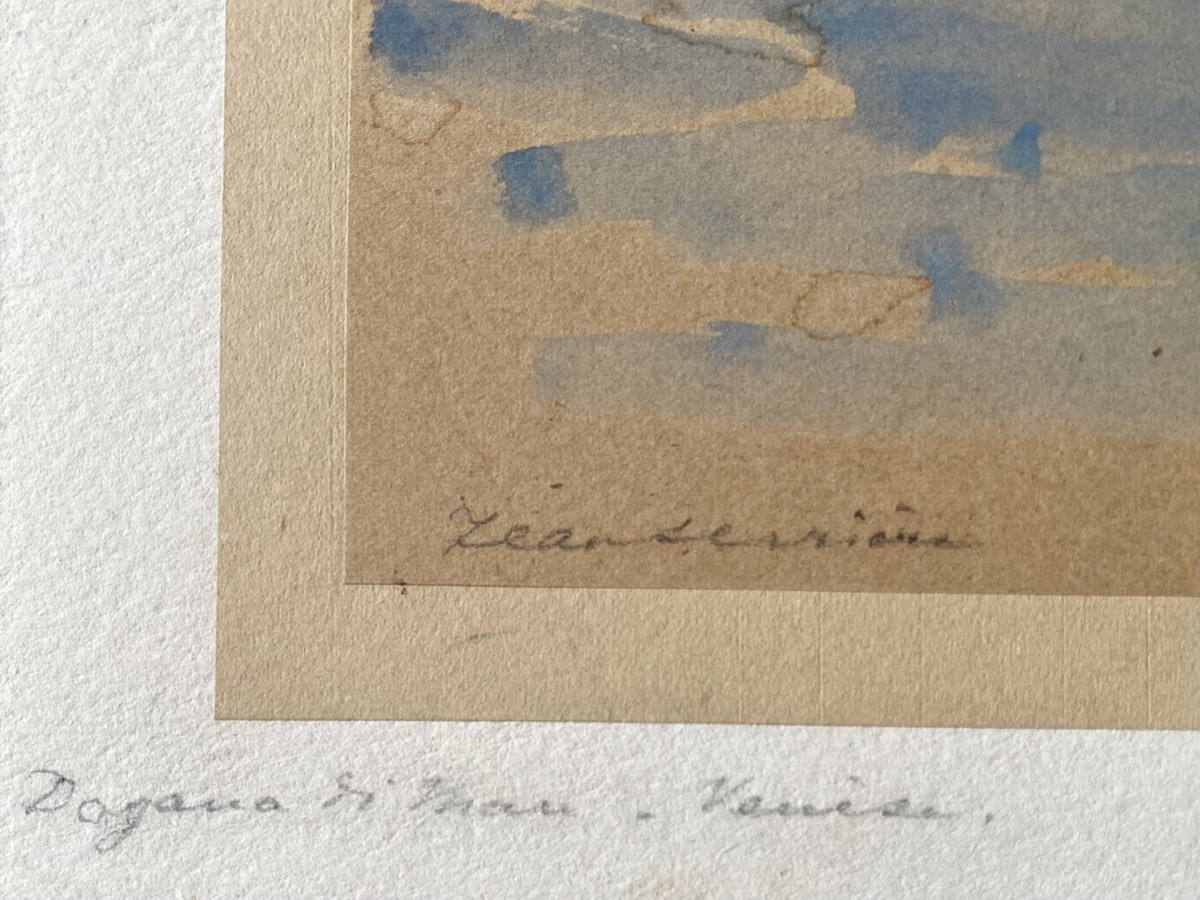
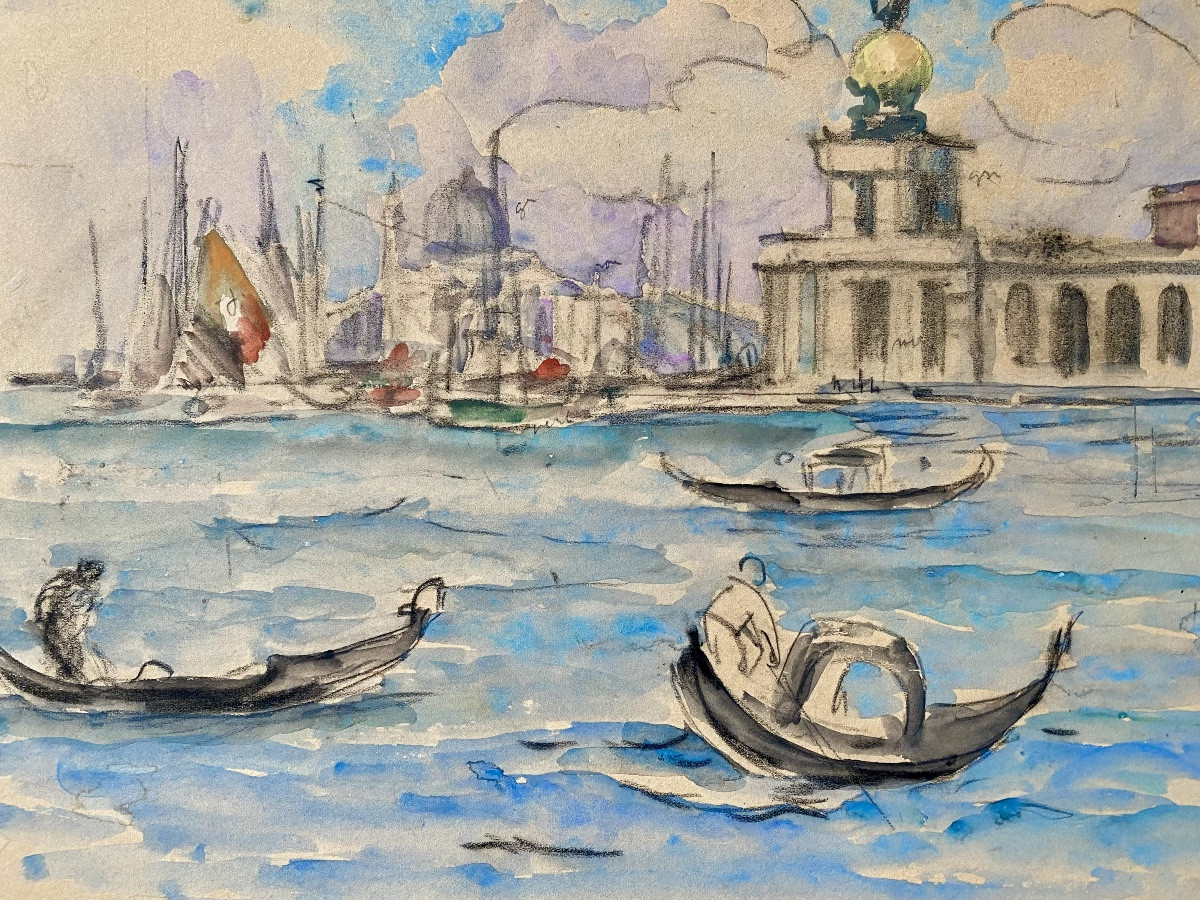
Watercolor and gouache on paper, signed lower left Jean Serrière (1893-1968), depicting a view of the "Dogana di Mare" - sea customs - in Venice. The Dogana di Mare is located at the tip of Dorsoduro, next to the church of Santa Maria di Salute. Its silhouette is part of the city's clichés, as the building is located in a high-traffic area, at the junction of the Grand Canal and the Giudecca Canal, and opposite Saint Mark's Square. Dimensions: 32.5 x 25 cm (as seen). In good condition, a few stains to be noted lower left.
Jean Serrière was born on February 26, 1893 in Nancy; in 1900 he came to Paris to study, then, refusing to enter the Ecole des Beaux Arts whose teaching did not correspond to what he was looking for, he went to paint at La Palette, rue du Val-de-Grâce, an independent studio where J .-E. Blanche, Desvallières, Cottet, Laprade; then he attended the Académie Lejeune in Montparnasse, where he met Guindet, Gromaire, Dubreuil; he also worked with the decorator Karbowsky.
Jean Serrière was attracted, after the 1914 war, to hammered copper and silver brassware - and around 1922, he made furniture that he exhibited at the Pavillon de Marsan. His inexhaustible curiosity, and no doubt the painter's contact with metal, prompted him to study enameling techniques, which he learned by reading specialized works; living in the countryside, he built his first coke oven. His work as an enameller began.
Since 1921 he has exhibited at the Salon des Artistes décorateurs, dinanderie and then his first enamels, while the painter is always present at the Salon d'Automne. In 1922, he was awarded a travel grant, and won prizes and diplomas at the 1925 and 1937 exhibitions. From 1920 to 1933, he took part in permanent exhibitions at Hébrard with Metthey, Marinot, Degas, Bourdelle, Pompon and others. Jean Serrière, who has works in numerous private collections and museums in France and abroad, has been a Chevalier de la Légion d'honneur since 1938.
If Jean Serrière appears as the master of contemporary enameling, we must not forget the diversity of his gifts. always remaining a painter, furniture and especially brassware, have been marked by his personality. No specialized training intervened in his orientation towards enameling. A series of research and experiments revealed to him the secrets of a craft as precise as it is rigorous.
Severrière is a master of contemporary enameling.From the day he dedicated himself to this art, he designed his enamels according to the material he chose as his new mode of expression. Rarely treating landscapes, he composed scenes inspired by antiquity and fairy-tale-like settings where, in the dense, complex and teeming splendor of color, appear figures reminiscent of Monticelli, but above all admirable still lifes whose "objects" are reduced to deep, sensitive resonances, with generously harmonized colorations. An attentive and amused observer of the animal world, Serrière adopted the cloisonné technique to preserve the linear purity of his ducks, birds and gazelles, which sometimes evoke the precision of Pisanello. He draws with copper or silver wire, and models with his hand. A colorist as much as a skilled technician, Jean Serrière often lets the reddish tones of the copper plate show through, softened by the "fondant" to amber pinks.
.He knows how to play with the art of opacity or transparency of this glass powder colored with metallic oxides that the heat of the kiln, over the course of six or seven brief firings, will melt, blend, transpose, and from which will be born the mysterious and unalterable beauty of the enameled plate. It would appear that Jean Serrière died on December 20, 1968, in the 14th arrondissement of Paris. He was 75 at the time.
Source: https://www.docantic.com/fr/page/94/jean-serriere-1893-1968-biographie
Period: 20th century
Style: Modern Art
Condition: Good condition
Material: Water color
Width: 32,5 cm
Height: 25 cm
Reference (ID): 1753937
Availability: In stock