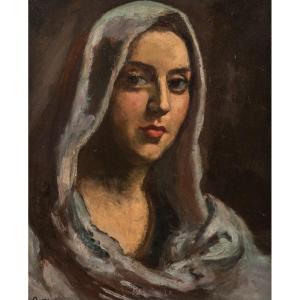
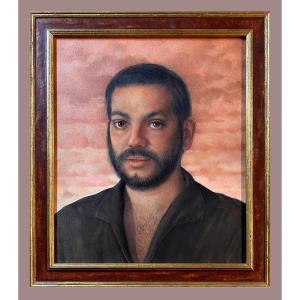
Joseph Lacasse (1894-1975): Study Of A Dockworker 1913 Oil On Canvas, Signed, Titled And Dated
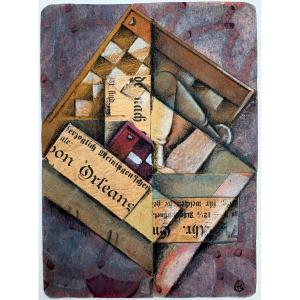
The Belgian artist Joseph Lacasse is a lost pioneer. It happens, once every twenty or thirty years, that a forgotten painter, suddenly thrust into the limelight, overturns our understanding of an entire period of artistic creation. S In the French sphere, we saw a case about some years ago: just after his death, which was announced rather hastily, it was realized that Léopold Survage had been one of the most spontaneous and balanced innovators of his time. Today, we must turn our attention to the case of Joseph Lacasse (1894-1975), whose work is equally worthy of challenging hierarchies and conventional wisdom. It's not that this painter went entirely unnoticed. His exhibitions were frequent, both in his native Belgium and later in Paris, where he died. Yet the public knew nothing of his work. We are dealing with a true genius, as early as 1910. Was he familiar with Cubism? In any case, he was a Cubist by instinct, demonstrating extraordinary mastery of the movement at the ages of fifteen and sixteen. Moreover, in his "pebbles" series, he captured the colors of shale and coal, so characteristic of the Borinage region near his childhood. In truth, this is not a variant of Cubism, but rather a kind of abstract Cubism, where the dissected object is redefined, poised between abstraction and figuration. As for the figures he painted in those years before his twenties, they are simultaneously real, stylized, and unfolded according to geometric principles reminiscent of Boccioni and Balla, principles he himself could not possibly have known. As if this prodigious illumination were not enough, the works of the same period contain strident, gestural, and effusion-like qualities comparable to those of Kandinsky. The hand is free to disregard the intentions of the mind. But the vital impulse remains the primary driving force: Joseph Lacasse cares nothing for slogans, schools, or manifestos. From his thirties onward, his artistic journey becomes intertwined with all the innovations and achievements of our time. With careful examination, one can discover affinities with most of the leading painters who have enriched our vision. It is clear, for example, that he can be compared to Nicolas de Staël. He is his contemporary without ever imitating him. Similarly, some of his canvases are, at first glance, quite comparable to those of Serge Poliakoff. A closer examination reveals them to be infinitely more subtle and sophisticated.
Period: 20th century
Style: Modern Art
Condition: Good condition
Material: Oil painting
Length: 60
Width: 40
Reference (ID): 1668750
Availability: In stock