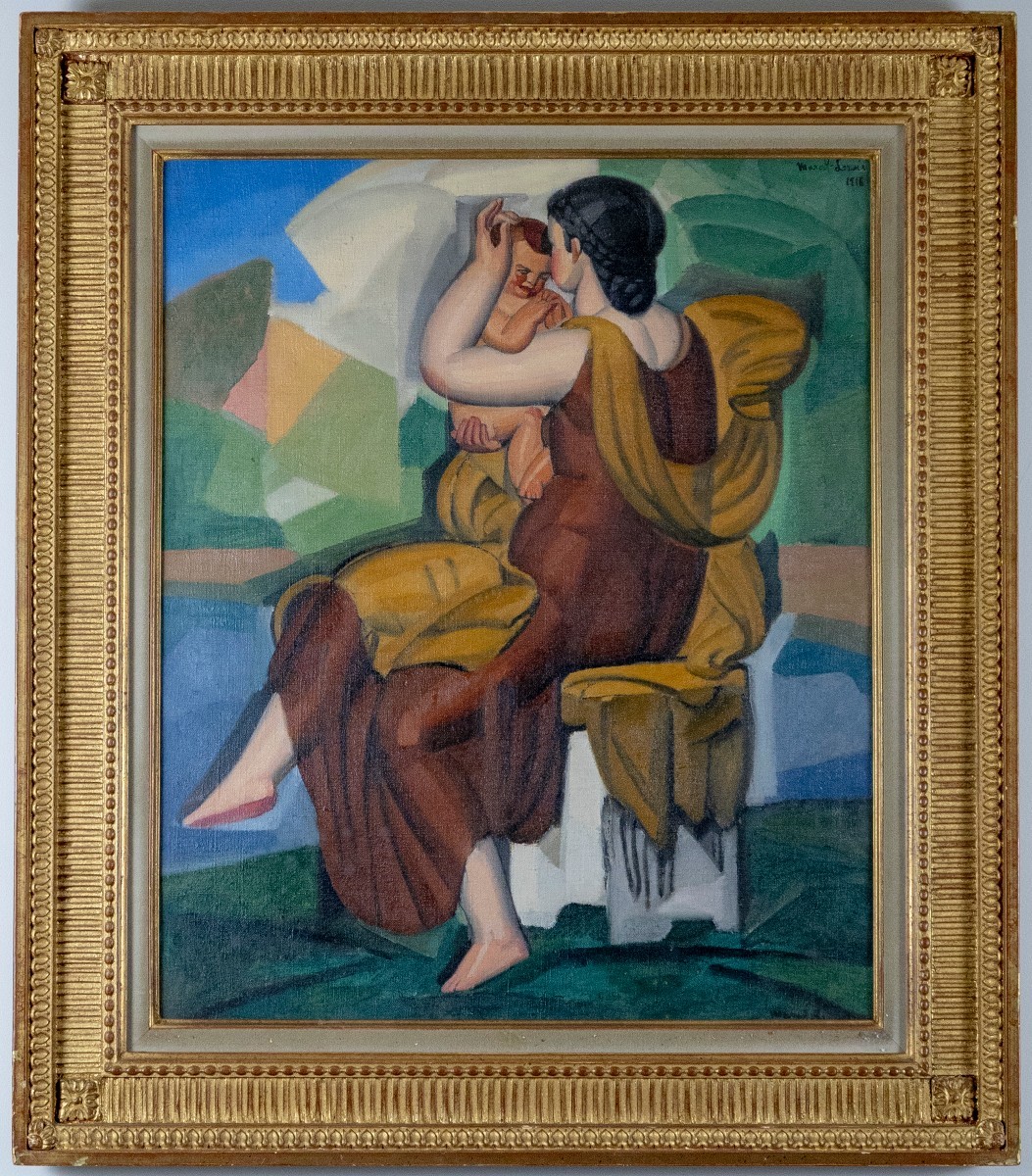


Jules Oury, Known As Marcel-lenoir, 1872-1931. Woman With Child, 1916. Canvas, Signed And Dated
Jules Oury, better known by his pseudonym Marcel-Lenoir, was a French Symbolist and mystical painter and fresco artist, born in Montauban, like Ingres and Bourdelle. He is famous for his large-scale religious and secular decorative ensembles, which place him among the key figures of the "renaissance" of fresco and religious art in France around 1900-1920. Marcel Lenoir holds a special place in the history of art, particularly within the Art Nouveau movement. A celebrated figure at the Moulin Rouge and the Bal Bullier, and close to Paul Verlaine and Auguste Rodin, he was a guest of the jeweler and merchant Arnould and Josephin Péladan at his Rose-Croix salon. A mystic, a Rosicrucian, drawn to Christ, and haunted by visions, he produced a body of work with an essentially esoteric iconography, reserved for the initiated, and veiled in hidden symbols. An illuminator by training, the artist was passionate about creating gouaches and watercolors enhanced with gold, lithographs, and posters, and even proved himself a skilled wood sculptor with a particular interest in ceramics. His works are meticulous, rich in detail, and possess a certain grace. Marcel-Lenoir was an exceptional figure at the heart of new artistic movements: Symbolism, Art Nouveau, and Expressionism. Works such as *The Ordeal* (1896), *The Invocation to the Green Onyx Madonna* (1897), and *Christ Forgiving the World* (1898) bear witness to his thematic and aesthetic aims. Marcel-Lenoir's work, with its symbolic richness, technique, and already aristocratic style, brilliantly resonates with these movements. He occupies a prominent place within a period of art history renowned for its numerous avant-garde revolutions. His artistic circle was transformed; he was a friend of Pablo Picasso, Maurice Denis, and the Créteil Abbey. His work was scrutinized at the Salon d'Automne, the Salon des Indépendants, and the Cercle International des Arts, and honored by major art dealers such as Charles Vildrac, Clovis Sagot, Charles Boutet de Monvel, and Kleiss in Copenhagen. The artist, with his theologian's sensibility, continued to paint religious scenes, which he revitalized by combining portraits, scenes of daily life, landscapes, and still lifes. He developed a new aesthetic—modern, bold, sensitive, and independent of the avant-garde movements of the time, such as Fauvism, Cubism, and Abstraction—characterized by impasto, vibrant colors, a focus on volume, and the simplification of forms. The Engagement (1910), The Carousel (1910), The Joy of Living (1912), and The Place Nationale (1913) attest to these iconographic and technical choices. The artist's work, no less symbolic and imbued with a new power, offers a premise, a different path for Modern Art, distinct from the avant-garde and far removed from academicism. Between 1919 and 1931, Marcel-Lenoir held a privileged position within a period of Art History recognized for a "return to order."Marcel-Lenoir thus establishes a scene fulfilled through a Cubist approach, composed of geometric facets. In the foreground, we see green grass and an immaculate white bench where Madeleine and their son Marcel are seated. In the middle ground, a bluish river flows, bordered by a sandy beach. In the background, vegetation rises towards the blue sky, caressed by a thick white cloud. Madeleine and Marcel occupy a large part of the composition and majestically dominate nature in a synthetic representation. Madeleine tenderly embraces her baby Marcel, born in 1919. And this secular motherhood, under the Master's mystical brush, is elevated to the sacred, becoming a Virgin and Child.
Our painting, created between1916 and 1920, is characteristic of this period, in which painters such as Picasso, while retaining Cubist elements, turned towards a revisited classicism.Marcel-Lenoir thus establishes a scene fulfilled through a Cubist approach, composed of geometric facets. In the foreground, we see green grass and an immaculate white bench where Madeleine and their son Marcel are seated. In the middle ground, a bluish river flows, bordered by a sandy beach. In the background, vegetation rises towards the blue sky, caressed by a thick white cloud. Madeleine and Marcel occupy a large part of the composition and majestically dominate nature in a synthetic representation. Madeleine tenderly embraces her baby Marcel, born in 1919. And this secular motherhood, under the Master's mystical brush, is elevated to the sacred, becoming a Virgin and Child.Marcel-Lenoir thus establishes a scene fulfilled through a Cubist approach, composed of geometric facets. In the foreground, we see green grass and an immaculate white bench where Madeleine and their son Marcel are seated. In the middle ground, a bluish river flows, bordered by a sandy beach. In the background, vegetation rises towards the blue sky, caressed by a thick white cloud. Madeleine and Marcel occupy a large part of the composition and majestically dominate nature in a synthetic representation. Madeleine tenderly embraces her baby Marcel, born in 1919. And this secular motherhood, under the Master's mystical brush, is elevated to the sacred, becoming a Virgin and Child.
A now-famous figure in the art world, he moved in the circles of both the Parisian and Montauban schools. With the artist Boleslas Biegas, he founded the Salon of Modern Mystical Art and was part of the La Douce France group. He continued his acclaimed exhibitions in salons, in his studio, and with new dealers such as Georges Chéron and Bing. The artist constantly enriched his iconography with religious and secular scenes. During the First World War, although exempted from military service for health reasons, he continued to work and made a unique foray into the art of fresco painting. In 1920, he founded a school for teaching this technique in his Parisian studio, which became very popular with both French and international students. The artist also celebrated his modern style, in which a new concept known as Decorative Art triumphed. The artist continually revisited modernity and reinvented himself. Many artists drew inspiration from Marcel Lenoir, and we can speak of a distinct "Marcel Lenoir school." Works such as *The Life of Jesus* (1919), *The Virgin with the Apple* (1920), *The Happy Ones* (1920), *Self-Portrait* (1920), and *The White Scarf* (1925) exemplify this influence. Marcel Lenoir's work has established him as a key figure among the masters of Decorative Arts.
Drawings, studies of heads, and Symbolist compositions by Jules Oury/Marcel Lenoir are held in regional museums (for example, in Toulouse and Reims) as well as at the Centre Pompidou.
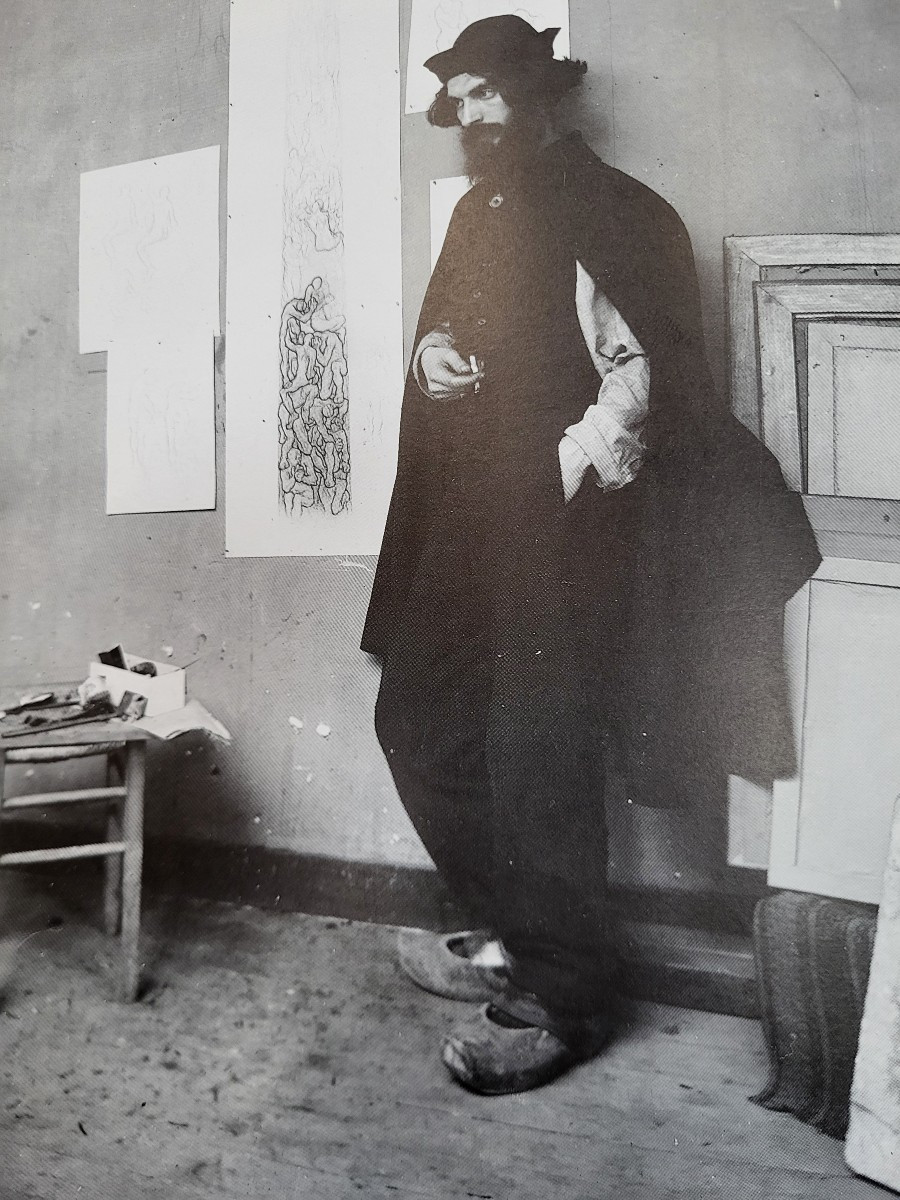
An exhibition was dedicated in 2021 in Montauban to this complex personality, whose photo is shown below.
Our painting, created between1916 and 1920, is characteristic of this period, in which painters such as Picasso, while retaining Cubist elements, turned towards a revisited classicism.Marcel-Lenoir thus establishes a scene fulfilled through a Cubist approach, composed of geometric facets. In the foreground, we see green grass and an immaculate white bench where Madeleine and their son Marcel are seated. In the middle ground, a bluish river flows, bordered by a sandy beach. In the background, vegetation rises towards the blue sky, caressed by a thick white cloud. Madeleine and Marcel occupy a large part of the composition and majestically dominate nature in a synthetic representation. Madeleine tenderly embraces her baby Marcel, born in 1919. And this secular motherhood, under the Master's mystical brush, is elevated to the sacred, becoming a Virgin and Child.Marcel-Lenoir thus establishes a scene fulfilled through a Cubist approach, composed of geometric facets. In the foreground, we see green grass and an immaculate white bench where Madeleine and their son Marcel are seated. In the middle ground, a bluish river flows, bordered by a sandy beach. In the background, vegetation rises towards the blue sky, caressed by a thick white cloud. Madeleine and Marcel occupy a large part of the composition and majestically dominate nature in a synthetic representation. Madeleine tenderly embraces her baby Marcel, born in 1919. And this secular motherhood, under the Master's mystical brush, is elevated to the sacred, becoming a Virgin and Child.
A now-famous figure in the art world, he moved in the circles of both the Parisian and Montauban schools. With the artist Boleslas Biegas, he founded the Salon of Modern Mystical Art and was part of the La Douce France group. He continued his acclaimed exhibitions in salons, in his studio, and with new dealers such as Georges Chéron and Bing. The artist constantly enriched his iconography with religious and secular scenes. During the First World War, although exempted from military service for health reasons, he continued to work and made a unique foray into the art of fresco painting. In 1920, he founded a school for teaching this technique in his Parisian studio, which became very popular with both French and international students. The artist also celebrated his modern style, in which a new concept known as Decorative Art triumphed. The artist continually revisited modernity and reinvented himself. Many artists drew inspiration from Marcel Lenoir, and we can speak of a distinct "Marcel Lenoir school." Works such as *The Life of Jesus* (1919), *The Virgin with the Apple* (1920), *The Happy Ones* (1920), *Self-Portrait* (1920), and *The White Scarf* (1925) exemplify this influence. Marcel Lenoir's work has established him as a key figure among the masters of Decorative Arts.
Drawings, studies of heads, and Symbolist compositions by Jules Oury/Marcel Lenoir are held in regional museums (for example, in Toulouse and Reims) as well as at the Centre Pompidou.
An exhibition was dedicated in 2021 in Montauban to this complex personality, whose photo is shown below.
17 000 €
Period: 20th century
Style: Modern Art
Condition: Perfect condition
Length: 64
Width: 73
Reference (ID): 1668163
Availability: In stock
Print