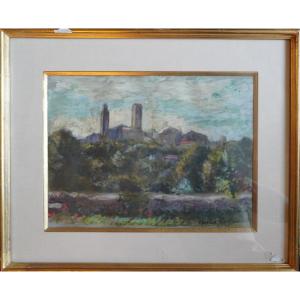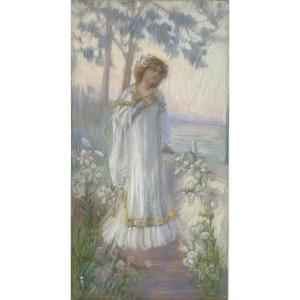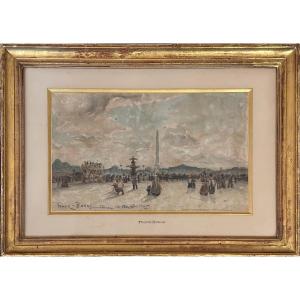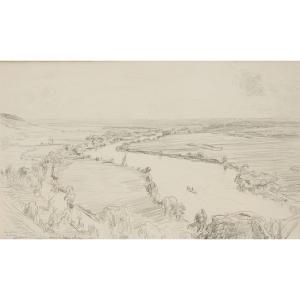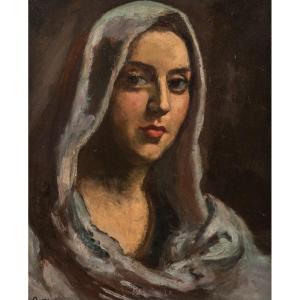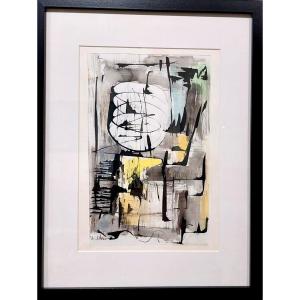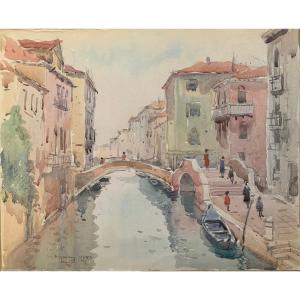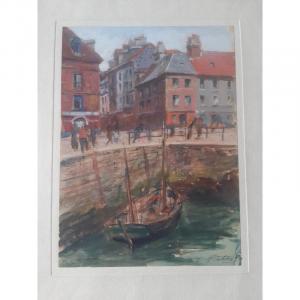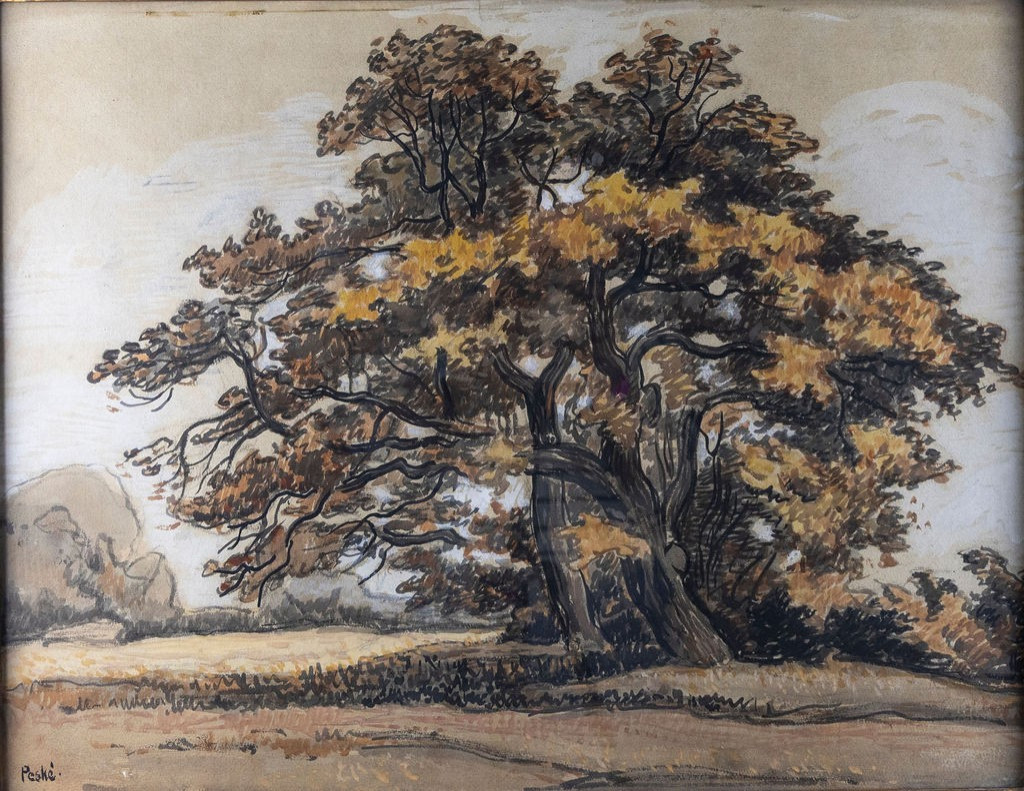
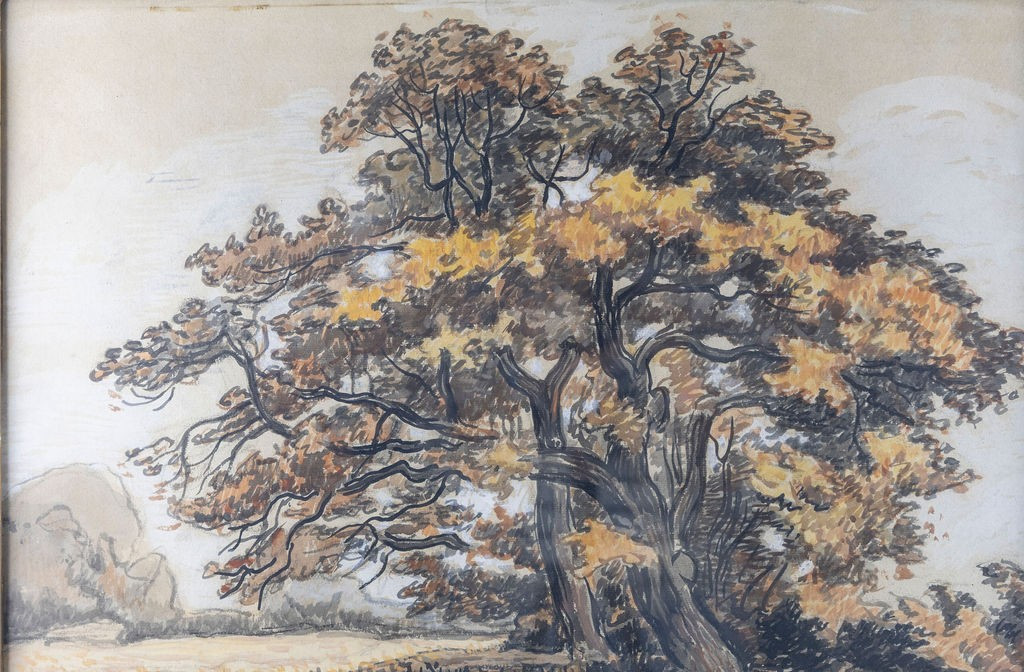


Jean Peské 1870-1949: Trees, Ink And Watercolor, Signed Lower Left
Jean Peské (Jean Mirosław Peszke) is a post-impressionist painter, engraver and illustrator of Russian-Polish origin, active mainly in France at the turn of the 19th and 20th centuries. He is best known for his luminous landscapes, trees, and Mediterranean scenes (Brittany, Vendée, Bormes-les-Mimosas, Collioure), as well as for his connections with the Parisian avant-garde. Born in 1870 in Golta (now in Ukraine), to a Polish father and a Russian mother, he trained at the painting schools of kyiv, Odessa, and Warsaw before settling in Paris in 1891 after receiving an inheritance from his father. He entered the Académie Julian (studios of Jean-Paul Laurens and Benjamin Constant) and quickly became part of the artistic and intellectual circles of the capital. He died in Le Mans in 1949, having achieved considerable renown during the interwar period. In Paris, Peské associated with Signac, Pissarro, Bonnard, Vuillard, Sérusier, Toulouse-Lautrec, and the Nabis group. Under the influence of Signac and the Neo-Impressionists, he experimented with pointillism and the division of brushstrokes before returning to a freer, more tactile style. He was also close to intellectual circles (for example, he was acquainted with Guillaume Apollinaire and met Marie Curie), which solidified his place in the Parisian bohemian scene of the late 19th century. He is associated with the Post-Impressionists, with a predilection for landscapes and especially trees, which earned him the nickname "the forester of painting." His works play on a light and colorful palette, with a constant interest in the vibration of light and a touch that remains sensitive, sometimes almost tactile. Peské exhibited regularly from the 1890s onward at the Salon des Indépendants and the Salon d'Automne, and later at the Le Barc de Bouteville gallery. Then, in the light of the South of France (Bormes-les-Mimosas, Lavandou, Collioure), where he lived most of the time from 1914 onwards, he explored oil painting, watercolor, engraving, and wash drawings enhanced with India ink, developing a highly acclaimed personal technique. In 1934, he founded an art museum in Collioure, which became the precursor to the city's current Museum of Modern Art. Works by Peské are held in several institutions, notably the Musée d'Orsay, the Petit Palais in Geneva, and regional museums such as the one in Bormes-les-Mimosas, as well as local public collections (for example, in Montrouge). The work exhibited here dates from the period before 1914 and was drawn in the Fontainebleau forest, where Peské rented a house.
1 450 €
Period: 20th century
Style: Modern Art
Condition: Perfect condition
Length: 48
Width: 61
Reference (ID): 1662967
Availability: In stock
Print