Frank Boggs(1855-1926)
Frank Myers Boggs, born in Ohio in 1855,an American painter who became a French citizen, established himself in Paris as one of the great interpreters of the Seine and its quays, which he tirelessly captured in their changing light and atmosphere. His views of Paris combine a solid realism in the depiction of the urban fabric with a free, atmospheric touch, close—without fully embracing it—to the Impressionist aesthetic.
A declared lover of Paris, Boggs favored quays, bridges, markets and major thoroughfares, turning the city into a true stage for modern everyday life. He returned again and again to the banks of the Seine—Pont Neuf, Pont Royal, Pont des Arts, Notre-Dame, the Louvre, Place de la Concorde—at different times of day, in rain and fog, or in the grey, vibrating light of the capital.
His Parisian views are characterized by firmly constructed compositions, dominated by changing skies and muted tones of grey, broken blues and browns, which give the city a discreet rather than dazzling poetry. As a plein-air painter, he sought to render the fleeting effects of atmosphere on water, stone and wet pavements, while preserving a precise readability of the monuments.
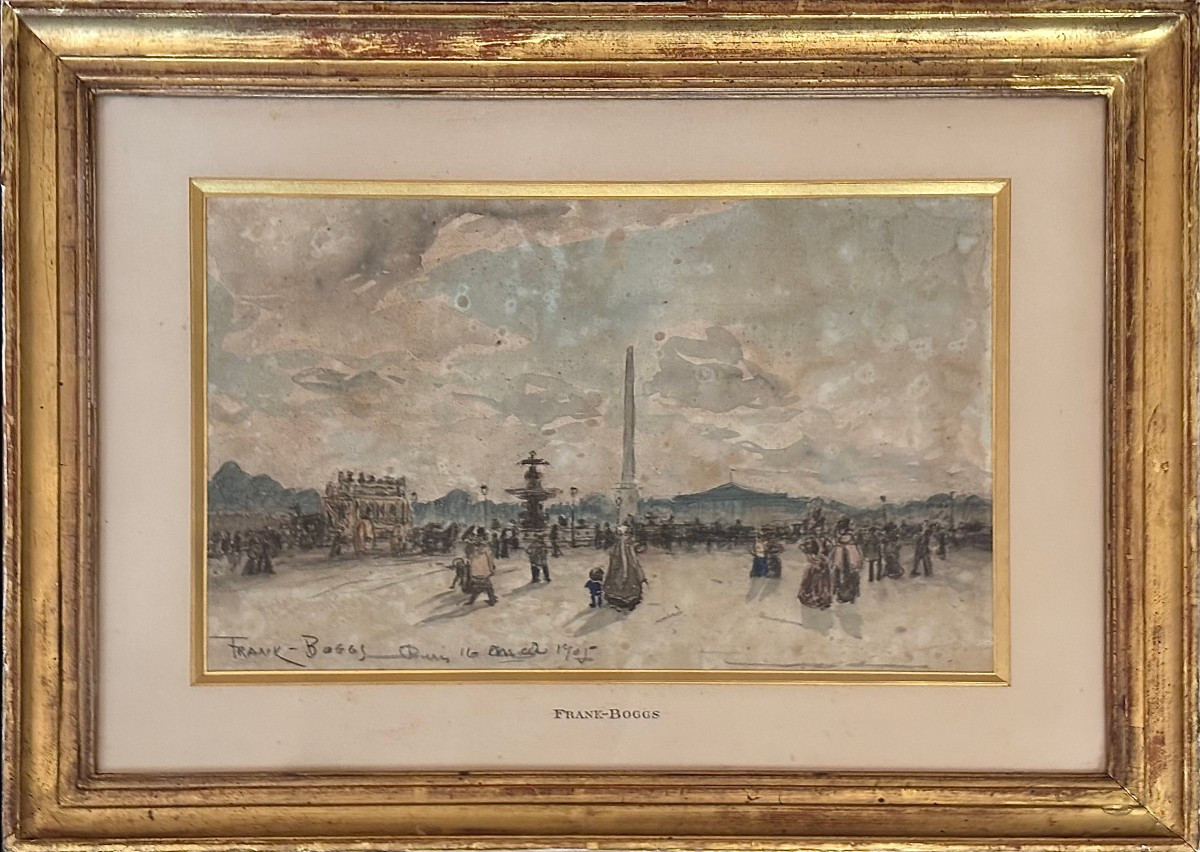
Trained in Paris in the studio of Jean-Léon Gérôme, Boggs was close to Jongkind and in contact with several Impressionists (Monet, Sisley, Renoir, Boudin), while remaining on the fringes of their group. His son Frank-Will continued this urban vein, becoming himself a watercolorist and painter of views of Paris.In his views of Place de la Concorde, Boggs turns this vast crossroads into a true hub of circulation and perspectives, where the axis of the Champs-Élysées, the Seine and the Tuileries come together. He plays with broad stretches of wet roadway, reflections and changeable skies, treating the obelisk, statues and lampposts as firm architectural landmarks set within a vibrant atmosphere.
In this view of the Place de la Concorde, Boggs transforms this vast crossroads into a veritable hub of traffic and perspectives, where the axis of the Champs-Élysées, the Seine, and the Tuileries converge. He plays with the wide expanses of wet pavement, reflections, and changing skies, treating obelisks, statues, and lampposts as firm architectural landmarks within a vibrant atmosphere.
Period: 20th century
Style: Modern Art
Condition: Good condition
Length: 40
Width: 56
Reference (ID): 1766592
Availability: In stock