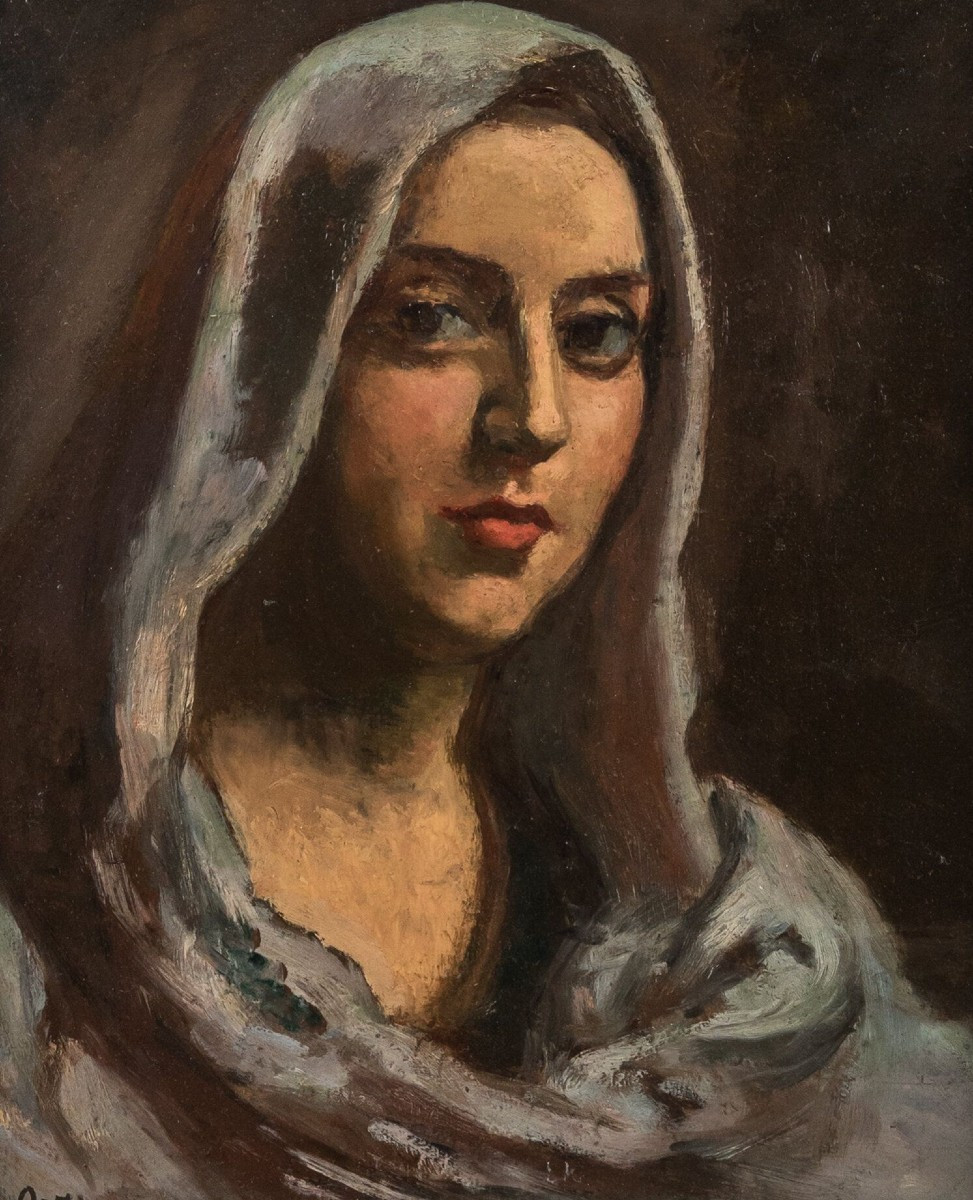
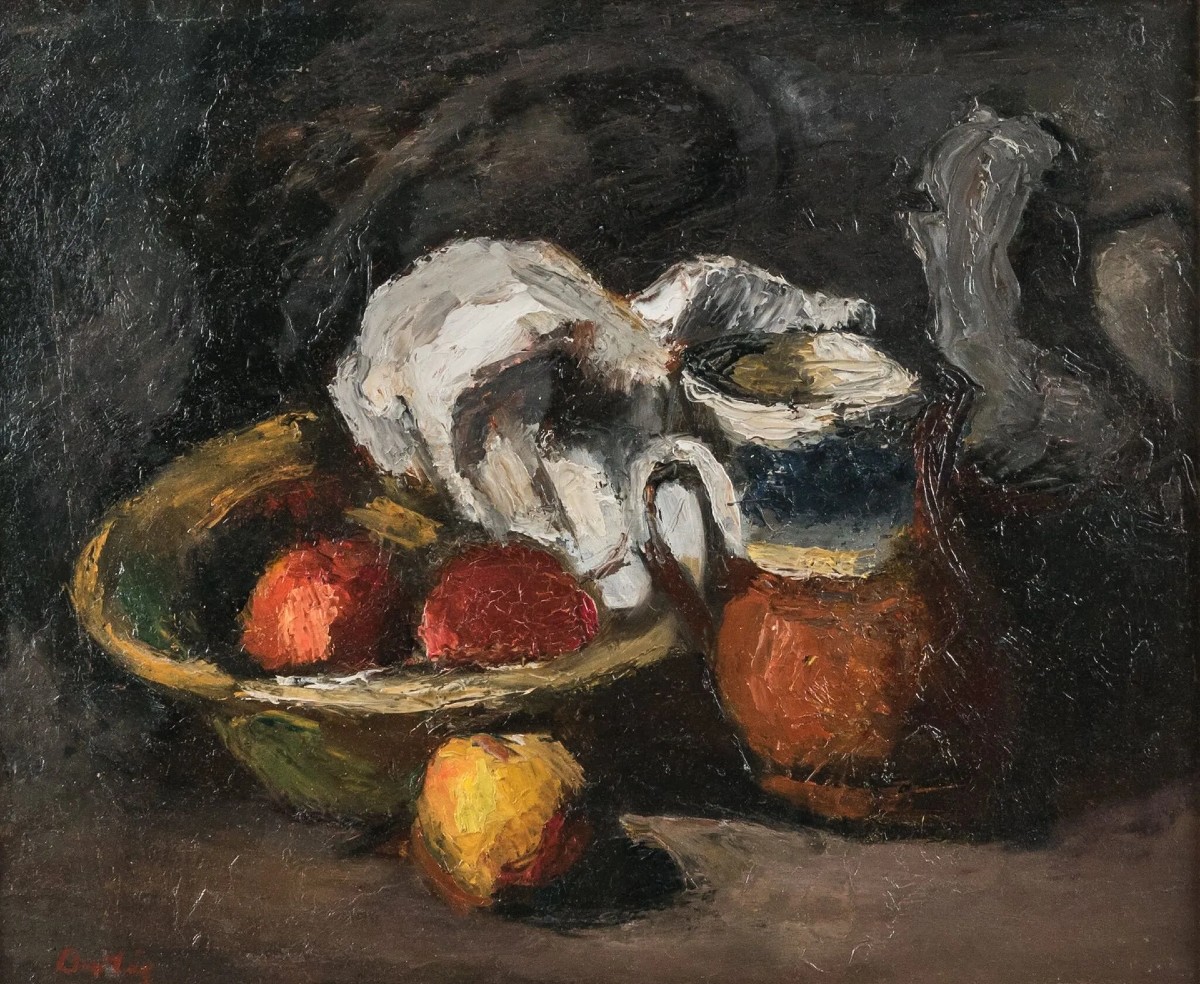
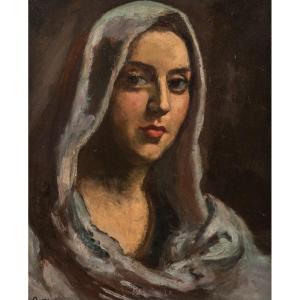

Manuel Ortiz De Zarate (1886-1947) :double-sided Oil: Woman With Scarf+apple Basket
Manuel Ortiz de Zárate (Come 1886–Los Angeles 1947) was born in Italy into a family of artists—his father a Chilean composer, his brother a painter. He returned to Chile as a child, where he lost his mother at a young age and learned to paint under Pedro Lira before entering the School of Fine Arts in Santiago. At fifteen, he set his sights on Europe. In Rome, he survived by copying the Old Masters—especially Guido Reni—for ecclesiastical patrons, after being "discovered" painting in a museum by a providential bishop. Resourceful and already cosmopolitan, he made frequent trips to Paris.
In 1904, in Venice, he met Amedeo Modigliani—a pivotal encounter. Ortiz de Zárate spoke to him about Cézanne and, above all, about Paris, which he already knew. He acted as a kind of intermediary: he helped guide Modigliani toward the French capital, where everything would unfold. Settling in Paris in 1906 with Édwige Piechowska, he became established in Montparnasse, particularly at La Ruche. There he reconnected with Modigliani, and their relationship blossomed into a studio camaraderie typical of the era: passionate discussions, mutual influences, and a bohemian lifestyle. Both shared a precarious existence, fragile health, and fierce ambition. But while Modigliani stubbornly pursued his personal style, Ortiz de Zárate explored further—notably Cubism—and integrated himself into the art market, signing his work with Léonce Rosenberg. Their connection was also personal: in 1914, they both attempted to enlist in the army—but were rejected for health reasons. This detail speaks volumes about their bond: a brotherhood of exiles, of foreign artists in Paris, caught up in the same era. Apollinaire nicknamed him "the only Patagon of Paris," a testament to his singularity within the Montparnasse scene. Less mythologized than Modigliani, Ortiz de Zárate nevertheless remained a well-integrated figure in the art world.
He also frequented Picasso and Kisling. With them he played a role in the discovery of African and Oceanic art by the European public.
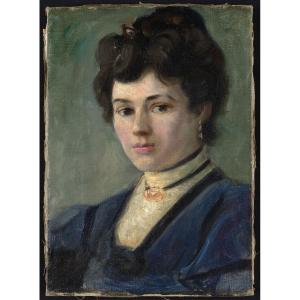
He lived through the war, stayed in France during the Occupation, and then left for the United States after 1945. He died in Los Angeles in 1946—far from Montparnasse, but with a life deeply intertwined with one of its myths: Modigliani, whom he had helped, modestly but undeniably, to steer toward Paris. In this canvas, Ortiz de Zárate works with broad, almost sculptural masses, allowing the paint to vibrate rather than smoothing the surface. The muted tones, brownish-green and blue-gray, envelop the figure in a twilight that highlights the warm glow of the face and neck. The modeling is achieved through broad brushstrokes, as if the painter were hesitating and then confirming each contour, giving the figure a presence that is both fragile and intensely focused. Based on the rather free use of materials, the muted tones, and the somewhat synthetic monumentality, this work is closer to a period of maturity than to his formative years. This type of treatment, still marked by an influence of the Old Masters but already highly personal, evokes the 1910s and 1920s rather than a late or strictly Cubist period.
In 1904, in Venice, he met Amedeo Modigliani—a pivotal encounter. Ortiz de Zárate spoke to him about Cézanne and, above all, about Paris, which he already knew. He acted as a kind of intermediary: he helped guide Modigliani toward the French capital, where everything would unfold. Settling in Paris in 1906 with Édwige Piechowska, he became established in Montparnasse, particularly at La Ruche. There he reconnected with Modigliani, and their relationship blossomed into a studio camaraderie typical of the era: passionate discussions, mutual influences, and a bohemian lifestyle. Both shared a precarious existence, fragile health, and fierce ambition. But while Modigliani stubbornly pursued his personal style, Ortiz de Zárate explored further—notably Cubism—and integrated himself into the art market, signing his work with Léonce Rosenberg. Their connection was also personal: in 1914, they both attempted to enlist in the army—but were rejected for health reasons. This detail speaks volumes about their bond: a brotherhood of exiles, of foreign artists in Paris, caught up in the same era. Apollinaire nicknamed him "the only Patagon of Paris," a testament to his singularity within the Montparnasse scene. Less mythologized than Modigliani, Ortiz de Zárate nevertheless remained a well-integrated figure in the art world.
He also frequented Picasso and Kisling. With them he played a role in the discovery of African and Oceanic art by the European public.
He lived through the war, stayed in France during the Occupation, and then left for the United States after 1945. He died in Los Angeles in 1946—far from Montparnasse, but with a life deeply intertwined with one of its myths: Modigliani, whom he had helped, modestly but undeniably, to steer toward Paris. In this canvas, Ortiz de Zárate works with broad, almost sculptural masses, allowing the paint to vibrate rather than smoothing the surface. The muted tones, brownish-green and blue-gray, envelop the figure in a twilight that highlights the warm glow of the face and neck. The modeling is achieved through broad brushstrokes, as if the painter were hesitating and then confirming each contour, giving the figure a presence that is both fragile and intensely focused. Based on the rather free use of materials, the muted tones, and the somewhat synthetic monumentality, this work is closer to a period of maturity than to his formative years. This type of treatment, still marked by an influence of the Old Masters but already highly personal, evokes the 1910s and 1920s rather than a late or strictly Cubist period.
3 400 €
Period: 20th century
Style: Modern Art
Condition: Perfect condition
Length: 45
Width: 37
Reference (ID): 1762146
Availability: In stock
Print