
Georges Lemmen (1865–1916) India Ink Drawing On Paper: Madame Lemmen And Her Daughter
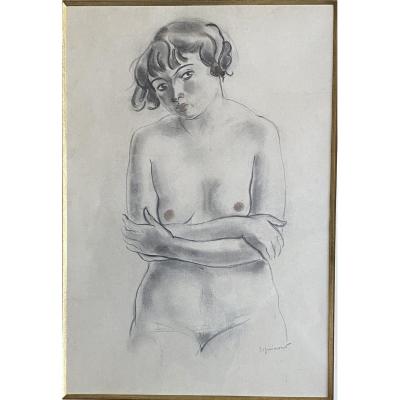
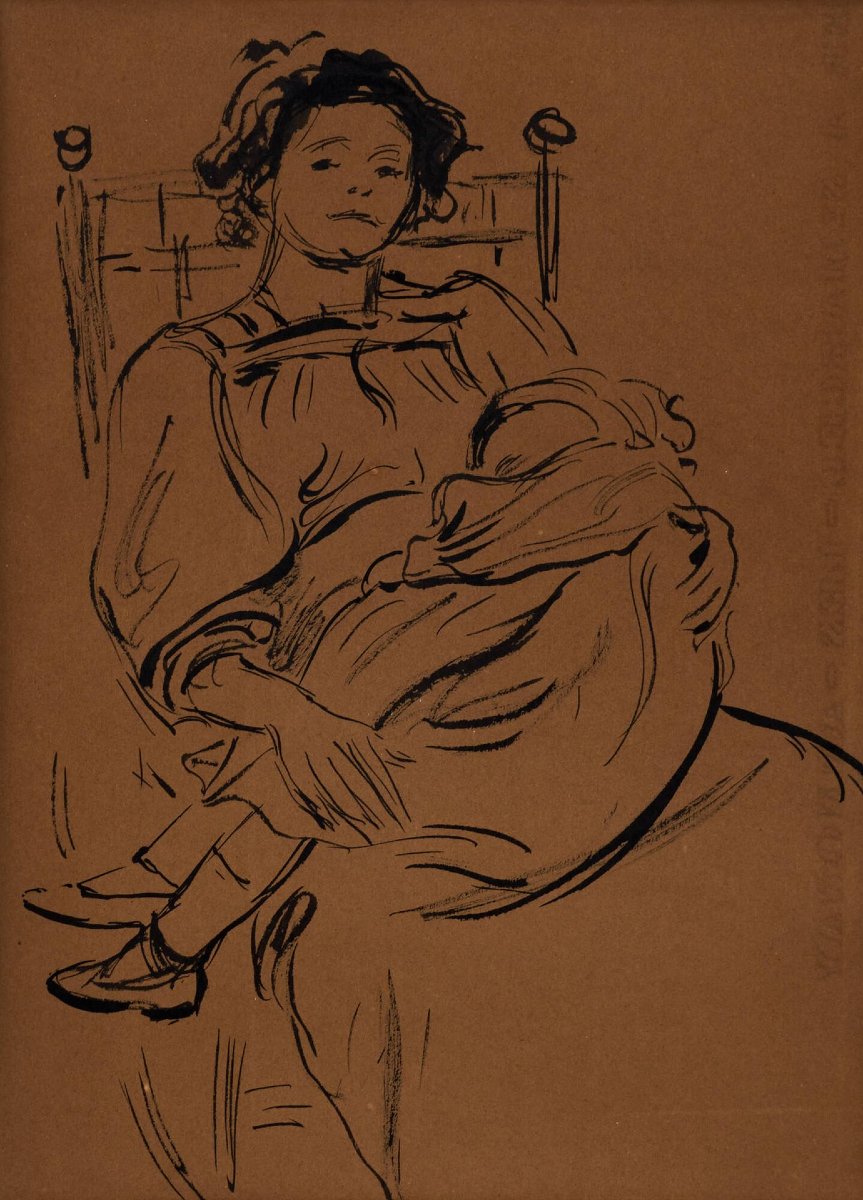
Georges LEMMEN (Belgian School, 1865–1916). India ink drawing on paper: *Madame Lemmen and her daughter Lise Asleep*.
Provenance: Lemmen Studio.
Inscriptions on the back of the frame:
Inscriptions on the back of the frame: "Drawing by George Lemmen from Lemmen’s studio; my father, Edmond Willems, helped sort the drawings there—alongside the sculptor Paul Du Bois—following the artist's death. This drawing depicts his daughter Lise and her nurse, Marie. 1918.
From the late 1880s onwards, Belgium became a major hub for the spread of Neo-Impressionism, following the reception of Seurat and Signac at the *Salon des XX* in Brussels. Van Rysselberghe, Finch, Lemmen, and Anna Boch adopted the divided or dotted brushstroke technique after seeing works such as *A Sunday Afternoon on the Island of La Grande Jatte*, which sparked both critical scandal and fascination among avant-garde artists. In his Brussels studio, Lemmen played a pivotal role in bridging circles beyond the immediate group of Pointillist painters. His sphere of influence is best understood as a convergence of groups: *Les XX*, the Neo-Impressionist subgroup (van Rysselberghe, Finch, Boch, van de Velde), and a network of young artists and decorators drawn to Art Nouveau. While Van Rysselberghe held a more prominent international profile (known for portraits and large, luminous scenes), Lemmen is often viewed as a more intimate figure whose contribution was crucial in linking Neo-Impressionism with Art Nouveau. His recent rediscovery on the art market—marked by record prices for his Pointillist portraits—confirms his status as a major master of Belgian Neo-Impressionism rather than a secondary figure. This India ink drawing serves as a fine example of Lemmen’s work depicting domestic happiness.
Provenance: Lemmen Studio.
Inscriptions on the back of the frame:
Inscriptions on the back of the frame: "Drawing by George Lemmen from Lemmen’s studio; my father, Edmond Willems, helped sort the drawings there—alongside the sculptor Paul Du Bois—following the artist's death. This drawing depicts his daughter Lise and her nurse, Marie. 1918.
From the late 1880s onwards, Belgium became a major hub for the spread of Neo-Impressionism, following the reception of Seurat and Signac at the *Salon des XX* in Brussels. Van Rysselberghe, Finch, Lemmen, and Anna Boch adopted the divided or dotted brushstroke technique after seeing works such as *A Sunday Afternoon on the Island of La Grande Jatte*, which sparked both critical scandal and fascination among avant-garde artists. In his Brussels studio, Lemmen played a pivotal role in bridging circles beyond the immediate group of Pointillist painters. His sphere of influence is best understood as a convergence of groups: *Les XX*, the Neo-Impressionist subgroup (van Rysselberghe, Finch, Boch, van de Velde), and a network of young artists and decorators drawn to Art Nouveau. While Van Rysselberghe held a more prominent international profile (known for portraits and large, luminous scenes), Lemmen is often viewed as a more intimate figure whose contribution was crucial in linking Neo-Impressionism with Art Nouveau. His recent rediscovery on the art market—marked by record prices for his Pointillist portraits—confirms his status as a major master of Belgian Neo-Impressionism rather than a secondary figure. This India ink drawing serves as a fine example of Lemmen’s work depicting domestic happiness.
600 €
Period: 20th century
Style: Modern Art
Condition: Excellent condition
Length: 31
Width: 23
Reference (ID): 1780846
Availability: In stock
Print