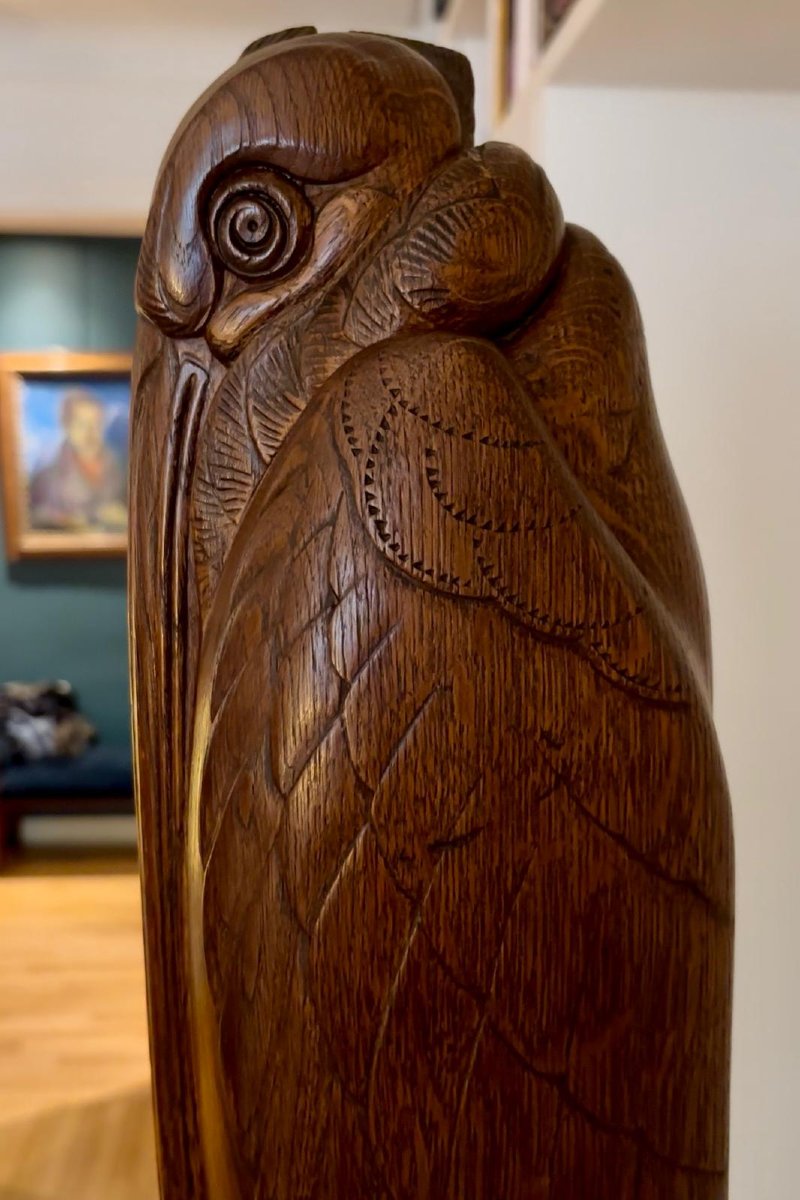
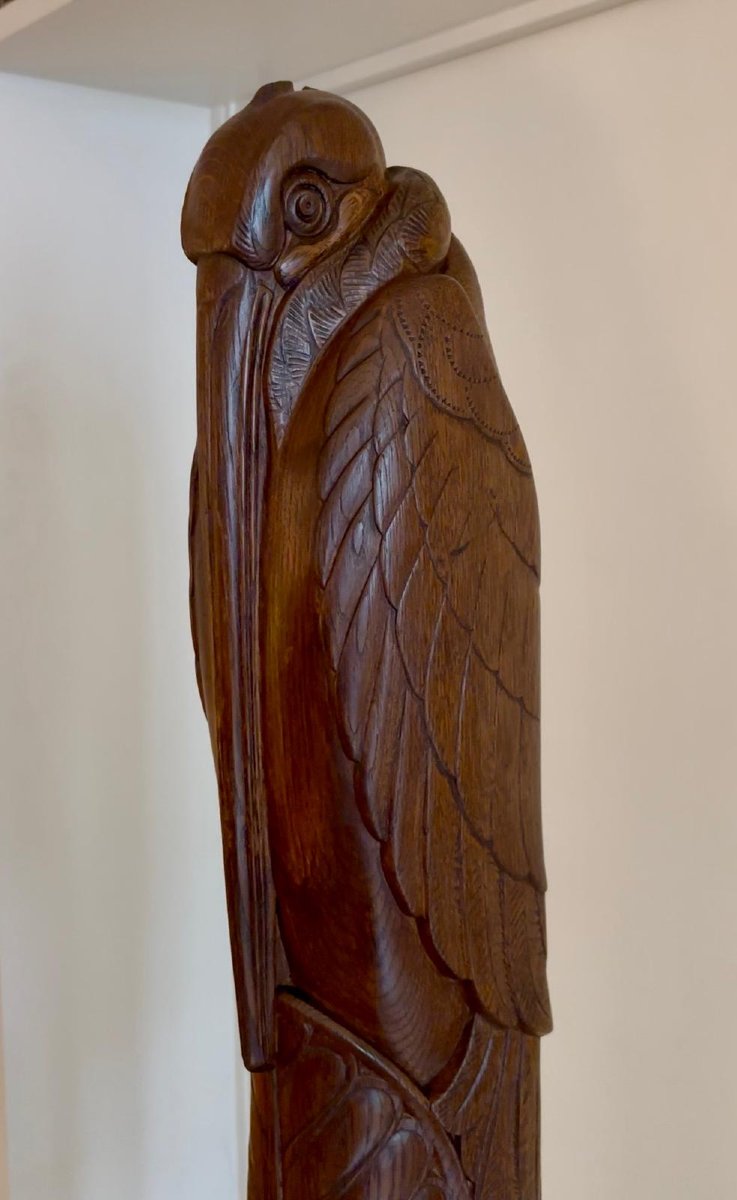


Paul Follot (1877-1941) Marabou Bird Adorned With Vegetal Scrolls, Oak Sculpture
PAUL FOLLOT (1877-1941) & LAURENT MALCLES (1879-1951) "Marabout"
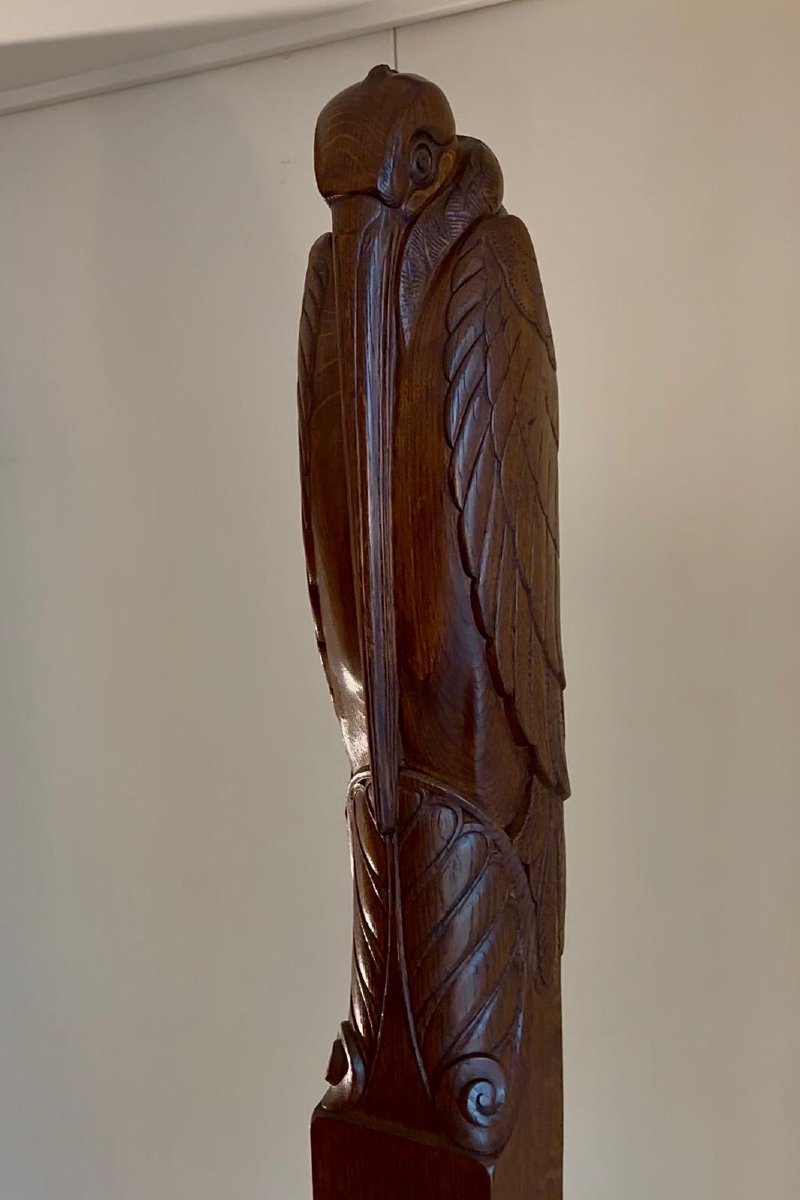
Carved oak staircase newel post. Direct carving featuring vegetal scrolls at the base and a quadrangular shaft. Height: 176 cm – Depth: 15 cm.
Paul Follot (1877–1941), son of the wallpaper manufacturer Félix Follot, established himself before 1914 as one of the most refined Parisian decorators of his generation. Trained in the wake of Grasset, he was initially active within the orbit of *La Maison Moderne* before creating his famous studio-residence on Rue Victor-Schœlcher—a true manifesto of his style at the pivotal juncture between Art Nouveau and Art Deco, a major transition sometimes referred to as "Modern Style."
Around 1901, he began working for Julius Meier-Graefe at *La Maison Moderne*, where he designed jewelry, tapestries, goldsmith’s work, textiles, and bronzes using an Art Nouveau vocabulary strongly influenced by stylized Gothic forms and leafy scrolls.
Between 1901 and 1903, this output—created for a cosmopolitan, luxury clientele—cemented his reputation in the fields of fine objects and the decorative arts.
In 1903, he co-founded the group *L’Art dans Tout* ("Art in Everything"), clearly positioning himself within the movement of French decorative art that sought to unify interior architecture, furniture, and objects under a single concept of "total art." In 1904, he set up his own business, running his own workshop and catering to a wealthy clientele with a style renowned for its luxury, elegance, and quality of craftsmanship.
From 1908–1909 onwards, he was a founding member of the *Société des Artistes Décorateurs* (Society of Decorative Artists) and participated in its Salons, where he helped pioneer a "new path" for French decorative art; his work foreshadowed certain principles of the future Art Deco movement through the simplification of forms and a more geometric stylization of motifs.
Between 1910 and 1914, alongside his interior design work, he created new jewelry designs and collaborated with major firms—such as Wedgwood for ceramics, Cornille & Cie for textiles, and Christofle for metalwork—demonstrating the reach of his influence into the high-end industrial sector.
This sculpture forms the base of the staircase railing in his private townhouse on Rue Victor-Schœlcher.
Around the mid-1900s, as his career as a decorator was gaining momentum, Follot conceived a project for a private Parisian townhouse at 5 Rue Victor-Schœlcher in the 14th arrondissement, designed to serve simultaneously as a family home, a creative studio, and a showcase for his work.
The building was constructed between 1912 and 1914 in collaboration with architect Pierre Selmersheim, based on Follot’s designs, making it a perfect distillation of his decorative style. The 1914 inauguration drew the cream of Parisian society—a testament to the prestige Follot had achieved on the eve of the war. The residence was viewed as a showcase, with each room illustrating a different facet of his artistry (furniture, textiles, woodwork, ironwork, and lighting).
The interior ensemble encapsulates a major stylistic transition: some rooms remain strongly marked by Art Nouveau (arabesques, stylized plant motifs), while others—already more streamlined—herald the Art Deco spirit through firmer lines, more architectural volumes, and a more structured decorative approach.
1.
Listed as a historic monument and preserving its key decorative features, this iconic private mansion underwent restoration and refurbishment in the 21st century; since 2018, it has housed the Institut Giacometti.
This finely carved *marabout* (a decorative figure or finial) has had its original section restored and mounted on a contemporary base. It was created with the collaboration of the renowned woodcarver Laurent Malcles (1879–1951), who directed the workshops and design studios at the famous École Boulle in Paris, training an entire generation of master craftspeople.
The house and studio on Rue Victor-Schœlcher—which Paul Follot was forced to part with in the late 1930s—was stripped of certain decorative elements, including this *marabout*, which we were able to locate and rescue.
Provenance: formerly in the Paul Follot collection; remained in the family ever since.
Illustration: this staircase railing appears in a period photograph of the entrance to Paul Follot’s house at 5 Rue Victor-Schœlcher (Paris, 14th arrondissement). Bibliography: Léopold Diego Sanchez, *Paul Follot, un artiste décorateur parisien*, AAM éditions, Brussels, 2020, p. 104 for the mention of the model.
Carved oak staircase newel post. Direct carving featuring vegetal scrolls at the base and a quadrangular shaft. Height: 176 cm – Depth: 15 cm.
Paul Follot (1877–1941), son of the wallpaper manufacturer Félix Follot, established himself before 1914 as one of the most refined Parisian decorators of his generation. Trained in the wake of Grasset, he was initially active within the orbit of *La Maison Moderne* before creating his famous studio-residence on Rue Victor-Schœlcher—a true manifesto of his style at the pivotal juncture between Art Nouveau and Art Deco, a major transition sometimes referred to as "Modern Style."
Around 1901, he began working for Julius Meier-Graefe at *La Maison Moderne*, where he designed jewelry, tapestries, goldsmith’s work, textiles, and bronzes using an Art Nouveau vocabulary strongly influenced by stylized Gothic forms and leafy scrolls.
Between 1901 and 1903, this output—created for a cosmopolitan, luxury clientele—cemented his reputation in the fields of fine objects and the decorative arts.
In 1903, he co-founded the group *L’Art dans Tout* ("Art in Everything"), clearly positioning himself within the movement of French decorative art that sought to unify interior architecture, furniture, and objects under a single concept of "total art." In 1904, he set up his own business, running his own workshop and catering to a wealthy clientele with a style renowned for its luxury, elegance, and quality of craftsmanship.
From 1908–1909 onwards, he was a founding member of the *Société des Artistes Décorateurs* (Society of Decorative Artists) and participated in its Salons, where he helped pioneer a "new path" for French decorative art; his work foreshadowed certain principles of the future Art Deco movement through the simplification of forms and a more geometric stylization of motifs.
Between 1910 and 1914, alongside his interior design work, he created new jewelry designs and collaborated with major firms—such as Wedgwood for ceramics, Cornille & Cie for textiles, and Christofle for metalwork—demonstrating the reach of his influence into the high-end industrial sector.
This sculpture forms the base of the staircase railing in his private townhouse on Rue Victor-Schœlcher.
Around the mid-1900s, as his career as a decorator was gaining momentum, Follot conceived a project for a private Parisian townhouse at 5 Rue Victor-Schœlcher in the 14th arrondissement, designed to serve simultaneously as a family home, a creative studio, and a showcase for his work.
The building was constructed between 1912 and 1914 in collaboration with architect Pierre Selmersheim, based on Follot’s designs, making it a perfect distillation of his decorative style. The 1914 inauguration drew the cream of Parisian society—a testament to the prestige Follot had achieved on the eve of the war. The residence was viewed as a showcase, with each room illustrating a different facet of his artistry (furniture, textiles, woodwork, ironwork, and lighting).
The interior ensemble encapsulates a major stylistic transition: some rooms remain strongly marked by Art Nouveau (arabesques, stylized plant motifs), while others—already more streamlined—herald the Art Deco spirit through firmer lines, more architectural volumes, and a more structured decorative approach.
1.
Listed as a historic monument and preserving its key decorative features, this iconic private mansion underwent restoration and refurbishment in the 21st century; since 2018, it has housed the Institut Giacometti.
This finely carved *marabout* (a decorative figure or finial) has had its original section restored and mounted on a contemporary base. It was created with the collaboration of the renowned woodcarver Laurent Malcles (1879–1951), who directed the workshops and design studios at the famous École Boulle in Paris, training an entire generation of master craftspeople.
The house and studio on Rue Victor-Schœlcher—which Paul Follot was forced to part with in the late 1930s—was stripped of certain decorative elements, including this *marabout*, which we were able to locate and rescue.
Provenance: formerly in the Paul Follot collection; remained in the family ever since.
Illustration: this staircase railing appears in a period photograph of the entrance to Paul Follot’s house at 5 Rue Victor-Schœlcher (Paris, 14th arrondissement). Bibliography: Léopold Diego Sanchez, *Paul Follot, un artiste décorateur parisien*, AAM éditions, Brussels, 2020, p. 104 for the mention of the model.
22 000 €
Period: 20th century
Style: Modern Art
Condition: Perfect condition
Length: 58
Width: 33
Height: 178
Reference (ID): 1770049
Availability: In stock
Print