A robust and characterful example of early Spanish craftsmanship, this 17th-century side table in solid oak embodies the rustic elegance and architectural sensibility of Iberian furniture from the Bar[...]
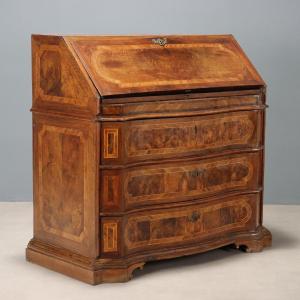
Baroque walnut and crotchet chest of drawers with maple and olive wood trim. Three-drawer curved front, drop-leaf upper door, four-drawer internal cabinet, and central open compartment with sliding sh[...]
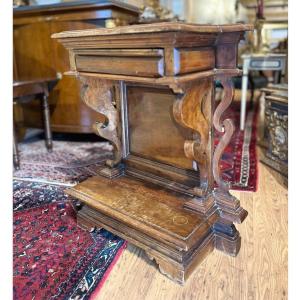
Small 17th-century cabinet in walnut, an antique piece of great charm,
probably made from an original prie-dieu.
The cabinet features one upper drawer and two lower doors, with an internal compartme[...]
Pair of majestic Italian Baroque architectural columns from the 17th centuryA rare and captivating pair of structural columns dating back to 17th-century Italy, originally designed as prestigious arch[...]
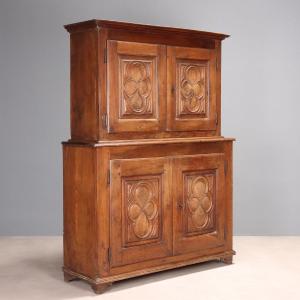
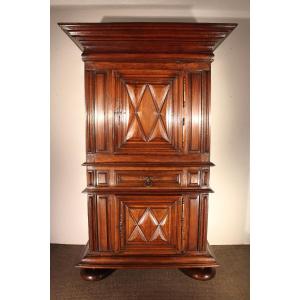
Baroque double-body sideboard in walnut, base and upper part with pair of paneled doors with central carved cloverleaf panels, bracket feet, old but replaced locks. Italy, early 17th century.
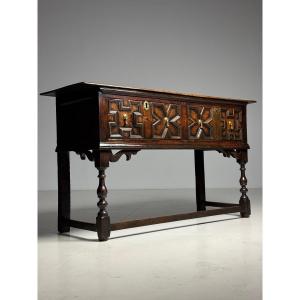
An exceptional piece of furniture, this magnificent 17th-century Danish console and/or work table, also known as an arbejdsbord at the time, is crafted from solid oak. Its clean, functional lines are [...]
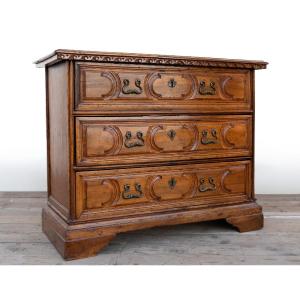
Elegant small Venetian antique chest of drawers dating to the late 17th or early 18th century, an authentic period piece crafted from finely worked solid walnut wood. The piece features three spaciou[...]
We are pleased to present this refined antique Italian chest dating back to the 17th century. Crafted from solid walnut, this chest's warm, rich brown color lends it a versatile aesthetic suitable for[...]
Baroque walnut bedside table converted from a prie-dieu. Three-drawer front in walnut burl, with maple and walnut inlays, repeated on the top and lower panel, ebonized moldings. Carved double-bracket [...]
Venetian Walnut Canterano – Late 17th CenturyProvenance: VeniceDimensions: 112 × 49 × 90 cmDescription: Elegant Venetian canterano from the late 1600s, crafted in blond walnut and distinguished by its[...]
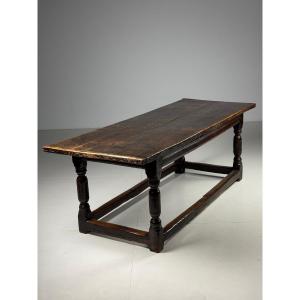
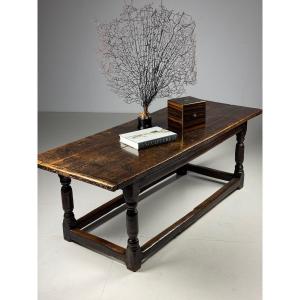
17th-century refectory table. Quite original! Made of solid oak. One of the long sides is adorned with beautiful leaf carvings on the ruler. The other side is plain and undecorated. Magnificent as a s[...]
Antique Kneeler in Solid Walnut – Late 17th/18th Century Elegant antique kneeler crafted in solid walnut, dating from the late 17th to the 18th century. The structure features harmonious lines enhance[...]
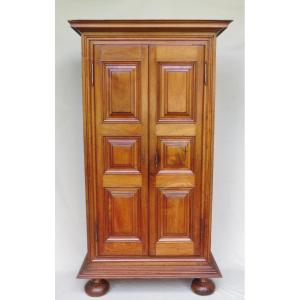
This very small but exceptionally large cabinet is made of solid walnut and opens with two three-panel doors. Its upper and lower cornices are original, as are its hardware: key, lock, escutcheon, and[...]
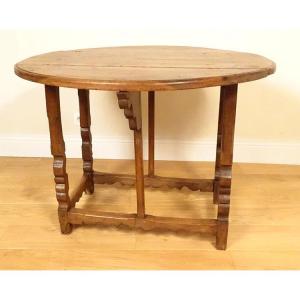
Early Spanish rustic table in carved walnut, known as a "winged" table because it folds thanks to its two drop leaves. The carved, undulating, and crenellated legs have two additional supports for the[...]
Large cabinet with two doors in walnut wood, Central Italy, 17th century. The wardrobe is characterized by an imposing architecture punctuated by pilasters with molded capitals and a strongly projecti[...]
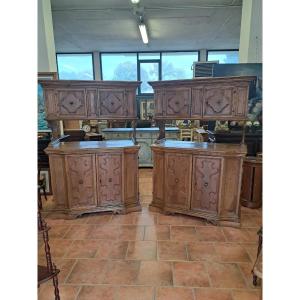
Wonderful pair of double-bodied sacristy sideboards, 17th century, in blond walnut. Original shoeing and nailing, beautiful wavy shapes on the low sideboard, carved panels with an elegant maple fillet[...]
English commode, 17th century. A very beautiful antique piece. Made of solid oak. Originating from England, during the reign of William and Mary (1689-1702). The commode has two spacious drawers. Unfo[...]
17th-century refectory table. Quite original! Made of solid oak. One of the long sides features beautiful leaf carvings on the ruler. The other side is plain and undecorated. Magnificent as a side tab[...]
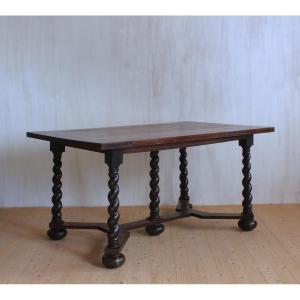
This Swiss table is made of walnut and walnut veneer. It rests on four turned legs joined by a rotating stretcher. It has a drawer in the apron, and the top is inlaid with geometric patterns around th[...]
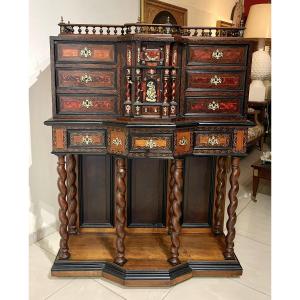
An elegant 17th-century Spanish cabinet (vargueño), finely crafted in walnut and exotic woods. The front features a drop-front that opens to reveal a richly decorated interior with lemonwood marquetry[...]
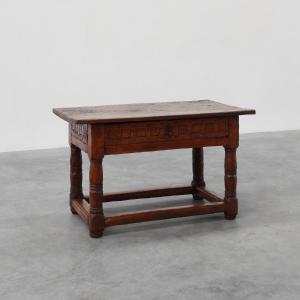
Solid walnut smalltable with turned legs joined by crosspieces. On the front there is a beautiful drawer carved with geometric motifs, original key and lock. Spain, 17th century.
Very beautiful wooden credenza from the 17th century. - Dimensions: height: 180 centimeters (including 80 cm of lower part, on columns); width: 117 centimeters; depth: 59 centimeters.
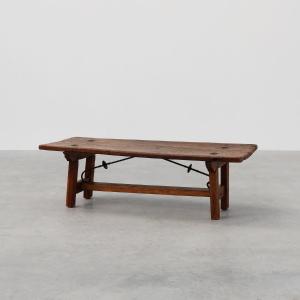
Spain / 17th century / Side Table / oak / Spanish / Rustic / wabi sabi / French ProvincialAntique side table in solid oak with beautiful geometric carvings and patina. Hand made in the 17th century in[...]
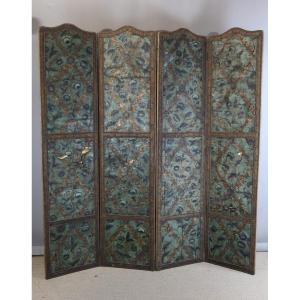
Large screen with four leaves upholstered in Cordoba leather from the 17th century. This screen has some accidents and tears, we can provide the contact details of a restorer of antique leathers on re[...]
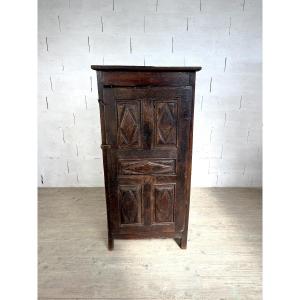
Elegant and authentic, this 17th-century single-door bonnet cabinet from Haute-Auvergne embodies all the charm of French regional furniture. Originally designed to carefully preserve bonnets and headd[...]
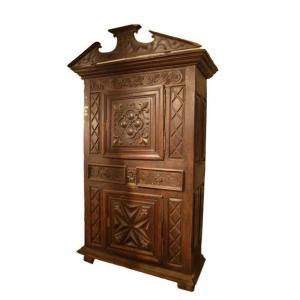
Italian cabinet, Florentine, 1600s in walnut wood. It has a temple hat, 2 doors and 2 drawers. Origin: Northern Italy, Florence Period: 1600 Dimensions: 152x66x255h cm Code: 1941 Visit our website www[...]
Cabinet in marquetry and shell decorated with numerous gilded bronzes. The upper part dates from the 17th century and has three drawers on each side. The door in the center is decorated with a bronze [...]
Handsome Louis XIII standing man, late 17th century, entirely in walnut, from a small castle in Tours, opening with 2 doors and a drawer in its belt, ball feet, enhanced with a very beautiful cornice [...]
Ebonized walnut table, truncated pyramidal legs with carved leaf capitals, joined to a curved cross-vaulted base with a central plume. The tabletop features a beautiful scagliola panel depicting a cen[...]
This refined 17th-century cabinet is typical of Baroque furniture designed to store precious items, coins, or documents. Made of Ebony, red tortoiseshell, and bronze, the piece features numerous drawe[...]
Large Italian Chest from Veneto, 1600s, in Walnut Wood. Features a Front Panel Adorned with Rich Inlaid Motifs.Origin: Italy, VenetoPeriod: 1600sDimensions: 166x53x59h cm
17th-century Italian folding table in walnut wood. It features inlay motifs on the top, 3 large drawers with panels in the lower part, and inside, small drawers with an open compartment.Origin: Northe[...]
Chest. Walnut wood, textile remains, wrought iron. 17th century. Rectangular walnut chest or sideboard with a flat lid featuring fine moldings on the outside, another running along the front of the ca[...]
Wrought iron chest called Nuremberg for transporting precious objects, Germany 17th early 18th century. Two holes in the bottom allowed the chest to be fixed to the floor of the ship or carriage. The [...]
Castilian chest. Walnut wood, wrought iron, and polychromy. Spain, 17th century. Rectangular chest with a flat lid, slightly raised on spheres, decorated on the outside with smooth moldings on the top[...]
Chest in walnut wood and wrought iron fittings, 17th century. Rectangular chest with base and lid with moldings, wrought iron fittings and angles on a red fabric background composed of stylized and si[...]
Castilian chest. Walnut wood, textile, and wrought iron. 17th century. Rectangular chest with a flat lid and no legs, decorated with carved moldings on the upper and lower edges of the piece and on th[...]
Baroque Emilian sideboard in walnut from the early 18th century with subsequent reductions and modifications. Top and front decorated with metal studs, two drawers in the band, pair of doors. Sides em[...]
Italian Screen composed of two elements of three leaves each, for a total of six panels. Wooden structure, leather stretched and painted by hand, decorated with rural scenes animated by people, herds,[...]
Table. Walnut wood. 17th century. Table with a smooth rectangular top and two drawers at the front, decorated with simple geometric shapes on their fronts, leaving a strip of tongues between them. The[...]
Superb 17th-century Tuscan Italian chest of drawers made from fine walnut wood. This magnificent piece features four spacious drawers adorned with engravings and carvings of rare beauty.Origin: Italy,[...]
Italian Lombard-Venetian Walnut Chest of Drawers from the late 17th to early 18th century. It features 3 large drawers with original locks for each drawer.Origin: ItalyPeriod: Late 17th century, early[...]
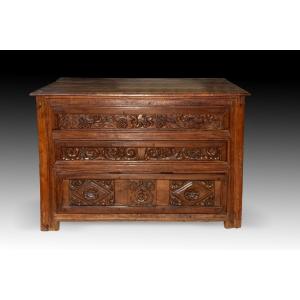
Sacristy chest of drawers in walnut wood with carved decoration. Spain, 17th century. This piece of furniture has three very deep drawers, the tallest being the lower one, resting on rectangular legs [...]
Large French cabinet from the end of the 1600s in oak. It has 4 doors, 2 in the upper body, 2 in the lower one; in the central one there is a large drawer. All enriched by carving motifs. Origin: Fran[...]
Mahogany dining table with a straight folding leg, 17th century. The four legs, joined by straight frames and attached to the top by frames, have no notable decorative elements, but they do have a ser[...]
Town hall chest. Walnut wood. 17th century. Rectangular carved walnut chest with a flat lid and simple decoration on the fronts with smooth moldings of varying widths. It is slightly raised above the [...]
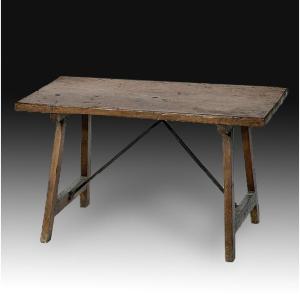
Table with San Antonio legs. Walnut wood, wrought iron. Spain, 17th century. Rectangular tabletop with San Antonio legs (inclined towards the front of the piece and joined by a straight frame), which [...]
Counter. Walnut wood, wrought iron. Spain, 17th century. Rectangular low cabinet in oak wood with wrought iron elements, slightly raised on four legs, with a slightly projecting straight top and front[...]
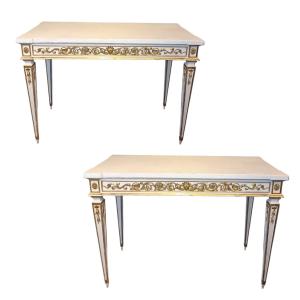
Elegant, made of white lacquered wood, with inserts in carved and gilded wood with pure gold with phytomorphic and floral motifs. The front has a central frieze, while the legs with a truncated pyrami[...]
Proantic uses a cookie to analyze traffic and improve its service by using Google Analytics. Data sent to Google Analytics (frequency of visits to the site and pages visited) are anonymous. No other cookie tracks your activity, your personal data is not collected. Thank you for helping us to have better understanding how Proantic is used.























 Le Magazine de PROANTIC
 TRÉSORS Magazine
 Rivista Artiquariato