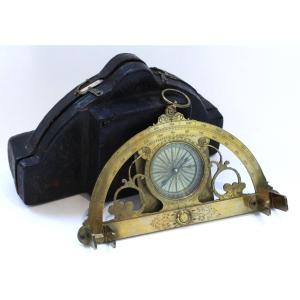
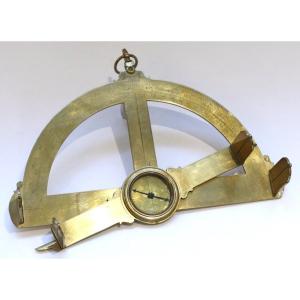
A small set of two ophthalmic instruments of rare quality and luxurious design. These two instruments were used together and share the same provenance. They are both French, dating from around 1760-17[...]
Rare brass equinoctial sundial, Germany, second half of the 17th century. Brass, silver, and iron; 14 cm long, 7 cm wide, and 6.5 cm high. This rare brass equinoctial sundial is unsigned but certainly[...]
Equinoctial ring in gilt brass, Germany, circa 1700. Gilt brass, brass, and steel; 6.3 cm in diameter and 8 cm high including the bail. The ring, constructed of brass and gilt brass, consists of two c[...]
Pre-Hevelius sundial, dated 1616. Brass; 6 x 5.8 cm and 7.3 cm with the bail. This rare altitude sundial, known as the Hevelius type after the example made by Joannes Hevelius in 1638 (preserved at th[...]
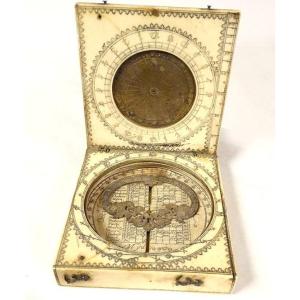
A rare portable sundial in engraved ivory, a fine example of 17th-century German scientific instrumentation, probably made in Nuremberg, a city renowned for its precision and horological innovations. [...]
Rare equinoctial ring. Signed "N Bion A PARIS", circa 1700, in bronze, composed of meridian and equatorial rings. Latitude engraved with names of European cities alternating with floral motifs. Rotati[...]
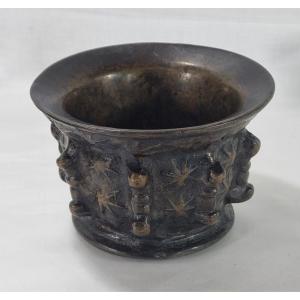
A heavy Spanish bronze mortar dating from the 17th, possibly the 16th century. Beautiful decoration: eight vertical ribs interspersed with stars. Two stairs each time. The outer upper edge is entirely[...]
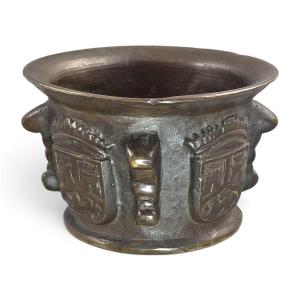
A massive bronze mortar made in Spain in the 17th or possibly the 16th century. It was used regularly but is still in very good condition. It is decorated with five ribs, each adorned with a figure of[...]
Brass sundial made by Nicolas BION fecit 1655 - 1733. Butterfield type, octagonal table sumptuously engraved freehand. Compass marked with a pretty fleur-de-lis to the North. On the back the main citi[...]
Scultetus amputation saw, late 17th century, early 18th century. It measures 32cm in length, with an 11cm blade. The blade is removed by loosening the two screws, which are in good working order.
Uncommon diptych dial comprising only one azimuth or horizontal axis-wire dial constructed from two strong boxwood plates and reinforced with brass plates. The dial is not signed but French, datable t[...]
Very old bronze mortar with fins. Presented natural in good condition as in the photos Height: 11 cm Diameter: 13 cm Max width with fins 18.5 cm Very heavy. Shipping throughout France Don't forget to [...]
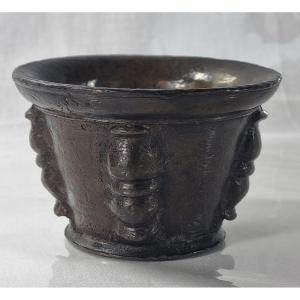
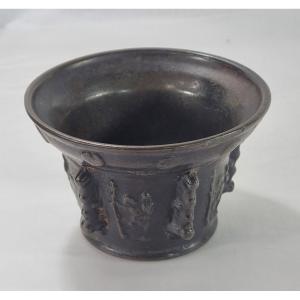
Mortar and pestle. Bronze. 17th century. Mortar with a circular base, cylindrical body and slightly outwardly flared mouth, decorated with a series of smooth horizontal moldings arranged both at the b[...]
Horizontal brass sundial
signed around its bird gnomon “A. André à Paris”.
On the back various
decorations and the latitude of 17 cities.
Green small-grained shagreen
case with burgundy velvet i[...]
Flemish mortar. Bronze. 17th century.
Presents the mark.
Mortar with a circular base with a mouth that extends outwards from the two upper bands and a body with a slight notch and relief decoration [...]
Wrought iron scalpel. 17th century
Smooth blade with a double-edged spear point in one piece with a faceted handle.
Length: 19.2 cm
Width of the blade at the heel: 2.4 cm
Very good condition wi[...]
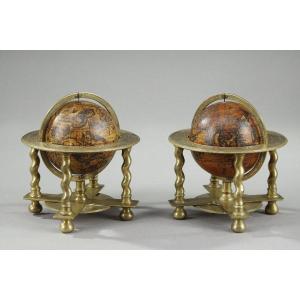
Pair of celestial and terrestrial table globes, wooden globe covered with engraved and enhanced paper spindles. Bronze mounts with two rings comprising a horizon table engraved with a zodiacal scale a[...]
Compass built entirely of brass and equipped with a point allowing it to hold a pencil, dating from the 17th century. This early instrument is of fairly artisanal manufacture. Numerous marks of use an[...]
17th / 18th Century Apothecary Mortar In Gaïac Wood Very beautiful patina Good condition, some chips at the neck, see photos Height: 18.3 cm Diameter at the base: 10 cm Diameter at the neck: 12.7 cm
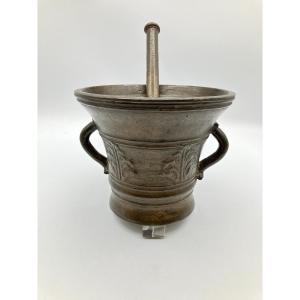
Bronze mortar with handles. Decorated with acanthus leaves in relief, complete with original clapper.
mortar height cm 16 kilograms 6.4 with clapper kg 7.8
clapper cm 29
Italy 17th century[...]
Round-shaped pocket or travel sundial model, constructed in turned ivory, and with a floating compass. The dial bears the signature/label of David Trap, illustrated with a biblical scene, and is dated[...]
Universal octogonal sundial signed Hager in gilt brass with the family particularity of a weather vane of winds.
It lays in its leather case with geometric designs in glazed leather and bears at ba[...]
Brass graphometer signed “Butterfield in Paris” decorated with a surprising decoration of four strawberries and plants and the usual acanthus. The graphometer dates back to the start of Butterfield pr[...]
Early Dutch graphometer signed "I. David". This is Ian David from Leiden. The instrument therefore dates back to the years 1640-1650. The instrument is engraved with two scales of 180° degrees, then d[...]
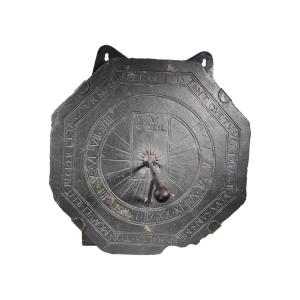
A LARGE 17TH CENTURY FRENCH SLATE OCTAGONAL SUNDIAL With wrought iron gnomon profusely engraved with Latin letters. Size: 39x39 cm. With the latter hanging system. The dial is set with a wrought iron [...]
Diptych-type sundial, decorated with dentils, inside a compass with mobile analemma and an equinoctial dial on a paper background bearing the names of cities; on the mobile door a lunar calendar; on t[...]
Small bronze ointment mortar 17th century Origin Netherlands or Germany With 2 square handles Very good condition Provenance: former private collection Seen by MM. the experts Philippe and Jean-Christ[...]
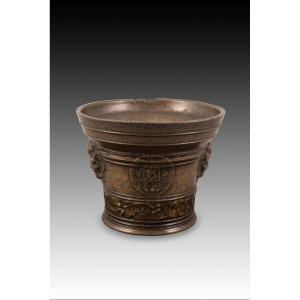
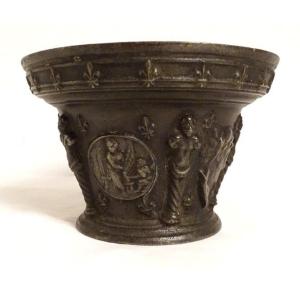
Brass* apothecary mortar, flared body with buttresses in the shape of terms or caryatids, body decorated with screaming grotesque heads in profile as well as medallions representing Hercules and the d[...]
Rare diptych sundial by Mathieu Berville, who signed a 'fixed-price agreement' in 1668. The early signers in ca. 1660 are Nicolas Crucefix, Jacques Lemoyne, followed in 1668 by Charles Bloud, Gabriel [...]
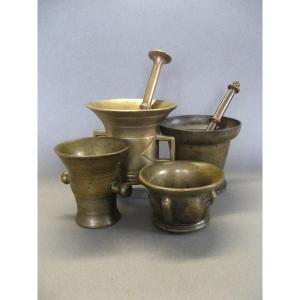
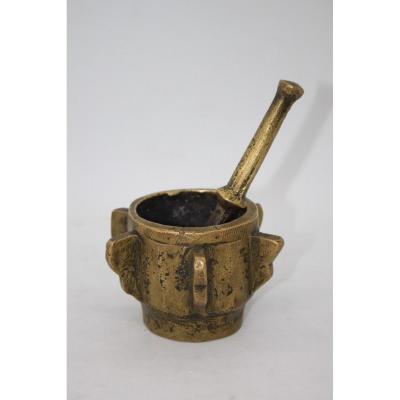
Apothecary mortar and pestle with two handles from the end of the 17th or the beginning of the 18th. Good condition. Height 12 cm, diameter at the neck 14 cm, original pestle length 21.5 cm, total wei[...]
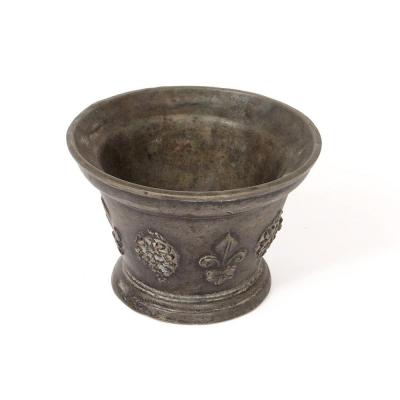
Mortar of apothecary in brass *, decorated with flowers of lilies and masks of faunas, work certainly of the Puy-en-Velais, period XVIIth century. This mortar is in good general condition. A note: som[...]
Proantic uses a cookie to analyze traffic and improve its service by using Google Analytics. Data sent to Google Analytics (frequency of visits to the site and pages visited) are anonymous. No other cookie tracks your activity, your personal data is not collected. Thank you for helping us to have better understanding how Proantic is used.