Dish Hilt Dutch Rapier, Circa 1610
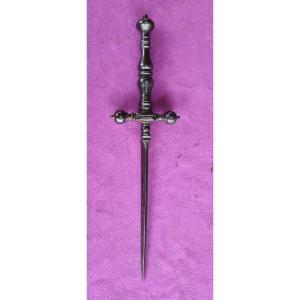
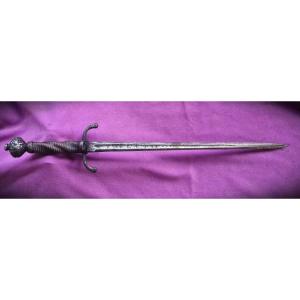
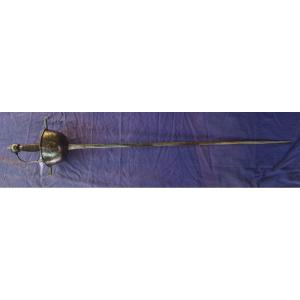
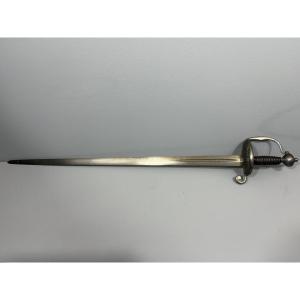
This rapier is a fairly uncommon model, probably originating from the Netherlands. It can be dated from the first half of the 17th century, around 1610–1620. Indeed, while the hilt’s shape corresponds exactly to Type No. 93 in Norman’s classification—which generally dates this type of rapier from between 1630 and 1660— the distancebetween the quillons and the guard dish plate, which allows the index finger to pass easily betyween quillons and dish plate ,indicates a very early date of manufacture, since as we move forward in time, this space for the index finger becomes narrower and loses its functional purpose. Furthermore, Norman specifies that the double quillons ending in balls are characteristic of weapons made prior to 1630. Therefore, the accepted dating is : the years 1610–1620.
A similar rapier is illustrated as No. 27 in the book “Rapiers” by Eric Valentine, from the former Baron de Cosson collection.The author speculates that it is British, though without certainty, and dates it from1630.
BLADE: its flared shoulder rests directly on the guard dish plate. Immediately, the blade takes on a diamond-shaped cross-section all the way to the point. Note that the blade has retained remarkable elasticity, which indicates a very high quality of forging. Once again, it is important for a weapon from this period to distinguish between armorer’s craftsmanship and ornamentation.
Blade length = 105.8 cm, width near the shoulder201 cm, thickness near the shoulder= 7.6 mm, balance point 11 cm from the guard.
GUARD Guard dish plate: four-lobed, made of re-pierced iron with a flat pattern. A small portion of this plate, on the inner side, is an old repair, likely due to damage sustained in combat. The repair is clearly old, as the patina isexactly the same as on the rest of the guard.
Quillons: On the side opposite of theknuckle bow, double quillons ending in a ball-shaped tips with rounded facets thatrest on the guard plate On the side of the knucle bow, a volute-shaped quillon rests against the guard plate.
Knuckle bow: It features in the center a ball with worn plant-motif chiseling, and it ends at the pommel, to which it is secured by a screw.
POMMEL:It is shaped like a flattened sphere resting on a baluster and features a chiseled plant motif, continuing the design of the guard plate.
GRIP : It is twisted and covered with twisted wire binding in a chevron pattern alternating with simple wire binding. The ferruleq made of the braided crowns, known as “Turk's heads,” are present and in good condition.
This weapon is therefore a rare model. The use of quillons to firmly secure the guard plate at three points isc haracteristic of a weapon designed for combat. It will therefore be an interesting addition to a rapier collection
Red FX-1666;
Shipping fee contribution: France 30€, Europe 50 €
1 850 €
Period: 17th century
Style: Renaissance, Louis 13th
Condition: Good condition
Material: Other
Length: 122 cm
Reference (ID): 1862996
Availability: In stock
Print