

Mechelen 1757, Holy Water Stoop , Sterling Silver
Solid Silver Régence Holy Water Stoup – Pierre Barbier, Mechelen, 1757
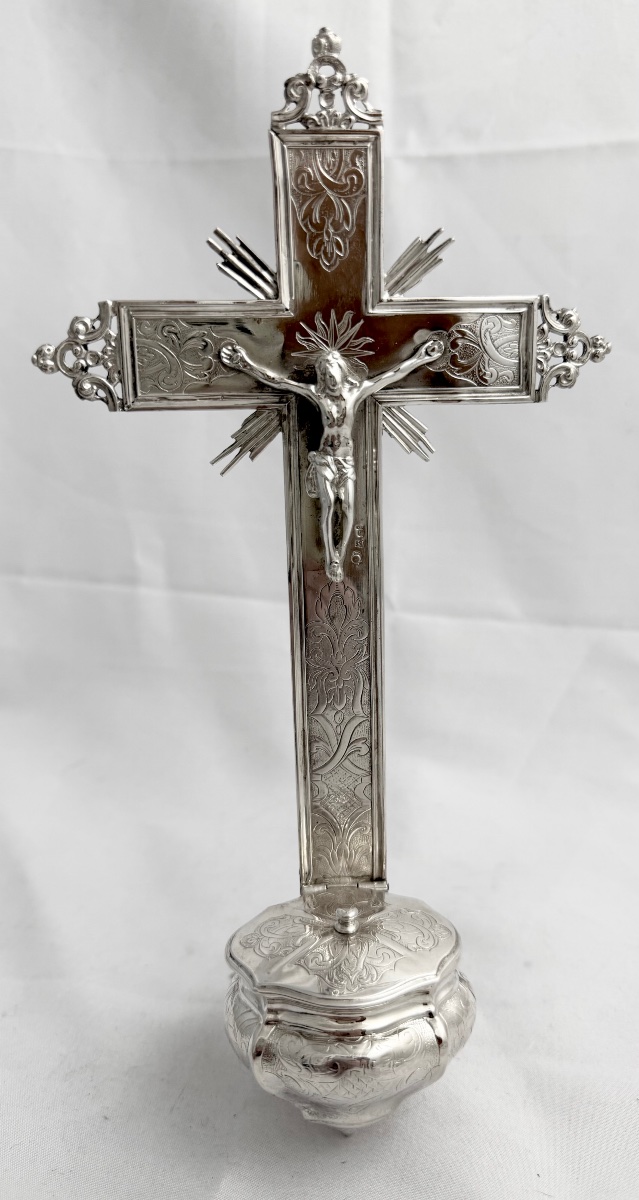
Remarkable solid silver domestic holy water stoup, made in 1757 by the Mechelen master silversmith Pierre Barbier, also known as Pieter Barbieri.
This holy water stoup remains strongly influenced by the Régence style, which enjoyed considerable popularity in the Southern Netherlands between 1720 and 1740 and whose ornamental vocabulary continued to flourish well beyond the middle of the eighteenth century in certain silversmithing centres.
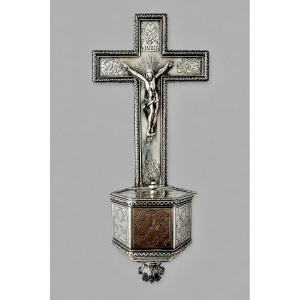
The large cross, framed by moulded borders, is embellished at its three extremities with pierced finials and features four clusters of rays emanating from the intersection of its arms, symbolising divine glory. The figure of Christ, sculpted in the round and secured to the cross, stands out against a polished silver background, his head surrounded by a radiant halo engraved into the metal.
The baluster-shaped holy water reservoir, with its shaped and faceted sides, is fitted with a hinged cover surmounted by a knob finial. It retains its removable inner liner.
One of the most attractive features of this piece is the richness of its engraved decoration, which covers a substantial proportion of the silver surface, both on the cross and on the reservoir and its cover. The symmetrical compositions of scrolling foliage, palmettes, acanthus leaves and stylised floral motifs, set against matted and crosshatched grounds, belong entirely to the ornamental vocabulary of the Régence period.
A particularly unusual feature is the hinged support at the back, consisting of two diverging legs. This ingenious device allows the holy water stoup not only to be suspended from a wall or mounted on a velvet-covered panel, but also to stand independently on a piece of furniture, a bedside table or a prie-dieu.
Dimensions and weight
Height: 26 cm
Width: 14 cm
Weight: 165 grams
Hallmarks
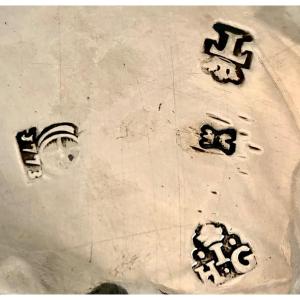
Three clearly identifiable hallmarks are struck on the front of the cross, to the right of the figure of Christ:
- The assay mark of the city of Mechelen.
- The date mark 57, corresponding to the year 1757.
- The maker’s mark of Pierre Barbier, depicting a poppy seed capsule.
The latter appears on the copper registration plate of the Mechelen master silversmiths, reproduced in Georges van Doorslaer’s authoritative publication on the silver of Mechelen.
Pierre Barbier, also known as Pieter Barbieri, master silversmith in Mechelen, documented from 1727 to 1762
Born into a family of Mechelen silversmiths, Pierre Barbier was most probably the son of François Barbiers, who worked notably for St Rumbold’s Church and the Chapel of Our Lady of Zellaar.
Pierre Barbier occupied a prominent position within the Mechelen silversmiths’ guild, serving as its dean on three occasions, in 1727, 1735 and 1750. These appointments testify to the esteem in which he was held by his fellow silversmiths.
In 1734, the Guild of the Young Crossbowmen commissioned him to produce its silver torchères, a prestigious commission for which he received the considerable sum of 1,932 florins and 14 sols.
In 1744, he made a chalice, its paten and spoon for the Chapel of Our Lady of Zellaar, to which he also supplied a pair of cruets in 1751.
Several of his works are recorded in Belgian public and ecclesiastical collections, including:
- A silver oil and vinegar cruet stand dated 1756, preserved in the municipal museum of Mechelen.
- An archer’s crown dated 1752, preserved in St Nicholas’ Church in Sint-Niklaas.
- Two ornamental plaques from a guild collar dated 1757, belonging to the archers’ guild of Muizen.
Pierre Barbier lived in the Rue de la Chaussée, near the Old Palace of Mechelen. He died on 28 December 1762.
The numerous documented secular and ecclesiastical commissions, together with the positions he held within his guild, establish Pierre Barbier as one of the prominent Mechelen silversmiths of the eighteenth century.
(Source: Georges van Doorslaer, La corporation et les ouvrages des orfèvres malinois, 1935, pp. 145–146 and 149.)
The domestic holy water stoup and the Counter-Reformation
The use of holy water in the domestic sphere has its origins in the Middle Ages, dating back to the early centuries of the second millennium. The faithful brought holy water home from church and kept it in their houses, attributing to it protective virtues against illness, danger and the forces of evil.
Although this practice was already well established, it was from the late sixteenth century, and particularly from the beginning of the seventeenth century, that domestic holy water stoups became increasingly widespread throughout Catholic Europe.
This development must be understood within the broader movement of spiritual reconquest undertaken by the Catholic Church during the Counter-Reformation, following the Council of Trent (1545–1563). Faced with the spread of Protestantism, the Church sought to reaffirm the importance of sacramentals, religious imagery and devotional practices, not only within churches but also in the privacy of the home.
The domestic holy water stoup thus became one of the emblematic objects of this endeavour to integrate Catholic religious observance into the daily lives of the faithful. Placed beside the bed, at the entrance to a bedroom or in a private oratory, it enabled worshippers to make the sign of the cross with holy water upon rising and before retiring, before prayer or at other significant moments of the day.
This movement of Catholic reconquest found particularly fertile ground in the Southern Netherlands, notably under the reign of Archdukes Albert and Isabella (1598–1621), who were great patrons of the Catholic religious and artistic revival.
It was within this context that, from the beginning of the seventeenth century, domestic holy water stoups began to be produced in considerable numbers and in a wide variety of materials: terracotta, faience, porcelain, carved wood, copper, brass and bronze, and, for the most precious examples, solid silver and silver-gilt.
Silver holy water stoups were particularly favoured as devotional objects by the aristocracy, the higher clergy and the wealthy bourgeoisie. Their manufacture was entrusted to silversmiths, who employed the same technical skills and artistic refinement as those devoted to the creation of the most prestigious pieces of ecclesiastical silver.
Among the remarkable examples preserved in public collections are the silver-gilt holy water stoup made in Paris in 1677–1678 by Nicolas Delaunay, now in the Louvre Museum (inv. OA 10416), and the magnificent holy water stoup executed in Rome around 1702 by Giovanni Giardini for Pope Clement XI, preserved in the Metropolitan Museum of Art in New York (inv. 1995.110).
The present holy water stoup, made in Mechelen in 1757 by Pierre Barbier, belongs firmly within this tradition of domestic religious silver in the Southern Netherlands. The richness of its engraved Régence decoration, the elegance of its proportions, its unusual hinged support and the distinction of its maker render it a particularly remarkable example of eighteenth-century Mechelen silver and private religious devotion.
Bibliographical references
Georges van Doorslaer, La corporation et les ouvrages des orfèvres malinois, 1935, pp. 145–146 for the registration plate and maker’s mark, and p. 149 for the biography and recorded works of Pierre Barbier.
Michèle Bimbenet-Privat, Florian Doux and Catherine Gougeon, Orfèvrerie de la Renaissance et des Temps modernes, XVIe, XVIIe et XVIIIe siècles. La collection du musée du Louvre, Éditions Faton, 2022, vol. I, pp. 158–159, no. 33.
Metropolitan Museum of Art, New York, Holy-water stoup with relief of Mary of Egypt, Giovanni Giardini, Rome, circa 1702, inv. 1995.110.
Period: 18th century
Style: Louis 14th, Regency
Condition: Excellent condition
Material: Sterling silver
Width: 14 cm
Height: 26 cm
Reference (ID): 1856291
Availability: In stock