



Large Swept Hilt Rapier, Signed Koeter
Artist: Koeter
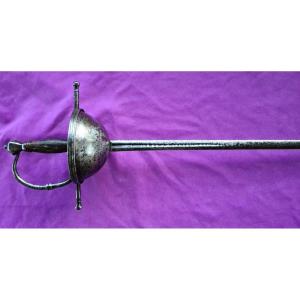
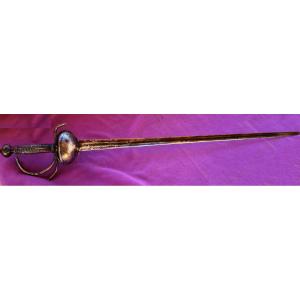
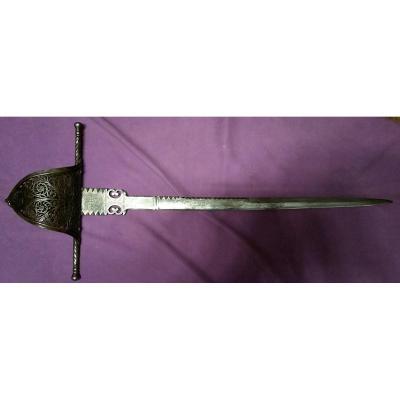
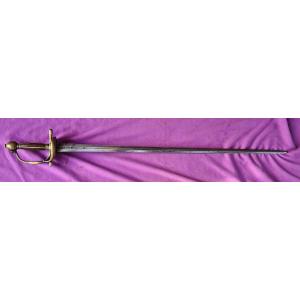
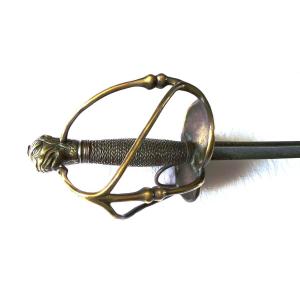
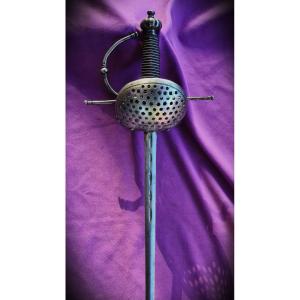
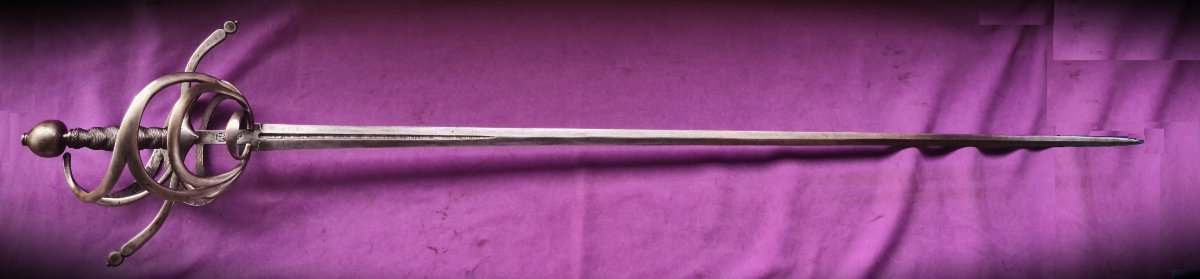
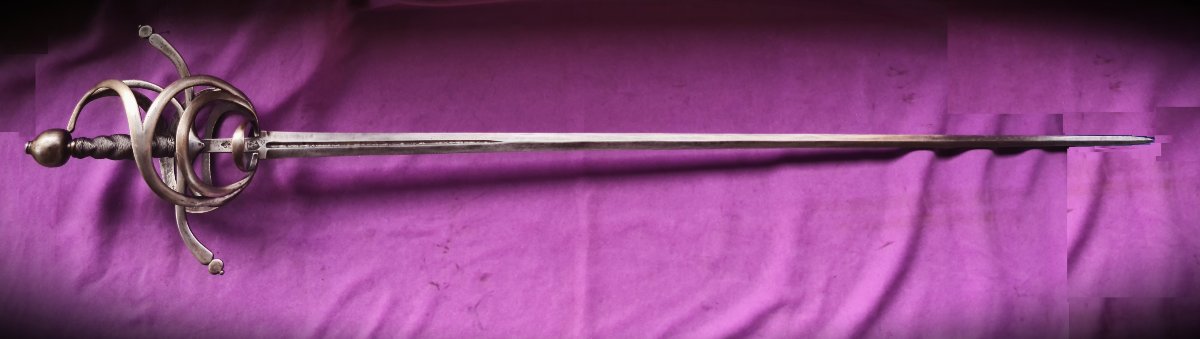
This is a beautiful, large rapier known as a “swept hilt rapier,” whose hilt components are oversized to allow it to be held with a gloved hand. The large overall dimensions of this weapon also allow us to infer that its owner was most likely of imposing stature.
The blade appears to be of Dutch origin in the broadest sense, based on the signature KOETER, which is a surname originating from the Netherlands.
However, the style of the mount could just as easily be Dutch as it could be French. It can be dated from the second half of the 16thcentury.
BLADE: After a 6.5 cm ricasso, it takes on a lozenge-shaped cross-section with a central fuller on each side. In these fullers, the following can be read:
Outer side: + + A N L E S T I N E S + + +
Inner side: + + K O E T E R + + +
The inscription AN LESTINES likely corresponds to the old spelling “Lestines” of a town in Hainaut (now Estines, Belgium), thus meaning “in Lestines.” “KOETER” is obviously the name of the manufacturer of this blade; I was unable to find any further information about him.
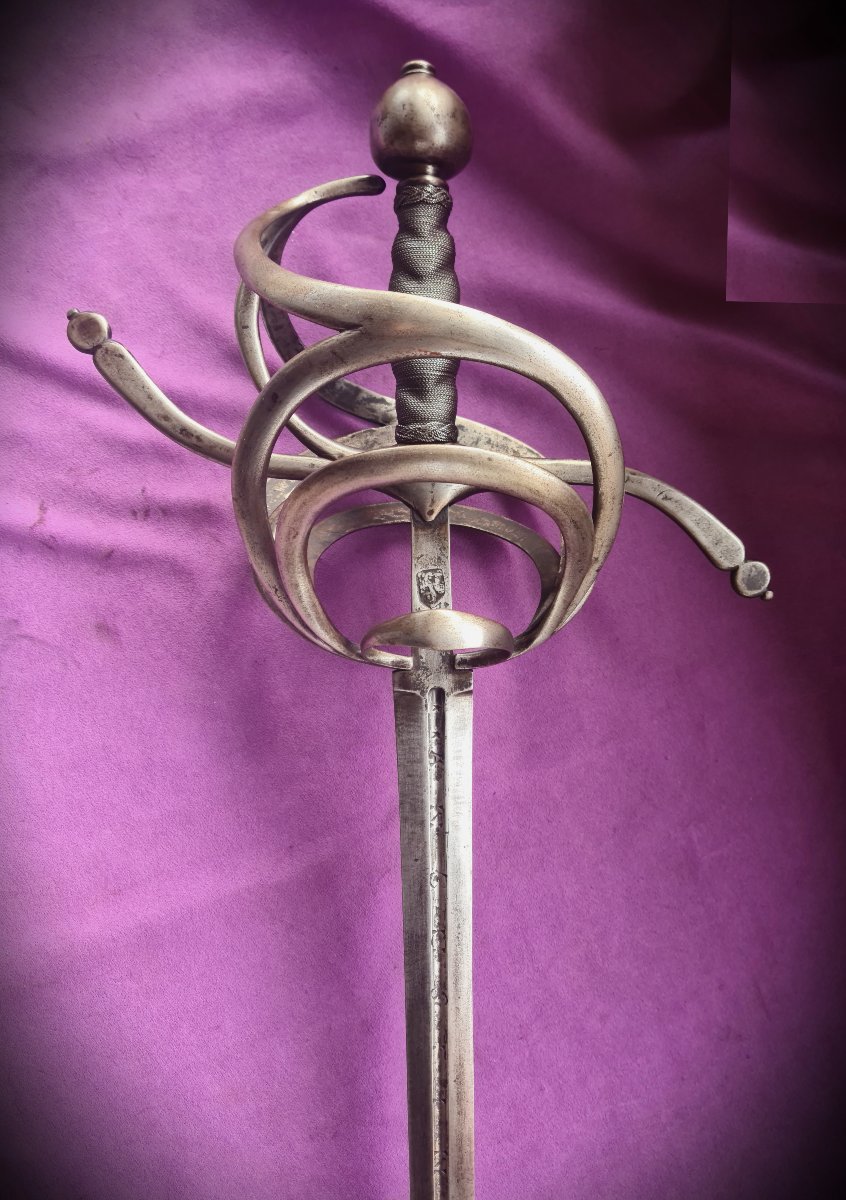
On each side, at the ricasso, there is a fleur-de-lis-shaped mark and a shield-shaped punch mark that I was unable to identify.
Blade length from the quillons to the tip = 112 cm, from the outer edge of the guard to the tip : 105.5 cm, width at the shoulder: 3 cm,thickness at the shoulder : 7.2 mm.
The balance is excellent, as the balance point is 5 cm from the edge of the guard.
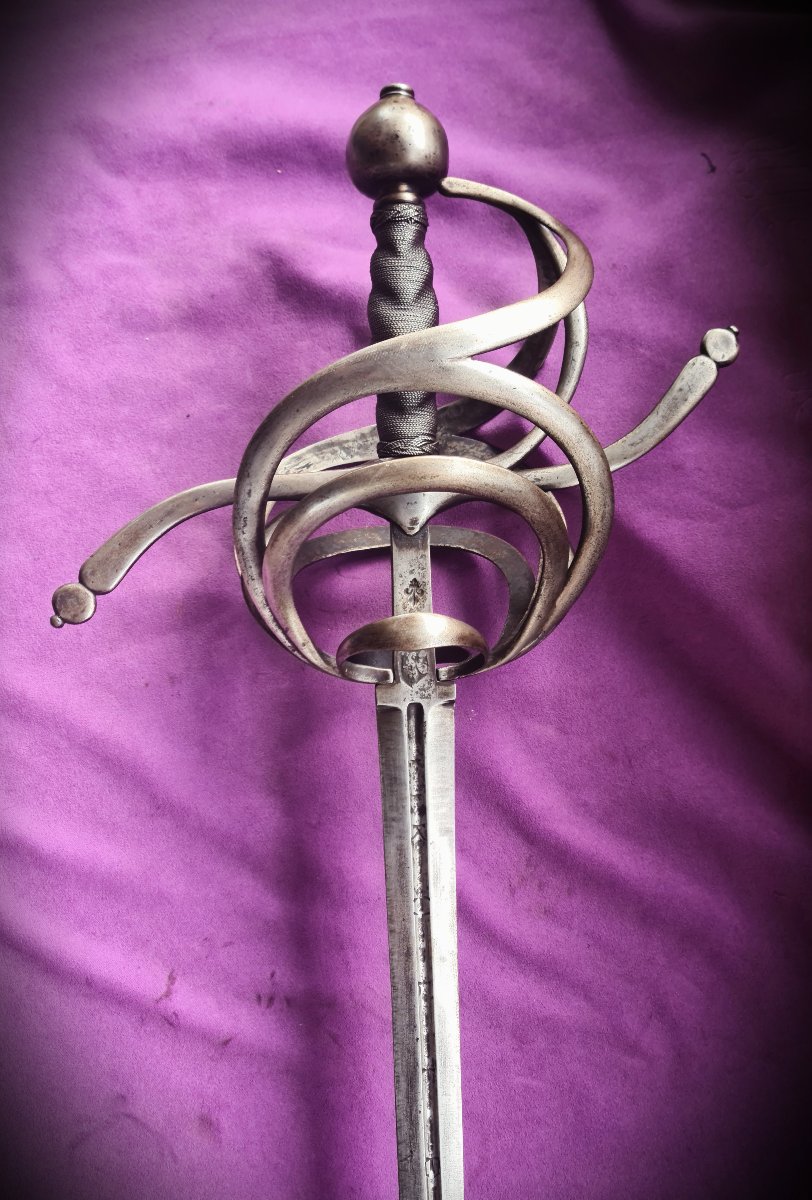
GUARD: On each side, there are 3 flattened rings ; the ring closest to the pommel extends to form a secondaryg uard branch that joins the knuckle bow near thepommel. The wide, reverse-curved quillons are terminated by small, flattened spheres. The guard is completed by two very large finger rings known as “donkey’s steps” or “arms” that join the rings of the guard.
POMMEL: It is shaped like a pointed bulb. This pommel is topped by a small, flattened buton to which the blade tang is riveted.
TANG : It is worked in a chevron pattern and covered with a double twisted iron wire binding , arranged in chevrons. The braided ring ferrules known as “Turk's heads” are present and in perfect condition.
This imposing rapier will fit naturally into a collection of early period weapons.
Ref. AMB-1616
Shipping fee contribution via UPS: France €60, Europe €80 Total length 128.5 cm
3 200 €
Period: 16th century
Style: Renaissance, Louis 13th
Condition: Excellent condition
Material: Other
Length: 128.5
Width: aux quillons 29 cm
Reference (ID): 1854792
Availability: In stock
Print