

Riga, 1600–1650, Jewelry Box, Lockable Case, Solid Silver Inlays
Rare tortoiseshell and solid silver jewelry box – Riga, circa 1650
A remarkable mid-17th-century jewelry box, likely made around 1650 in Riga, then an important Baltic trading city under Swedish rule.
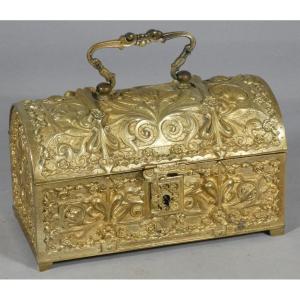
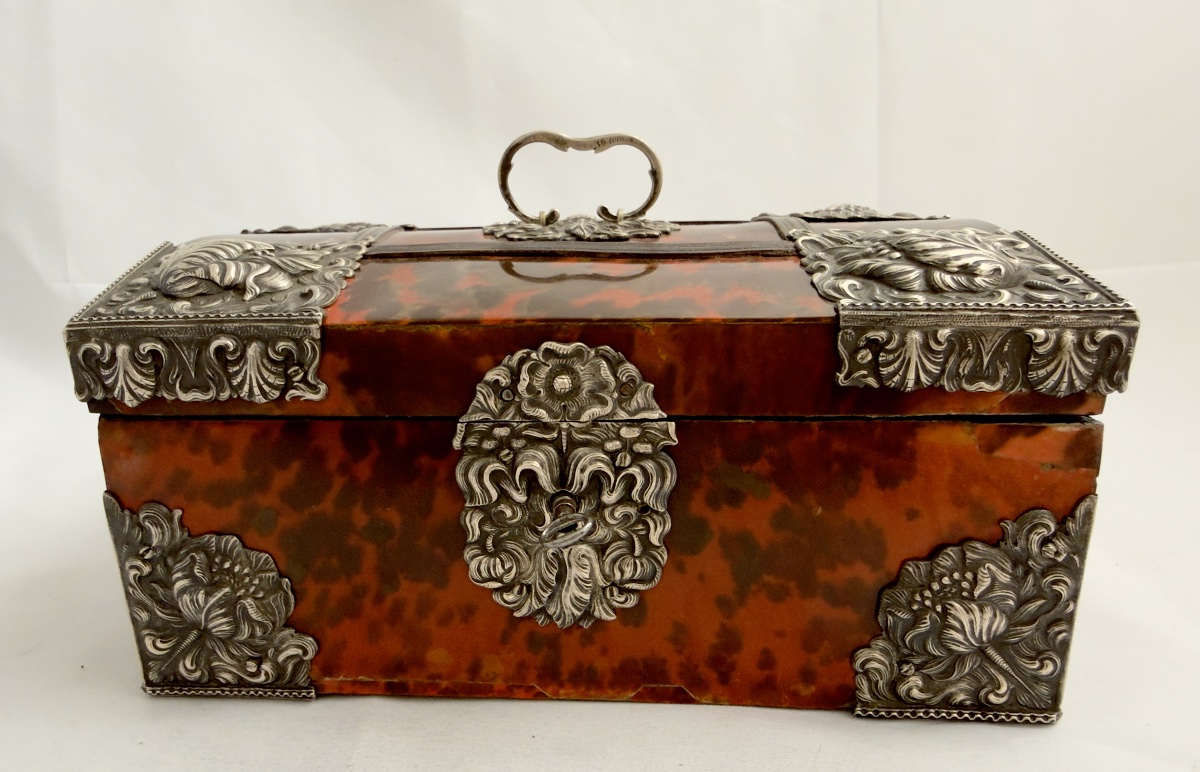
Rectangular in shape, this box features a slightly domed lid and a beechwood frame—a wood frequently used in the manufacture of this type of precious casket. The entire piece is inlaid with genuine tortoiseshell plates, displaying magnificent shades of reddish-orange and dark brown.
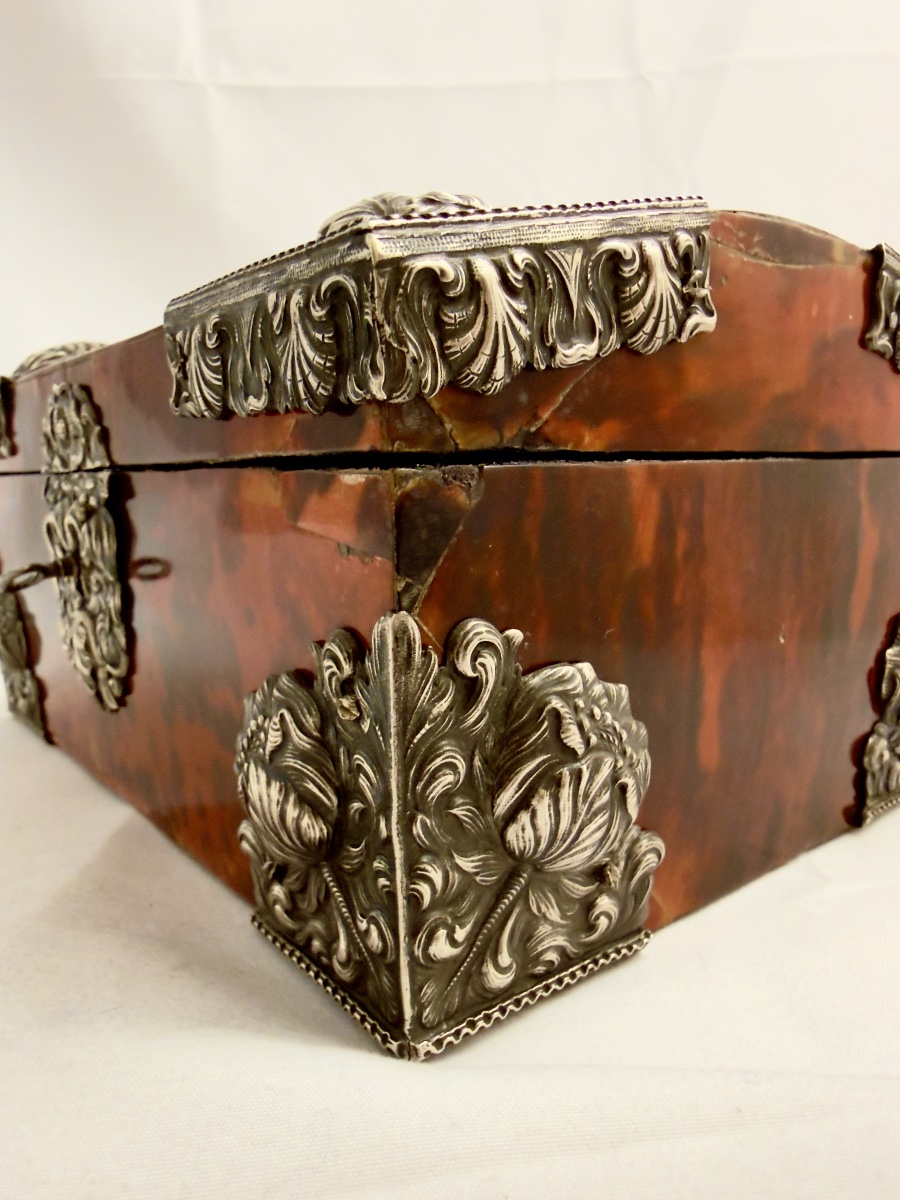
The box is embellished with substantial solid silver mounts, contemporary to its creation. The four corners of the lid are adorned with large spandrels of repoussé and chased silver, decorated with blooming flowers, foliage, and bold volutes characteristic of 17th-century Baroque design. Matching finials protect the lower corners of the box.
The lid is topped by a movable silver handle, mounted on a floral appliqué. The lock, which still has its key, is accompanied by a substantial silver lock plate, richly decorated with plant motifs.
The interior retains some of its original fittings, notably a small mirror and remnants of fabric in the lid. These elements confirm its original purpose as a jewelry box or a case intended to hold precious personal items. On the inner surface of the front panel, fragments of engravings and old papers that were once used to line the box also remain.
A type of precious casket common in 17th-century Europe
This casket belongs to a type of small, precious casket that saw significant development throughout Europe during the 17th century. Intended for storing jewelry, personal items, or other valuables, these boxes frequently combine a wooden structure with luxurious materials—notably tortoiseshell, ivory, or ebony—embellished with finely crafted metal mountings.
Several production centers stood out in this craft, particularly Antwerp, cities in Bavaria, and various Italian workshops. Despite their regional variations, these boxes reflect a taste shared by European elites for precious objects, where the richness of the materials is combined with the refinement of the craftsmanship.
Hallmarks and Origin
The lid’s handle bears the inscription “16 Loth,” corresponding to the theoretical fineness of 16/16, or 1,000 parts per thousand of silver. The Loth or lötig system of measurement was traditionally used in German-speaking regions and in several areas of Central and Northern Europe.
Two hallmarks are also visible on the reverse of the handle: one featuring two crossed keys in a saltire, attributed to the city of Riga, and a heart-shaped maker’s mark containing three initials, which appear to read GSF or GSP.
This latter hallmark has not yet been definitively attributed to a specific silversmith.
In the 17th century, Riga was an important commercial and artisanal center in the Baltic region, where many artisans and silversmiths from the Germanic world worked. The richness of the mountings, the quality of the silverwork, and the use of genuine tortoiseshell plates attest to the particularly luxurious nature of this casket.
The preservation of part of its original interior trim, along with its silver mountings and key, enhances the historical significance of this rare object.
Origin: Riga, present-day Latvia, then under Swedish rule.
Date: mid-17th century, circa 1650.
Materials: genuine tortoiseshell, solid silver with a fineness of 16 Loth, beech wood, mirror, fabric, and antique papers.
Silversmith: heart-shaped master’s mark, initials GSF or GSP, unidentified.
Dimensions: length 21 cm × width 15 cm × height 9 cm.
Condition
In very good condition for an object dating from the mid-17th century. The solid silver mountings are intact, and the lock and its original key are still present. The tortoiseshell covering is generally in excellent condition. An old restoration, likely carried out over a century ago, is visible on one of the corners of the box’s front panel. The interior retains some of its original furnishings, including the mirror, as well as fragments of fabric and paper.
Period: 17th century
Style: Renaissance, Louis 13th
Condition: Good condition
Material: Sterling silver
Width: 21 cm
Height: 9 cm
Depth: 15 cm
Reference (ID): 1853576
Availability: In stock