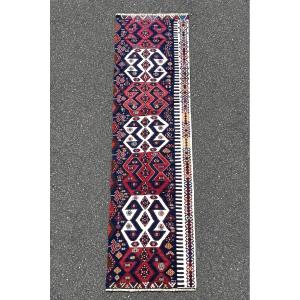
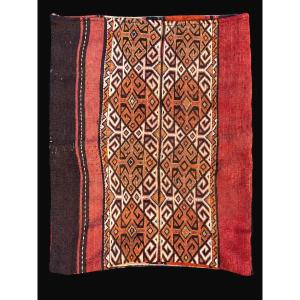
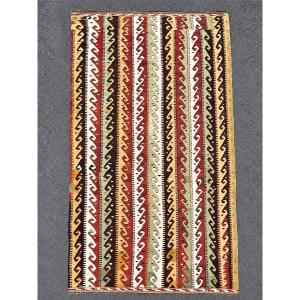
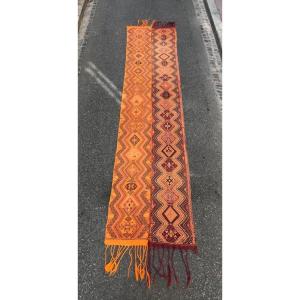
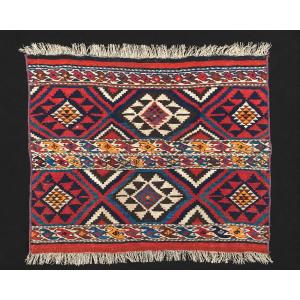
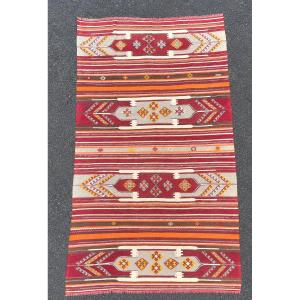
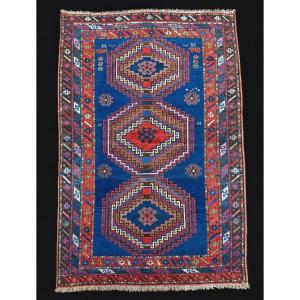
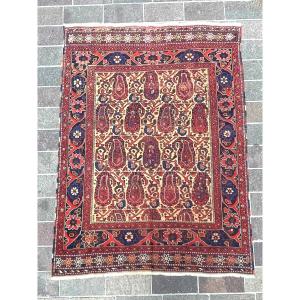
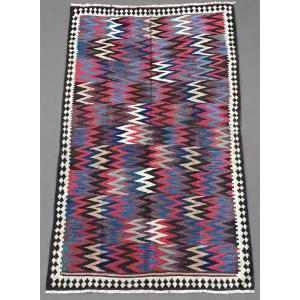
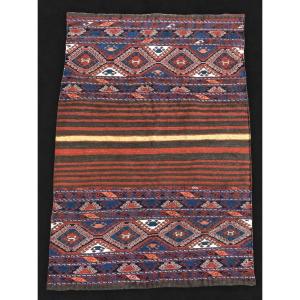
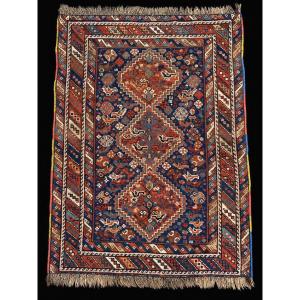
Chuval (grain Sack). Kocan / Persia. Circa 1900. 112 X 80 Cm.
As you may already know, we are passionate about ancient tribal textiles, those of formerly nomadic peoples.
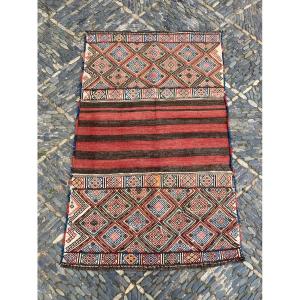
Here we see a chuval from Kocan, in Persia. Chuvals belong to the broad category of everyday textiles. They were used for storing and transporting grain.
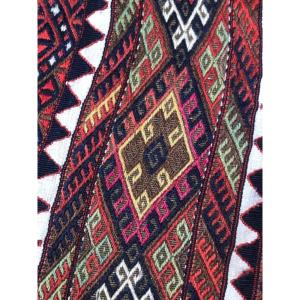
Its surface features a highly rhythmic composition, created by the alternation of narrow bands and wider embroidered sections. It features geometric motifs—diamonds, hook-shaped forms, and small crosses—in a palette of reds, dark blues, ivory, and muted tones. The piece combines several techniques: the front is embroidered, while the back is simply woven.
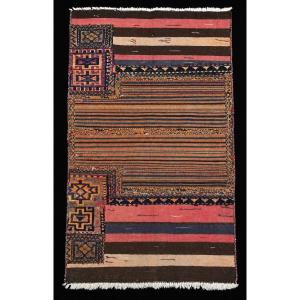
Turning the chuval over reveals a much more understated reverse side, made of camel wool. Its beautiful abrash—those variations in shade within a single color—are particularly striking. Here, they do not result from different dyes, but from the use of camel wool that is naturally lighter or darker in color. This precious and sought-after wool was more expensive than that of sheep or goats.
Kocan’s pieces are often highly refined. In this piece, the choice of materials is complemented by an extremely fine and tight weave. It is this meticulous craftsmanship—visible on both the front and the back—that gives this chuval its exceptional character and makes it a rare and precious object.
Kocan chuval, Persia
Woven and embroidered, wool on wool, mixed media
Plant-based dyes
Circa 1900–1920
Dimensions: 112 × 80 cm
In perfect condition
Choosing an antique rug or textile is often a matter of serendipity.
If this piece catches your eye, or if you’d like more information or photos, I’d be happy to discuss it with you.
Laurent Consul
Beauty of Kilims
06 42 61 73 46
650 €
Period: 20th century
Style: Orientalism
Condition: Excellent condition
Material: Wool
Length: 112 cm
Width: 80 cm
Reference (ID): 1849175
Availability: In stock
Print