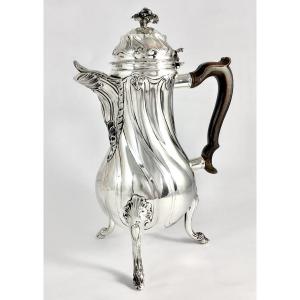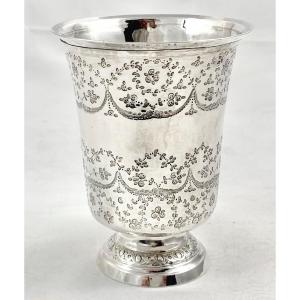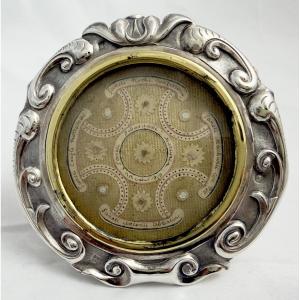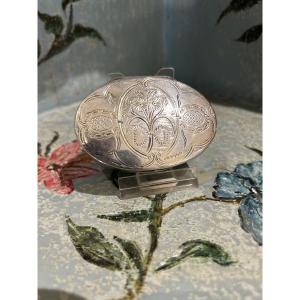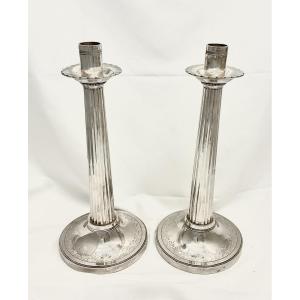



Paris, 1780, Louis XVI-style Water Jug Made Of Solid Silver
Solid Silver Ewer Basin with the Arms of the Beuverand de La Loyère and Sallier de Champolle Families
Paris, 1780–1781 — Louis XVI Period
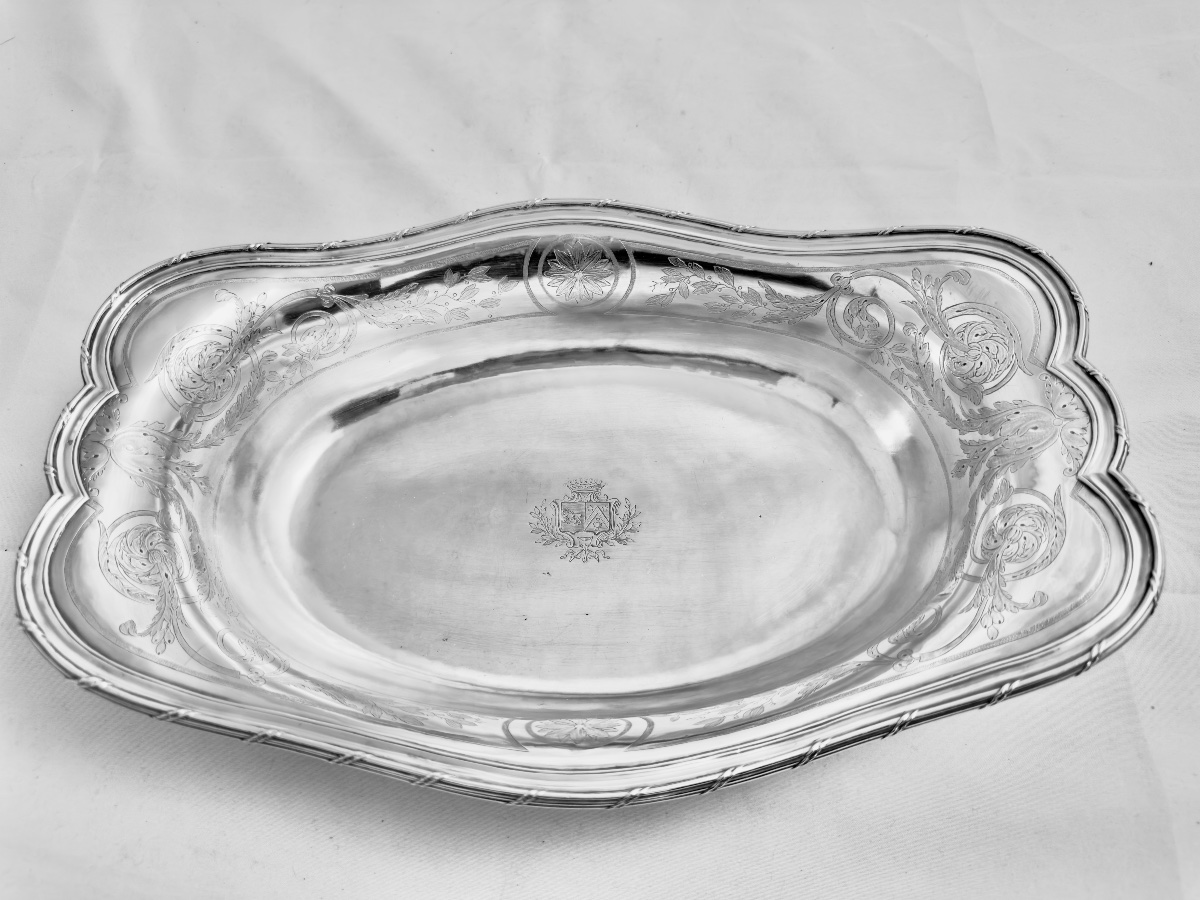
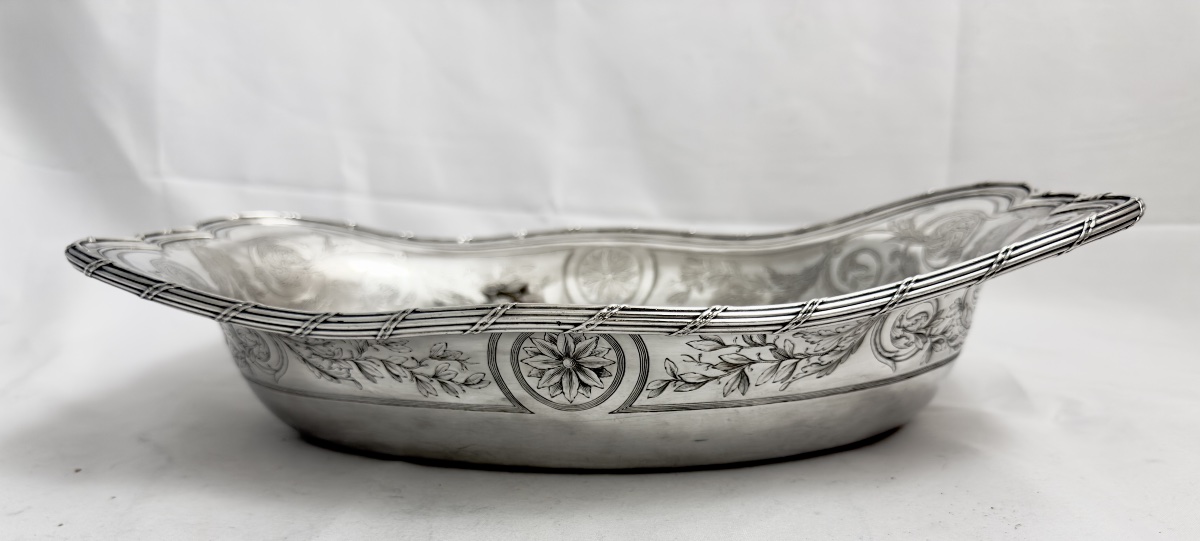
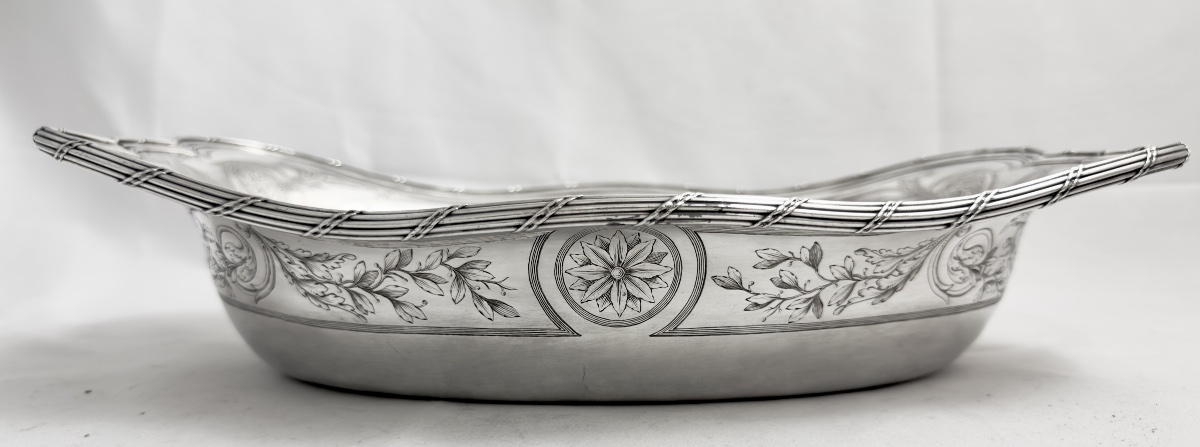
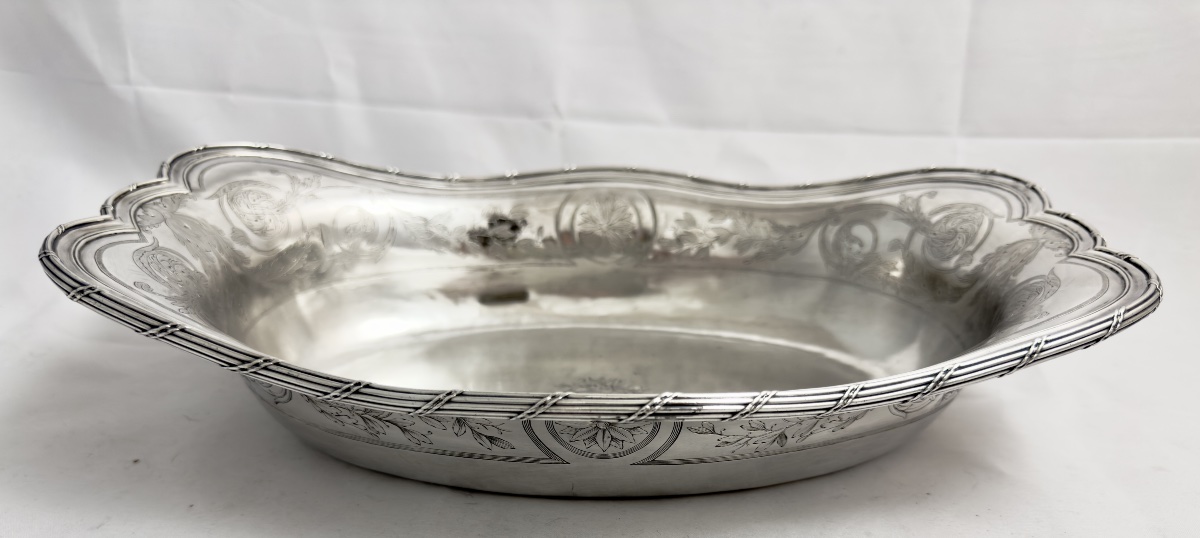
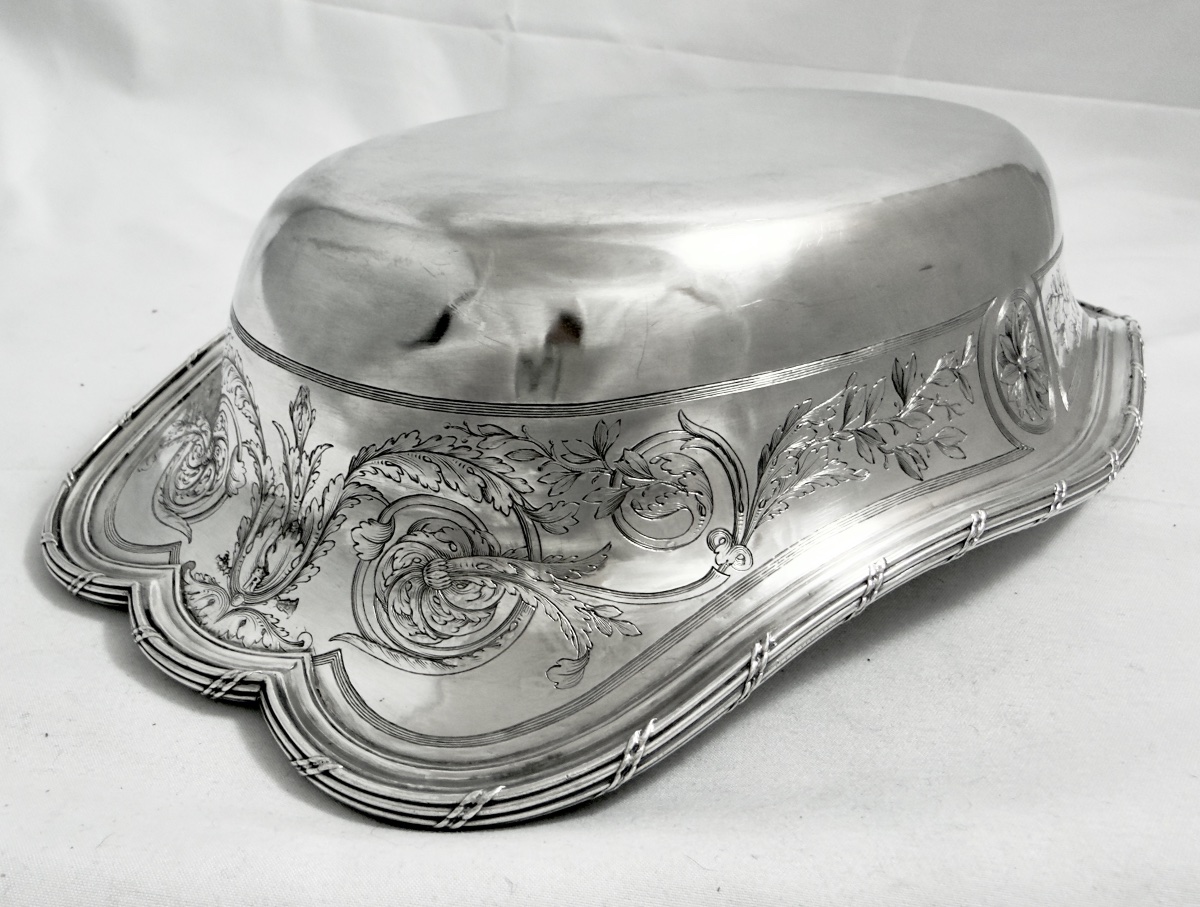
This solid silver ewer basin is distinguished by its elegant shaped outline, its ribbon-bound moulded border and, above all, the exceptional quality of its engraved decoration, extending over both the interior and exterior.
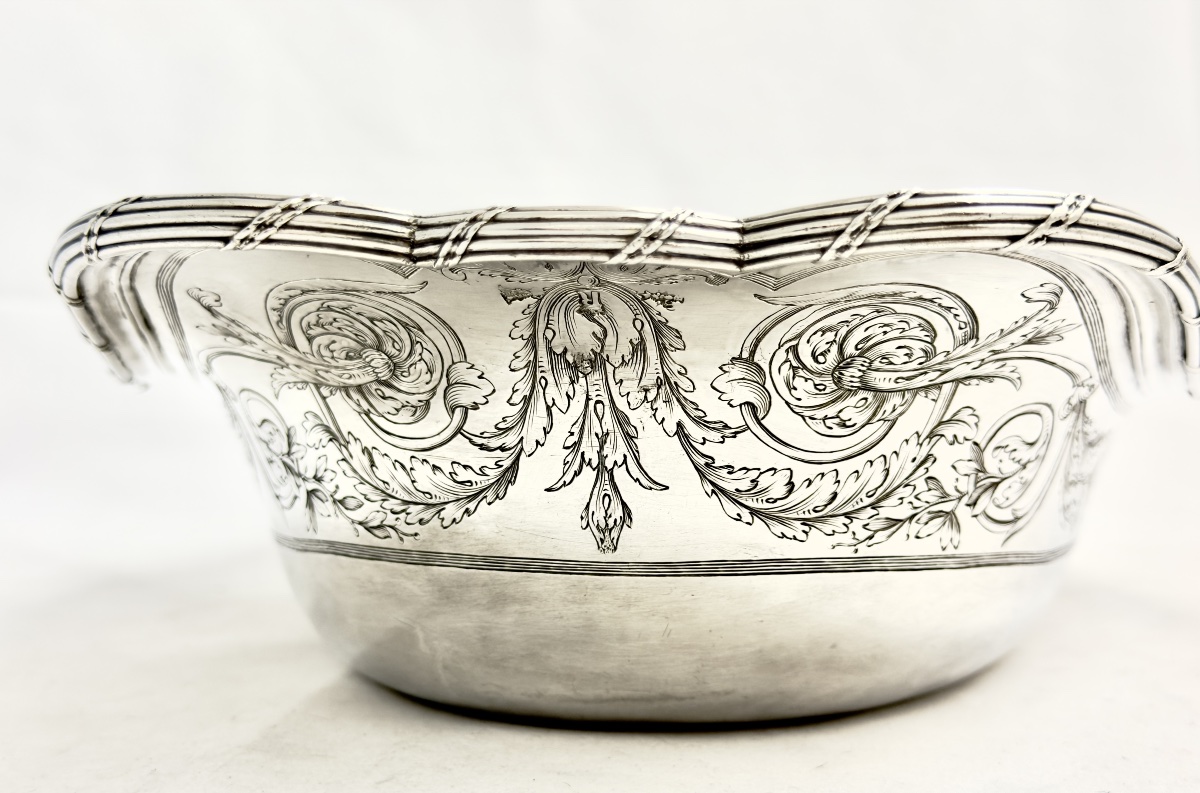
Oval in form, it has a deep well and flaring sides, with broadly curved, lobed ends. The rim is outlined by several parallel mouldings, regularly entwined with raised ribbons set diagonally. These finely detailed crossed ribbons appear to bind the mouldings into a continuous bundle. Their repetition follows the curves and changes of direction around the rim, while the carefully articulated profile creates subtle effects of light.
The sides bear a rich decoration of acanthus leaves, scrolls and interlacing curves, accompanied by leafy sprays and floral ornaments. Along the longer sides, rosettes enclosed within circular medallions punctuate the foliage, framed by engraved lines.
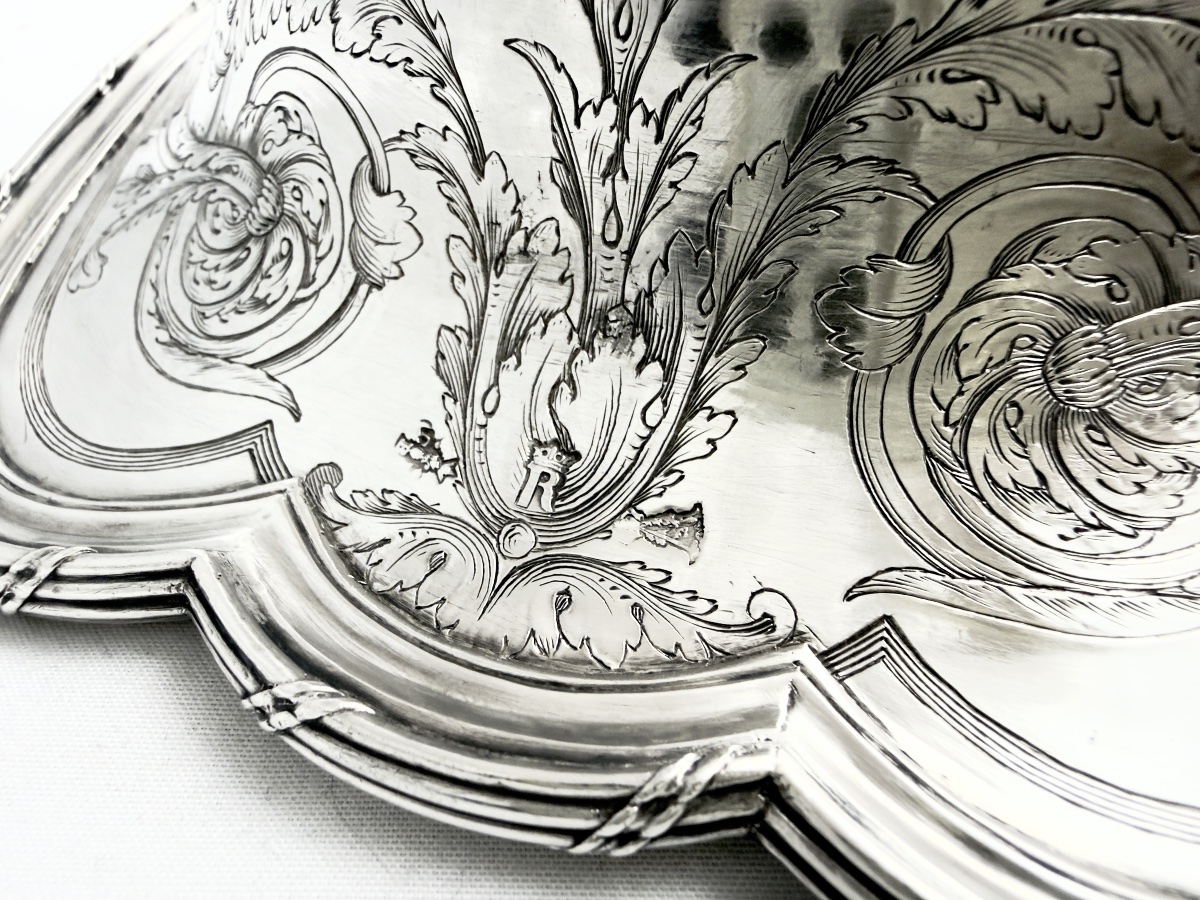
The extraordinary delicacy of the engraving is one of the principal attractions of this piece. The precise outlines, flowing stems and minute hatching used to model the leaves demonstrate particularly accomplished workmanship. Fine, light cuts alternate with more deeply engraved lines, lending depth and movement to the ornament. The same refinement appears on both the exterior and interior surfaces: this extensively developed decoration on both sides gives the basin its exceptional character.
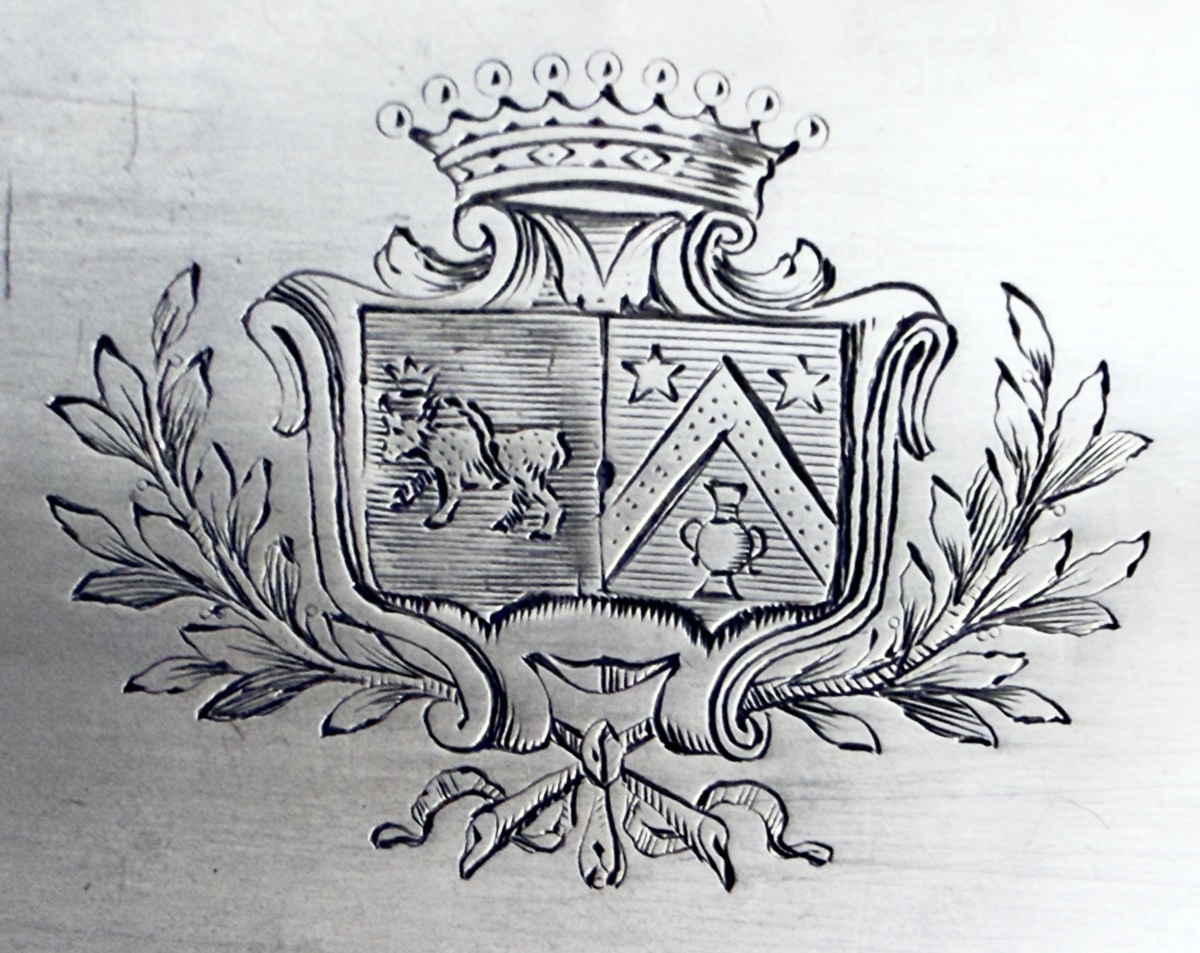
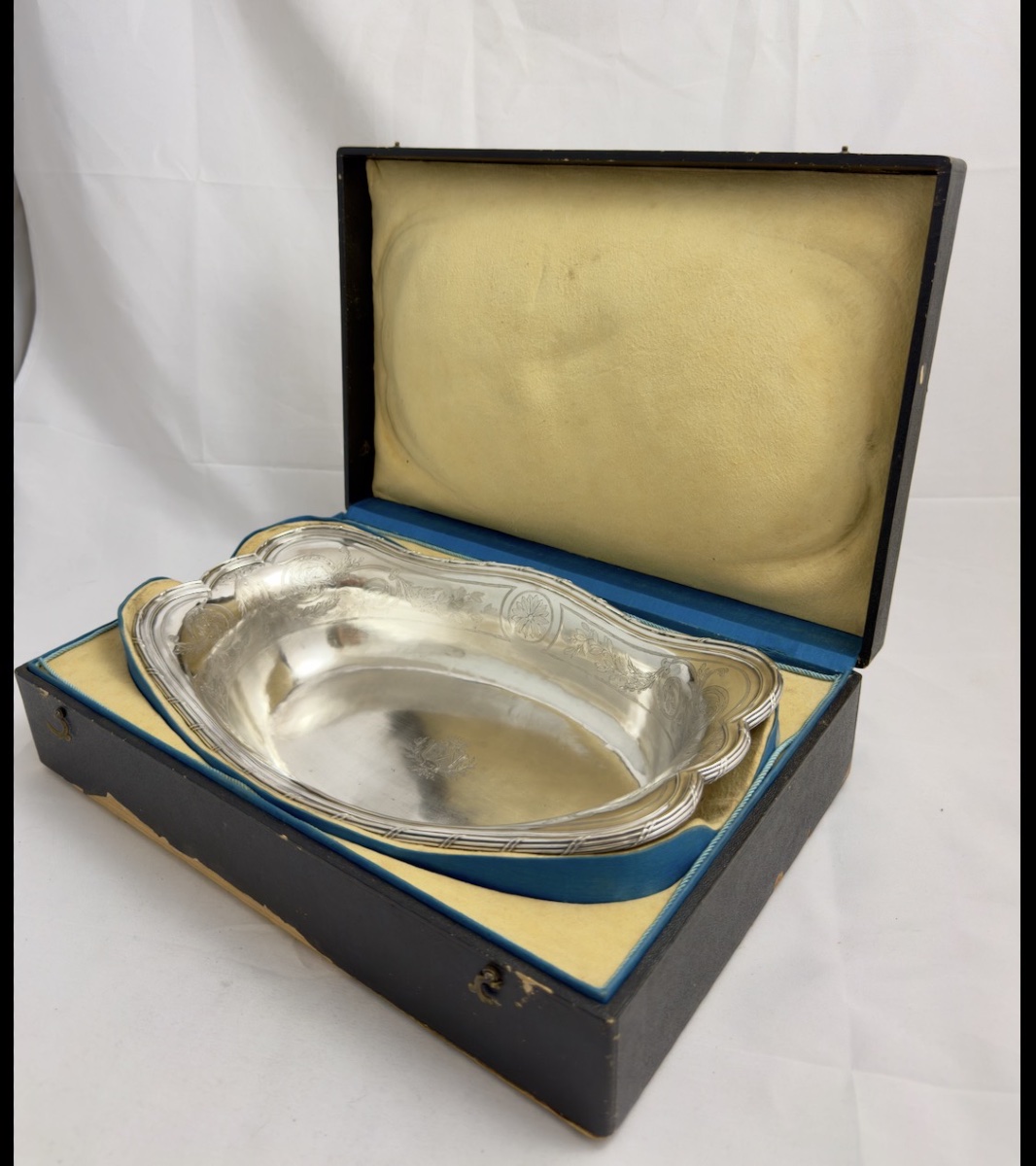
At the centre of the well, a plain reserve displays the marital arms of the Beuverand de La Loyère and Sallier de Champolle families. The shield is divided vertically, combining the crowned ox passant of the Beuverand family with the chevron accompanied by two stars and a vase of the Sallier family. It is framed by a scrolling cartouche, surmounted by a coronet and flanked by leafy branches tied with a ribbon bow.
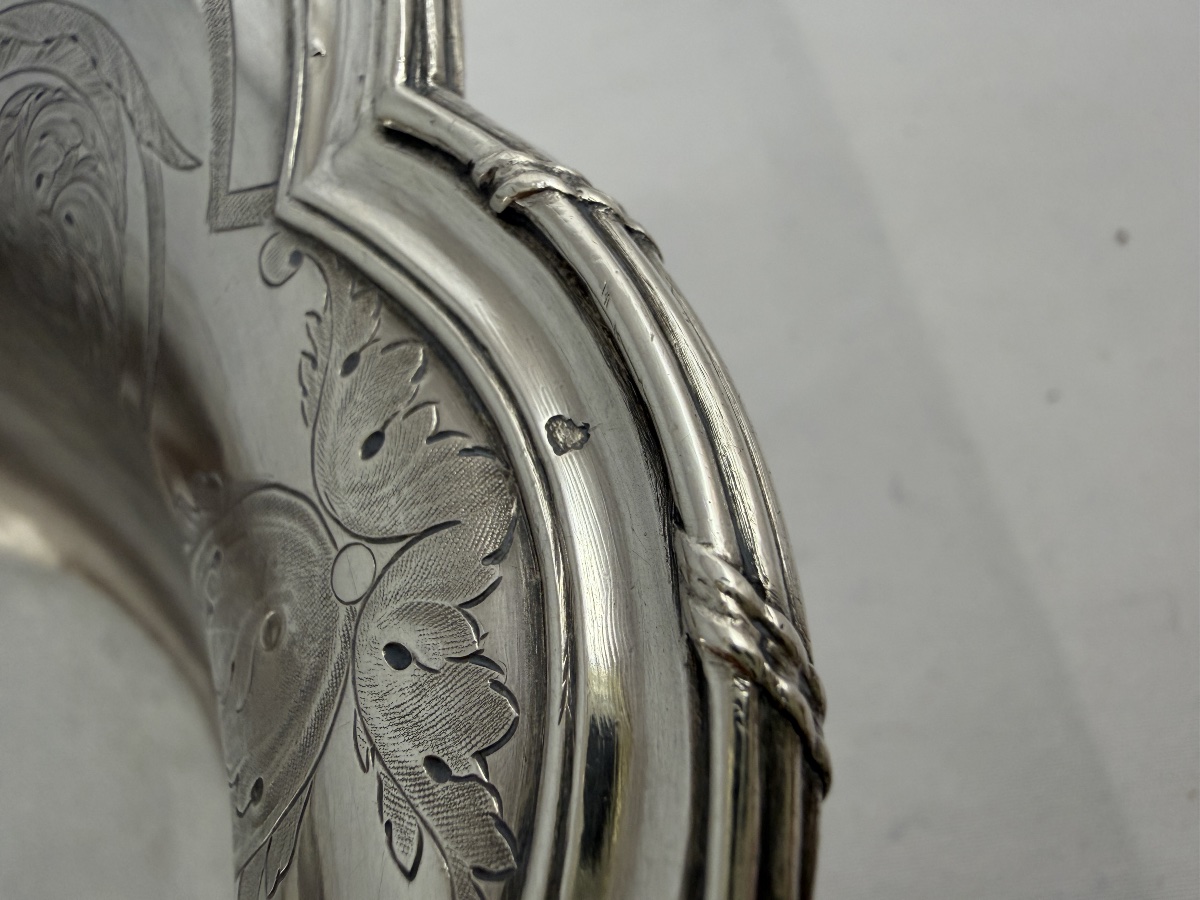
The basin bears the following Paris hallmarks:
- Duty charge mark: a large crowned A, used in Paris for large silver articles during 1780–1782.
- Warden’s date mark: a crowned R, corresponding to the period from 15 July 1780 to 1 August 1781. This date letter establishes the precise dating of 1780–1781.
- Duty discharge mark: a cherub’s head, registered on 26 August 1780 and used until September 1782. This mark is recorded for gold and small silver articles.
These marks place the basin in the years immediately preceding the French Revolution. Their chronology closely corresponds to the marriage of the two families whose arms it bears.
The marriage took place on 20 May 1781 at Frotey-lès-Vesoul, between Jean-Baptiste-Pierre-Marguerite de Beuverand de La Loyère and Anne-Louise-Pierrette-Joséphine Sallier de Champolle. The correspondence between the date of the basin and that of the marriage suggests that it may have been commissioned to mark their union.
Born in Chalon-sur-Saône on 31 March 1757, Jean-Baptiste-Pierre-Marguerite belonged to a family firmly established in Burgundy. An écuyer, or member of the untitled nobility, and Lord of La Loyère and Fragnes, he took his territorial designation from two neighbouring estates north of Chalon-sur-Saône, now united within the municipality of Fragnes-La Loyère. He served as a captain in the Artois Dragoon Regiment, a cavalry regiment of the royal army which became the 12th Dragoon Regiment in 1791.
He was the son of Marie-Jacques-Auguste de Beuverand de La Loyère, likewise Lord of La Loyère and Fragnes, and Catherine-Marie Champion de Nansouty. His paternal grandfather, Jacques-Louis-Auguste de Beuverand (1661–1715), had been admitted as a councillor to the Parlement of Metz in 1693, illustrating the family’s connections with the judicial nobility.
Through his mother, the daughter of Edmé-Étienne-François Champion de Nansouty and Marie-Charlotte-Françoise Bretagne, Jean-Baptiste was a first cousin of General Étienne-Marie-Antoine Champion de Nansouty (1768–1815). A general of division and Count of the Empire, Nansouty distinguished himself as one of Napoleon’s leading cavalry commanders.
His wife likewise came from a family of landed proprietors and officers serving the monarchy. Her father, Joseph-Pierre Sallier de Champolle, an écuyer and Lord of Frotey and Pusey, had been a captain in the Poitou Regiment before becoming a commissary attached to the second company of the King’s Bodyguard. Her mother, Louise-Antoinette-Gabrielle Poulletier de Périgny, was the daughter of Louis-Claude Poulletier de Périgny and Anne de La Combe.
The choice of Frotey-lès-Vesoul as the location for the wedding was probably connected with the bride’s family estates. The estate records of Louise-Antoinette-Gabrielle, who died in 1772, mention an inventory drawn up at the Château de Frotey in 1773. This château, which still survives, later became the nineteenth-century residence of the novelist Xavier de Montépin (1823–1902), particularly remembered for La Porteuse de pain.
The couple subsequently settled in Chalon-sur-Saône, where both spent their final years. Jean-Baptiste lived through the upheavals of the Revolution: his imprisonment at the former Cordeliers convent in Chalon during 1793–1794 is recorded with reference to Paul Montarlot’s study of the Émigrés de Saône-et-Loire, published in the Mémoires de la Société éduenne in 1914. Anne-Louise-Pierrette-Joséphine died in Chalon-sur-Saône on 6 April 1829; her husband survived her until 13 July 1836.
Their descendants continued the family’s military tradition. The eldest of their five children, Pierre-Joseph-Armand de Beuverand de La Loyère, generally known as Armand (1782–1857), became a maréchal de camp during the nineteenth century, a rank equivalent to brigadier general.
The basin remains housed in an antique fitted case, probably dating from the nineteenth century. Made of wood covered in black waxed paper, the case has a chamois leather lining with blue edging following the outline of the basin.
Solid silver — Paris, 1780–1781.
Net weight: 889.5 grams.
Antique fitted case in wood, black waxed paper and chamois leather, probably nineteenth century.
Period: 18th century
Style: Louis 16th, Directory
Condition: Some repairs
Material: Sterling silver
Length: 33 cm
Diameter: 22 cm
Height: 8 cm
Reference (ID): 1848422
Availability: In stock