
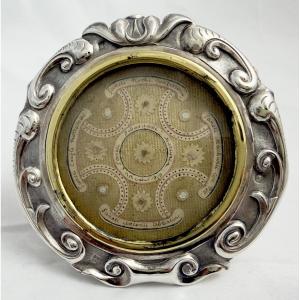


Osculatory Reliquary, Solid Silver, Bruges, 1831–1868, Philippus Meys, Kiss Of Peace
SILVER RELIQUARY PAX CONTAINING FIVE RELICS
Bruges, 1831–1868 — Philippus Petrus Mys (1801–1881)
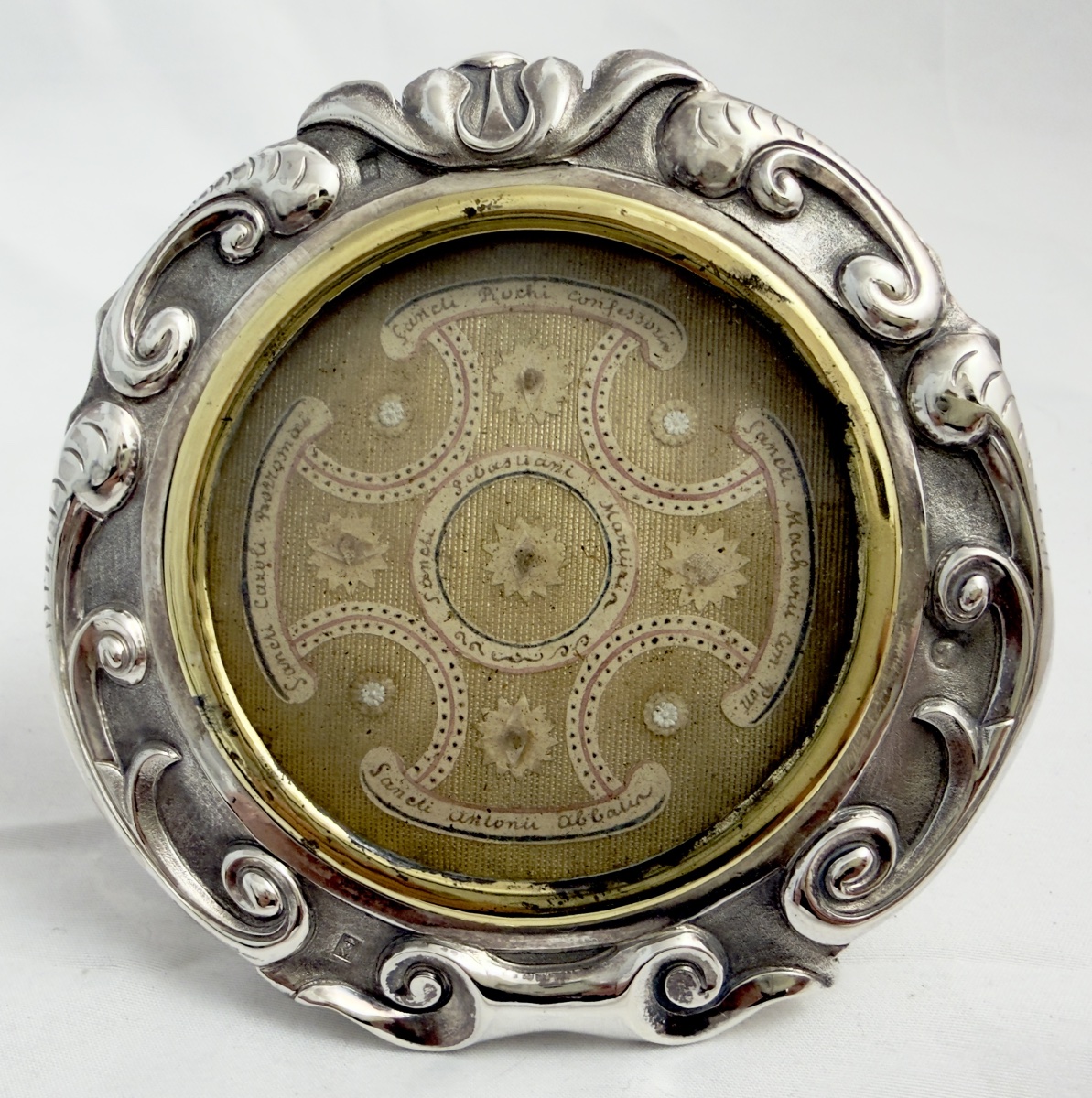
A solid silver reliquary pax, also known as an osculatory reliquary, made in Bruges by the silversmith Philippus Petrus Mys, whose surname is also written Meys. This object combines an elaborately decorated mount with a reliquary containing relics of five saints traditionally invoked against illness and epidemics.
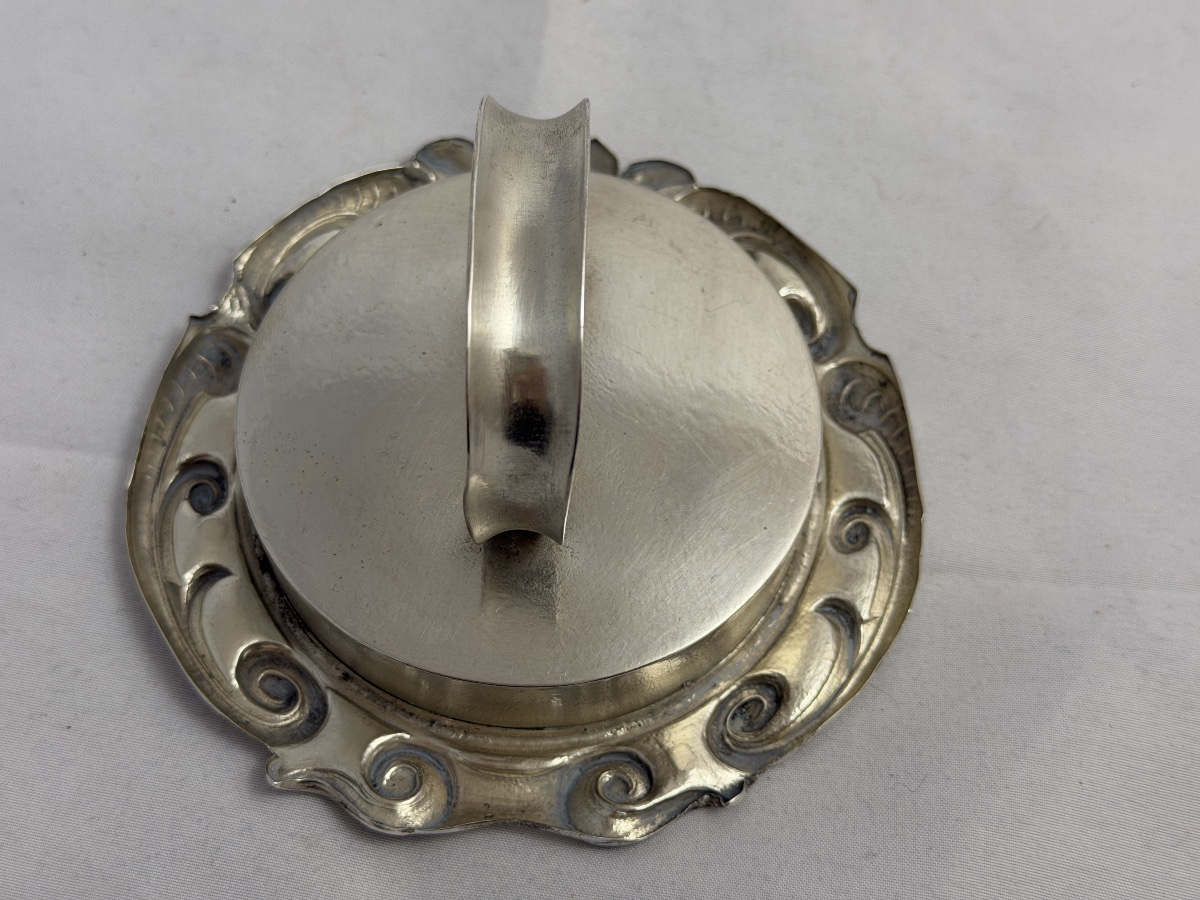
The circular mount features Rococo-inspired decoration composed of C-scrolls, curling foliage and shell motifs forming an undulating outline. The polished ornaments stand out against a finely matted ground, emphasising the relief and the play of light across the silver. A shell motif crowns the composition. On the reverse, a broad, curved handle allows the object to be held and presented for veneration.
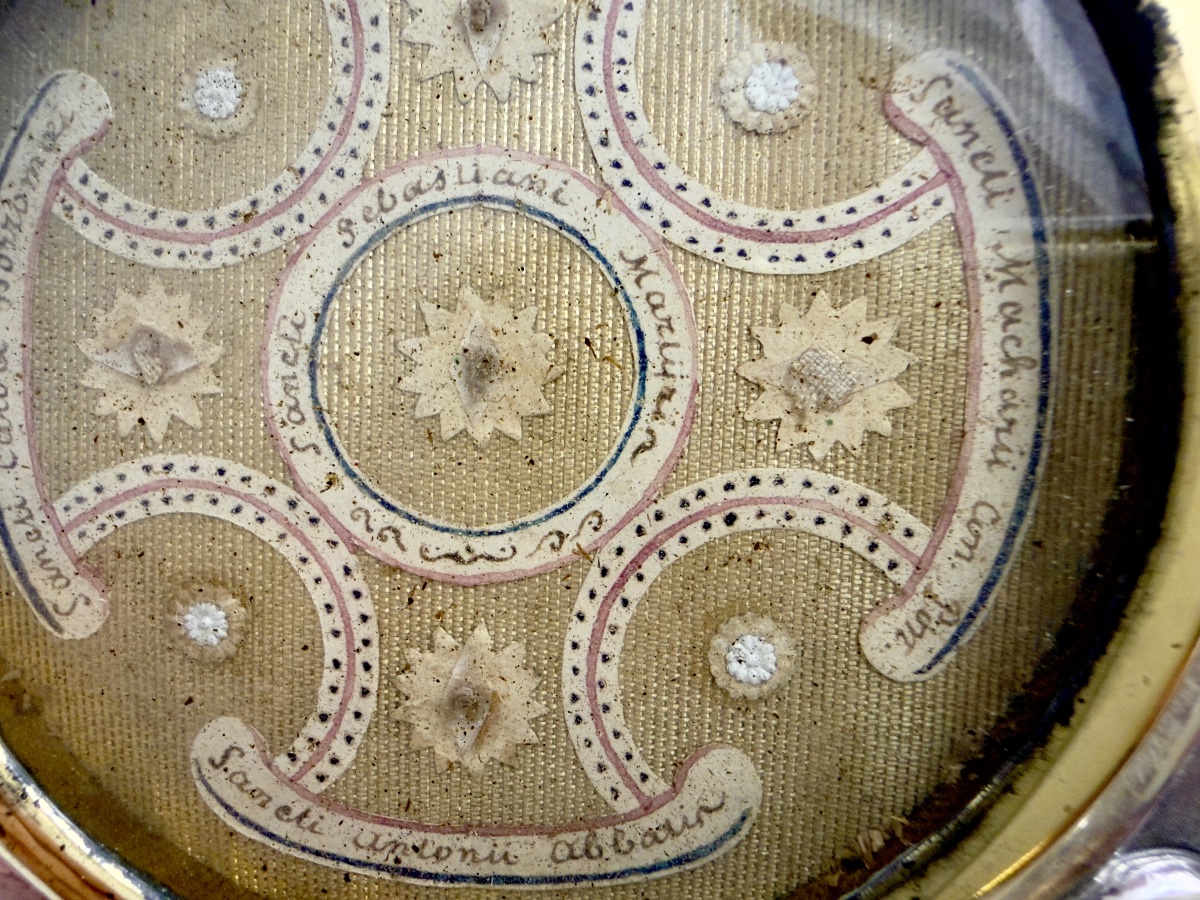
A gilt inner border frames the glass protecting the five relics. Against a gold-coloured textile ground, painted paper scrolls form a symmetrical arrangement around a central medallion. Outlined in pink and blue and embellished with dotted decoration, they bear the saints’ names handwritten in Latin. The relics are placed on star-shaped paper ornaments, with floral rosettes completing the carefully arranged composition.
THE FIVE SAINTS
At the centre is Saint Sebastian, a Roman martyr of the third century. According to tradition, this officer in the Roman army remained faithful to Christianity during the persecutions under Diocletian. He survived an initial execution by arrows before subsequently being put to death. He became one of the principal saints invoked for protection against the plague.
Around him are arranged the relics of four further saints:
Saint Roch of Montpellier, a fourteenth-century pilgrim, is said to have devoted part of his journey through Italy to caring for plague victims before contracting the disease himself. According to legend, a dog brought him bread while he lived in seclusion outside the town. Usually depicted as a pilgrim, displaying a wound on his thigh and accompanied by a dog, he is among the saints most widely invoked against the plague.
Saint Macarius of Ghent, a pilgrim and bishop from the East, was, according to tradition, of Armenian origin and Archbishop of Antioch. Welcomed at Saint Bavo’s Abbey in Ghent in 1011, he died there in 1012 during an epidemic. His veneration as a protector against contagious diseases became particularly widespread in the Low Countries. His relics are preserved in Saint Bavo’s Cathedral in Ghent.
Saint Anthony Abbot, an Egyptian hermit who lived circa 251–356, distributed his possessions among the poor before withdrawing into the desert. His example attracted numerous disciples, and he came to be regarded as one of the fathers of Christian monasticism. He was invoked against various illnesses, notably “Saint Anthony’s fire”, as well as the plague. His customary attributes are a tau-shaped staff, a bell and a pig.
Saint Charles Borromeo (1538–1584), Cardinal and Archbishop of Milan, played a major role in implementing the reforms of the Council of Trent. During the plague epidemic of 1576–1577, he organised relief for the sick and the poor and devoted his resources to their care. Canonised in 1610, he became an exemplary figure of Christian charity and an intercessor invoked during epidemics.
The association of these five saints suggests a devotion intended to seek their protection against illness and epidemics. This shared spiritual purpose lends particular significance to the ensemble.
In the inscriptions, the Latin title confessor, meaning “confessor of the faith”, designates a saint who bore witness to his faith through his life without suffering martyrdom. Here, it does not mean a priest who hears confessions.
THE SILVERSMITH AND HALLMARKS
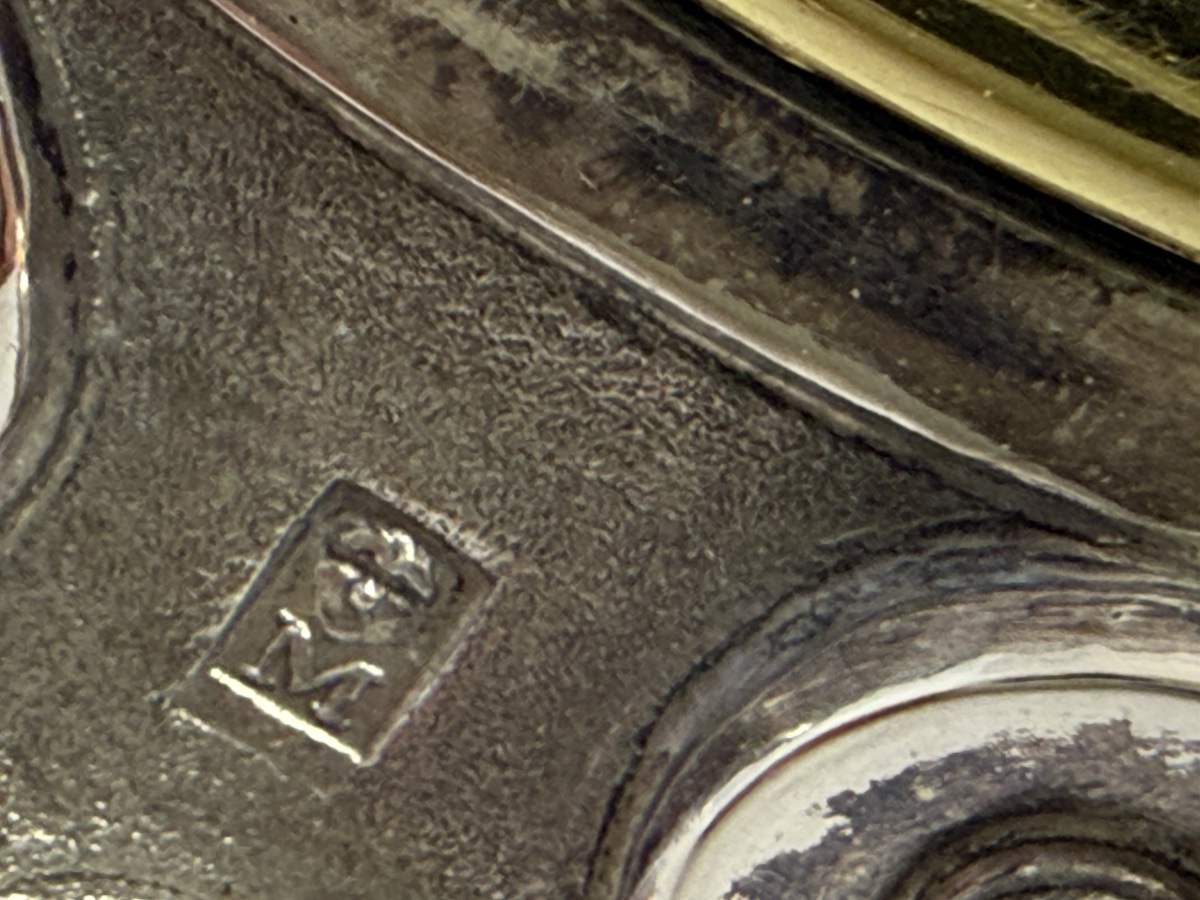
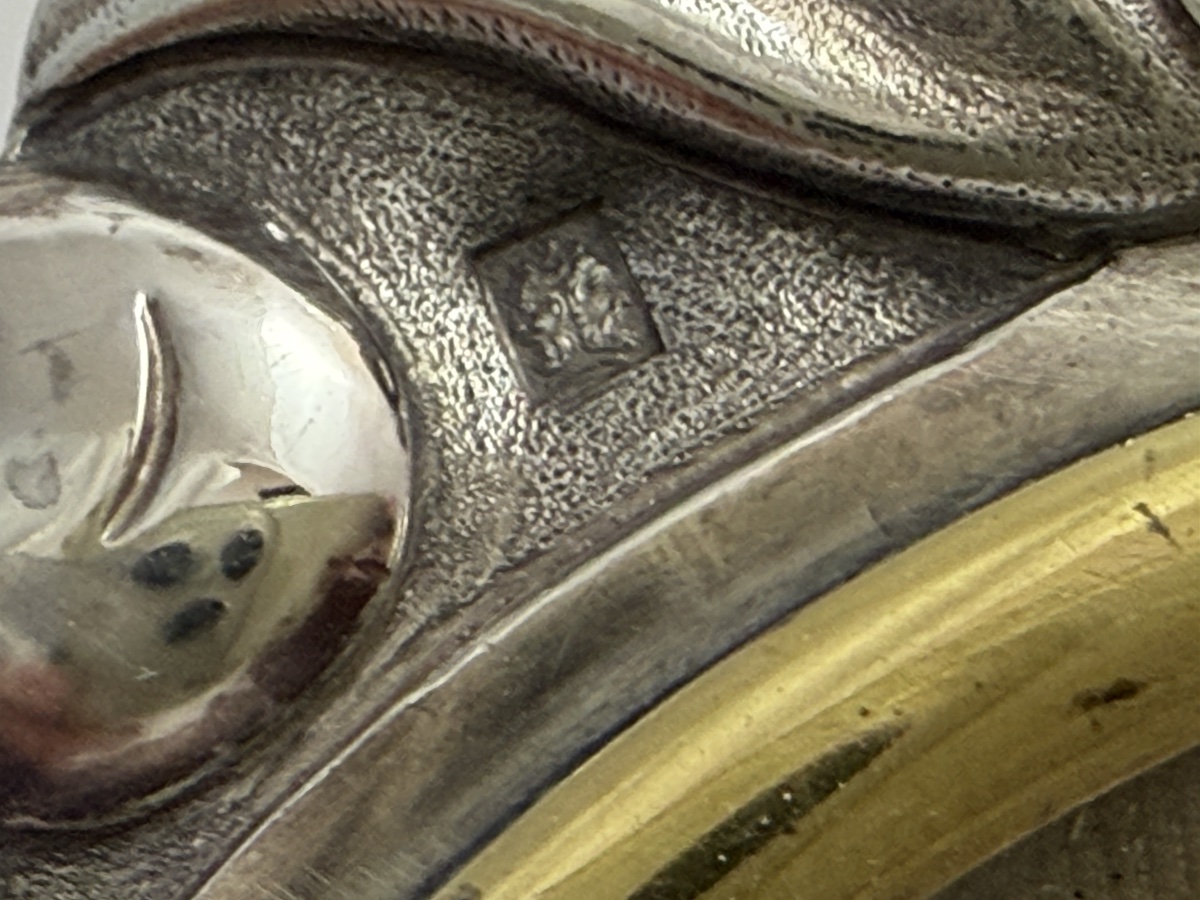
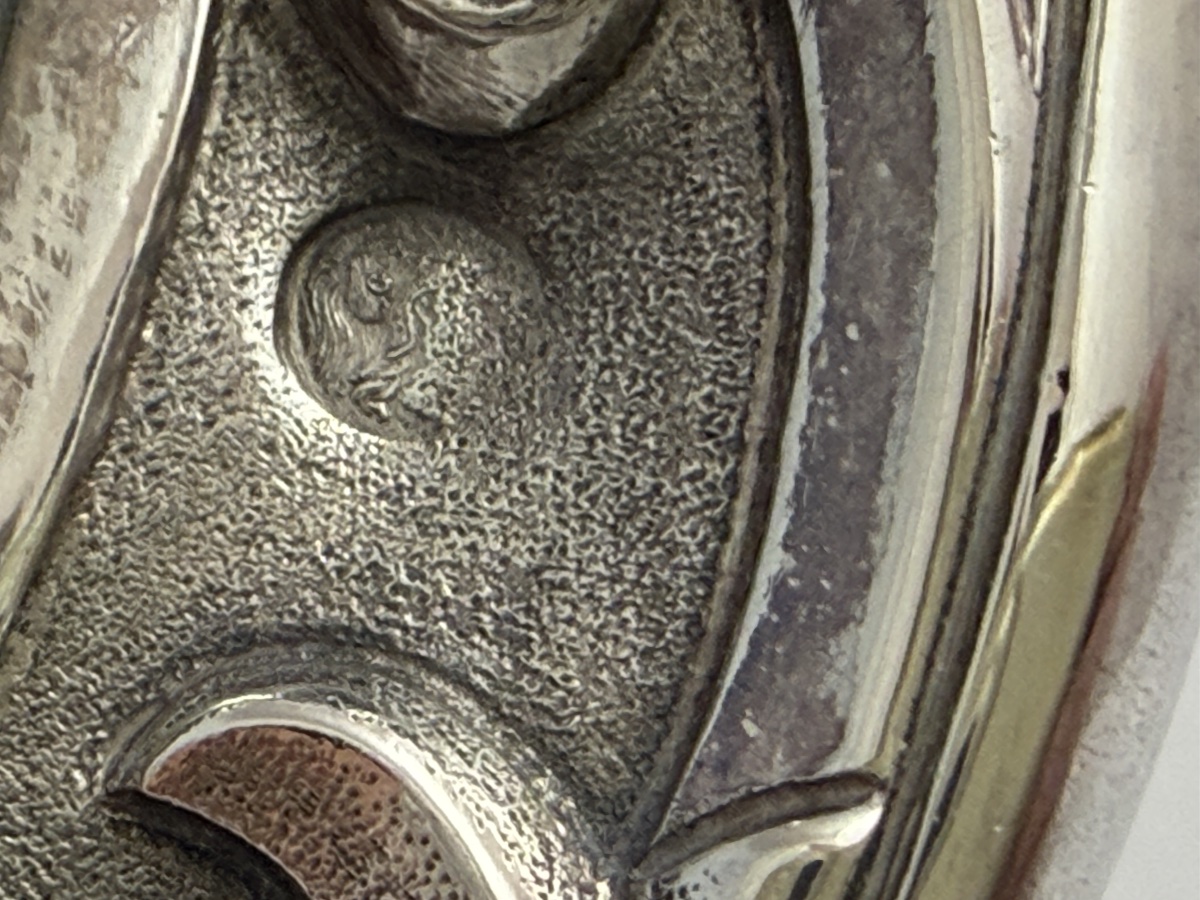
The mount bears the maker’s mark of Philippus Petrus Mys the younger: a stylised head above the letter M within a rectangular frame. It also carries the Belgian silver standard and guarantee marks for the period 1831–1868, together with the identifying mark of the Bruges assay office.
Philippus Petrus Mys was born in Bruges on 2 December 1801. The son of the silversmith Philippus Bellarminus Mys and Maria Carolina Van Speybrouck, he gradually took over his father’s activities and continued the family workshop independently after his father’s death. Until 1868, he remained at the house known as Amsterdam in Steenstraat, Bruges. He remained unmarried and died in Bruges on 10 October 1881.
His rectangular maker’s mark repeats the symbols of his father’s mark, which were enclosed within a lozenge. The introduction of this new shape is tentatively dated to the 1830s, when he is thought to have registered his own mark.
THE RELIQUARY PAX AND THE KISS OF PEACE
The term osculatory derives from the Latin osculum, meaning “kiss”. It indicates that the object was intended to be presented for veneration by kissing. The expression “osculatory reliquary” therefore emphasises its dual function: preserving relics and allowing the faithful to express their devotion to them.
This form is associated with the tradition of the kiss of peace and the pax, the Latin word for “peace”. In Christian worship, the kiss of peace expressed reconciliation and fellowship. From the thirteenth century onwards, portable plaques are documented as a means of transmitting this kiss: members of the clergy and the congregation would kiss the same object in succession, according to local custom. The practice spread across Europe during the late Middle Ages.
These objects, known as paxes or osculatories, could be made of ivory, wood, copper or silver. A handle on the reverse allowed them to be presented. Often decorated with an image of Christ, the Virgin or a saint, some incorporated relics behind a transparent cover, combining the form of the pax with the function of a reliquary. This Bruges example belongs to that tradition.
Dimensions: diameter 12.5 cm; overall depth approximately 8 cm, including the handle.
Condition: in perfect condition.
Period: 19th century
Style: Louis 15th - Transition
Condition: Excellent condition
Material: Sterling silver
Diameter: 12,5 cm
Reference (ID): 1847655
Availability: In stock