

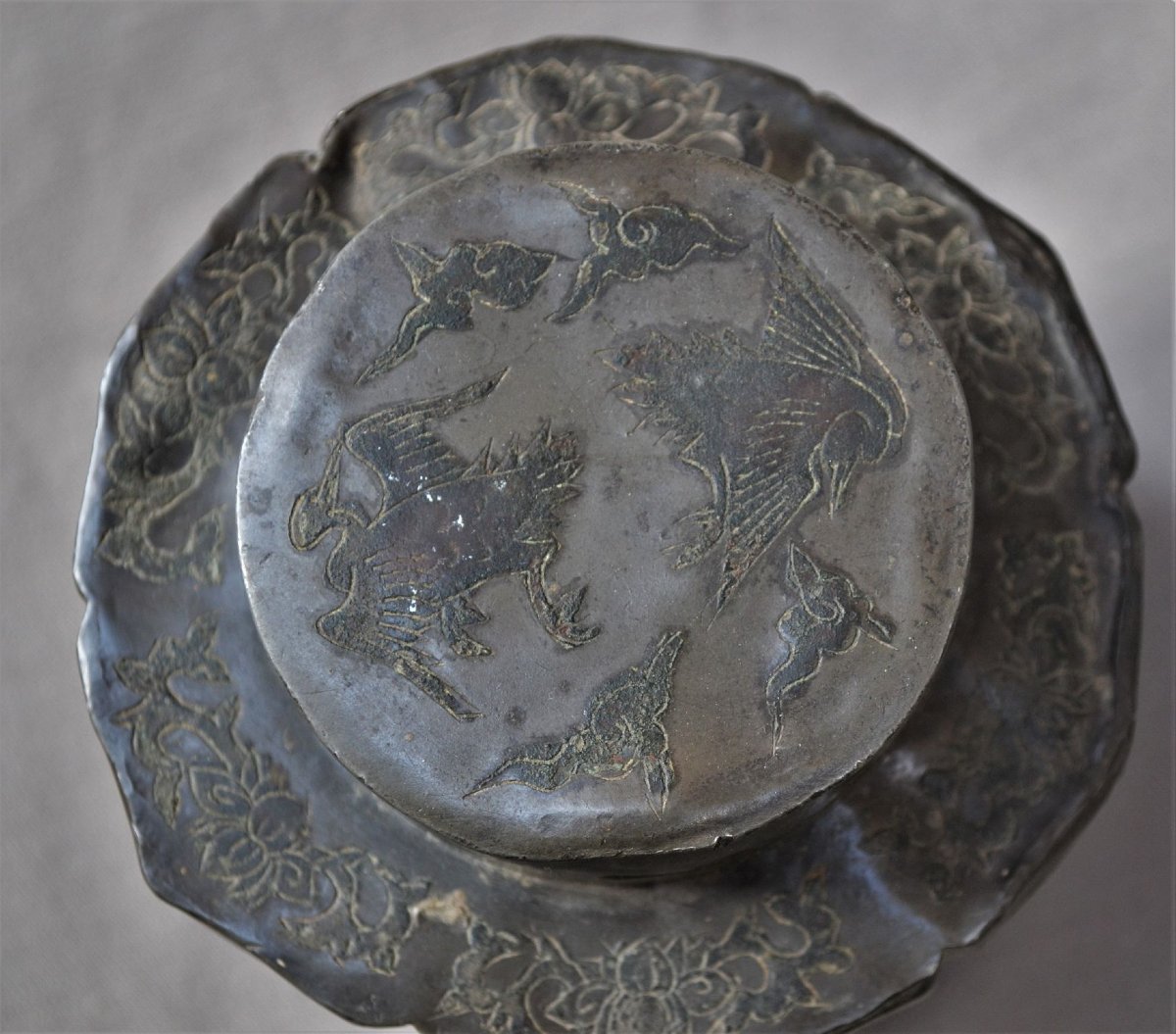


Pewter Teapot With Copper Inlay. China, Late Ming Dynasty. 17th Century.
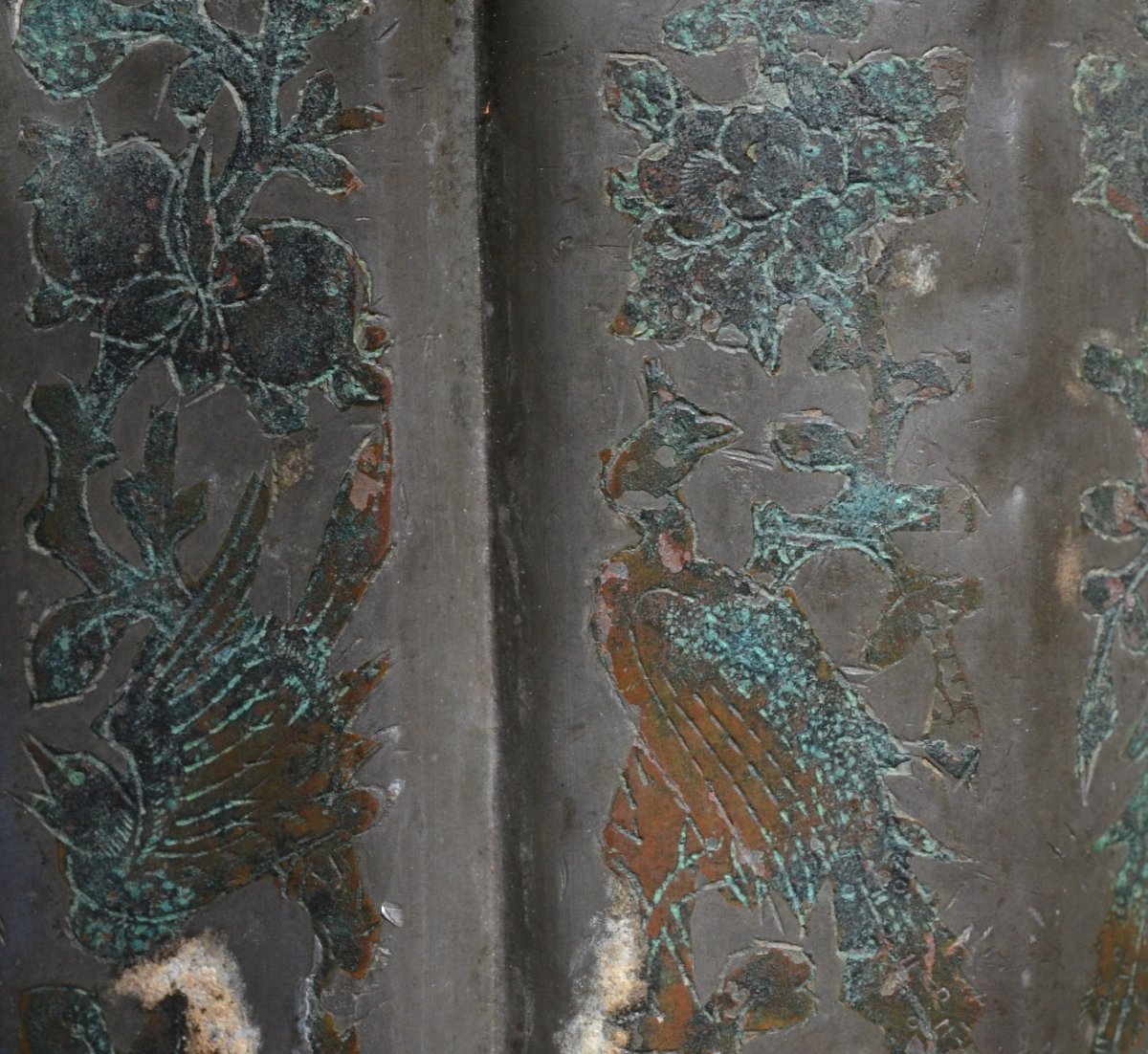
A polygonal pewter teapot with applied copper alloy decoration depicting birds among flowering branches. Pewter is the ideal material for storing tea, as the Chinese scholar Zhao Xigu noted as early as the 13th century in his work on tea. The circular lid is adorned with two flying cranes with contorted bodies, soaring among stylized clouds; the sides are decorated with Fenghuang, as well as other birds set against a backdrop of peonies and lotuses, symbolizing long life, virtue, harmony, and prosperity.... The technique of applying metal to pewter involves cutting out motifs from a very thin sheet of metal (copper or brass) and then soldering them onto the pewter object; this technique is much older than inlay work, which was primarily practiced during the late Qing Dynasty.
The design, rustic yet powerful, is characteristic of the late Ming Dynasty, particularly in the movement of the birds and the depiction of the clouds. However, this style persisted throughout the transitional period and into the reign of Kangxi. The composition, characterized by great freedom, stands out from late Qing works due to its dynamism and economy of means.
The technique of inlaying copper into pewter—and its great antiquity—are of particular interest in this object, whose decoration is not simply engraved but created through the combination of the two metals. A 17th-century Chinese piece. Two other examples of inlaid pewter from this period are known: these are dishes reproduced in the excellent work by Grace and Gregor Norman-Wilcox, “Chinese Pewter,” *Antiques*, May 1941, p. 243, figs. 3 and 4.
An old mark on the base, now too worn to confirm that it belongs to Shen Cunzhou, a pewter artist active during this period. This is a very rare object because pewter is fragile, and the vast majority of these warped or cracked pieces were melted down.
Height: 155 mm Width: 130 mm
1 700 €
Period: 17th century
Style: Asian art
Condition: En l'etat
Material: Tin
Diameter: 130mm
Height: 155mm
Reference (ID): 1848334
Availability: In stock
Print