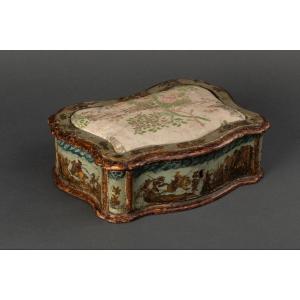
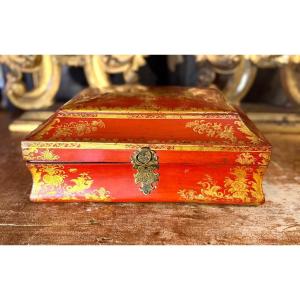
William & Mary Kingwood Strong Box
A safe from the William & Mary period (1689–1702), made of Kingswood veneer arranged in an “oyster” pattern (circular cross-sections), resting on ball-shaped feet and richly adorned with gilded brass fittings; England, London, late 17th century (circa 1690–1700).
Dimensions: 49.5 x 33 x 33 cm.
An exceptional safe, dating from the William and Mary era, is clad in Kingswood veneer arranged in a “partridge’s eye” ” (or “oyster”) pattern and is richly adorned with gilded brass fittings. The interior is lined with rosewood and features drawers as well as hidden compartments, designed to ensure the security of its contents. A sturdy lock, supplemented by threaded rods or iron bolts concealed within the walls, allowed the chest to be securely fastened to the floor of a home, a carriage, or, if necessary, on board a ship, thus protecting valuables both while traveling and within a residence.
These chests were primarily crafted between the late 17th century and the early 18th century. As objects of great luxury, they constituted one of the most prestigious forms of security furniture, intended to protect money, jewelry, important documents, and other valuable possessions. They also served as markers of social status, reflecting their owners’ wealth and taste through the use of precious tropical woods—imported at great expense—and elaborate gilded brass fittings.
This type of furniture is traditionally associated with England during the William and Mary era (1685–1702) and attests to the close ties that existed at the time between English and Dutch cabinetmaking. After the Dutch stadtholder William III ascended the English throne in 1689, Dutch craftsmen and aesthetic principles exerted a significant influence on English furniture production. One of the most eminent cabinetmakers of this period was Gerrit Jensen (1650–1725), a craftsman of Dutch origin who established a particularly prosperous workshop in London. This is why these chests are sometimes described as “Anglo-Dutch” pieces, although the most refined examples, made of kingwood, are generally attributed to London workshops.
Thanks to their portability and ingenious security features, these chests were particularly well-suited to the needs of merchants, officials on the move, and members of the wealthy elite. They are sometimes referred to as “captain’s chests,” suggesting that they may have been used aboard ships of the East India Company. However, an exclusively maritime use has not been confirmed by contemporary documents; they served more as portable safes, capable of accompanying their owners on their travels or being securely fastened within a residence.
Similar examples are held in the collections of international museums, such as the Victoria and Albert Museum, as well as in prestigious private residences and collections.
Reference:
Similar examples can be viewed, notably:
- Victoria & Albert Museum, inventory numbers W.10-1951, W.13-1966, and 793:1, 2-1896
- National Trust Collection, Ham House (Richmond, London), object NT 1139751.1
- National Trust Collection, Hardwick Hall (Derbyshire), object NT 1127721
6 000 €
Period: 17th century
Style: Louis 14th, Regency
Condition: Excellent condition
Material: Rosewood
Length: 49,5
Diameter: 33
Height: 33
Reference (ID): 1847114
Availability: In stock
Print