Chinese Pronk 'arbor' Plate
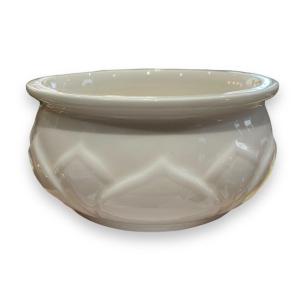
A deep Chinese porcelain bowl of the “Green Family” type, modeled after Cornelis Pronk’s “Arbor” (the arbor) design, commissioned by the Dutch East India Company (VOC); China, Jingdezhen, 18th century (circa 1739–1740).
Dimensions : approximately 24.5 cm in diameter.
Cornelis Pronk (1691–1759), a Dutch artist from Amsterdam, is known for the precision of his drawings depicting cities, landscapes, and historic monuments. Trained in portraiture by Arnold Boonen (1669–1729), he distinguished himself above all through his detailed topographical drawings, many of which were later engraved and published. In addition to painting and drawing, Pronk also designed decorative motifs, particularly for porcelain.
This design, titled “Arbor” (or “Figures Under an Arbor”), is the fourth porcelain motif created by Cornelis Pronk for the VOC. The original drawing was sent to Asia in 1738; it was his last official creation for the Company, although delays in shipping postponed the start of production. This composition comes in three versions: in the “green family,” in underglaze blue, and in the “Imari” style.
The design fits perfectly within the aesthetic of 18th-century European gardens; only the figures lend the composition a touch of “chinoiserie.” The scene depicts a leafy arbor in a park, featuring two ladies. Outside the arbor stand three small figures, while in the foreground, ducks swim on the water. The border is adorned with twelve cartouches containing, in alternating patterns, butterflies, fruits, and flowers, separated by palmette and shell motifs. It is said that the four insects depicted on the border were inspired by Maria Sibylla Merian’s work *Erucarum Ortus*, published in 1718 and expanded in a Dutch edition published in 1730.
The execution of this design posed no technical difficulties; however, as was the case with Pronk’s previous designs created for export, the prices quoted by Chinese merchants to VOC agents in Canton were considered very high. Consequently, only a small quantity was initially ordered. It is established that the VOC ships “Langewijk” (built in 1734, lost in 1740) and “Noordwijkerhout” (date of construction unknown) transported this shipment to Batavia in the spring of 1740. It was then shipped to Holland via the Cape of Good Hope.
Provenance : Dutch collection.
Similar plates are found in the following collections:
- Metropolitan Museum of Art, inventory no. 1984.224 (September 2026: on view at the Met Fifth Avenue, Gallery 201).
- Groninger Museum, inventory no. 1945.0473.
- Rijksmuseum Amsterdam, inventory no. AK-NM-13528.
Condition: perfect. The soup plate shows slight warping due to the firing process.
2 300 €
Period: 18th century
Style: Asian art
Condition: Good condition
Material: Porcelain
Width: 24,5 cm
Reference (ID): 1843553
Availability: In stock
Print