

Set Japanese Arita 'dog Training' Plates
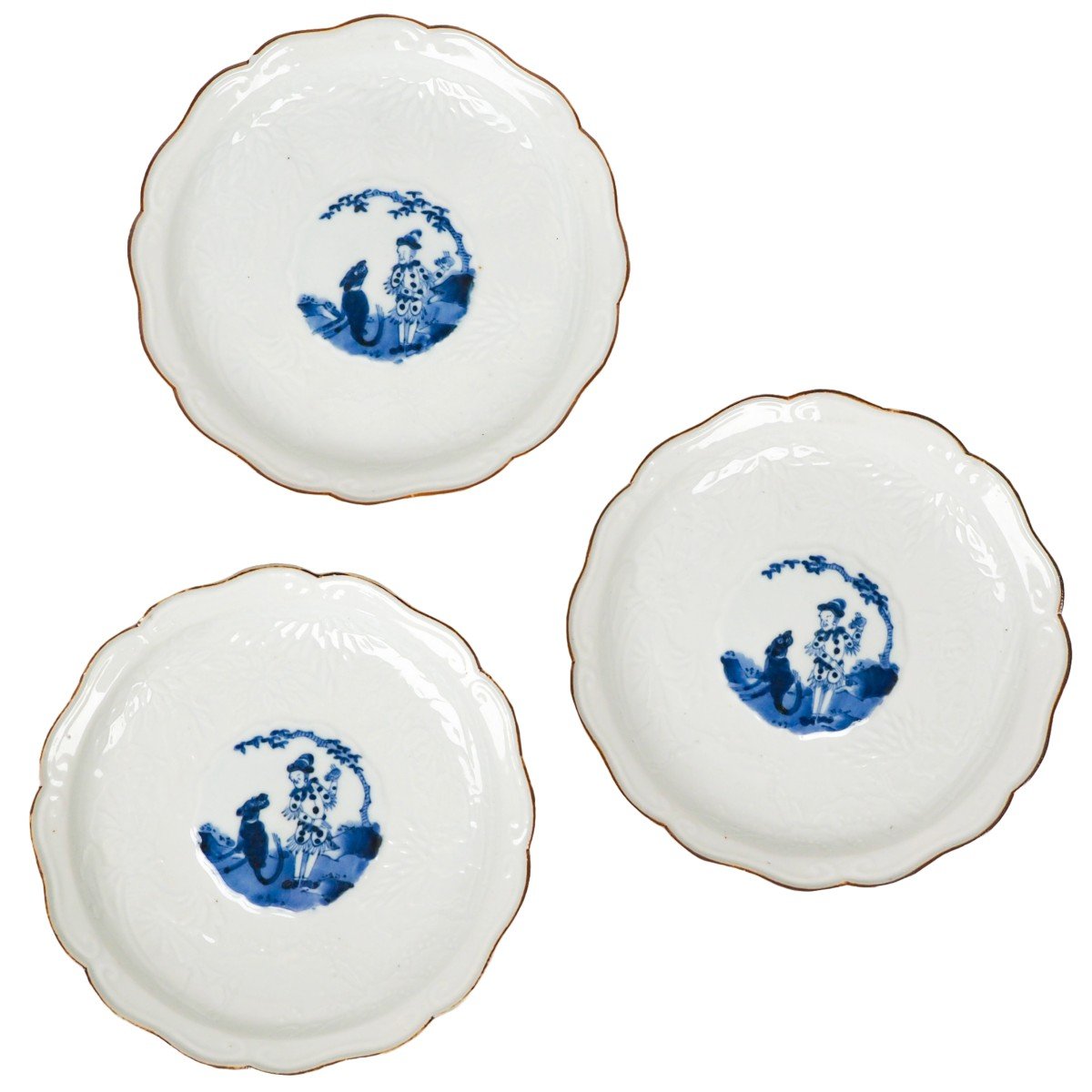
Three rare Kakiemon decorated plates in blue and white depicting a dog trainer in the center surrounded by low moulded relief decoration, 18th century, around 1700-1730, Arita, Japan.
Blue and white
Dimensions: 22 cm. diameter
Three rare Kakiemon decorated plates with flanged (eight-foliated) border and brown edged rim.
The low moulded white relief decoration is a depiction of three scholars from a group called 'The Seven Sages of the Bamboo Grove'. The Sages are associated with a hedonistic lifestyle of drinking, poetry and music. Although the origin of the group and stories lay back in ancient China, it was widely represented in Japanese art from the 16th century to the end of the Edo period (1615–1868).
The central medaillon of the plates is decorated with a 'Namban' style figure of a European with a long legged and tailed dog creature. This is the kind of novelty design that was particularly popular in the Nagasaki market both with visiting Japanese and Dutch buyers. The motif has a theatrical origin. This kind of figure was in England called a “Jack Pudding”, in Germany “Hans Wurst” and in Dutch "Hans Buling". He was a comic and remarkable figure: a combination of a fool and clown with a coarse appearance, occasionally depicted as an animal trainer! The name Jack Pudding is derived from a buffoon who performs pudding tricks, such as swallowing a certain number of yards of black-pudding (blood pudding in a sausage casing).
These kind of subjects are also closely linked to a "Merry Andrew". When an audience began to being bored by a performance, the Merry Andrew would stir their attention by some antic, slapstick or clever quip. There is for example a mid 18th century Delft plate design known which shows two figures; the Mountebank Hans Buling (a Dutchman), and his assistant Merry Andrew with their monkey on a stage. This is a scene taken of the prints called “Cries of London” by Marcellus Laroon (1653-1702).
The reverse of the plates have a character mark 'arashi' (嵐) meaning storm. It is also discussed that it could be a variant of the Chinese character 'shòu' (壽) standing for longevity. The last possibility is less likely because it identifies the plates coming from the Higuchi kiln in the Nangawara valley and would date them later around 1770-1780.
Kakiemon is a production technique (and style) of generations of the Kakiemon family who established their workshop near Arita on the island of Kyushu. The pottery tradition which uses very fine white clay has survived until today: Kakiemon XV is currently active and is regarded as one of the ‘living national treasures’ of Japan.
These plates are decorated in 'Nanban' style because of the European figure depicted in the center of the plates. In the 16th century, the Japanese termed Europeans and foreigners as ‘Nanban’, meaning 'southern barbarians'. Despite Europe being west of Japan, this label originated from the Chinese view of southern foreigners as uncivilized. This term was broadened and copied by the Japanese culture, leading to foreigners being referred to as "Nanban" by Japanese citizens.
Condition: Very good, only one plate with a minor rim chip. No hairlines, restorations or other chips.
Provenance:
-Christies 13th May of 200, 'Live Auction 5967, Japanese Art & Design', lot 7.
-Lempertz no. 307815.
-German Private Collection 2024.
1 550 €
Period: 18th century
Style: Asian art
Condition: Excellent condition
Material: Porcelain
Diameter: 22cm
Reference (ID): 1407646
Availability: In stock
Print