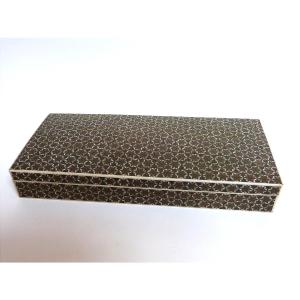
Indian Colonial Box Decorated With Inlays
Anglo-Indian workbox, made of teak and ebony, decorated with floral motifs in bone inlay; 18th century, circa 1700–1750, Vizagapatam, India.
Dimensions: 32.5 x 47.5 x 12 cm.
This large box, intended for storing documents or objects, exemplifies early 18th-century craftsmanship, characterized by both European influences and Indian taste and culture. The wood, a brownish hue streaked with darker veins, is a precious species, particularly resistant to the hot and humid climate of the Indian Ocean region and the Indonesian archipelago. The bone elements are engraved and finished with black lacquer, creating subtle variations in the floral knobs. Foliage motifs—formed by black stems and leaves—are inlaid into the wood, notably using ebony. The lid is adorned with four studded floral rosettes, while the side panels feature brass handles. The front is fitted with an elegant brass keyhole, complete with its key. The interior is compartmentalized, allowing for the storage of writing materials.
Vizagapatam was a major center for the production of luxury goods intended for export to Europe and other ports. Until independence in 1947, the city was part of the Presidency of Madras—an administrative division of British India centered on Madras and Fort St. George. The first written mention of furniture inlaid with ivory (or bone) in Vizagapatam dates back to 1756, in a account by Major John Corneille. He noted at the time that the region was renowned for the quality of its “chintz” (printed fabrics), considered “the best in India for the brilliance of their colors.” He added that “the town is also notable for its inlay work, executed, quite rightly, with absolute perfection.” As early as 1668, the British East India Company operated a textile factory there; in 1768, the British took control of the entire area. In Vizagapatam, it was customary to produce Western-style furniture, adorned with inlays of engraved and lacquered ivory (or bone). The decorative repertoire drew inspiration from Mughal culture, particularly through scrollwork motifs. Although the British exercised authority over Vizagapatam and the surrounding regions, the objects produced there during the 18th century were also intended for representatives of the Dutch East India Company, as well as for the European market. Condition: good, with some signs of wear on the inlays.
Reference:
For a similar example resting on a later base, see: Christie’s, February 17, 2016, Auction 12033, Lot No. 267.
3 500 €
Period: 18th century
Style: Orientalism
Condition: Excellent condition
Material: Rosewood
Length: 32,5
Width: 47,4
Height: 12
Reference (ID): 1847111
Availability: In stock
Print