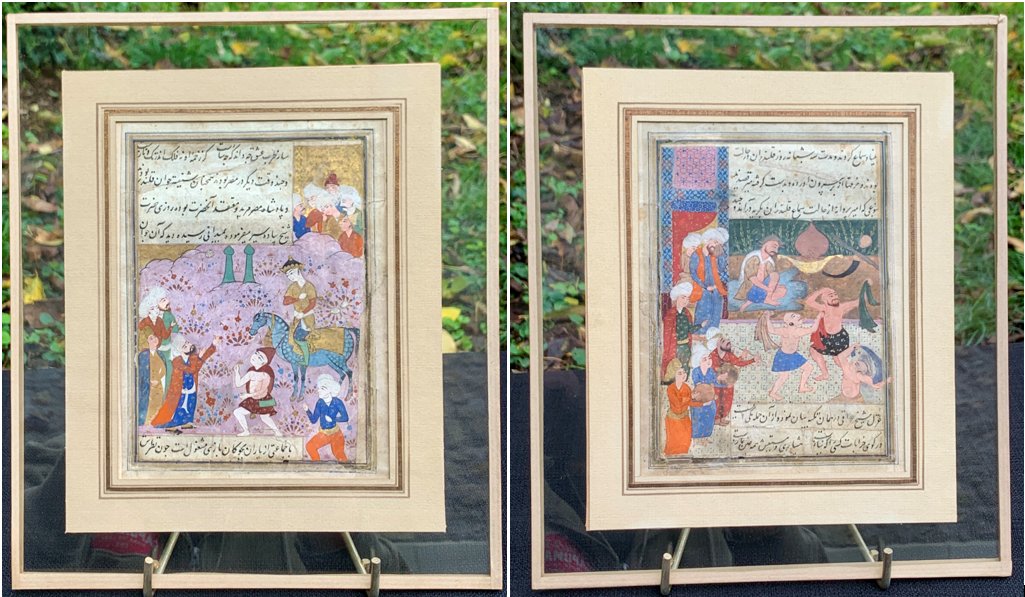



Around 1580/1600, Shiraz School, Persian Safavid Double-sided Page 2 Painted Miniatures
Artist: Ecole De Chiraz, Perse / Iran Vers 1580 /1600
ISLAMIC ART
Shiraz School, Persia / Iran, Safavid period around 1580 / 1600
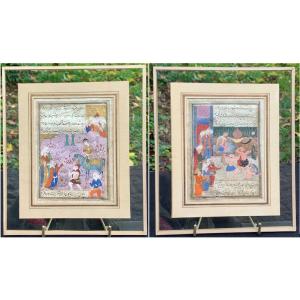
Pair of painted miniatures on paper, double-sided page
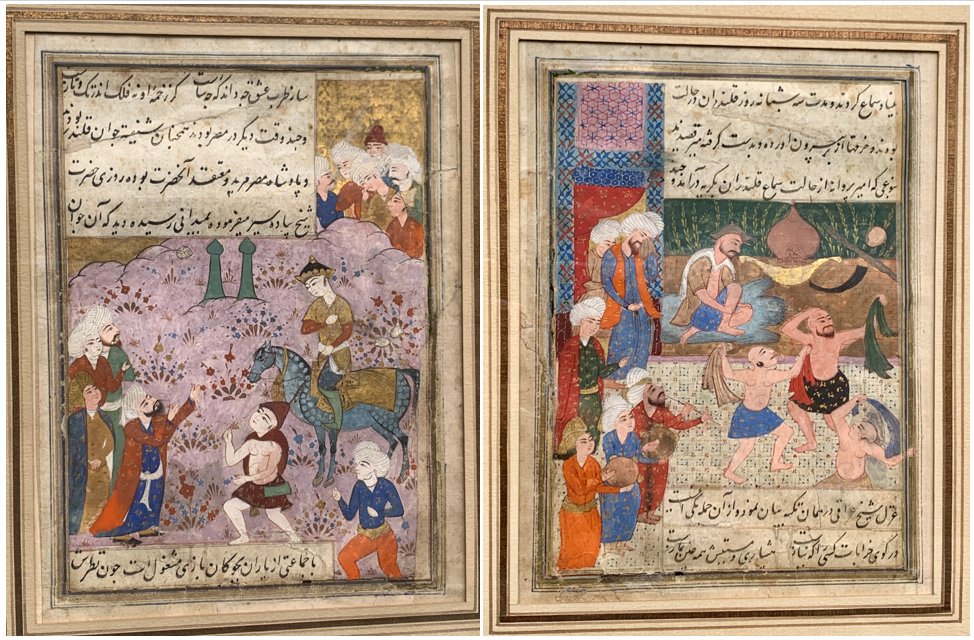
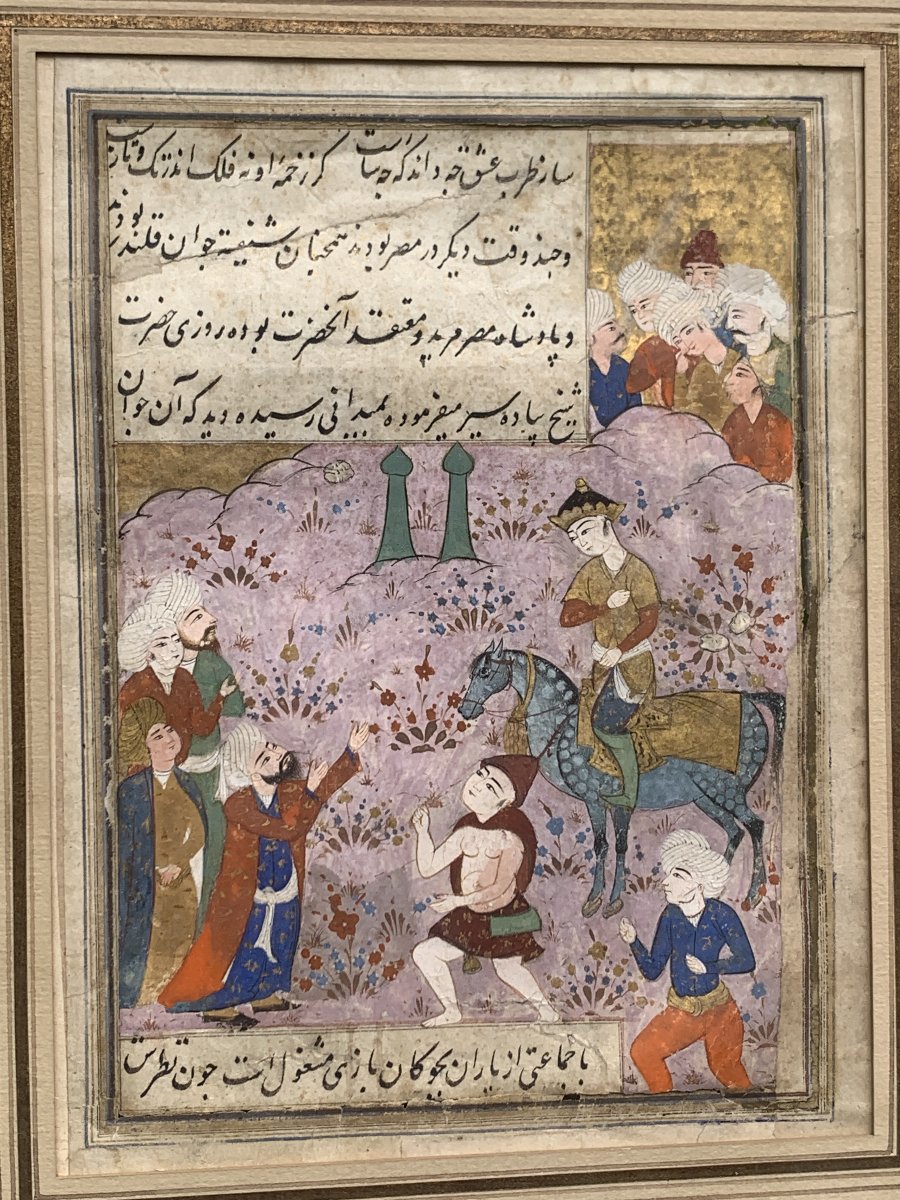
"The encounter with the horseman, the great Sufi master Shaykh Muhiyy al-Din Ibn 'Arabi (the horseman) and the Sheikh"
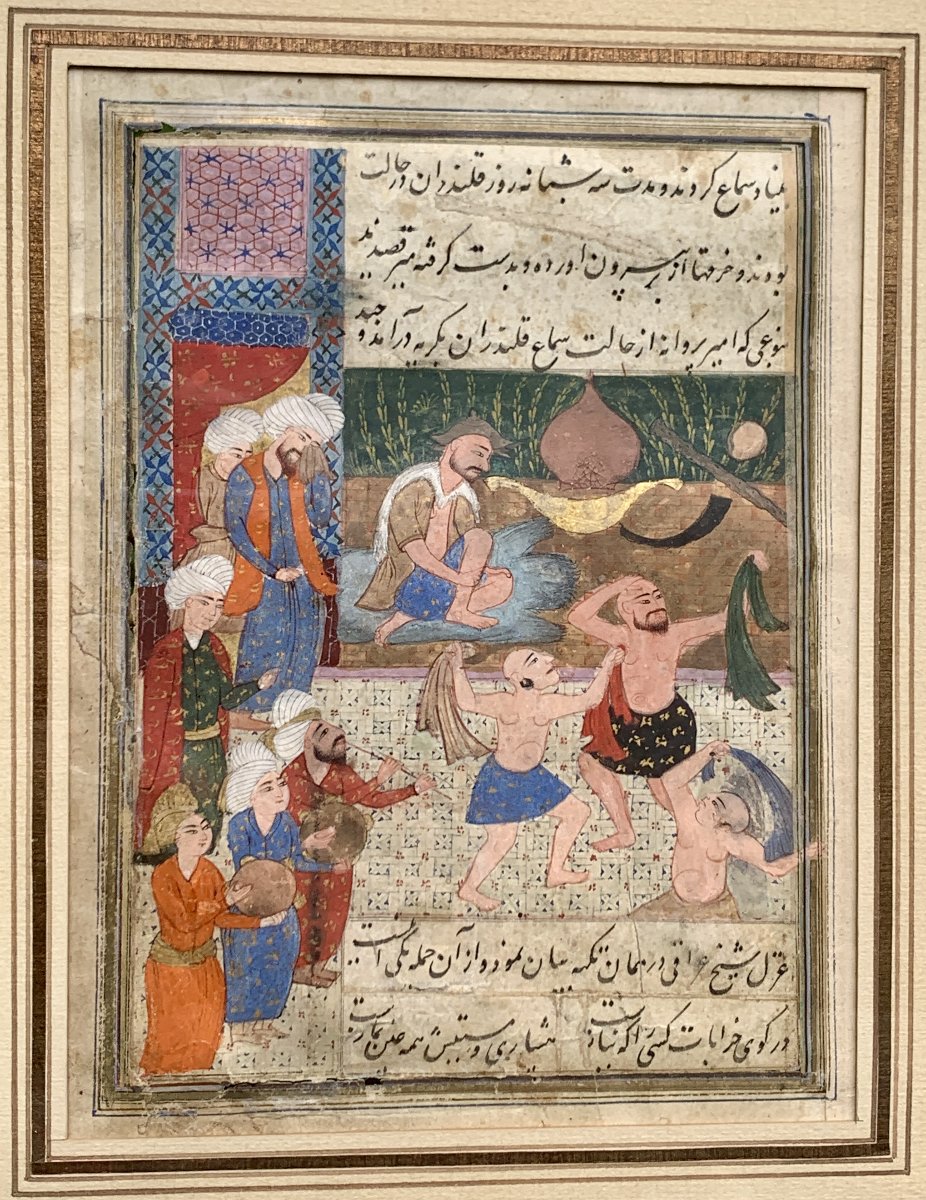
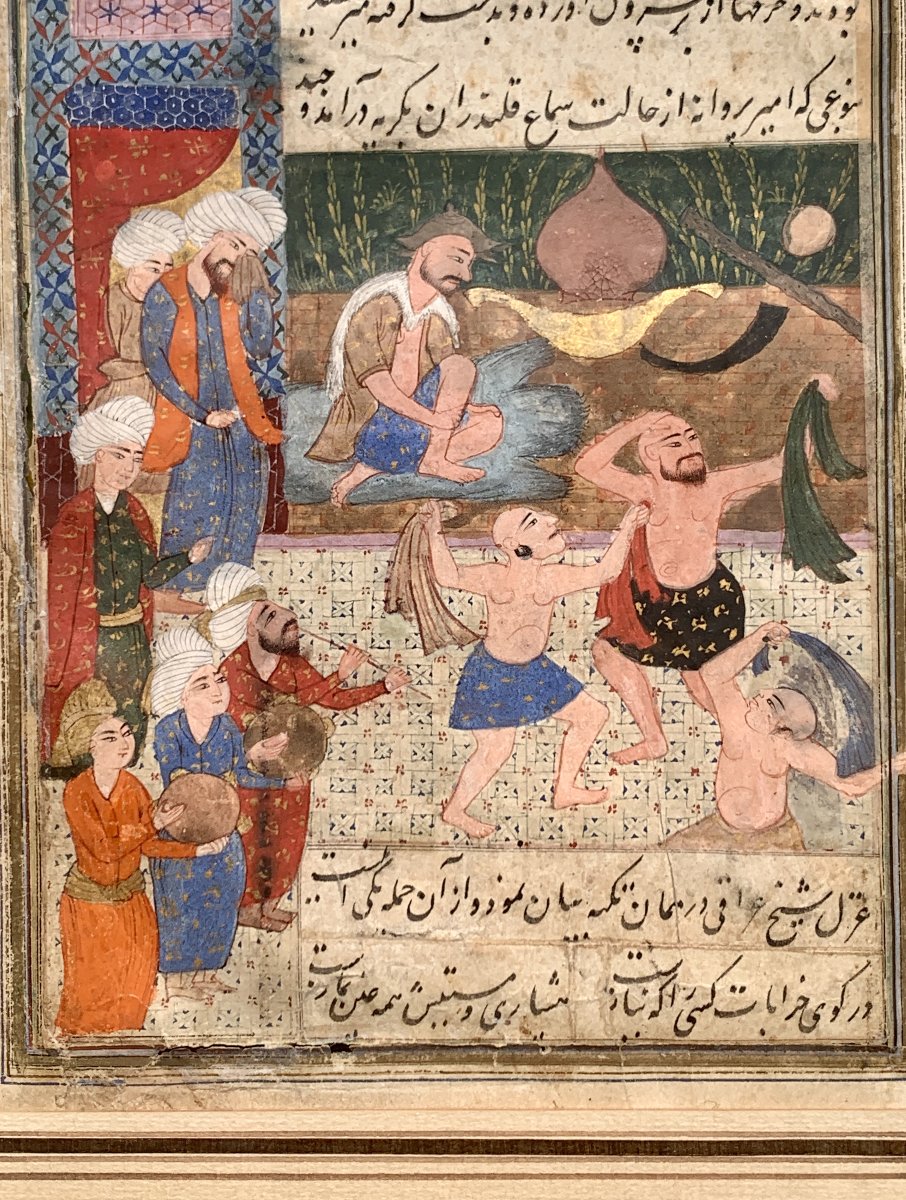
& "The trance and the struggle of Pahlawan Mahmud"
These stunning miniatures come from a classical Persian manuscript from the late 16th century (around 1580-1600), linked to the Shiraz school during the Safavid period. They illustrate pages from the famous collection book Majalis al-Ushshaq ("The Assembly of Lovers"), traditionally attributed to the Timurid sultan Husayn Bayqara or to Kamal al-Din Gazurgahi. This work brings together fictionalized and mystical biographies of great poets, Sufis, and famous lovers.
In the tradition of late 16th-century Persian manuscripts, the vast majority of pages only had text on the back of a painting, or a single illustration per page. To own a miniature on both sides is a rare setup, much more unusual and highly sought after. This means that this double-sided work comes from a complete, luxurious original manuscript characterized by:
* An intense narrative pace: This means that in the original copy of the Majalis al-Ushshaq from which your page comes, the action flowed so densely that the Shiraz workshop chose to illustrate two successive moments (or two closely related stories) without any major textual transition between the two sides.
* A “Royal” or High Nobility quality: Creating a double-sided miniature required perfect technical mastery. The artist had to use paper of extraordinary opacity and quality to apply layers of gouache and gold on both sides without the pigments bleeding through or weakening the support. The fact that the paper has survived more than 400 years in this condition is proof of that.
* The controlled transparency effect: When looking at the sheet against the light, you can see the care taken by the painters so that the dark color masses on one side don’t spoil the brightness of the pastel tones (like the mauve hills) on the other side.
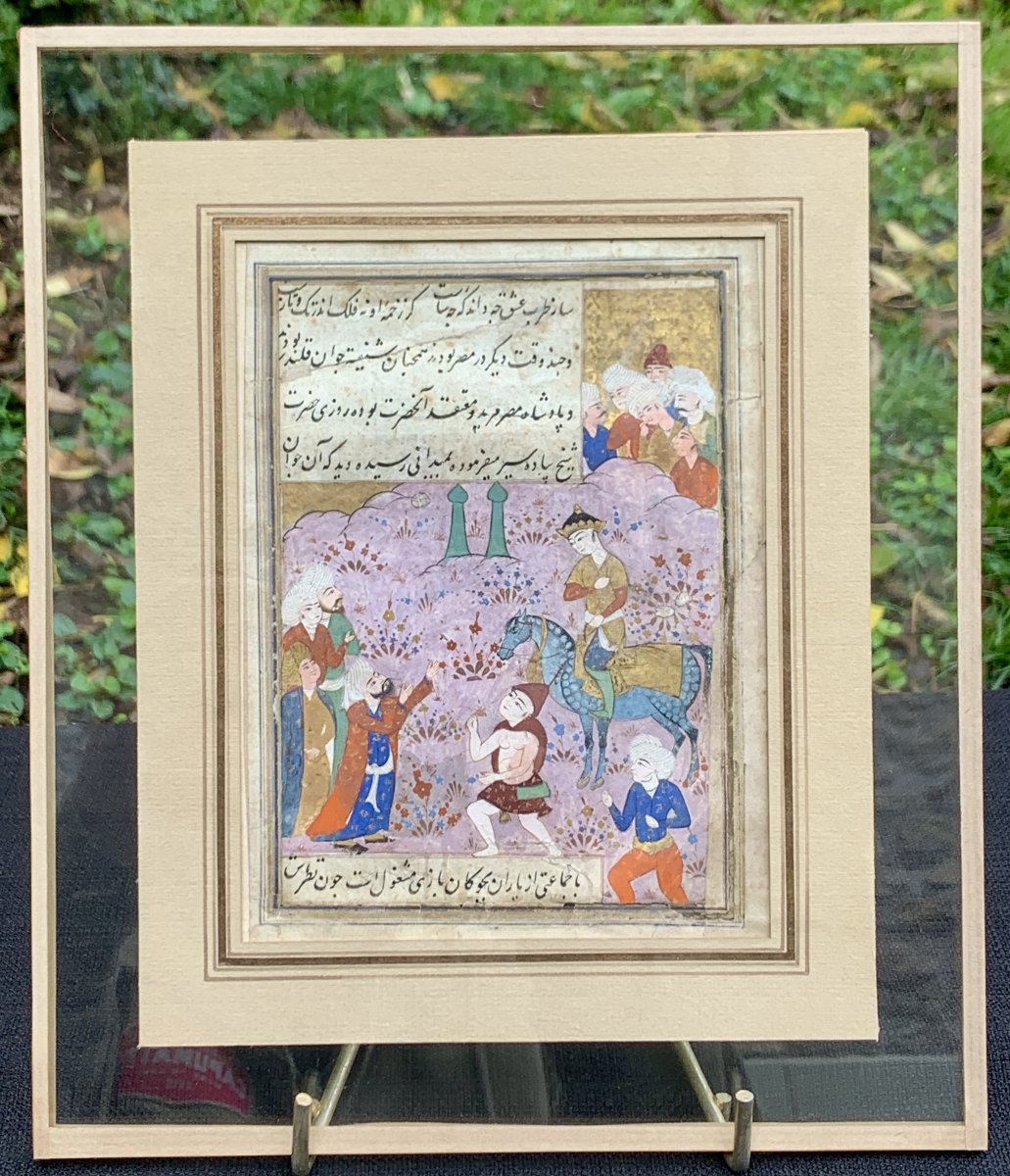
Framing in 'double-sided' glass (or between two glass panels) is indeed the best possible option. It allows you to admire the continuity of the work and to read the story in its original direction (by turning the page).
These two sheets perfectly illustrate Safavid calligraphy and illumination techniques, as well as the refinement of the royal and commercial workshops of Shiraz at the end of the 16th century. Every detail on the page is codified:
* Nasta'liq Script (نستعلیق) : Nicknamed 'the bride of Islamic scripts,' it was created in Iran in the 14th century. It is characterized by fluid lines, elongated shapes, and tilted accents. It is the script par excellence for Persian poetry. The scribe uses a pen (cut reed) with a slanted tip and a deep black soot-based ink.
* Text Clouds (Abri) : By closely observing the text panels, the letters do not directly touch the background of the page. The calligraphy is surrounded by white lobed shapes that resemble clouds. The painter would first paint the background (here, gold or a solid color), and then the calligrapher would isolate their text within these white reserves to give it depth.
* Separation lines and gold: The lines of text are strictly separated by fine lines drawn with a ruler in black ink and liquid gold (ground gold mixed with gum arabic). On the second sheet, you can also see small diagonal lines and miniature floral decorations in gold inserted between the blocks of text to fill empty spaces (decorative filling).
* An oriental paper made from rag, often sized and polished for a long time with an agate stone (Mohreh-zani technique) to get a perfectly smooth and satin surface, allowing the reed pen to glide without any roughness.
After carefully analyzing the structure of the Majalisal-Ushshaq manuscript, we can accurately reconstruct the story and the way the page is meant to be read. It’s actually two completely separate stories. The book is a collection of 76 biographies of mystics, with each chapter standing on its own. The way the page is meant to be read is connected with:
1. Meeting the Sheikh: The text tells the story of the great Sufi master Shaykh Muhyiddin Ibn 'Arabi (the rider) crossing paths with his beloved disciple Sadr al-Din. The last sentence at the bottom of the page cuts off on the word "when his gaze..."
In the original manuscript, the story continued on the following pages of text (which have been separated).
A few pages later in the book, 2. the chapter dedicated to the saintly wrestler Pahlawan Mahmud. The miniature illustrates this powerful moment when the dervishes enter a spiritual trance (samā').
The fact that these two scenes are painted on the same piece of paper means that in the original scribe's layout, the end of the chapter on Ibn 'Arabi and the beginning of the chapter on Pahlawan Mahmud accidentally ended up on the same sheet of paper.
Instead of having pages of plain text on the back of the paintings (which is the case for 90% of the leaves in this manuscript), this dense folio captures here two of the most beautiful illustrations in the whole book.
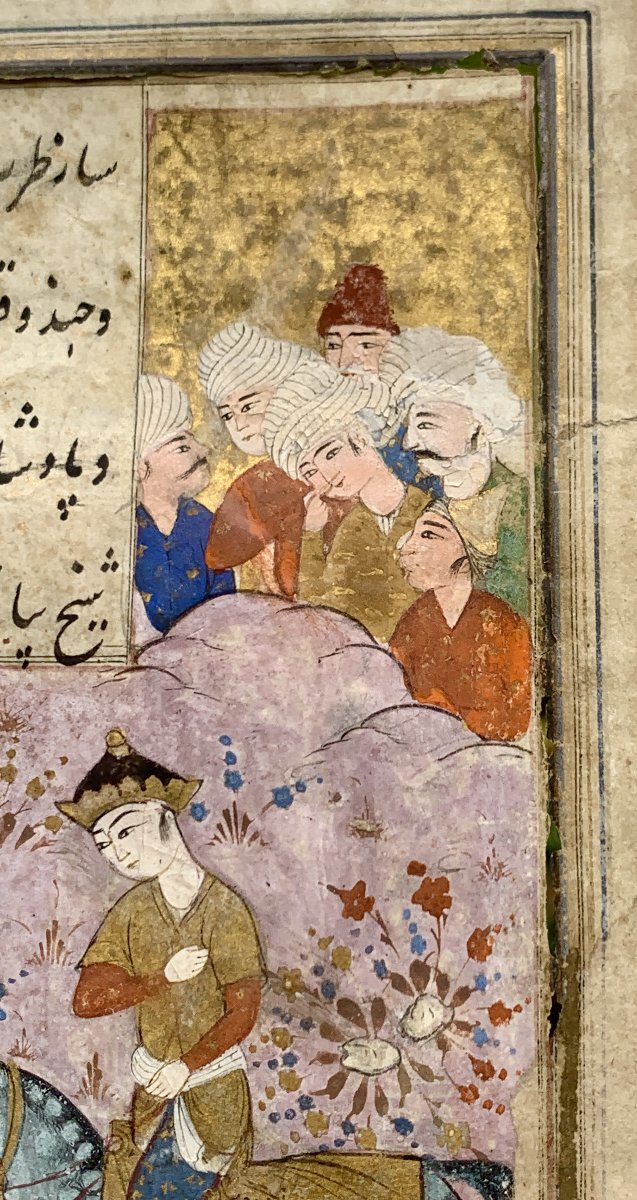
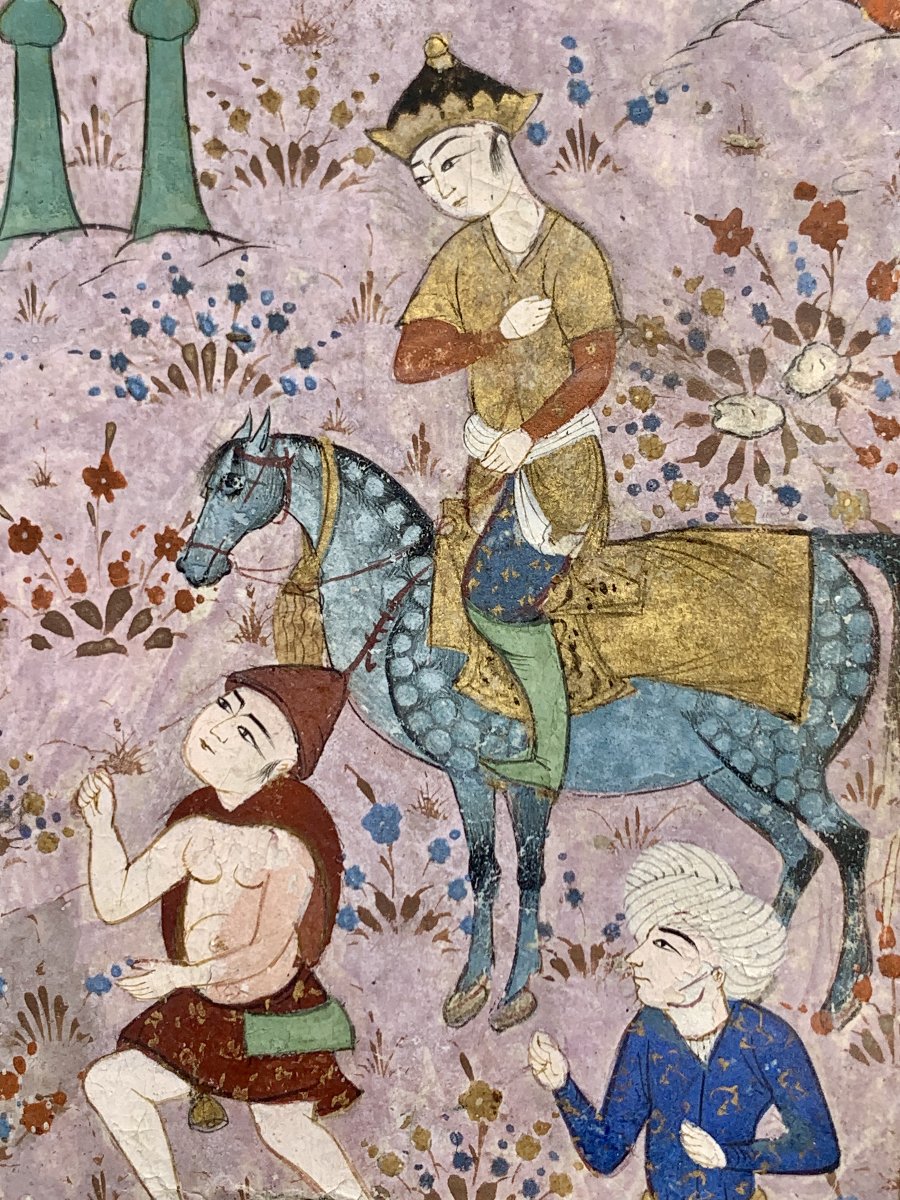
I. The accidental meeting of the rider, the great Sufi master Shaykh Muhyiddin Ibn 'Arabi (the rider), and the Sheikh.
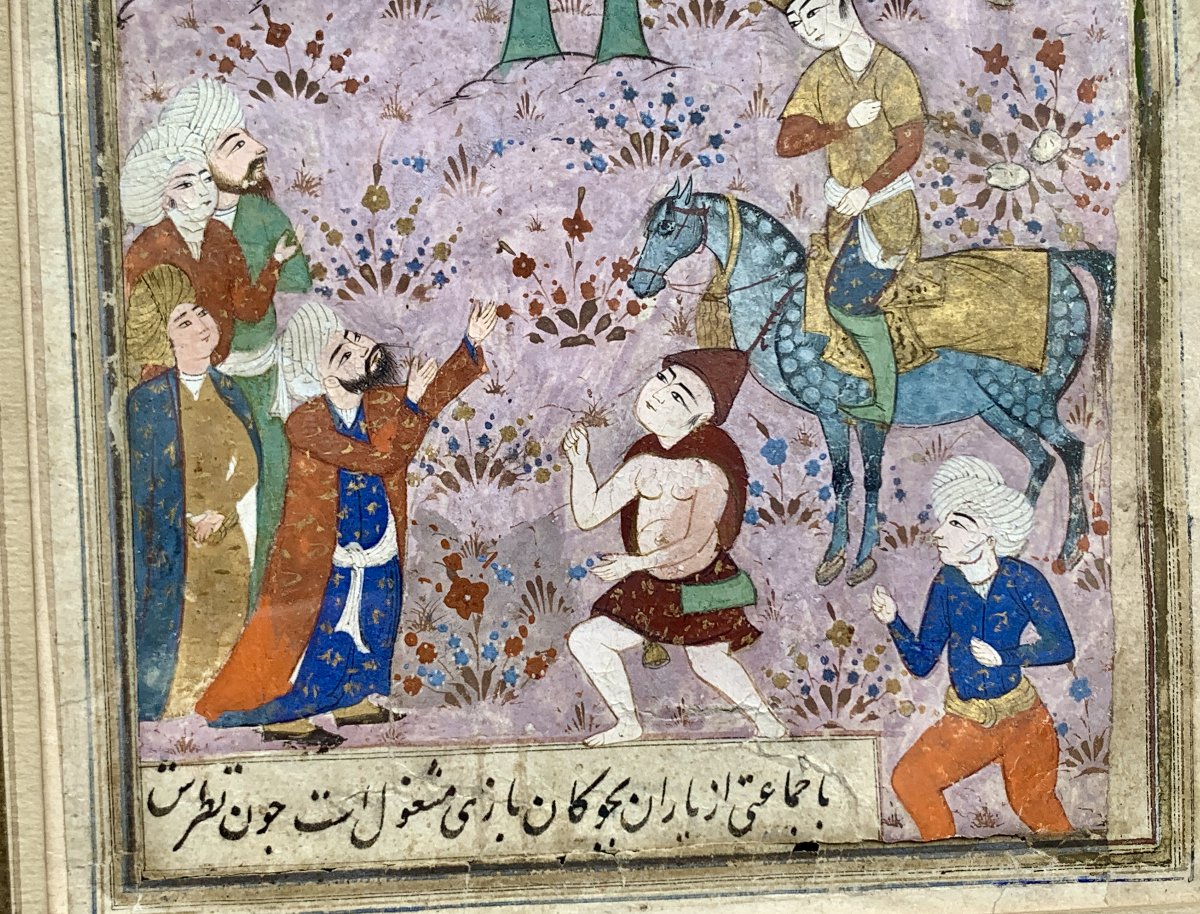
The first miniature illustrates a typical narrative scene where a noble character or a spiritual teacher on horseback crosses paths with followers, dervishes, or young people in a hilly landscape characteristic of the Shiraz style (with its purple hills and small clusters of flowers). The text in Nasta'liq script harmoniously surrounds the scene to convey the poetic story. It describes a spiritual and loving (allegorical) encounter in the pure Sufi tradition.
* Transcription from Persian (upper cartouche) :
ساز طرب عشق چه داند که چیست / کز نغمه او نه فلک نزدیک [ماست]وجد و وقت دیگر در مصر بود و استماع میشنید جوانی قلندر [بود]و پادشاه مصر مدتی وقت آنحضرت بوده و روزی حضرتشیخ پیاده سیر میفرمود به میدانی رسیده دید که آن جو[ان]
"What does the instrument of love's delight know of what it is? For from its melody, the nine heavens come close to us. At another time in Egypt, there was a moment of ecstasy (wajd); a young Kalandar dervish was being listened to. The King of Egypt had spent some time in the presence of His Holiness, and one day, while the venerable Sheikh was walking on foot, he arrived at a square and saw this young man..."
* Lower panel :
با جماعتی از یاران و بچگان بازی مشغول است چون نظر ...
Translation : «... busy playing with a group of companions and young people. When his gaze [fell upon him] ... »
The text gives full meaning to the miniature. It describes the exact moment when a great spiritual master (the Sheikh on horseback) crosses paths with a young kalandar (a wandering dervish). In the theoretical introduction of Majalis al-Ushshaq, earthly love for the beauty of a young man is seen as a bridge (the bridge, or Al-Majaz) leading to Divine Love and ultimate ecstasy (Wajd)
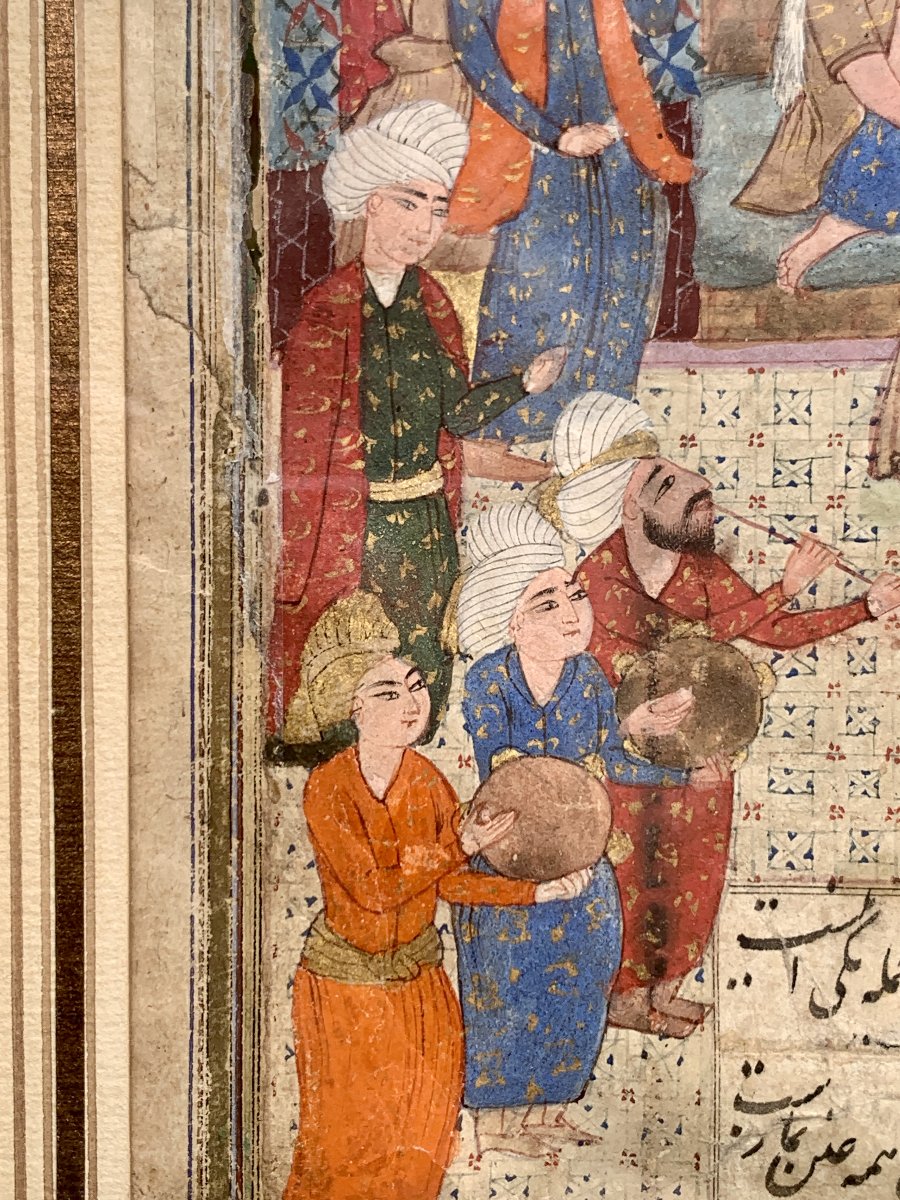
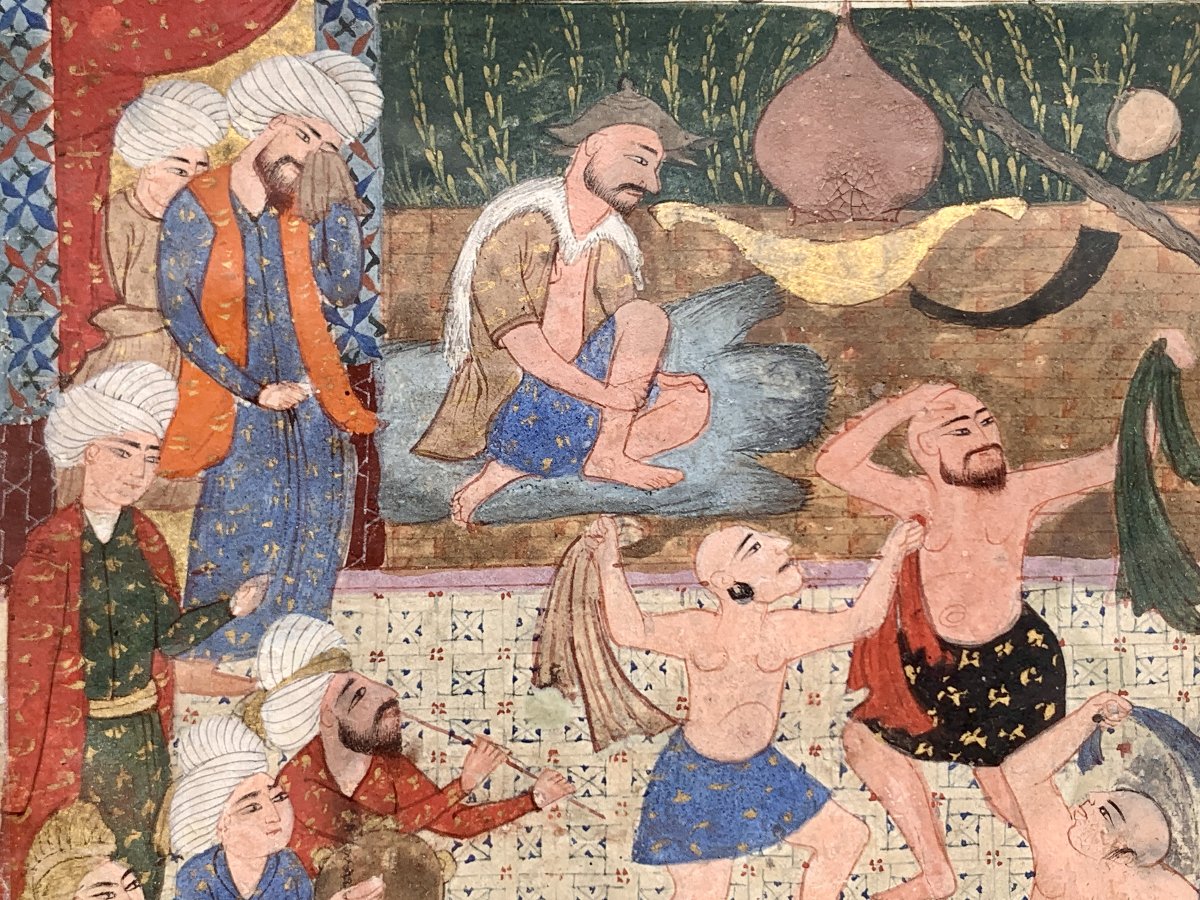
II. Trance and the Struggle of Pahlawan Mahmud
The second miniature depicts a very famous scene from the manuscript with Pahlawan Mahmud, better known as Puriya-ye Vali, who was both an undefeated wrestling champion, a Sufi poet, and a philosopher. This saint is the protector of the traditional wrestling guilds (Zurkhaneh) wrestling during a samā' session (Sufi mystical dance and trance) or in front of an audience.
He is considered the patron saint and spiritual founder of the Zurkhaneh rituals (literally "House of Strength"), a traditional Persian martial art that combines sacred bodybuilding, chivalric philosophy, and mystical devotion.
The ethics of Futuwwa: In the Sufi tradition, he embodies Javanmardi (spiritual chivalry).
The most famous legend tells that one day, before a crucial fight in Khorasan, he heard an old woman praying to God for her son (Mahmud's opponent) to win the fight to save her family from poverty. During the match, although much stronger, Mahmud pretended to be weak and deliberately let himself be thrown to the ground. The legend says that the very moment his back touched the ground, he reached spiritual enlightenment (the opening of the heart) by sacrificing his pride as a champion out of pure compassion.
In the miniature, the struggle you see in the center isn’t just a simple fight, but a metaphor for the battle against one’s own ego (the great Jihad), set within a Sufi trance session (Samā'). He is a major figure in Persian popular and spiritual culture.
*Transcription from Persian (upper cartouche) :
... سماع کردند و مدت سه شبانه روز قلندران در حالتبودند و خرقه ها چاک پسرون آوردند و دست گرفته رقصید[ند]شوخی که امیر پروانه از حالت سماع قلندران به گریه درآمد و ...
Translation : " ...They performed the Samā' (the mystical spiritual dance) and for three days and three nights, the kalandars remained in this state of ecstasy. They tore their dervish robes (khirqa), stepped forward and, holding hands, they danced. Such emotion arose that Emir Parvaneh, faced with the dervishes' Samā' ecstasy, broke into tears and... »
Lower caption:
غزل شیخ وقتی در همان تکه میان نمود و از آن حالت...در کوی خرابات کنی گر گذر اینبار...
Translation : “The Sheikh then sang a ghazal (love poem) in the middle of the arena (tanakeh / wrestling space), and from this state…” “If you pass this time through the district of ruins (Kharabat: allegorical place of the mystical tavern) …”
In the miniature, we can see dervishes in full trance, musicians playing the drum (tambourine) on the left, and in the center, semi-naked figures wearing the traditional wrestling pants (تنکه or tanakeh), taking part in ritual wrestling linked to dervish practices and the disciplines of the Futuwqa (spiritual chivalry).
The text perfectly captures the visual excitement of the painting: the gathering is caught up in the sacred energy of a collective trance (Samā'). The Emir or Prince, at the top left under the red canopy, is moved to tears. The wrestling happening in the center shouldn’t be seen as just a sport but as a spiritual and ascetic trial where physical renunciation merges with mystical union.
Dimensions :
15.5 cm height * 11 cm width for the sheet itself
and 26.7 * 22.8 for the support between 2 glasses.
Condition :
Old restorations on the edges; very little wear on the colors, which are bright, and on the gilding.
This sheet is a perfect example of the golden age of the Persian book, where poetry, calligraphy, and painting came together to create an object for visual meditation.
2 400 €
Period: 16th century
Style: Tribal Art
Condition: Condition of use
Material: Paper
Width: 11 cm (22,8 cm pour l'entre-2-verres)
Height: 15,5 cm pour le feuillet (26,7 cm pour l'entre-2-verres)
Reference (ID): 1843233
Availability: In stock
Print