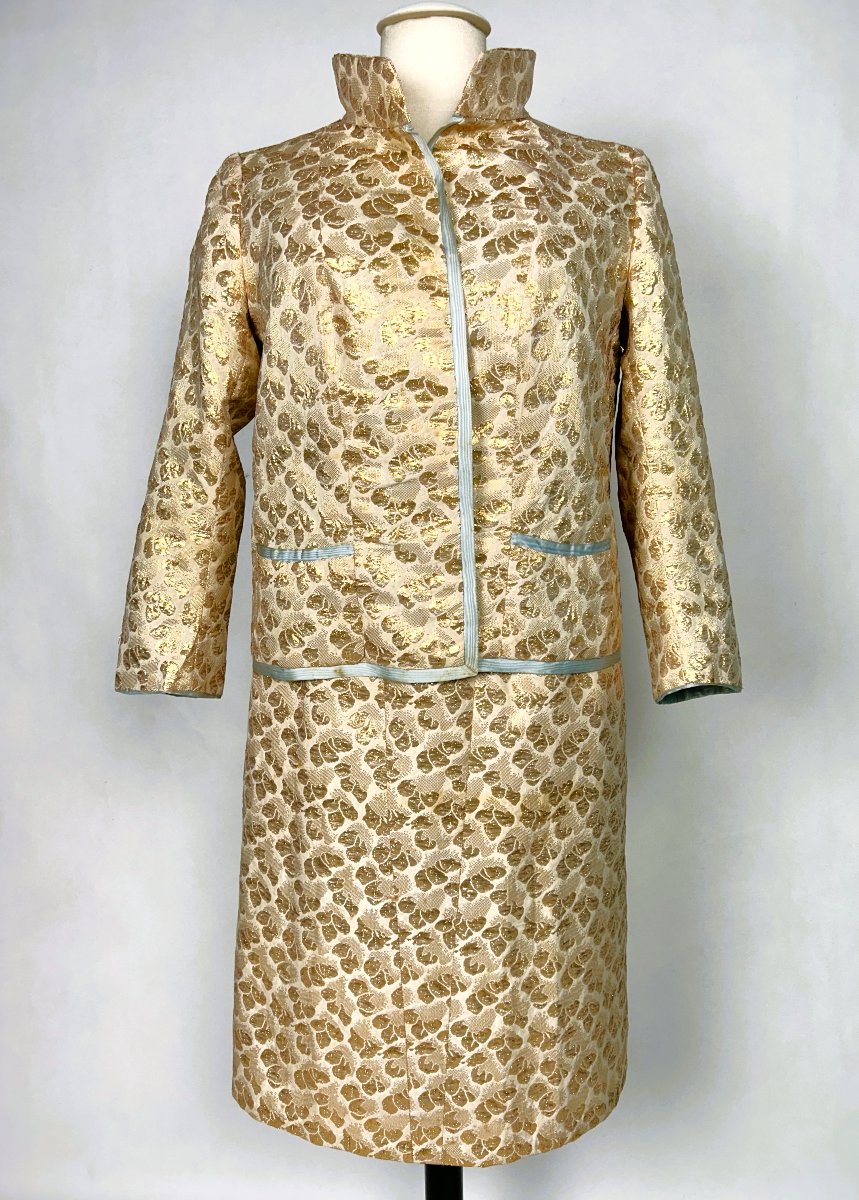
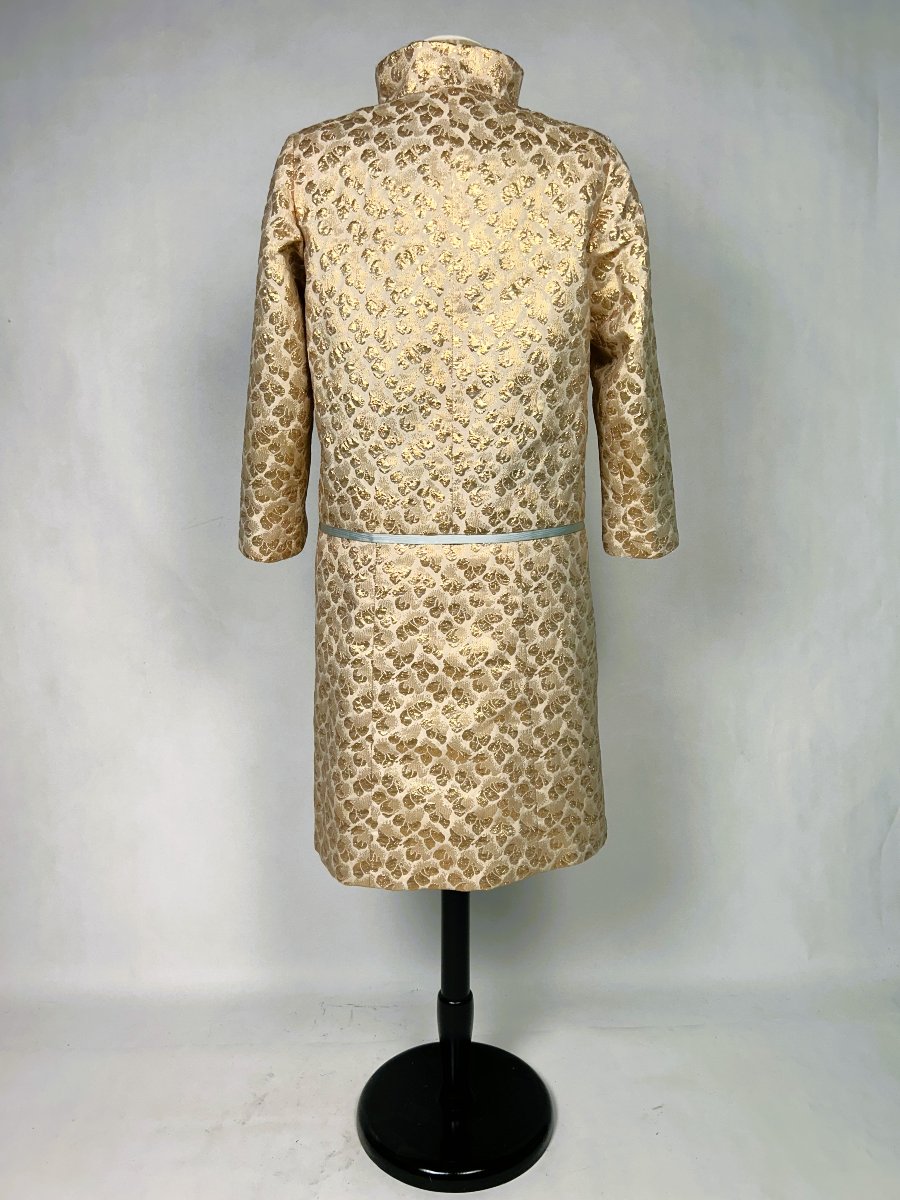


Gabrielle Chanel Skirt Suit, Hc No. 07412, In Gold Cloqué Lamé By Bucol - Fall/winter 1958–59
Fall/Winter 1958-1959 Collection
France
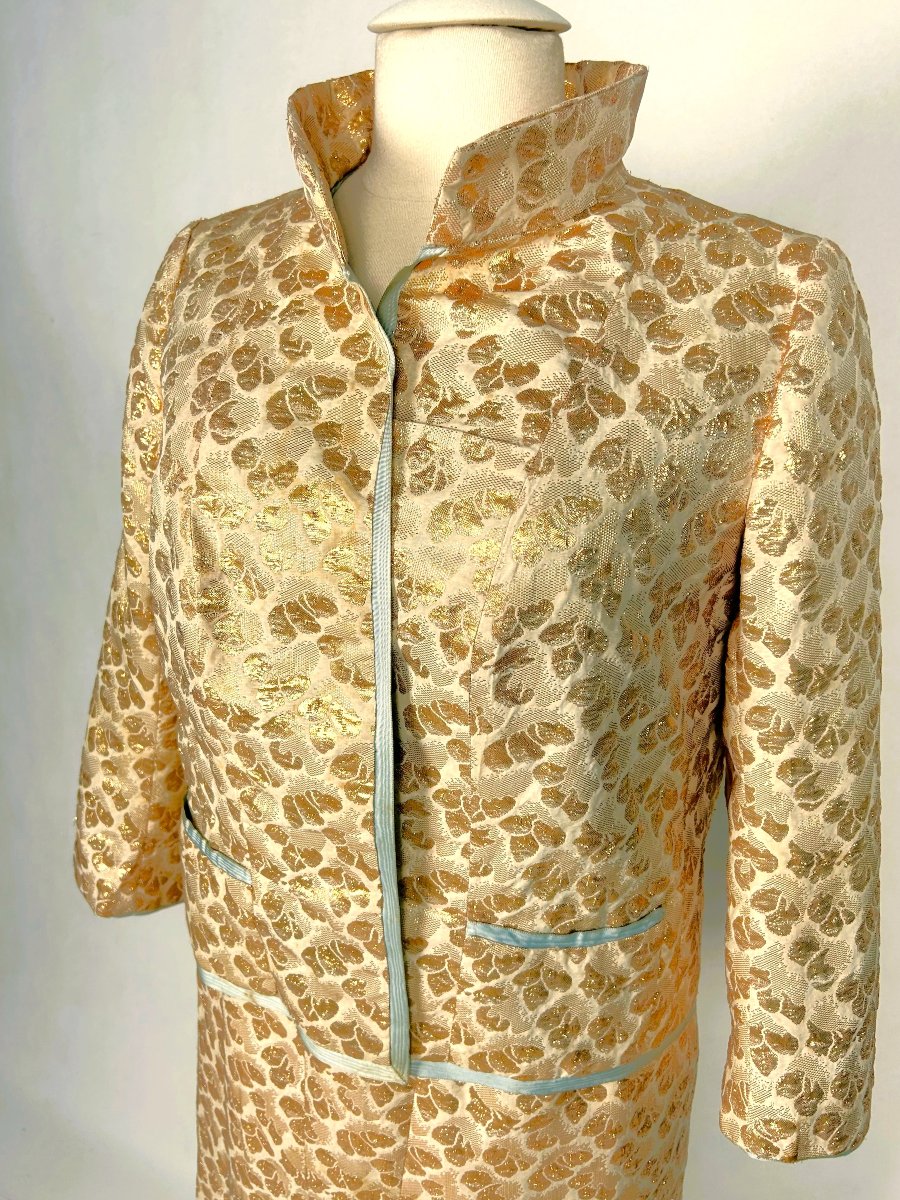
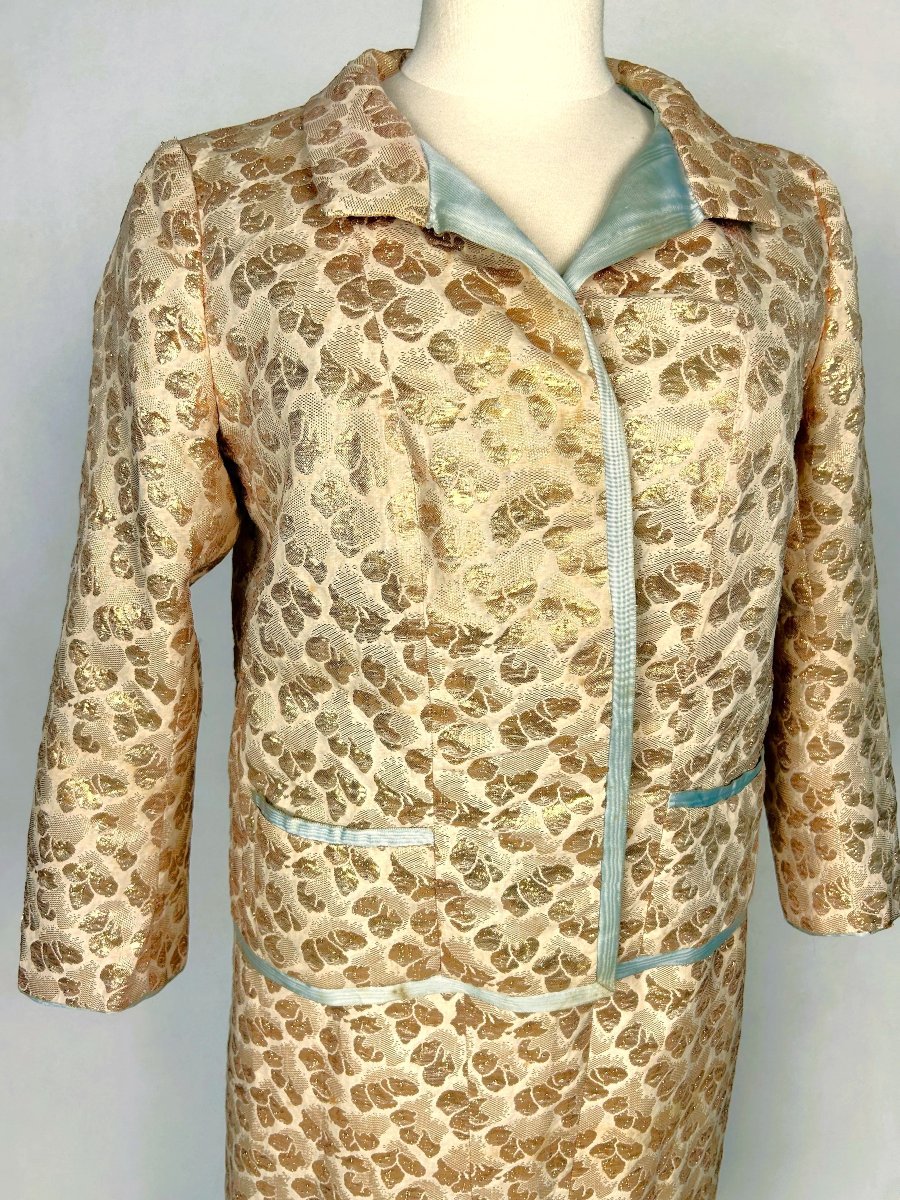
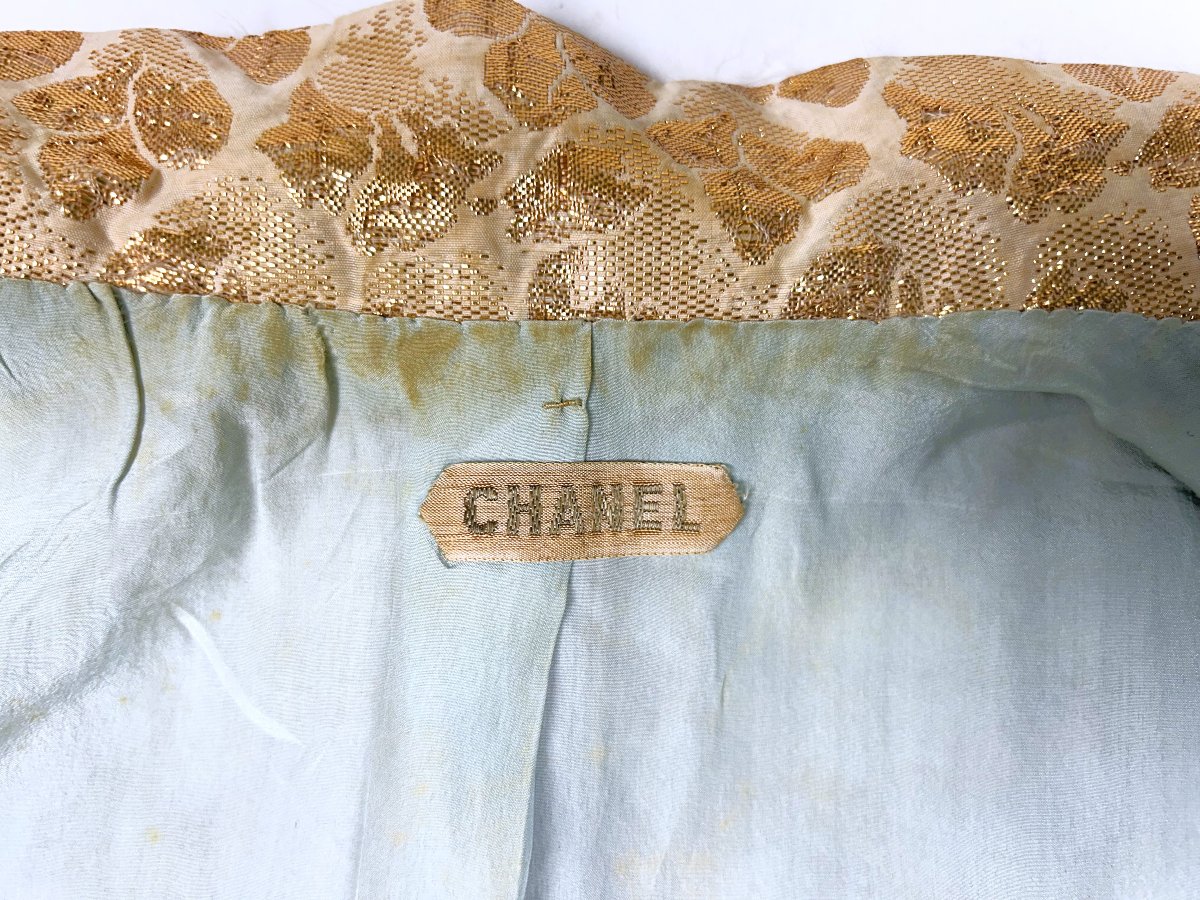
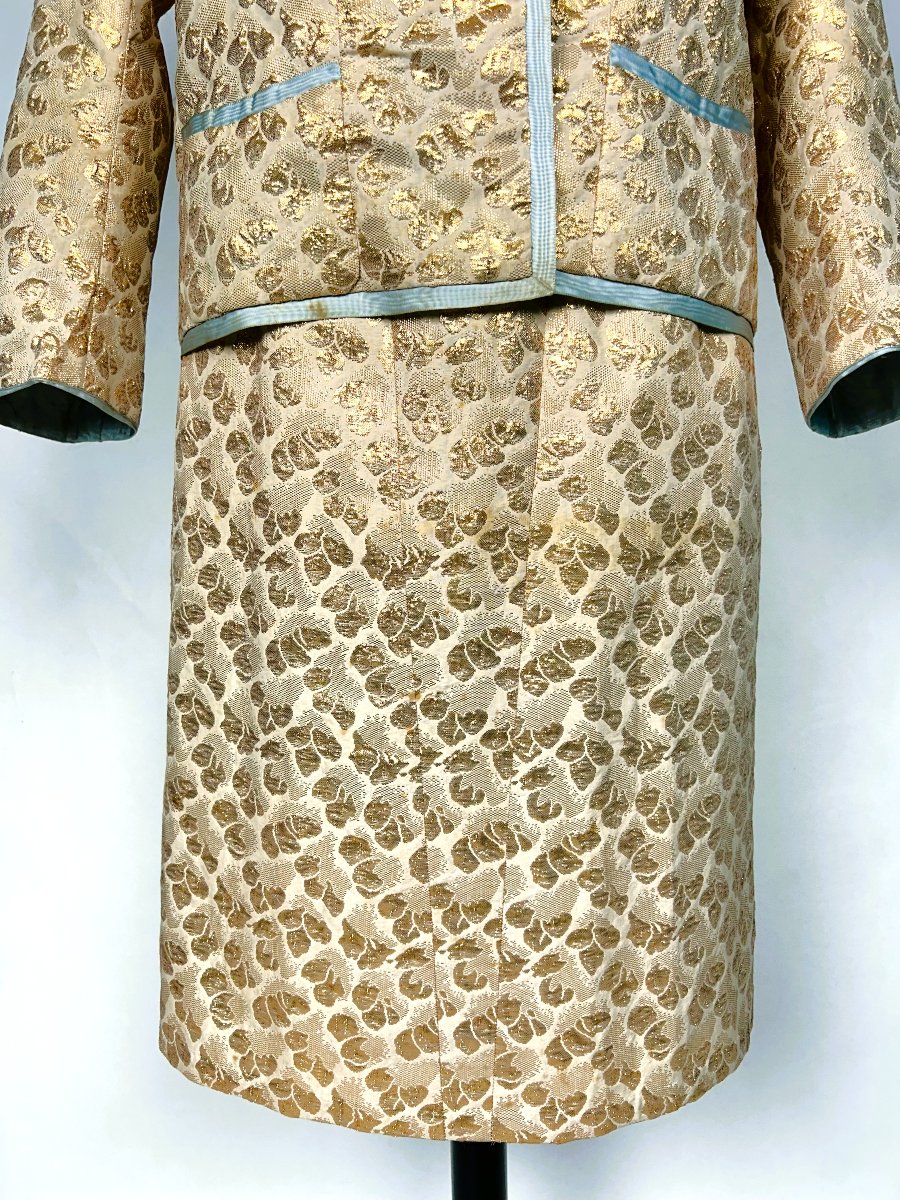
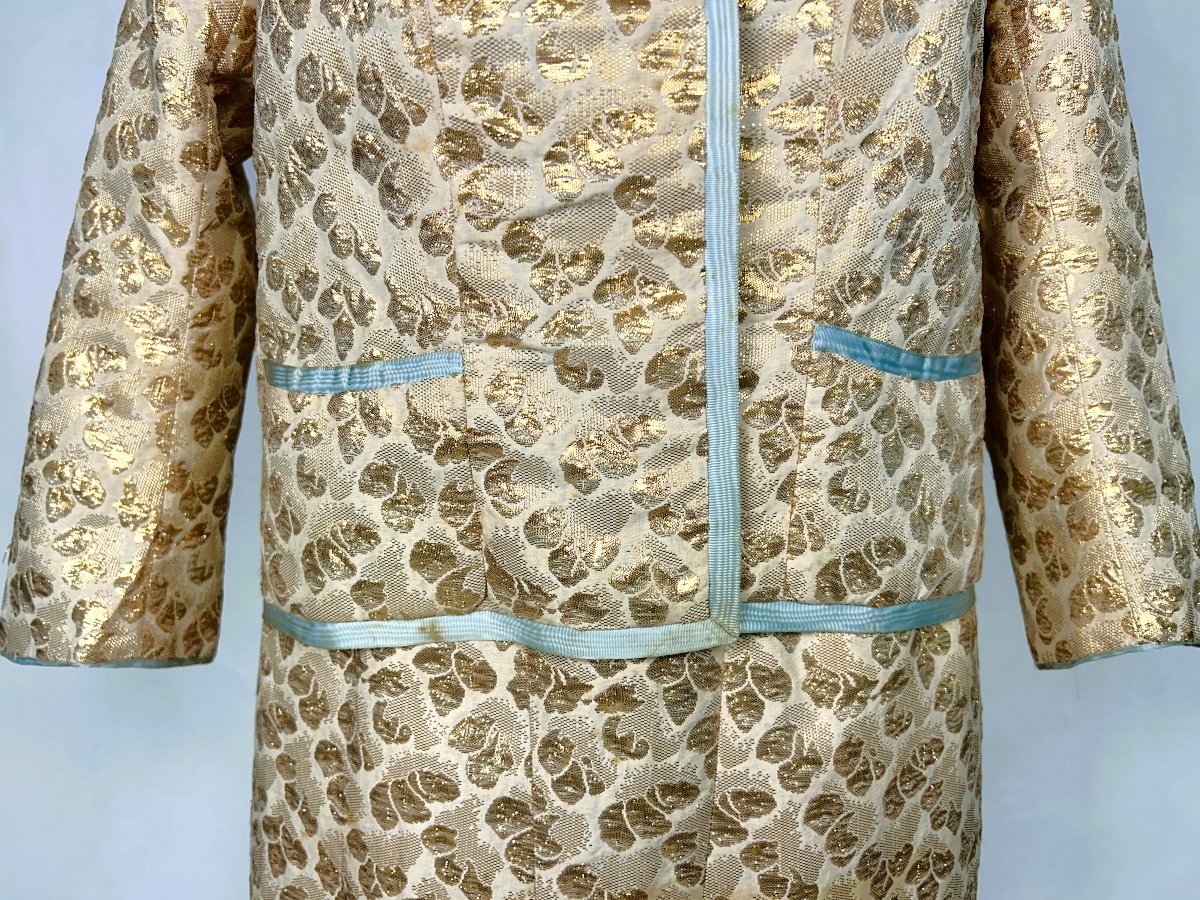
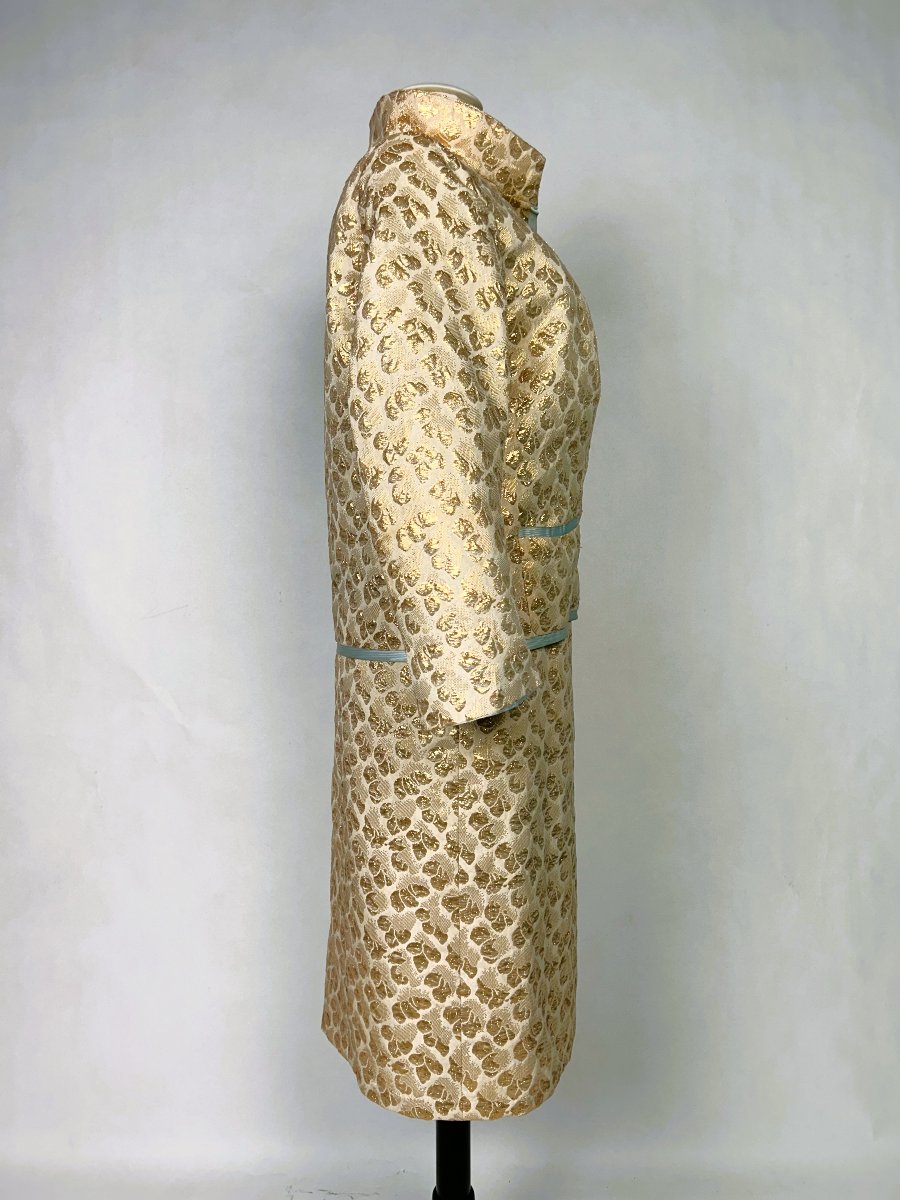
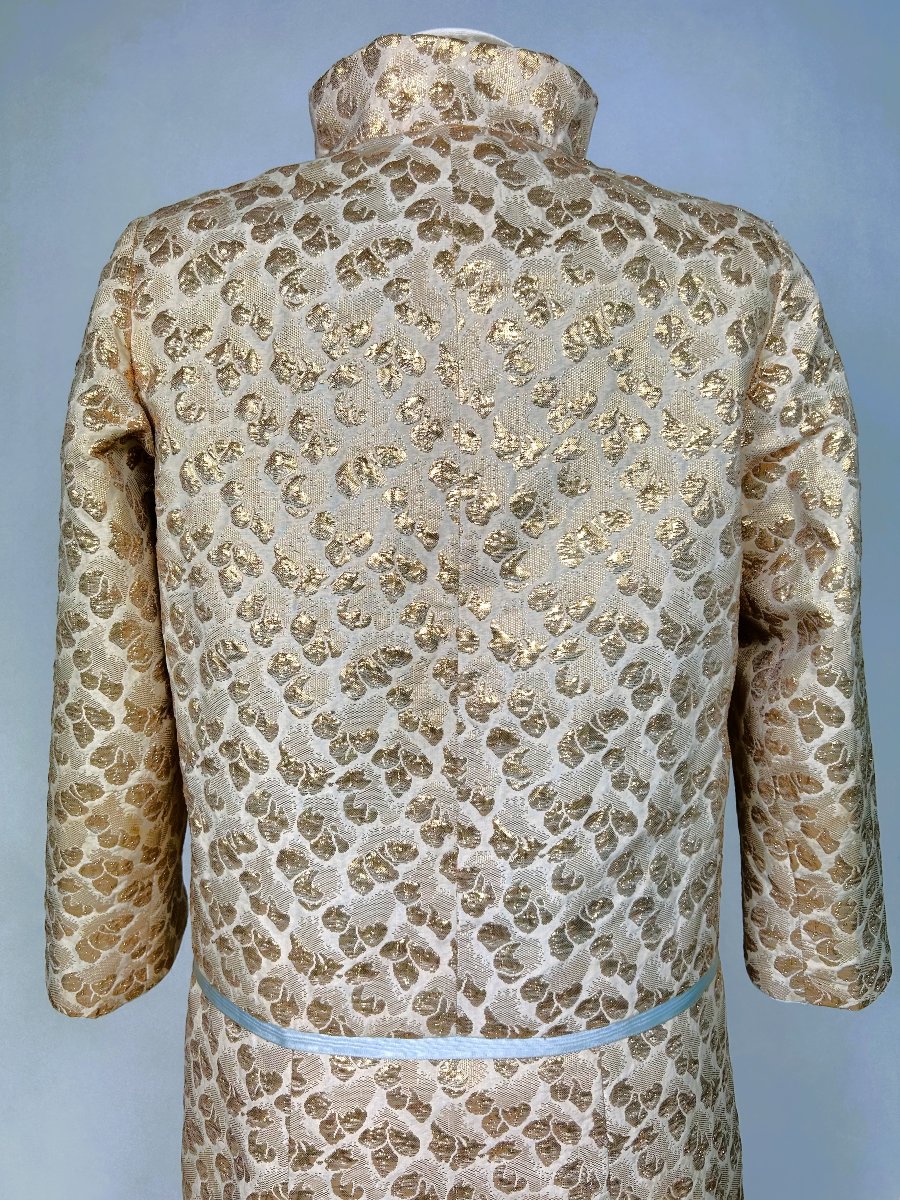
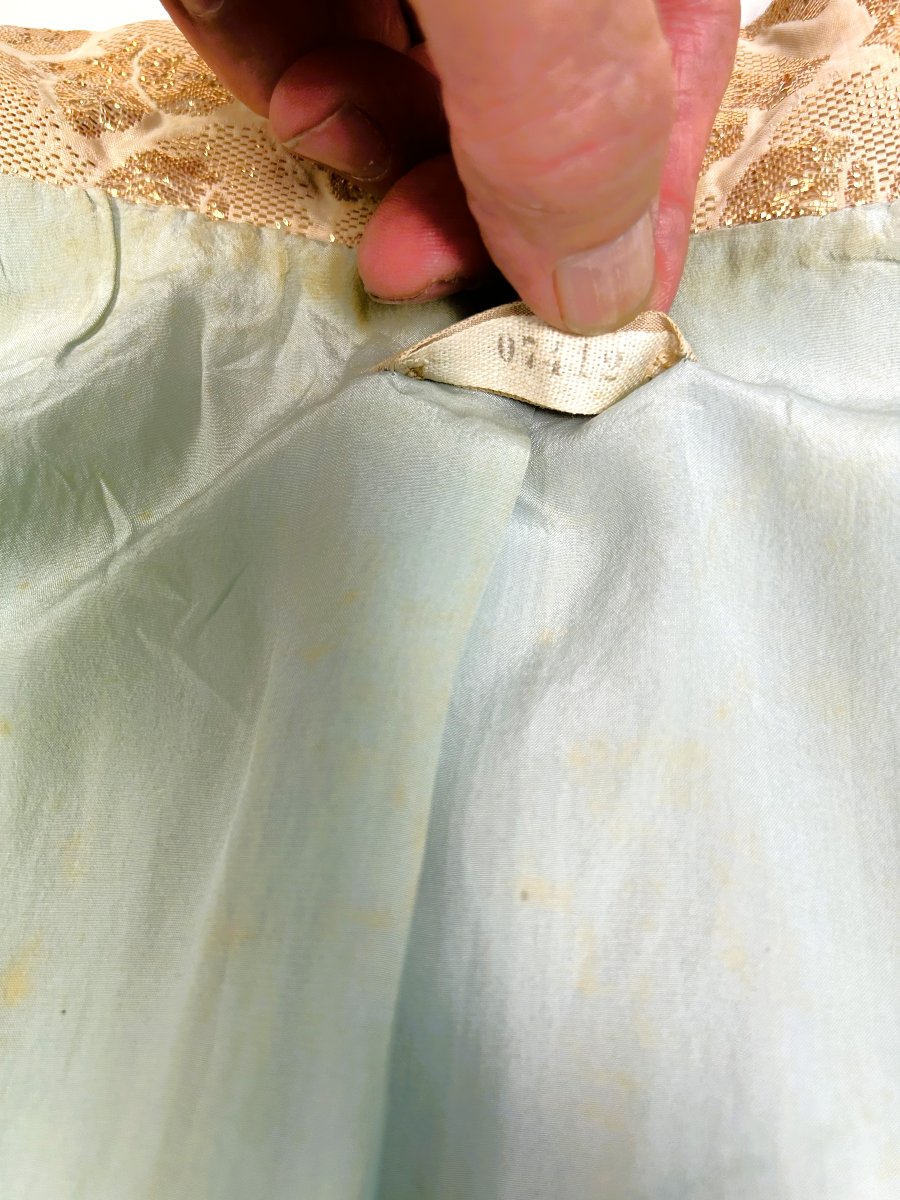
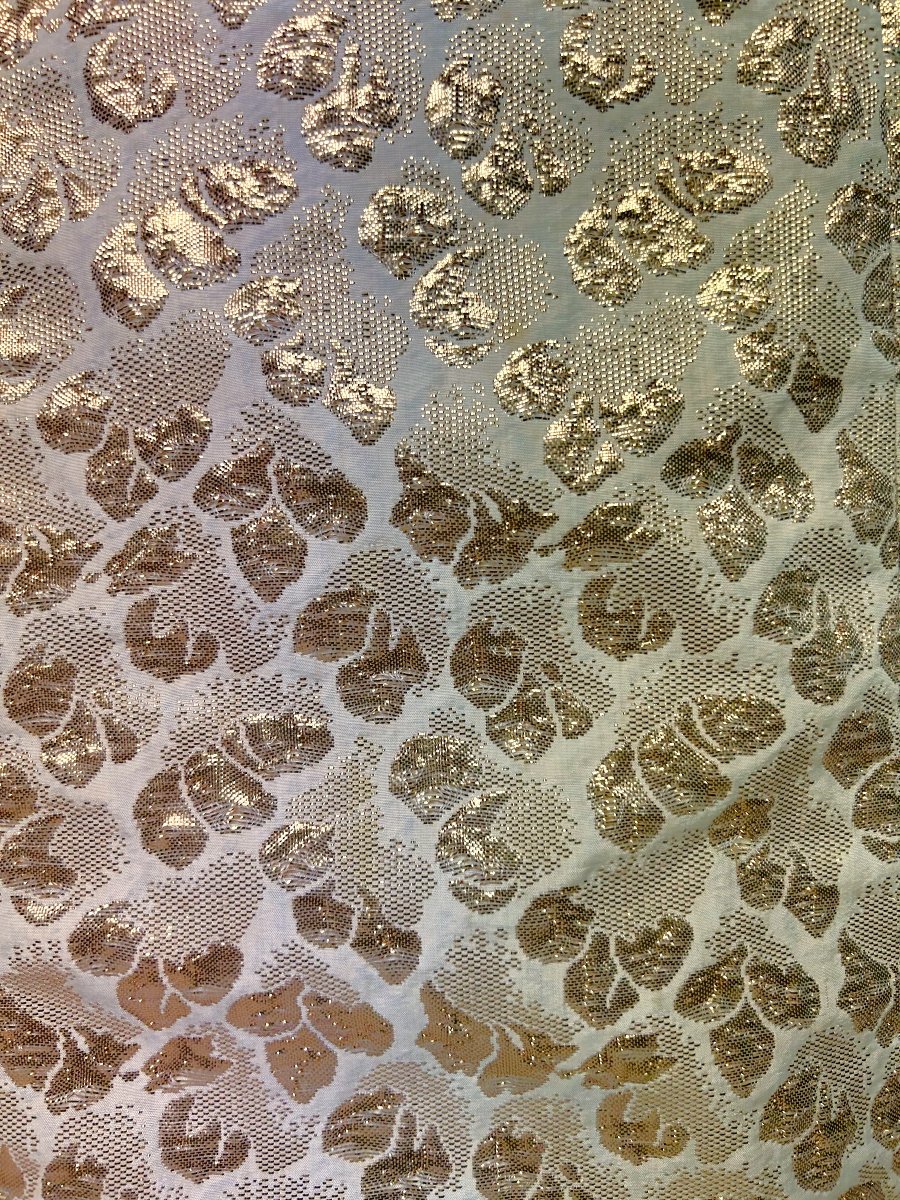
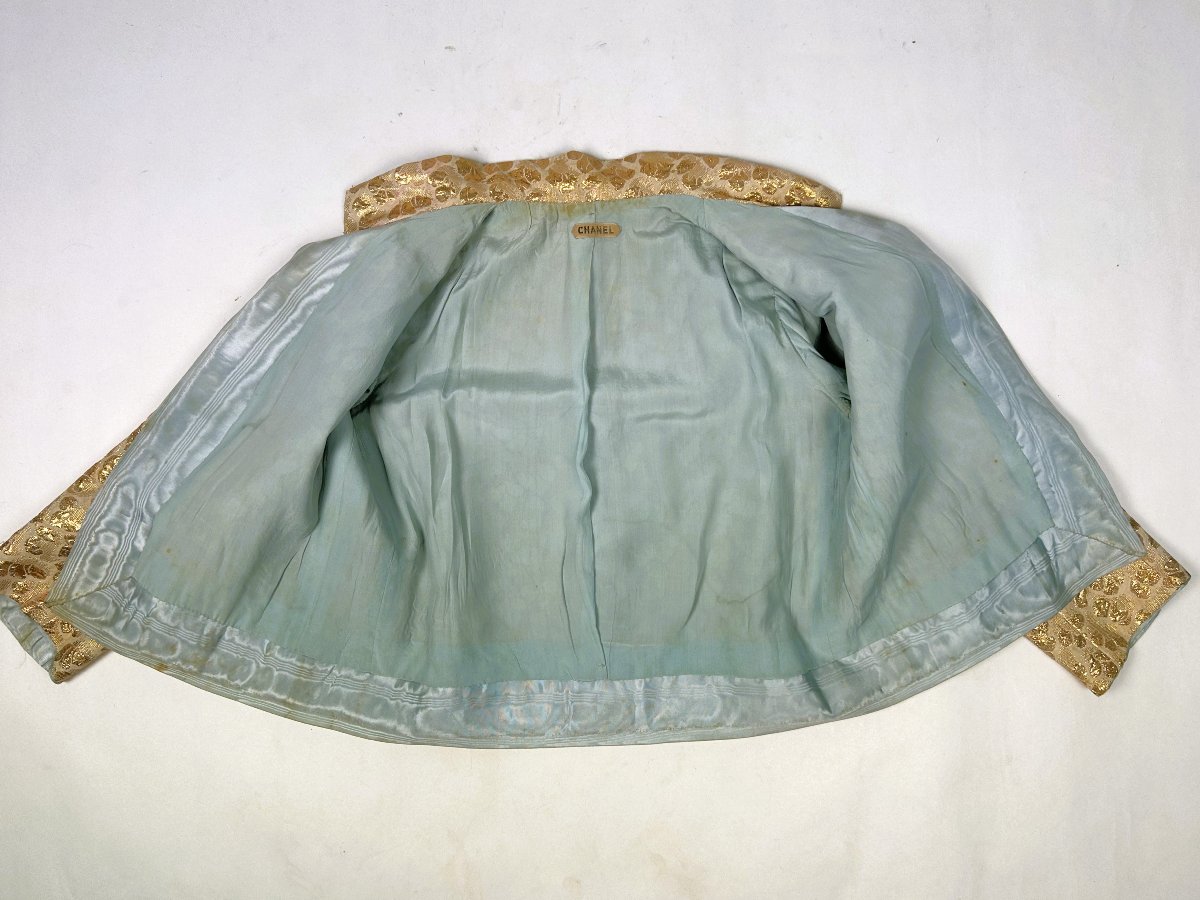
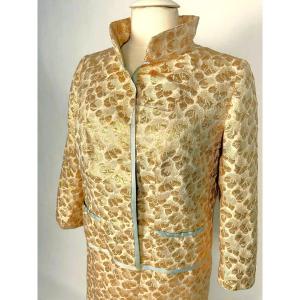
A rare and very early Gabrielle Chanel Haute Couture skirt suit, numbered 07412, from the Fall/Winter 1958–1959 collection. An identical piece was immortalized by model Hélène Arnaud and photographed by Henry Clarke for Vogue (photo available upon request). During this pivotal period following the reopening of her fashion house in 1954, Gabrielle Chanel collaborated closely with the prestigious Lyon-based silk manufacturer Bucol to incorporate innovative, metallic textiles into her flowing silhouettes, such as this gold cloqué lamé. Surprisingly, the jacket has no buttons or button placket, and the collar can be worn turned up! Only two genuine, very low-set pockets complete this jacket of exemplary simplicity. Its sky-blue silk crepe lining is edged with a matching silk moiré bias tape, echoing the details on the pockets. The skirt is a pencil skirt, fastened at the back with two zippers, and its cream taffeta lining was likely replaced at a later date (stains on the lining). A cream label with black lettering reading “Chanel,” with a cotton ribbon beneath the label bearing the number 07412. Aside from a few stains on the lining and traces of foundation (which is only natural), this ensemble has no holes or stains. Overall good condition in terms of color and preservation.
Dimensions: Equivalent to French Size 42-43. Jacket: Height 55 cm, Shoulders 39 cm, Sleeves 54 cm, Chest 103 cm, Waist 99 cm. Skirt: Length 61 cm, Waist 78 cm, Hips 103 cm
In 1953, the Chanel headquarters at 31 Rue Cambon—which had closed just before World War II—was undergoing renovations to reopen its doors. Offices, workshops, boutiques, as well as “Mademoiselle’s” apartment were being renovated. There were many reasons for the fashion designer’s return. But above all, Gabrielle Chanel—who had always advocated “practical” fashion for the modern, elegant woman— opposed the fashion designers who were at the height of their success at the time—such as Dior and Balenciaga—and the corseted fashion that ran counter to the liberated women who had played a role during the war. On February 5, 1954, she presented a collection of 130 designs, including her piped tweed suit. The Chanel suit was intended, according to the designer, a timeless garment, suitable for both day and evening wear simply by changing accessories—all of which was outside the fashion trends of the time. Its “always impeccable” appearance and comfort were directly inspired by men’s clothing: Karl Lagerfeld noted that: “The Chanel jacket is thus a men’s jacket that has become a quintessentially feminine garment, one that has crossed that boundary and has definitively become the symbol of a certain nonchalant, timeless, and ageless feminine elegance, that is to say, for all time.” This suit symbolizes Coco Chanel’s return to business after several years spent in Switzerland. However, the designer’s experiences during the war, as well as the dominance of silhouettes inherited from Dior’s New Look, meant that her return was not an immediate success. The European press, especially the French and British media—with the exception of Elle magazine and its editor-in-chief Hélène Lazareff—gave her collection a very poor reception: a “fiasco,” a “flop,” and austere designs that were too “out of step” with the times. For its part, the all-powerful American press—including magazines like *Life*, which would coin the term “Chanel Look,” or, above all, Vogue, gave her its support, and orders poured in from the United States. This success—particularly in the United States at first—meant that by the following year, the suit had become a classic and was widely copied; the proliferation of these copies would eventually turn this suit into a “symbol of a somewhat traditional bourgeoisie,” but also a symbol of “timeless” elegance, sometimes associated with the image of the Parisian woman. In the 1960s, Anouk Aimée and Romy Schneider were seen wearing this outfit; much later, it would be Lady Diana. On November 22, 1963, John F. Kennedy was assassinated in Dallas; Jacqueline Kennedy, at his side, wore a pink Chanel suit.
Period: 20th century
Style: Design 50's and 60's
Condition: Good condition
Material: Linen
Reference (ID): 1820559
Availability: In stock