

Clock Mythological Orpheus
ORDERING AND ADDITIONAL INFORMATION FROM OUR WEBSITE
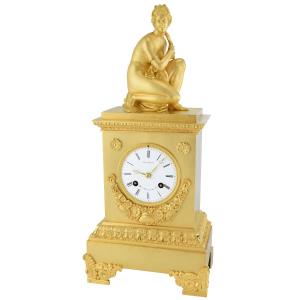
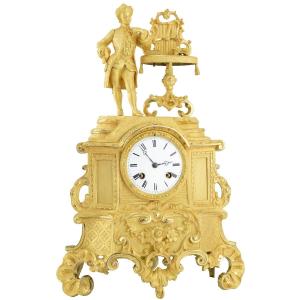
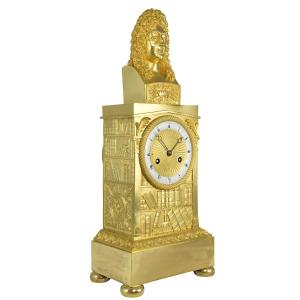
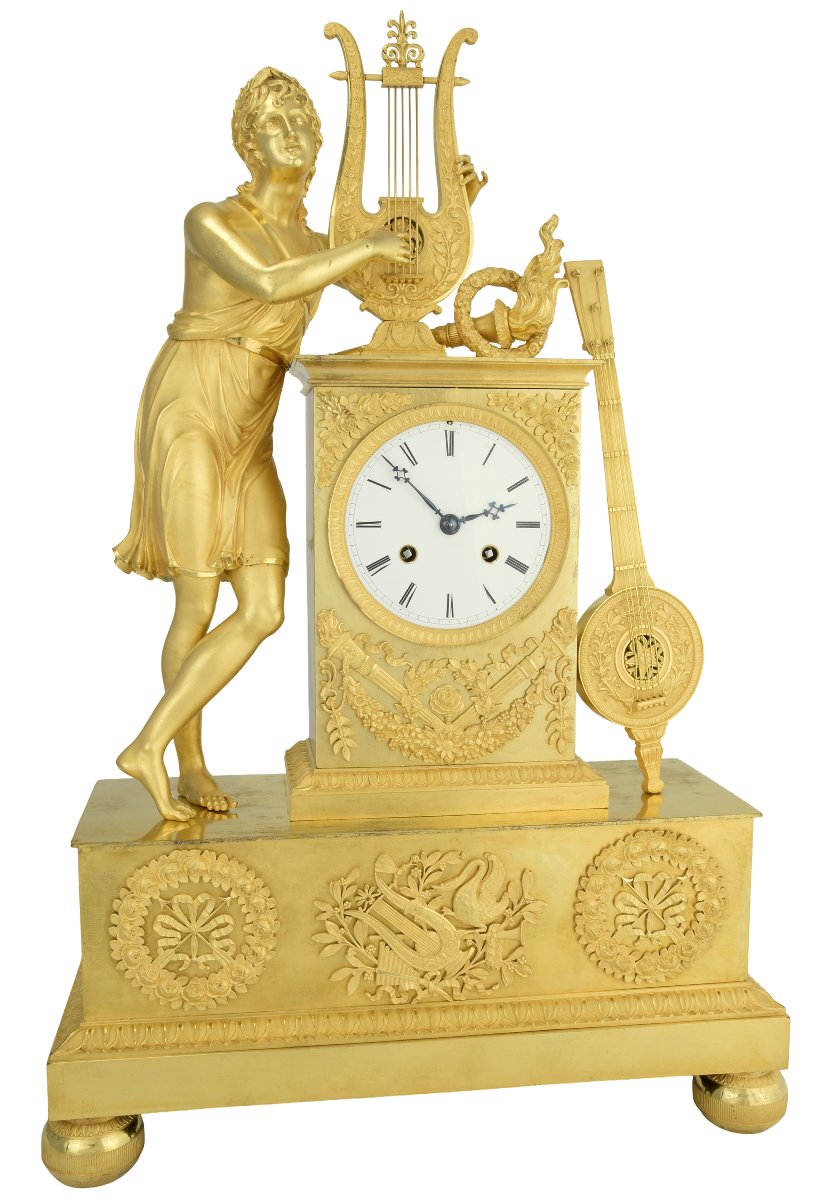
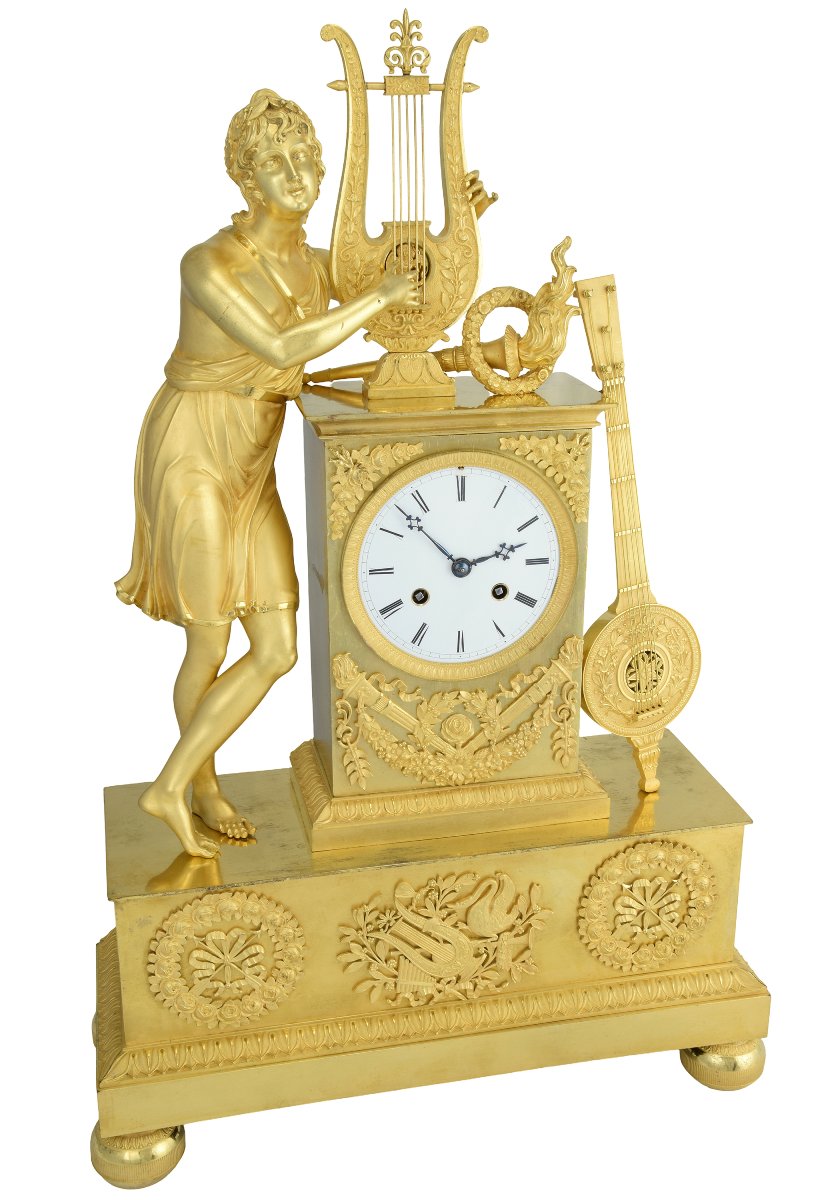
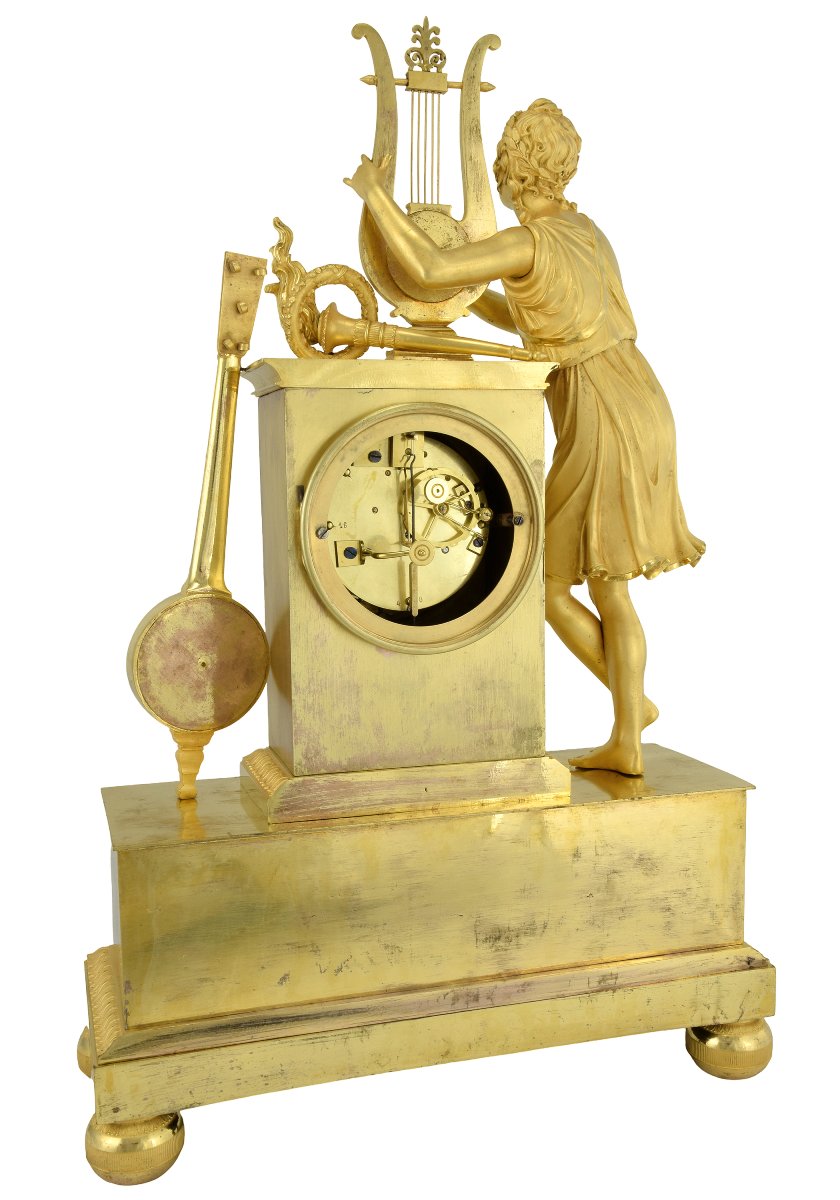
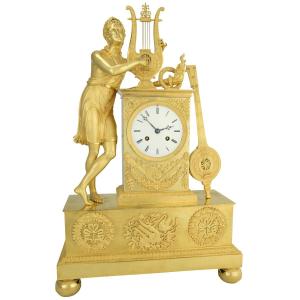
This remarkable mythological mantel clock depicting Orpheus constitutes an exceptional testimony to French decorative art of the Restoration period, circa 1820. Entirely crafted in finely chased bronze and mercury-gilt with gold, it is distinguished by the richness of its ornamental programme, the quality of its sculpture and the masterful balance of its composition. The gilding, still particularly luminous and homogeneous, admirably enhances the numerous details of the chasing. The ensemble displays perfect authenticity, both in its composition and in the presence of its decorative elements, and is preserved in a remarkable state of conservation, retaining all its decorative power and exceptional integrity.
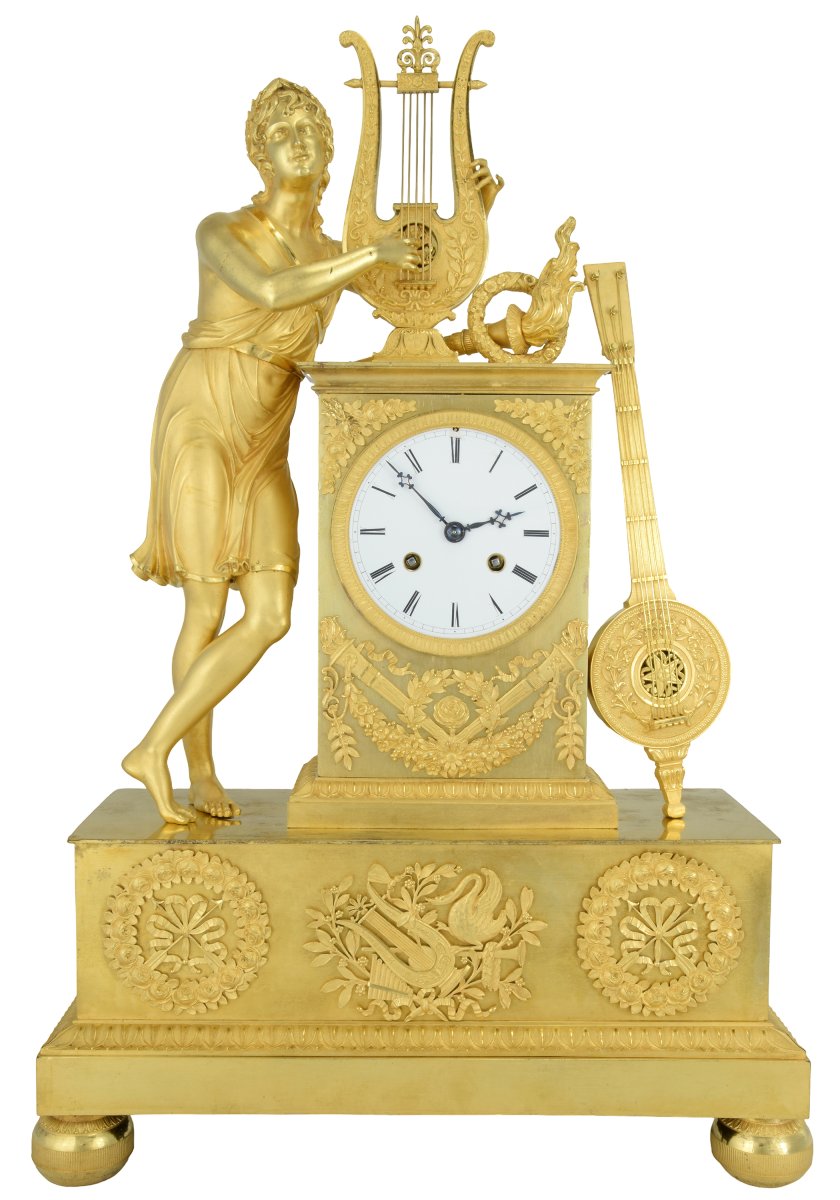
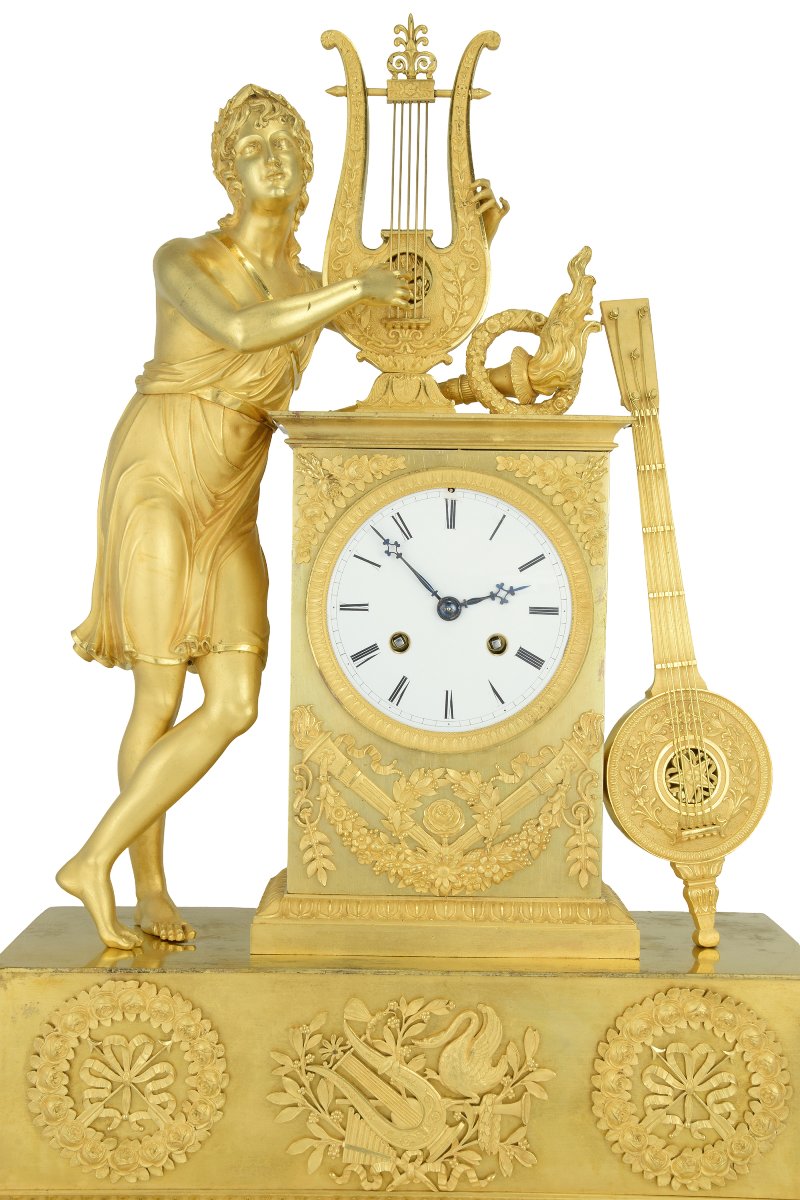
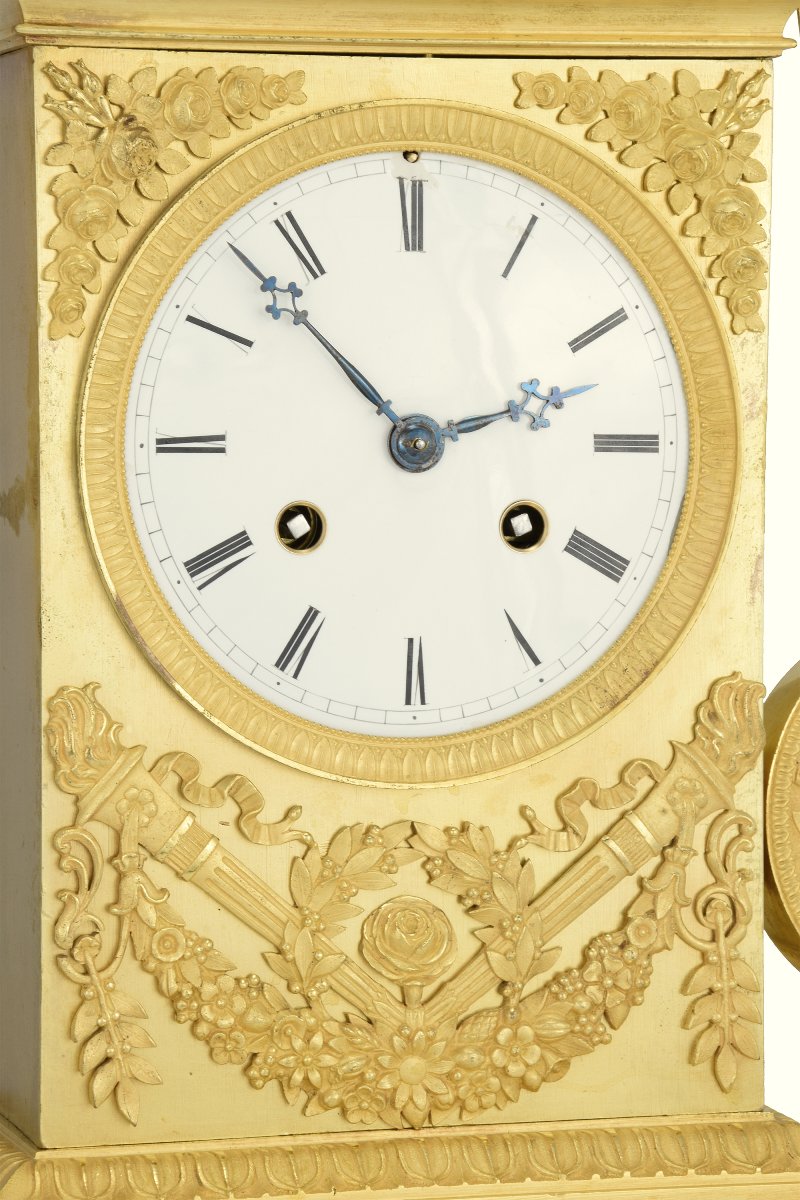
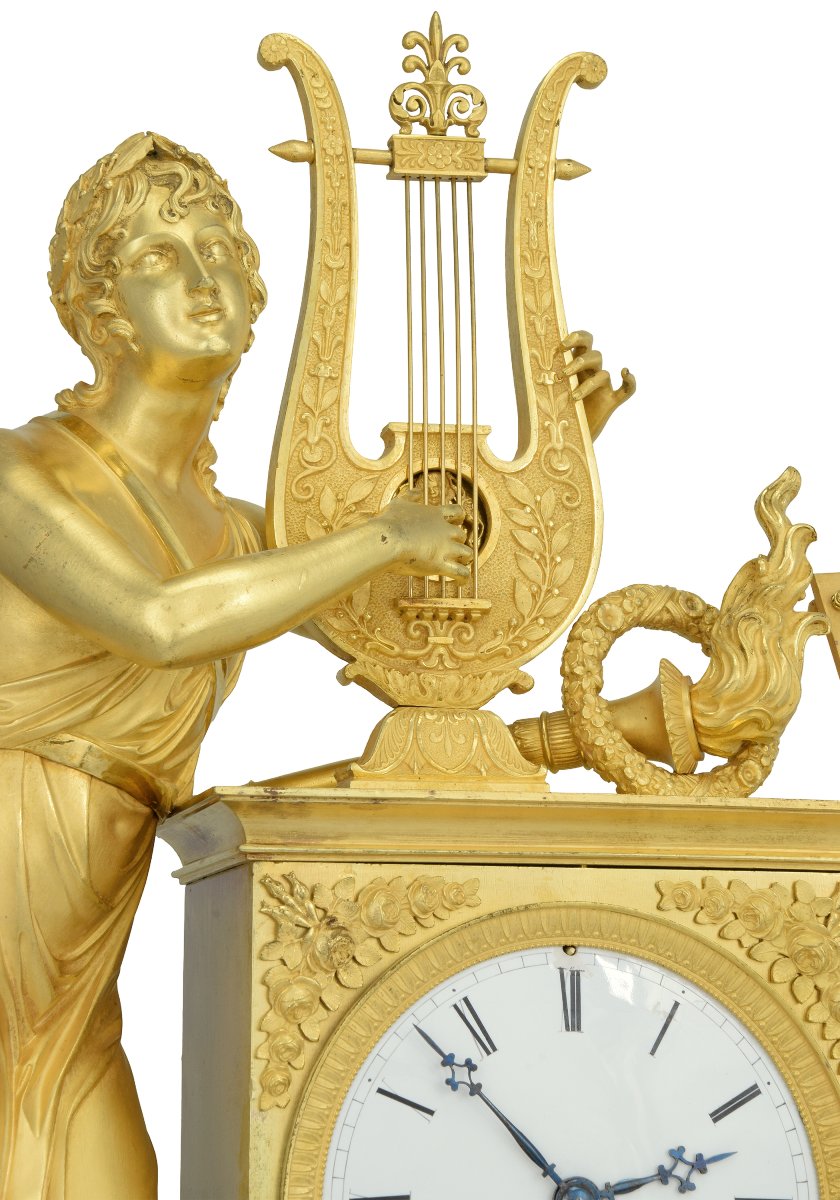
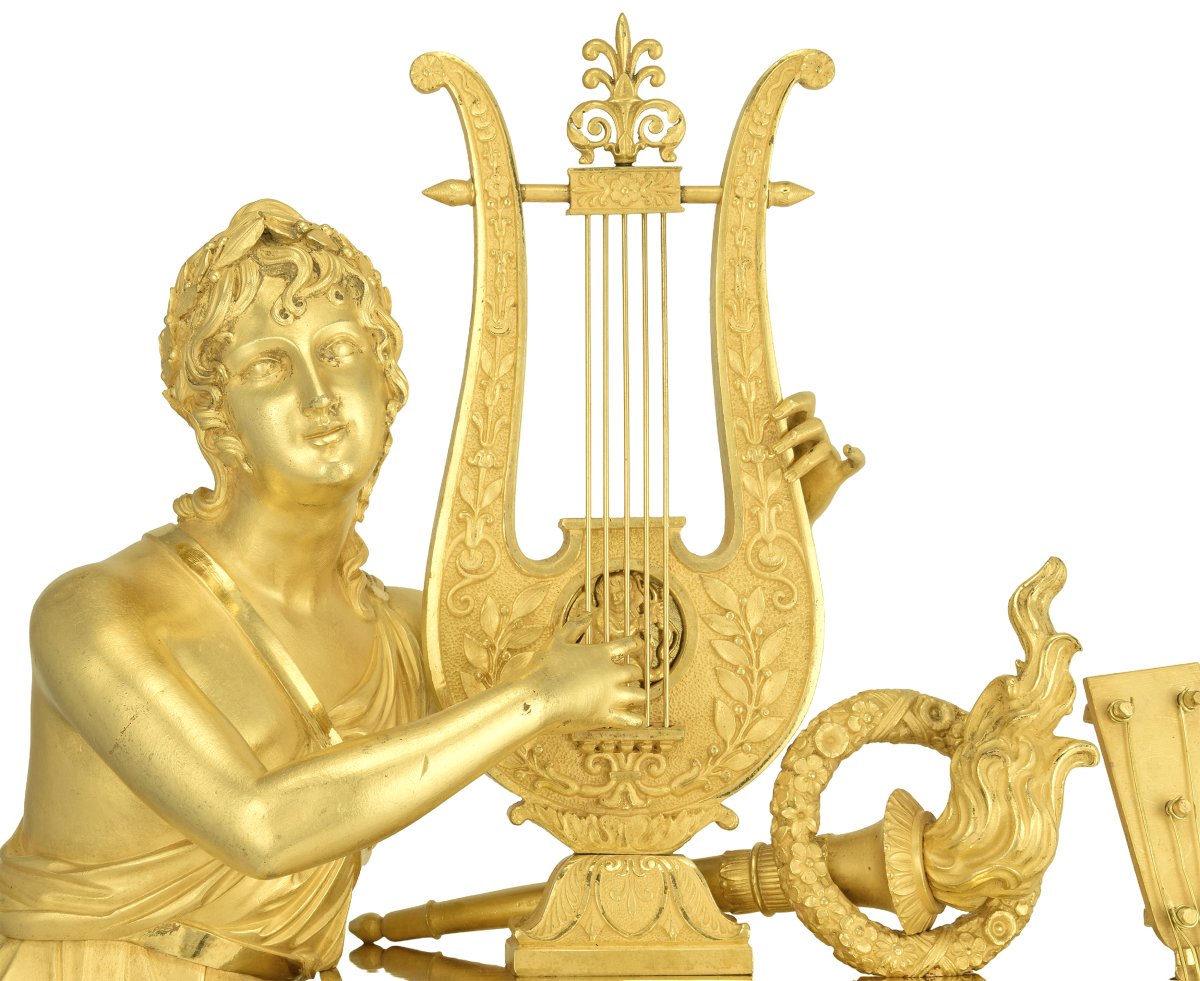
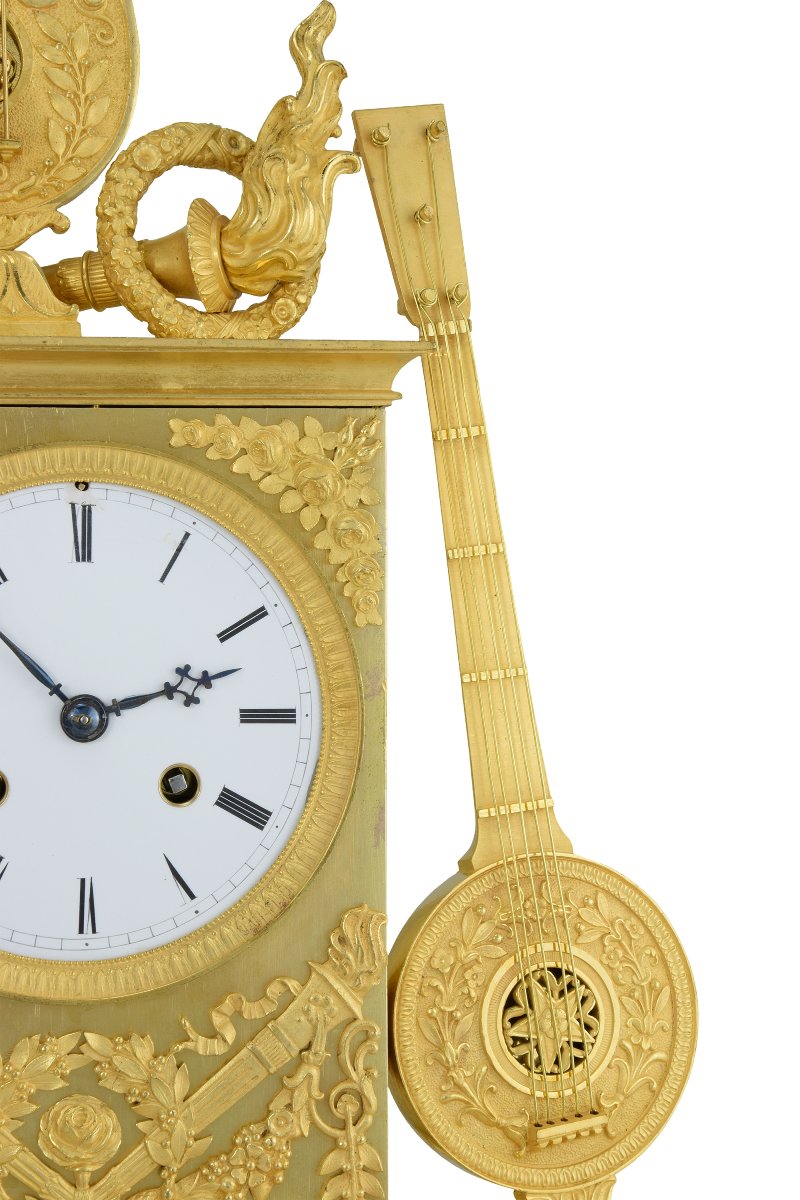
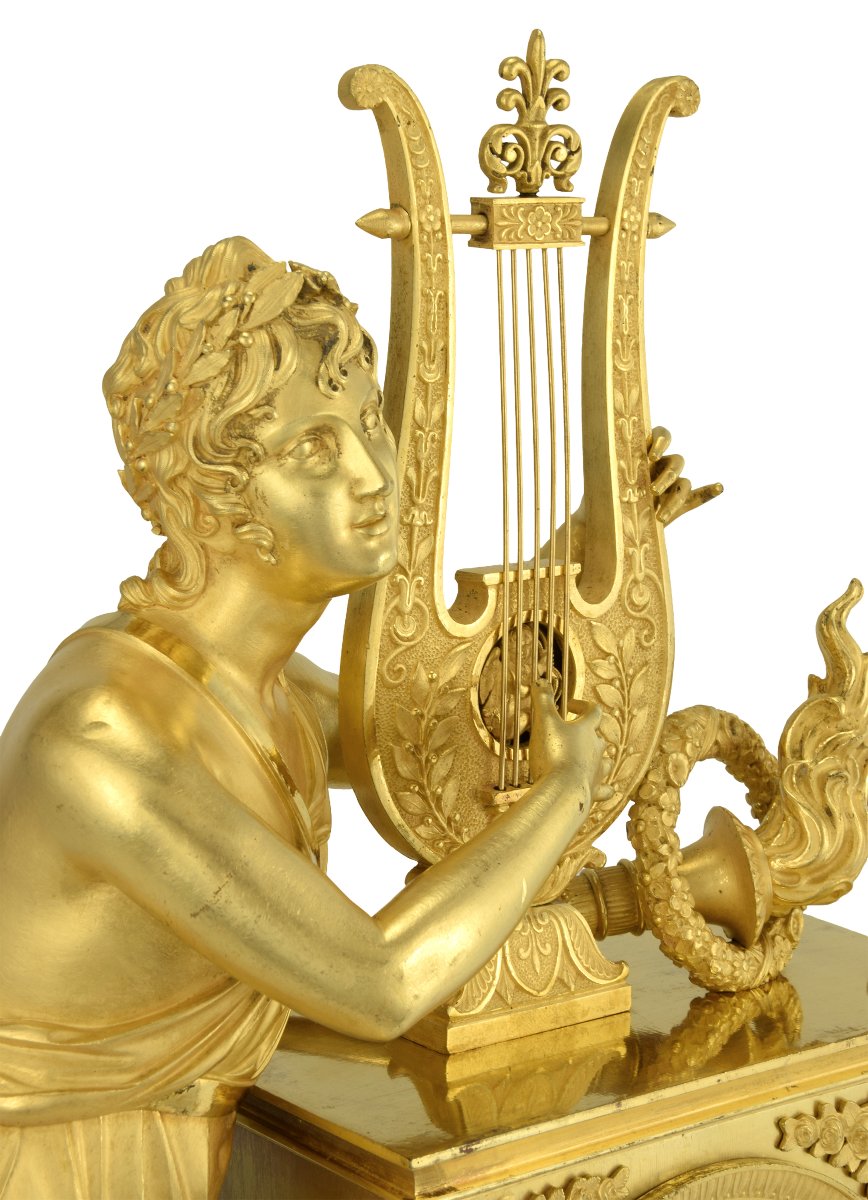
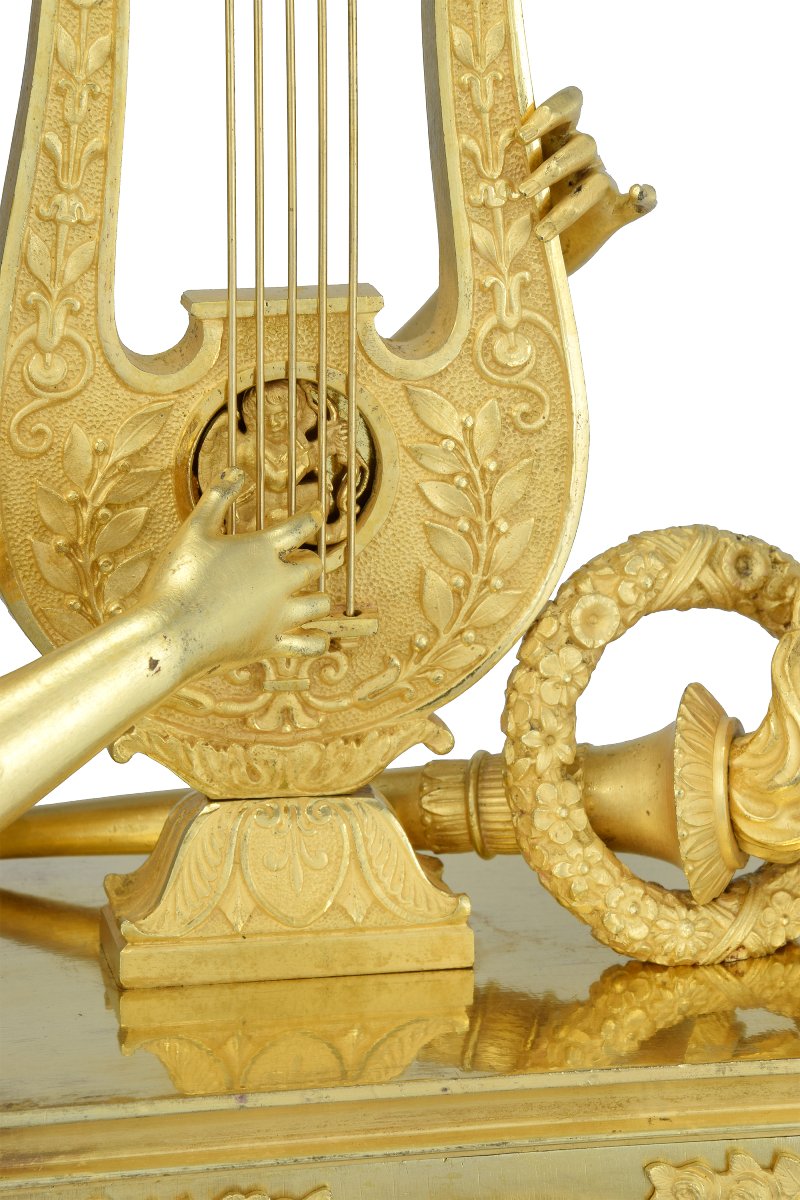
The upper section, a veritable apotheosis of the composition, is dominated by the figure of Orpheus, the celebrated musician of Greek mythology, represented as an idealised young man with a face imbued with gentleness and serenity. Draped in the antique manner in a garment with soft, carefully modelled folds, he stands in an elegant and natural pose, his body slightly inclined towards his instrument. His arm extends delicately to set the strings of the great lyre vibrating, the essential attribute of Orpheus and symbol of his legendary musical power. The lyre, executed with particular refinement, features two arched uprights richly chased with scrolling foliage, leaves and vegetal motifs, surmounted by an openwork finial. Beside him are several attributes associated with music, including a second stringed instrument suspended alongside the soundbox, while a richly ornamented wind instrument completes the scene. The entire group rests upon the summit of the clock case in a skilfully balanced composition. The presence of Orpheus, surrounded by his instruments, lends this clock a particularly poetic dimension, evoking the power of music which, according to the myth, was capable of enchanting men, animals and even the forces of nature. The circular white enamel dial, with black Roman numerals and finely graduated minute track, is framed by broad mouldings adorned with radiating motifs, while the blued-steel hands provide an elegant contrast to the golden brilliance of the bronze.
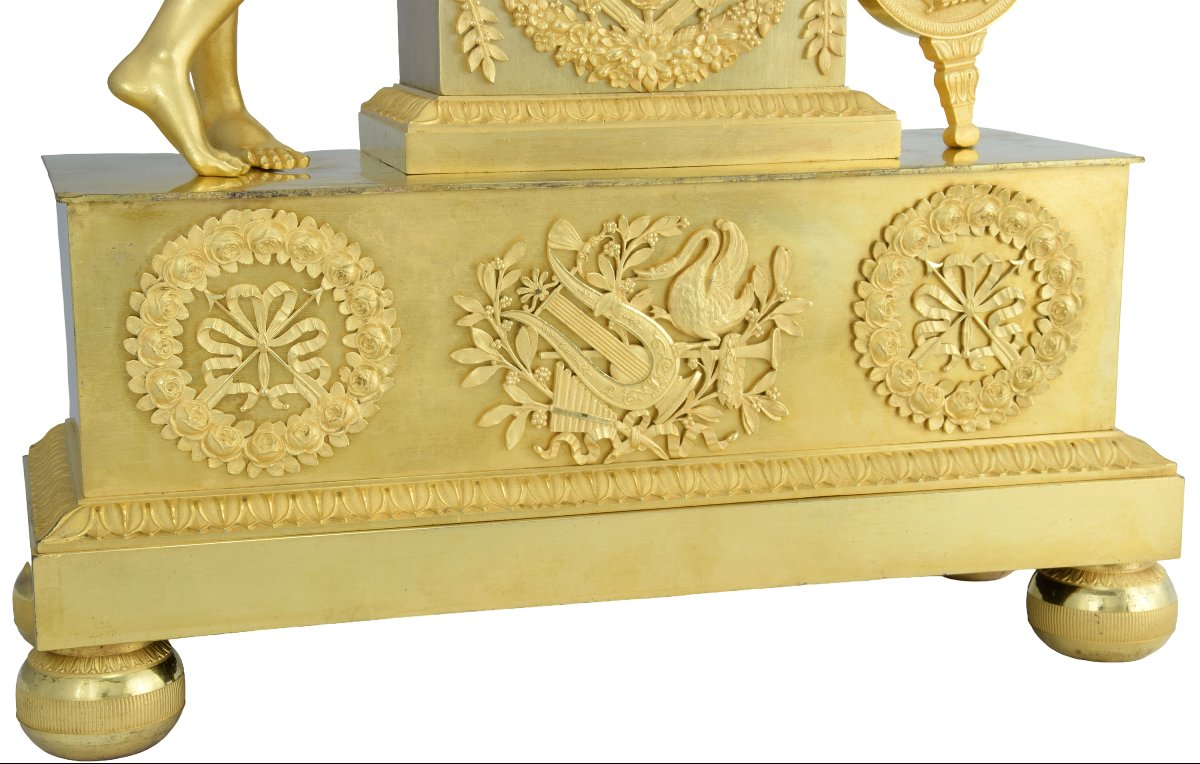
The lower section, monumental and architectural in form, features a rectangular stepped case resting upon a broad moulded base and four flattened spherical feet, finely fluted and decorated with vegetal friezes. The body of the clock is entirely animated by an exceptional decoration in gilt bronze. Delicate garlands of roses unfold around the dial, while the lower section presents a symmetrical composition of musical instruments, foliage, flowers and tied ribbons. At the centre stands a lyre accompanied by a swan with outstretched wings, leafy branches and flowering bouquets, directly recalling the musical and poetic world of Orpheus. On either side, large motifs of stringed instruments are intertwined with scrolls, foliage and flowers, while two circular medallions surrounded by rose wreaths contain compositions of ribbons and foliage. The various mouldings are enriched with friezes of water leaves, palmettes, pearls, scrolling foliage, floral garlands and vegetal motifs, whose precise chasing admirably emphasises the volumes. The variety of textures — matt, glossy, finely granulated and delicately polished surfaces — allows the mercury gilding to interact subtly with the light.
Through its monumental presence, particularly appealing iconography and exceptional richness of decoration, this Orpheus clock stands as a work of outstanding quality within the art of gilt bronze during the Restoration period. The perfect coherence of its composition, the elegance of the mythological figure, the profusion of its musical and floral attributes, together with the remarkable quality of the chasing, make it a particularly sought-after work of art. Its subject, directly inspired by Antiquity and treated with all the Neoclassical sensibility characteristic of creations dating from around 1820, lends it a timeless beauty and considerable decorative appeal. The remarkable preservation of its gilt bronzes and the integrity of its ornamental programme further enhance its significance. Rare for its scale, subject matter and richness of execution, this clock is therefore an exceptional work, destined to take its place equally well in a collection of antique gilt bronzes or in an interior seeking a spectacular, refined and deeply representative expression of French Restoration taste.
Original movement intact and unaltered, with silk-thread suspension. Striking on the hours and half-hours on an antique bell, producing a clear and authentic tone.
This remarkable mythological mantel clock depicting Orpheus constitutes an exceptional testimony to French decorative art of the Restoration period, circa 1820. Entirely crafted in finely chased bronze and mercury-gilt with gold, it is distinguished by the richness of its ornamental programme, the quality of its sculpture and the masterful balance of its composition. The gilding, still particularly luminous and homogeneous, admirably enhances the numerous details of the chasing. The ensemble displays perfect authenticity, both in its composition and in the presence of its decorative elements, and is preserved in a remarkable state of conservation, retaining all its decorative power and exceptional integrity.
The upper section, a veritable apotheosis of the composition, is dominated by the figure of Orpheus, the celebrated musician of Greek mythology, represented as an idealised young man with a face imbued with gentleness and serenity. Draped in the antique manner in a garment with soft, carefully modelled folds, he stands in an elegant and natural pose, his body slightly inclined towards his instrument. His arm extends delicately to set the strings of the great lyre vibrating, the essential attribute of Orpheus and symbol of his legendary musical power. The lyre, executed with particular refinement, features two arched uprights richly chased with scrolling foliage, leaves and vegetal motifs, surmounted by an openwork finial. Beside him are several attributes associated with music, including a second stringed instrument suspended alongside the soundbox, while a richly ornamented wind instrument completes the scene. The entire group rests upon the summit of the clock case in a skilfully balanced composition. The presence of Orpheus, surrounded by his instruments, lends this clock a particularly poetic dimension, evoking the power of music which, according to the myth, was capable of enchanting men, animals and even the forces of nature. The circular white enamel dial, with black Roman numerals and finely graduated minute track, is framed by broad mouldings adorned with radiating motifs, while the blued-steel hands provide an elegant contrast to the golden brilliance of the bronze.
The lower section, monumental and architectural in form, features a rectangular stepped case resting upon a broad moulded base and four flattened spherical feet, finely fluted and decorated with vegetal friezes. The body of the clock is entirely animated by an exceptional decoration in gilt bronze. Delicate garlands of roses unfold around the dial, while the lower section presents a symmetrical composition of musical instruments, foliage, flowers and tied ribbons. At the centre stands a lyre accompanied by a swan with outstretched wings, leafy branches and flowering bouquets, directly recalling the musical and poetic world of Orpheus. On either side, large motifs of stringed instruments are intertwined with scrolls, foliage and flowers, while two circular medallions surrounded by rose wreaths contain compositions of ribbons and foliage. The various mouldings are enriched with friezes of water leaves, palmettes, pearls, scrolling foliage, floral garlands and vegetal motifs, whose precise chasing admirably emphasises the volumes. The variety of textures — matt, glossy, finely granulated and delicately polished surfaces — allows the mercury gilding to interact subtly with the light.
Through its monumental presence, particularly appealing iconography and exceptional richness of decoration, this Orpheus clock stands as a work of outstanding quality within the art of gilt bronze during the Restoration period. The perfect coherence of its composition, the elegance of the mythological figure, the profusion of its musical and floral attributes, together with the remarkable quality of the chasing, make it a particularly sought-after work of art. Its subject, directly inspired by Antiquity and treated with all the Neoclassical sensibility characteristic of creations dating from around 1820, lends it a timeless beauty and considerable decorative appeal. The remarkable preservation of its gilt bronzes and the integrity of its ornamental programme further enhance its significance. Rare for its scale, subject matter and richness of execution, this clock is therefore an exceptional work, destined to take its place equally well in a collection of antique gilt bronzes or in an interior seeking a spectacular, refined and deeply representative expression of French Restoration taste.
Original movement intact and unaltered, with silk-thread suspension. Striking on the hours and half-hours on an antique bell, producing a clear and authentic tone.
1 700 €
Period: 19th century
Style: Consulat, Empire
Condition: Fully restored in our whorkshop
Material: Bronze
Width: 35 cm
Height: 53 cm
Depth: 14 cm
Reference (ID): 1807127
Availability: In stock
Print