Empire Pendulum Study And Philosophy
Artist: Dubuc Jeune
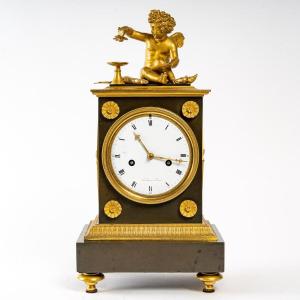
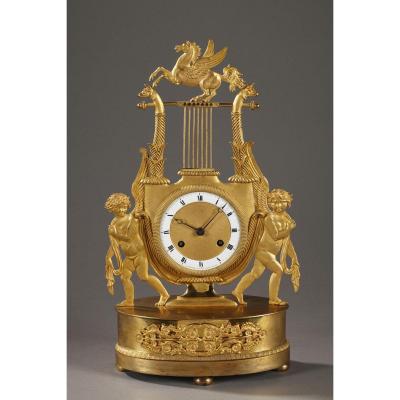
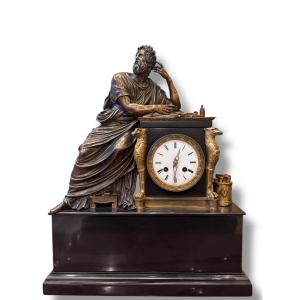
A superb French eight-day clock movement with anchor escapement, equipped with a rotating disc striking mechanism striking the hours in full and the half-hours in single. The dial is signed Dubuc jeune, with elegant Roman numerals for the hours and Arabic numerals for the minutes.
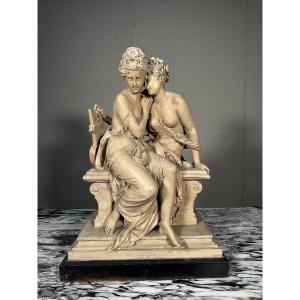
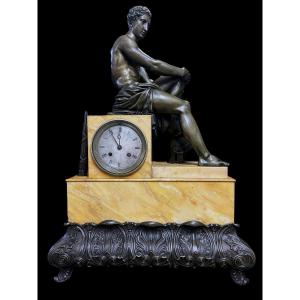
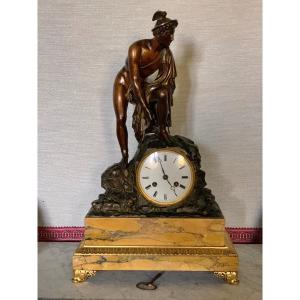
The movement rests on six spherical feet supporting a refined Siena marble base. In the center stands the patinated movement cage, richly decorated with gilt elements. To the left and right are two finely chased patinated bronze figures: a writing man representing Science and a reading woman representing Philosophy.
This model is a refined interpretation of the classic 18th-century design L'Étude et la Philosophie by Louis Simon Boizot (1743–1809), then a designer at the famous Manufacture des Gobelins and director of the design department of the Manufacture Nationale de Sèvres. His designs, first modeled in terracotta, were later realized in bronze or marble.
The bronze elements of this clock are of exceptional quality, both in the casting and in the extremely fine chasing. A rare and elegant piece for lovers of antique French clocks and neoclassical art.
Dubuc the Younger
Jean-Baptiste-Gabriel Dubuc, known as Dubuc the Younger, was an influential clockmaker in Paris, active during the periods of the Consulate and the Empire (circa 1800–1820). His workshop was located on Rue des Gravilliers from circa 1800 to 1817. Clocks bearing his signature were kept by aristocrats and eminent figures, including Charles-Marie-Philippe Huchet de la Bédoyère, the widow of the Marquis de la Guiche, Senator Henry Fargues, and André Masséna, Prince of Essling and Duke of Rivoli. Dubuc the Younger died in 1819. Dubuc the Younger likely had an older brother, Nicolas-Pierre-François Dubuc (Dubuc the Elder), also a clockmaker in Paris. To distinguish himself commercially, Jean-Baptiste signed his works Dubuc the Younger, while his brother used the name Dubuc the Elder. Dubuc the Younger's clocks were renowned for their high quality and elegance. Historians and auction experts consider his work to be among the finest creations of Parisian clockmakers of the early 19th century.
The movement rests on six spherical feet supporting a refined Siena marble base. In the center stands the patinated movement cage, richly decorated with gilt elements. To the left and right are two finely chased patinated bronze figures: a writing man representing Science and a reading woman representing Philosophy.
This model is a refined interpretation of the classic 18th-century design L'Étude et la Philosophie by Louis Simon Boizot (1743–1809), then a designer at the famous Manufacture des Gobelins and director of the design department of the Manufacture Nationale de Sèvres. His designs, first modeled in terracotta, were later realized in bronze or marble.
The bronze elements of this clock are of exceptional quality, both in the casting and in the extremely fine chasing. A rare and elegant piece for lovers of antique French clocks and neoclassical art.
Dubuc the Younger
Jean-Baptiste-Gabriel Dubuc, known as Dubuc the Younger, was an influential clockmaker in Paris, active during the periods of the Consulate and the Empire (circa 1800–1820). His workshop was located on Rue des Gravilliers from circa 1800 to 1817. Clocks bearing his signature were kept by aristocrats and eminent figures, including Charles-Marie-Philippe Huchet de la Bédoyère, the widow of the Marquis de la Guiche, Senator Henry Fargues, and André Masséna, Prince of Essling and Duke of Rivoli. Dubuc the Younger died in 1819. Dubuc the Younger likely had an older brother, Nicolas-Pierre-François Dubuc (Dubuc the Elder), also a clockmaker in Paris. To distinguish himself commercially, Jean-Baptiste signed his works Dubuc the Younger, while his brother used the name Dubuc the Elder. Dubuc the Younger's clocks were renowned for their high quality and elegance. Historians and auction experts consider his work to be among the finest creations of Parisian clockmakers of the early 19th century.
4 500 €
Period: 19th century
Style: Consulat, Empire
Condition: Good condition
Material: Bronze
Width: 62cm
Height: 47cm
Reference (ID): 1600212
Availability: In stock
Print