

Louis-alexandre Cabié – The Stream At Sunset – Oil On Panel – Signed
Artist: Cabié Louis-alexandre (1853 – 1939)
Louis-Alexandre Cabié (1853–1939)
The Stream at Sunset
Oil on panel
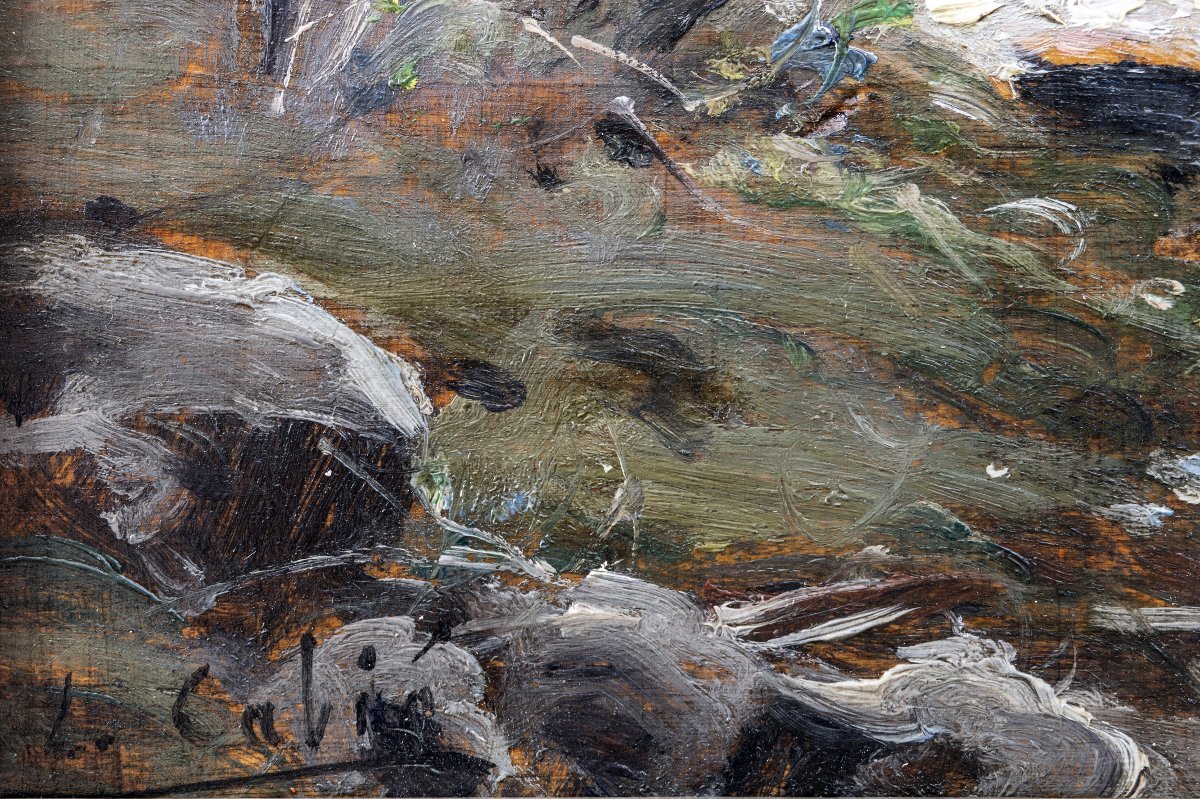
Signed lower left
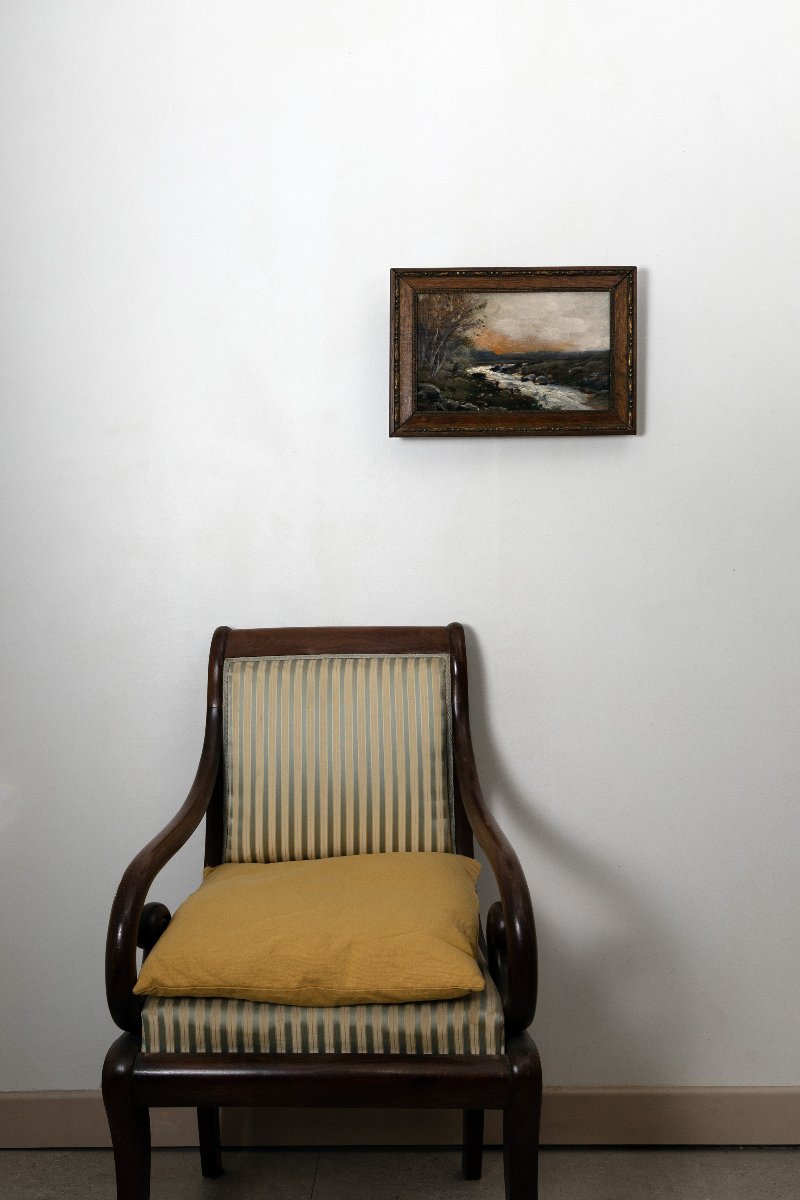
Dimensions: 35 x 23 cm. Dimensions with frame: 42 x 30.5 cm
Very good condition
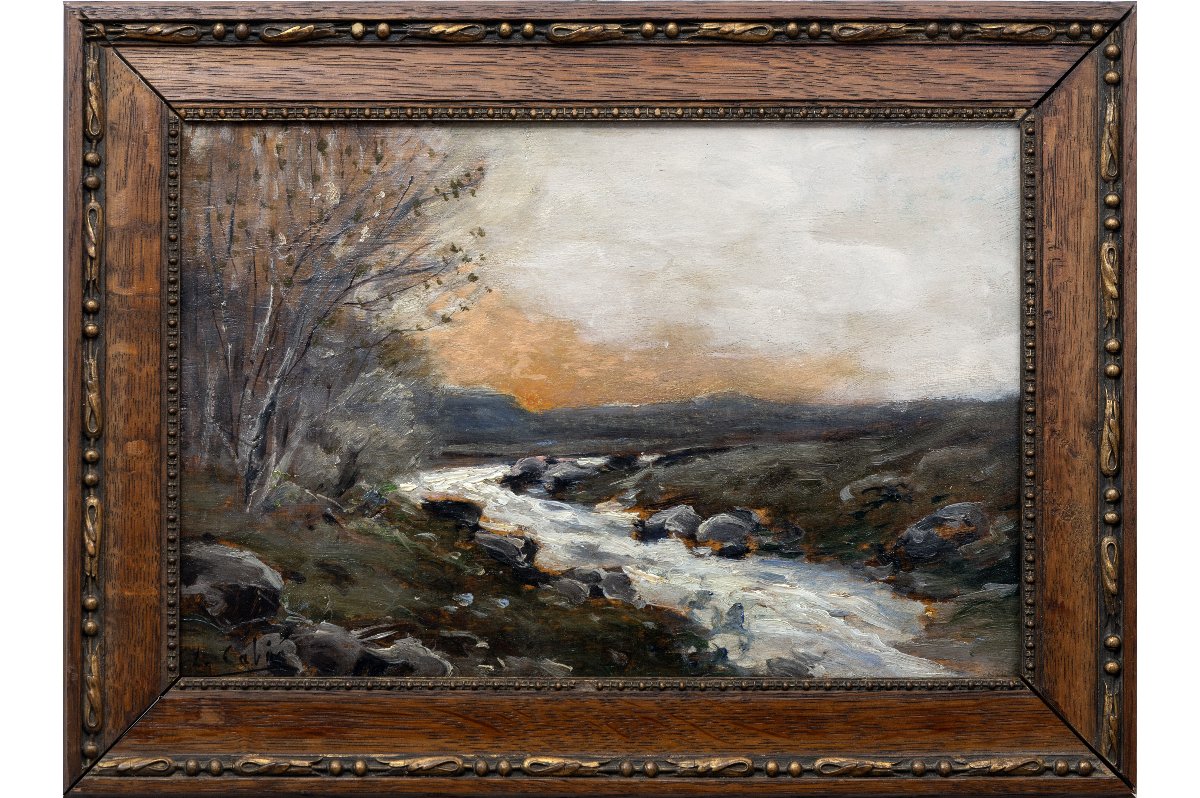
Oak frame, early 20th century
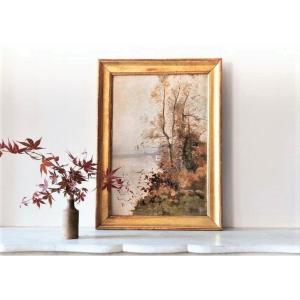
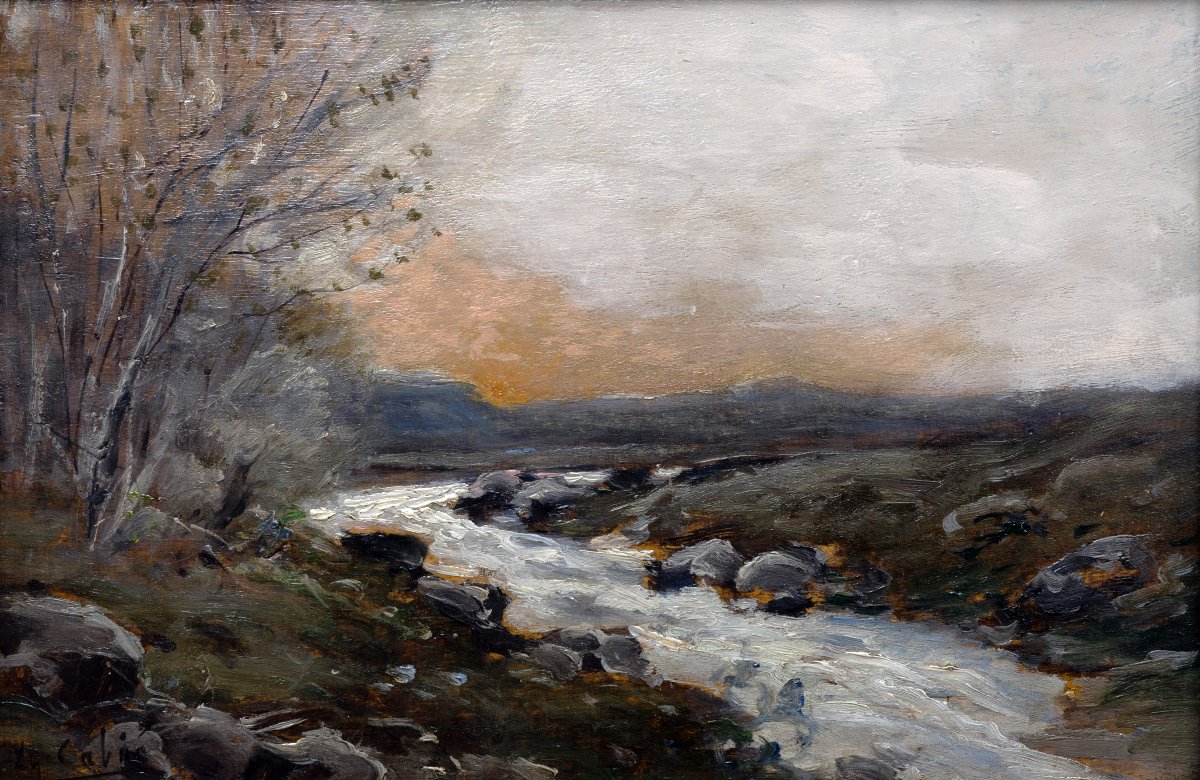
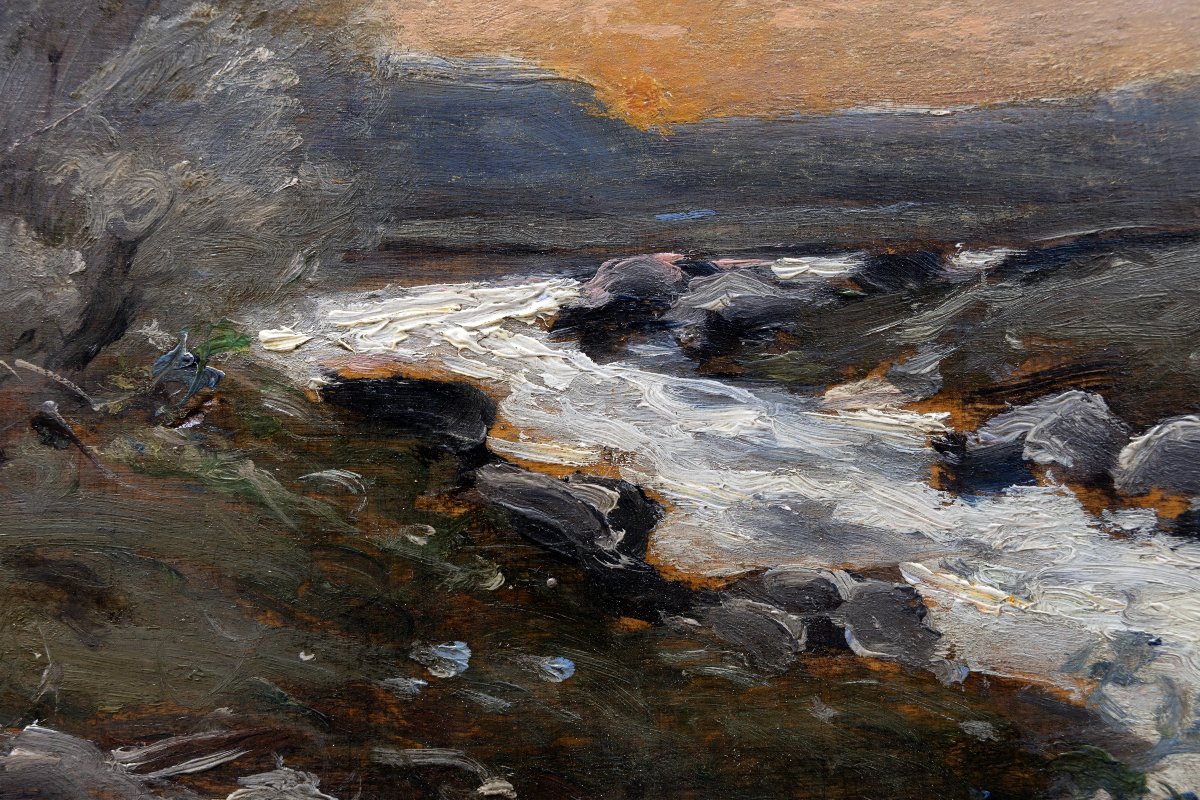
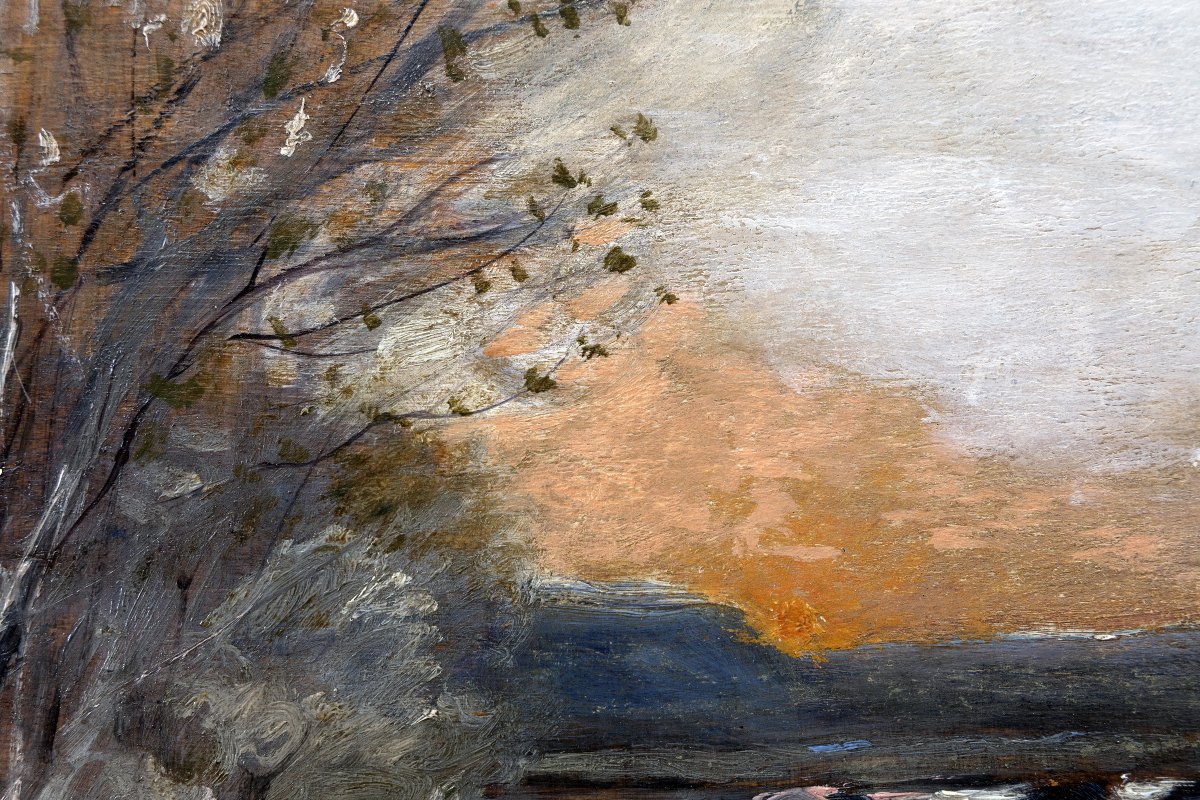
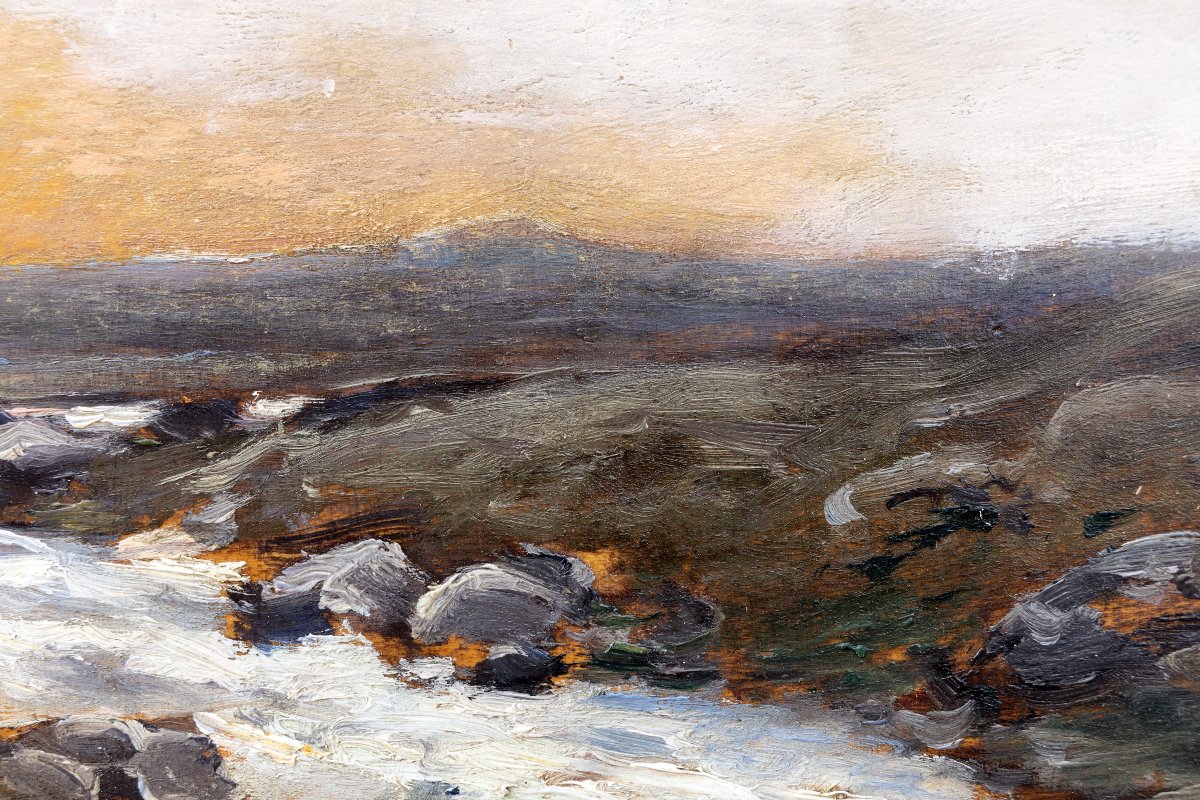
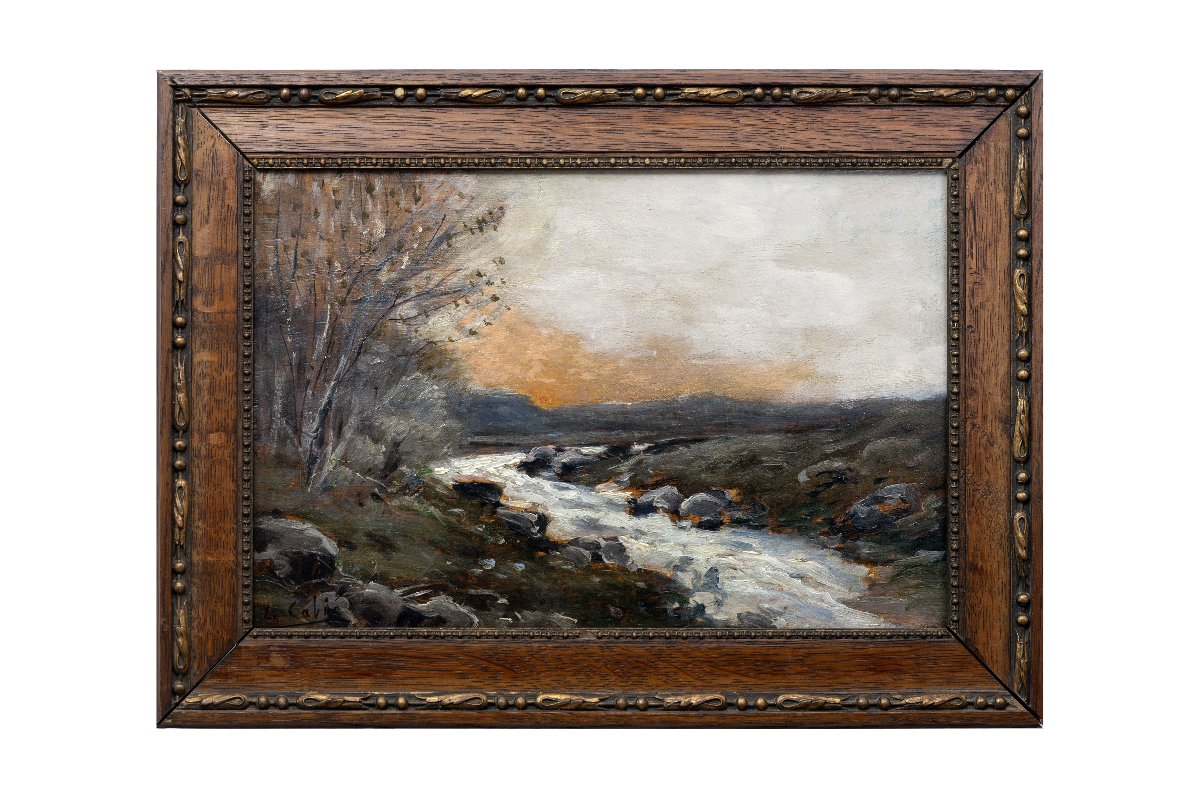
The day is drawing to a close. Behind the line of hills, the sun has left an orange trail that gently rises toward a sky that is still bright, almost white. Below, the stream winds its way between the stones. It catches the last rays of light and becomes, all by itself, the brightest spot in the painting.
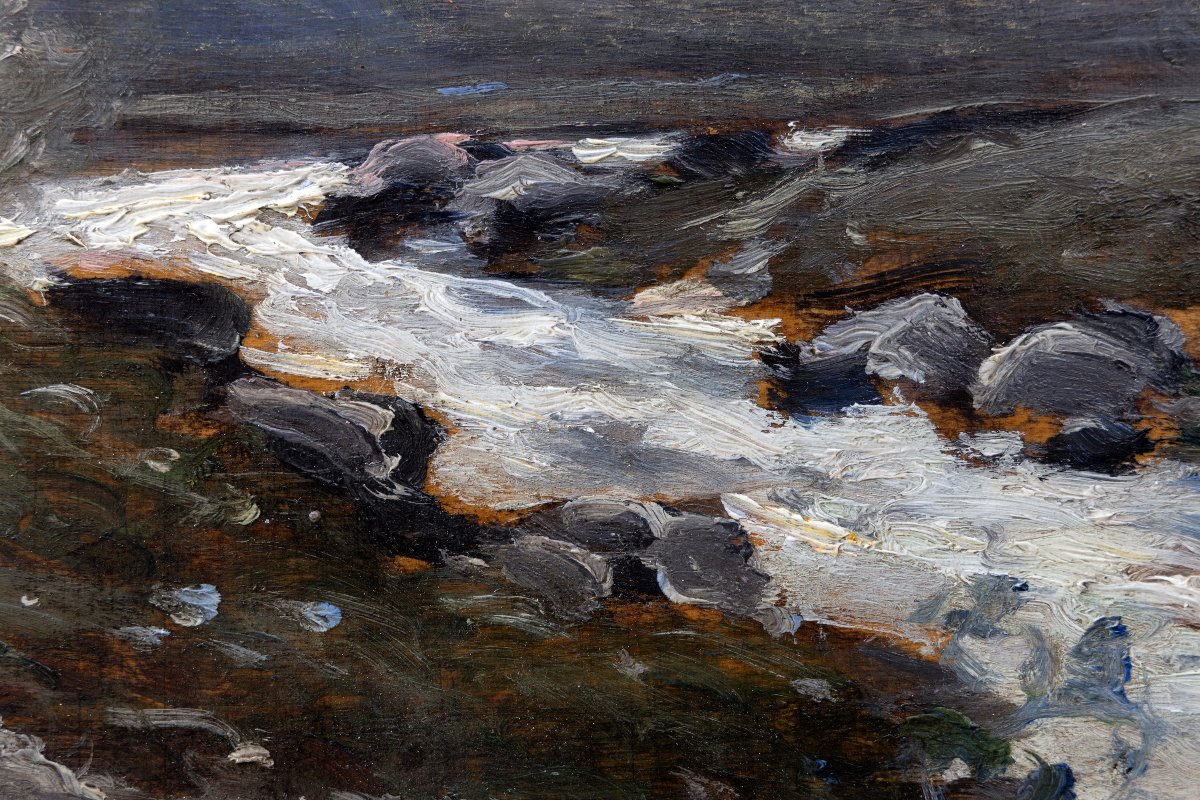
This is a small oil painting created en plein air, with the speed of someone who knows their subject well. The rocks are rendered with a few thick strokes, almost as if painted with a dry brush. The water, on the other hand, is painted in full impasto: creamy whites, applied boldly, that convey all the movement of the current. On the left, a cluster of still-bare trees stands out in silhouette. A few green leaves dot the branches—it is either the very beginning of spring or the end of fall.
A detail that Cabié enthusiasts will recognize: the painter leaves the wood of the panel exposed in places, particularly along the riverbanks and in the foreground. This warm, reddish-brown hue serves as a background and warms the entire lower portion of the composition. Nothing is covered unnecessarily.
It is also worth noting that twilight skies are quite rare in Cabié’s work, as he most often paints his landscapes in full light.
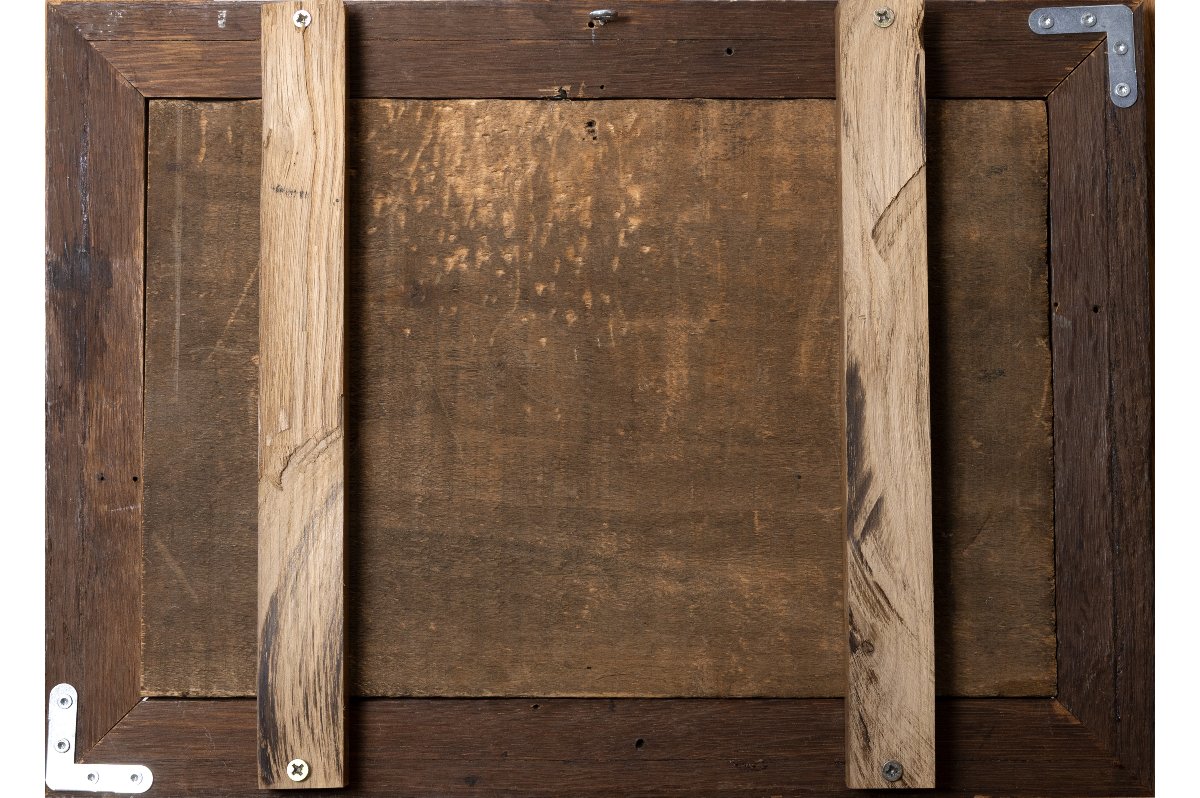
The frame: an early 20th-century wooden frame with a wide, flat profile. The decorative elements—the inner beaded frieze and the outer scroll border—are not carved from wood but molded in stucco and then gilded. The gilding is uneven and in its original condition, which harmonizes well with the muted tones of the painting. On the back, two screwed-in wooden battens serve as reinforcements and hold the entire piece together, supplemented by two metal brackets at the corners.
Condition: generally good. The panel is sound and the paint layer is stable. There are a few old retouches in the sky, as well as slight wear and surface soiling, which are normal for a work of this age. The frame shows normal signs of wear and small areas where the gilding has been touched up.
The Artist
Louis-Alexandre Cabié was born in Dol-de-Bretagne in 1853 and died in Bordeaux in 1939. He settled in Bordeaux around 1873 and spent most of his life there, after humble beginnings as a set painter.
A student of Hippolyte Pradelles and later of Henri Harpignies—with whom he became a close friend—he was influenced by Corot and Théodore Rousseau. He painted almost exclusively en plein air and very rarely included figures in his landscapes. His favorite subjects were the Gironde countryside, the Saintonge region, the banks of the Charente River, the Gironde estuary, and Royan. But it was above all the Vézère Valley in Périgord that captivated him: beginning in 1892, nearly a third of his body of work was created there, near Les Eyzies.
He exhibited at the Salon des Artistes Français beginning in 1887 and throughout his career, where he won several medals. In 1908, he was named a Knight of the Legion of Honor, sponsored by his mentor Harpignies. A street in Bordeaux bears his name today.
A critic of his time summed up his work well: Cabié is, above all, the painter of trees, rivers, and light that changes from hour to hour.
Work on view at the gallery (07240)
Shipping: Please contact us for shipping costs within France and internationally.
The Stream at Sunset
Oil on panel
Signed lower left
Dimensions: 35 x 23 cm. Dimensions with frame: 42 x 30.5 cm
Very good condition
Oak frame, early 20th century
The day is drawing to a close. Behind the line of hills, the sun has left an orange trail that gently rises toward a sky that is still bright, almost white. Below, the stream winds its way between the stones. It catches the last rays of light and becomes, all by itself, the brightest spot in the painting.
This is a small oil painting created en plein air, with the speed of someone who knows their subject well. The rocks are rendered with a few thick strokes, almost as if painted with a dry brush. The water, on the other hand, is painted in full impasto: creamy whites, applied boldly, that convey all the movement of the current. On the left, a cluster of still-bare trees stands out in silhouette. A few green leaves dot the branches—it is either the very beginning of spring or the end of fall.
A detail that Cabié enthusiasts will recognize: the painter leaves the wood of the panel exposed in places, particularly along the riverbanks and in the foreground. This warm, reddish-brown hue serves as a background and warms the entire lower portion of the composition. Nothing is covered unnecessarily.
It is also worth noting that twilight skies are quite rare in Cabié’s work, as he most often paints his landscapes in full light.
The frame: an early 20th-century wooden frame with a wide, flat profile. The decorative elements—the inner beaded frieze and the outer scroll border—are not carved from wood but molded in stucco and then gilded. The gilding is uneven and in its original condition, which harmonizes well with the muted tones of the painting. On the back, two screwed-in wooden battens serve as reinforcements and hold the entire piece together, supplemented by two metal brackets at the corners.
Condition: generally good. The panel is sound and the paint layer is stable. There are a few old retouches in the sky, as well as slight wear and surface soiling, which are normal for a work of this age. The frame shows normal signs of wear and small areas where the gilding has been touched up.
The Artist
Louis-Alexandre Cabié was born in Dol-de-Bretagne in 1853 and died in Bordeaux in 1939. He settled in Bordeaux around 1873 and spent most of his life there, after humble beginnings as a set painter.
A student of Hippolyte Pradelles and later of Henri Harpignies—with whom he became a close friend—he was influenced by Corot and Théodore Rousseau. He painted almost exclusively en plein air and very rarely included figures in his landscapes. His favorite subjects were the Gironde countryside, the Saintonge region, the banks of the Charente River, the Gironde estuary, and Royan. But it was above all the Vézère Valley in Périgord that captivated him: beginning in 1892, nearly a third of his body of work was created there, near Les Eyzies.
He exhibited at the Salon des Artistes Français beginning in 1887 and throughout his career, where he won several medals. In 1908, he was named a Knight of the Legion of Honor, sponsored by his mentor Harpignies. A street in Bordeaux bears his name today.
A critic of his time summed up his work well: Cabié is, above all, the painter of trees, rivers, and light that changes from hour to hour.
Work on view at the gallery (07240)
Shipping: Please contact us for shipping costs within France and internationally.
450 €
Period: 20th century
Style: Art Nouveau
Condition: Excellent condition
Material: Oil painting on wood
Width: 35 cm / 42 cm encadré
Height: 23 cm / 30,5 cm encadré
Reference (ID): 1802640
Availability: In stock
Print