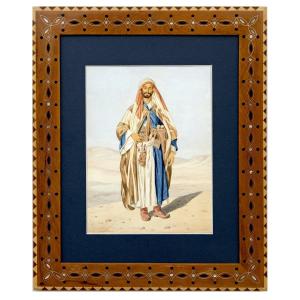


Louis Emile Pinel De Grandchamp - Bedouin In The Desert - Watercolor - Circa 1860–65 - Signed
Artist: Pinel De Grandchamp Louis Emile (1820 - 1894, France)
Louis Émile Pinel de Grandchamp (1820–1894)
“Bedouin in the Desert” — circa 1860–1865
Watercolor on paper
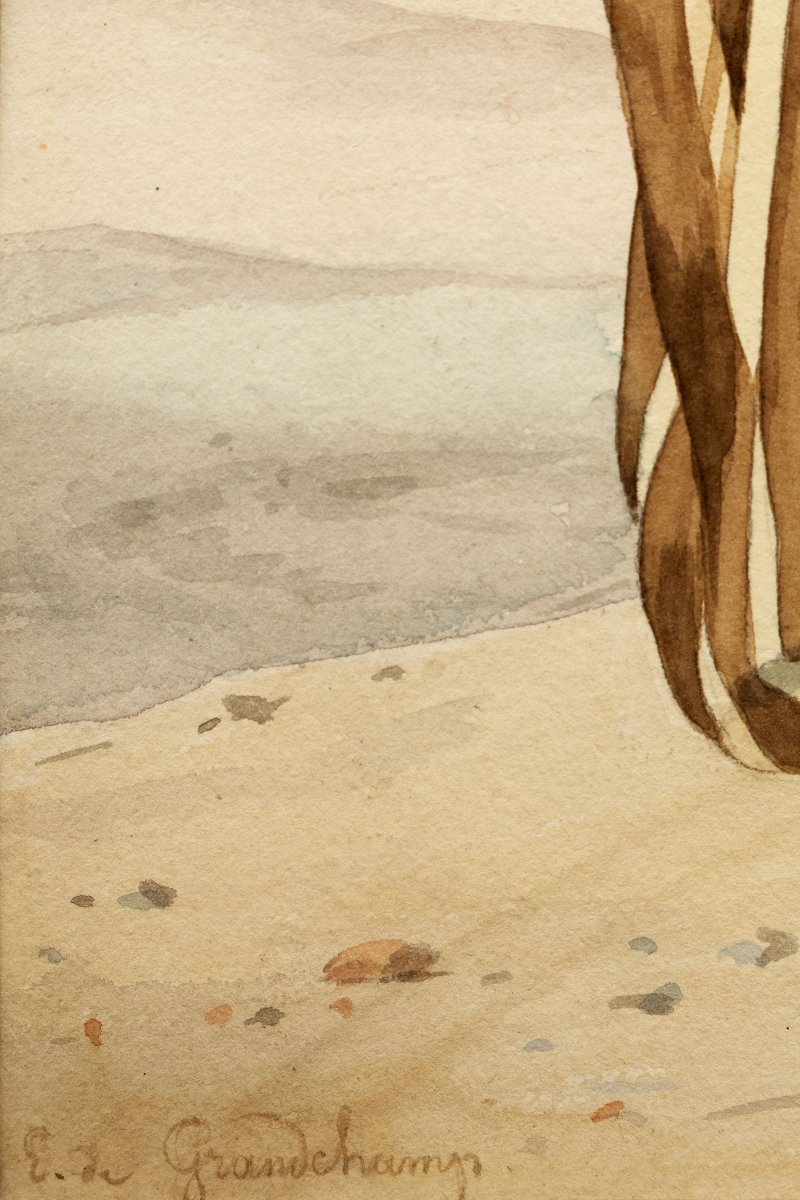
Signed lower left “E. de Grandchamp ”
28.8 x 21.2 cm (image size) — 49 x 41.2 cm (framed)
Very good condition
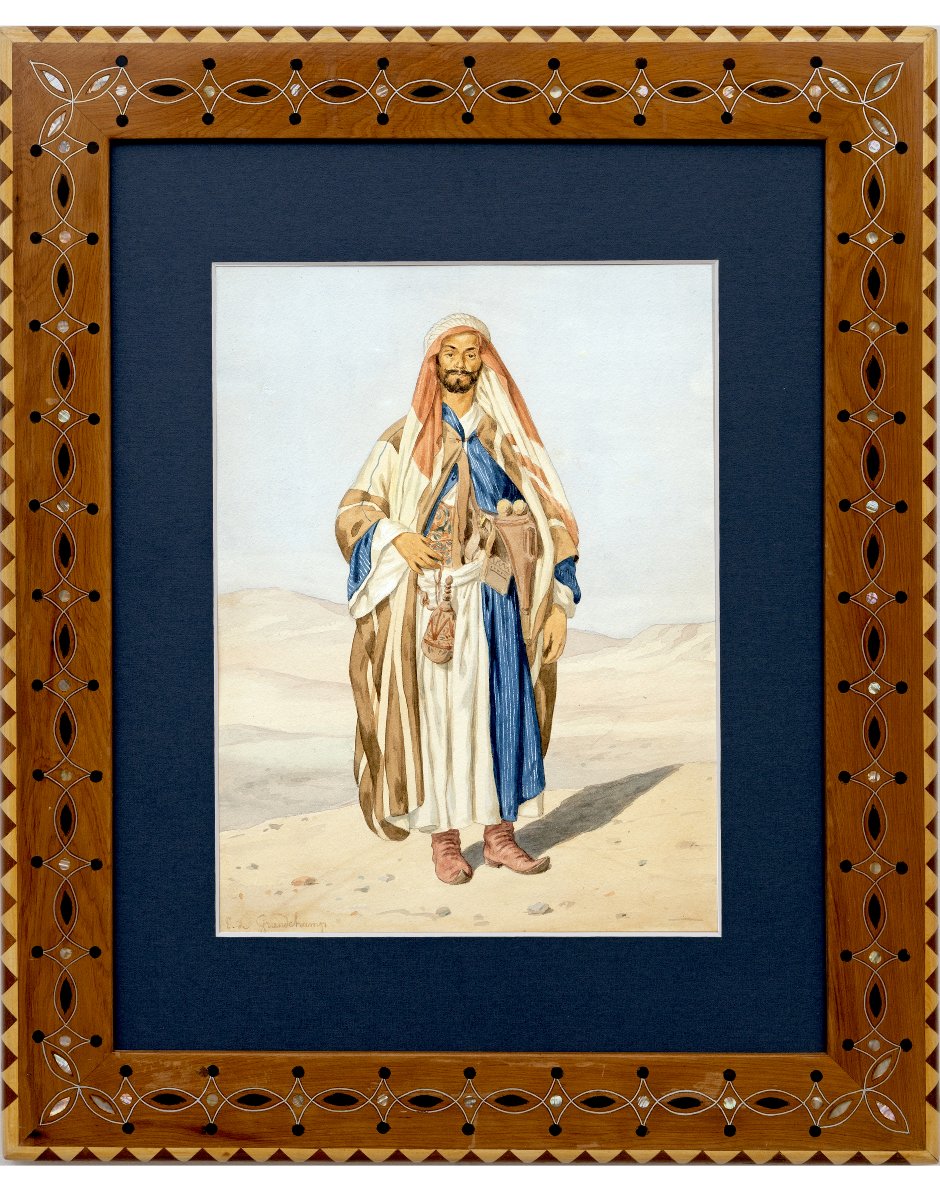
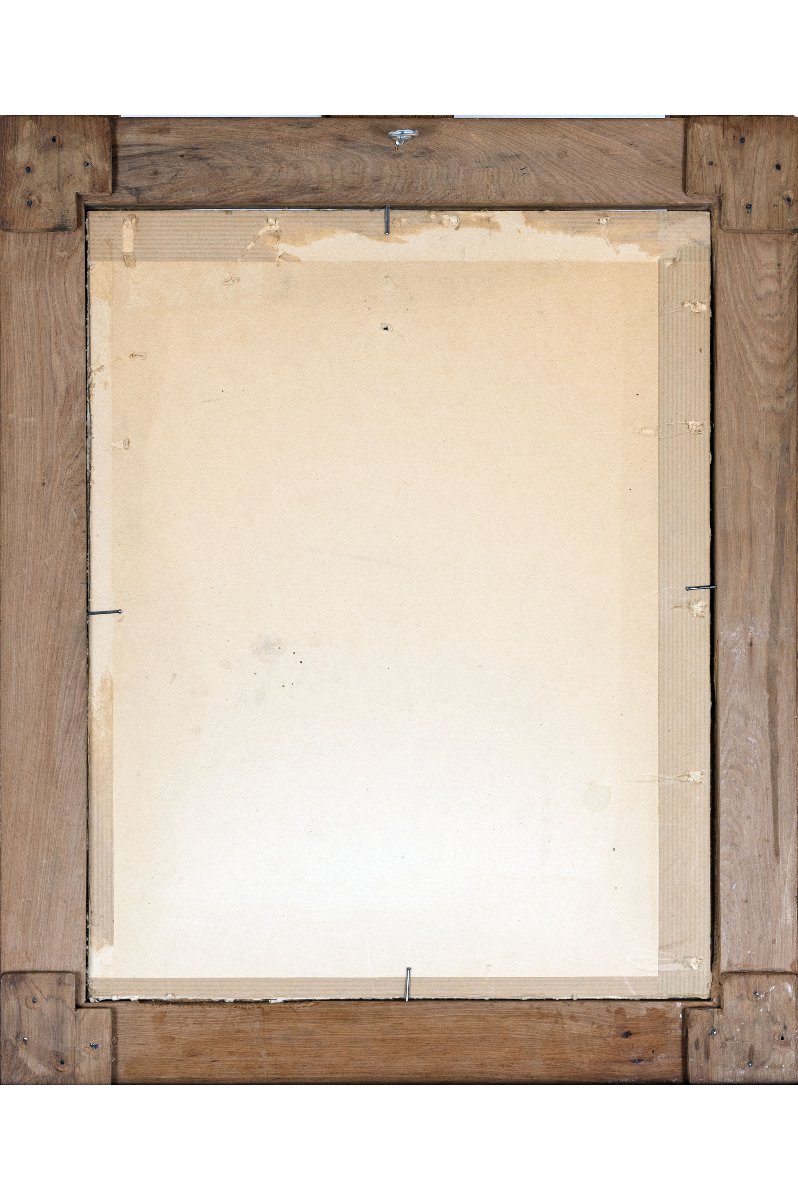
Contemporary handcrafted frame, wood inlaid and inlaid with mother-of-pearl, crafted in Essaouira (Morocco)
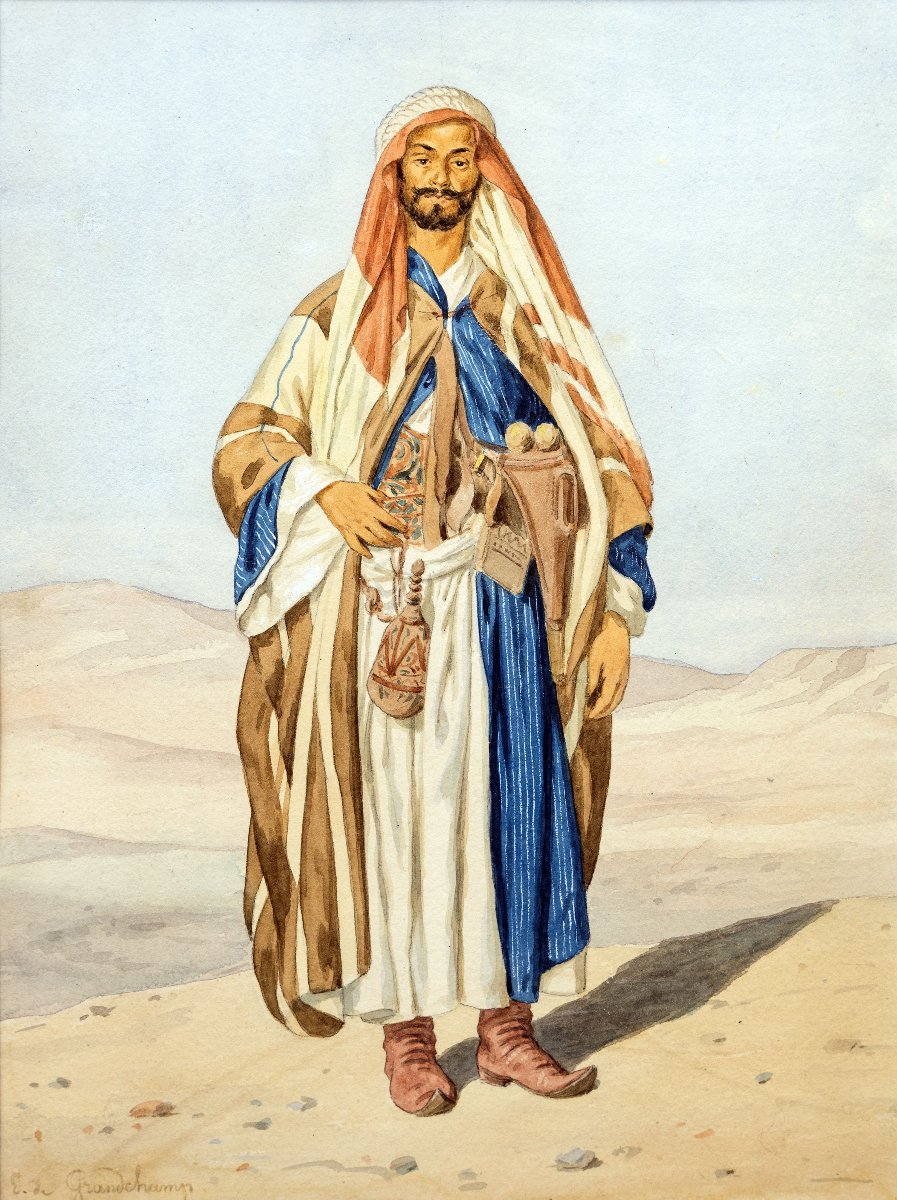
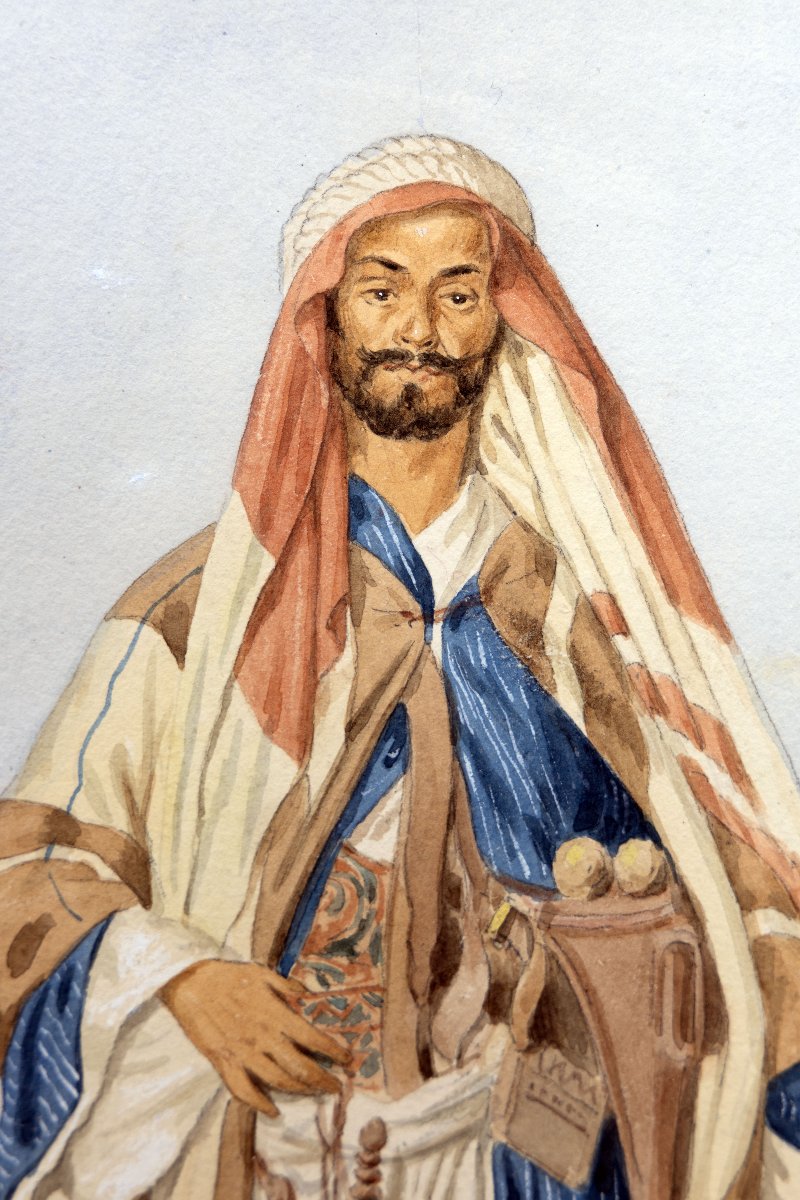
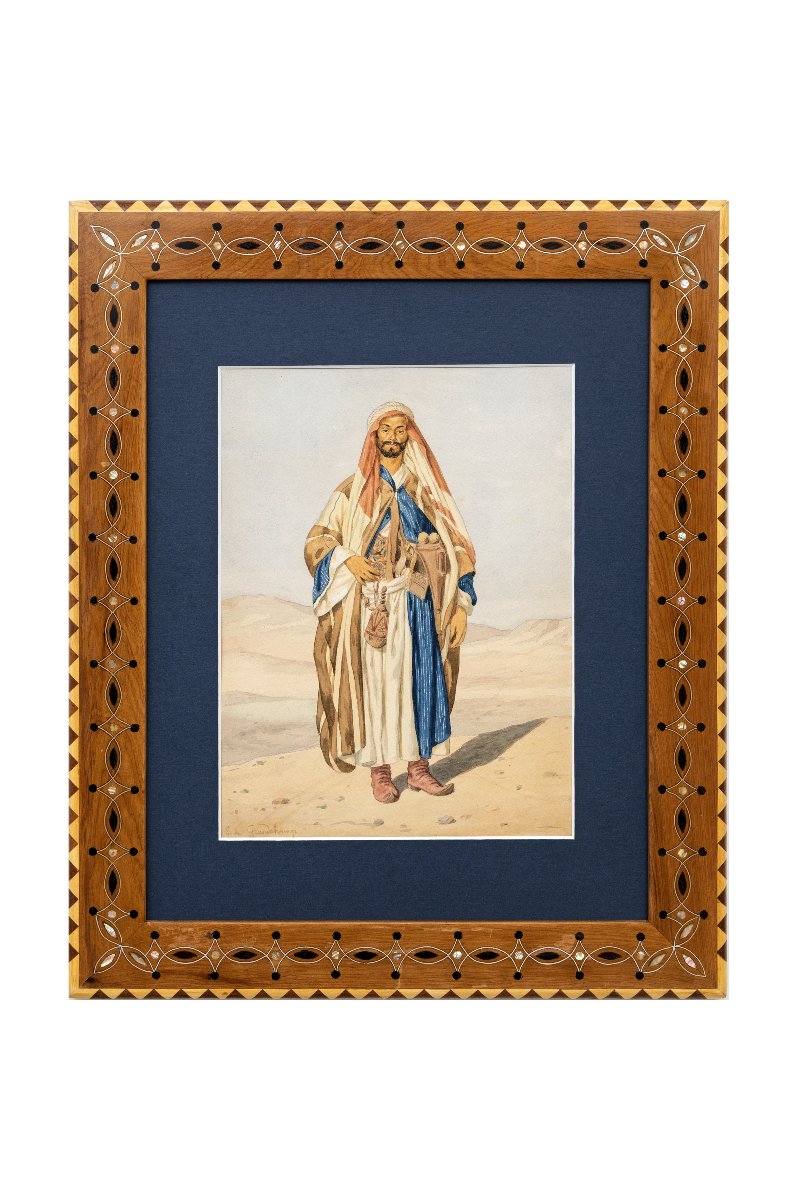
A man stands in the dunes, facing the viewer, motionless. His shadow cast on the sand indicates high noon.
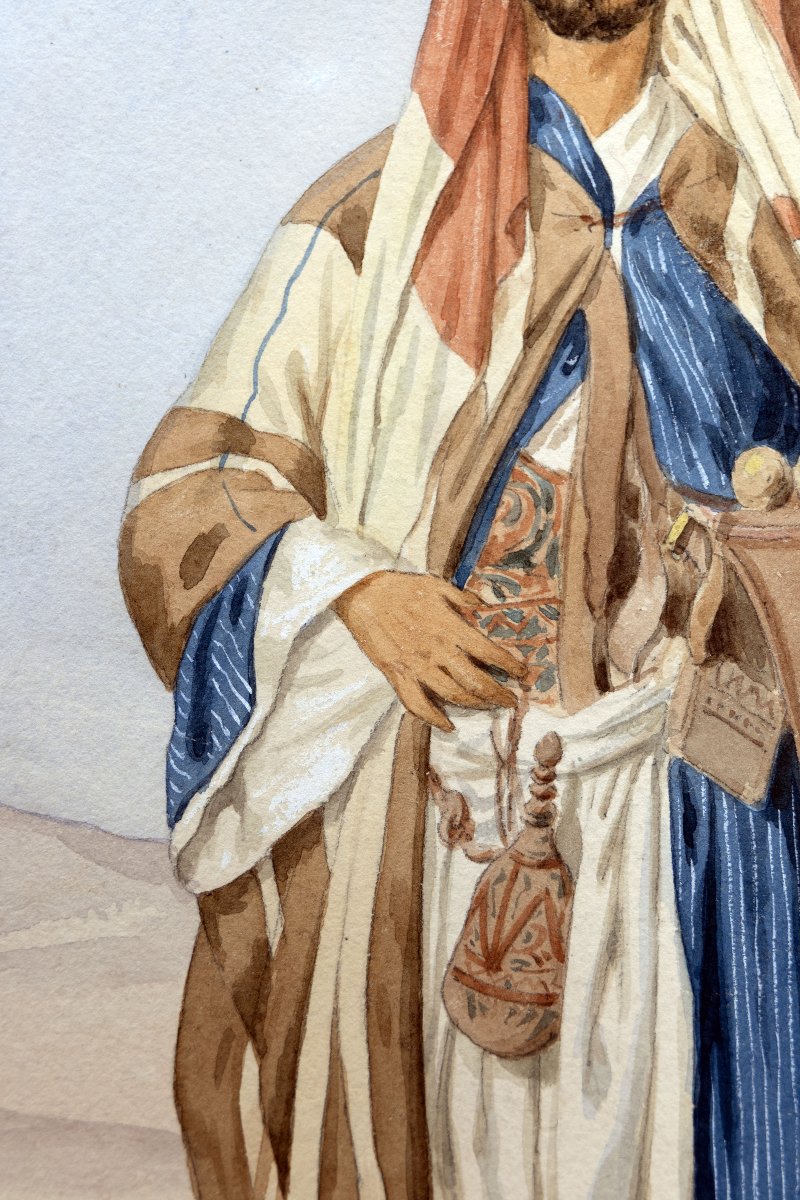
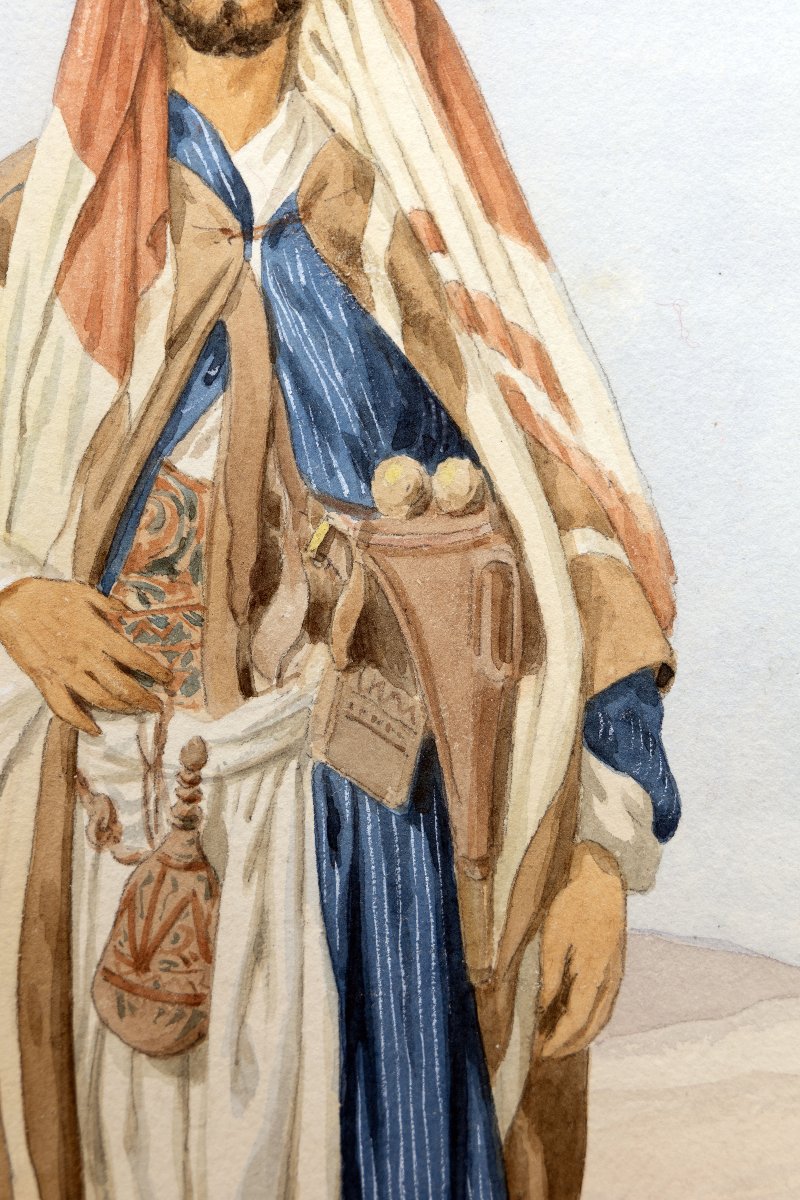
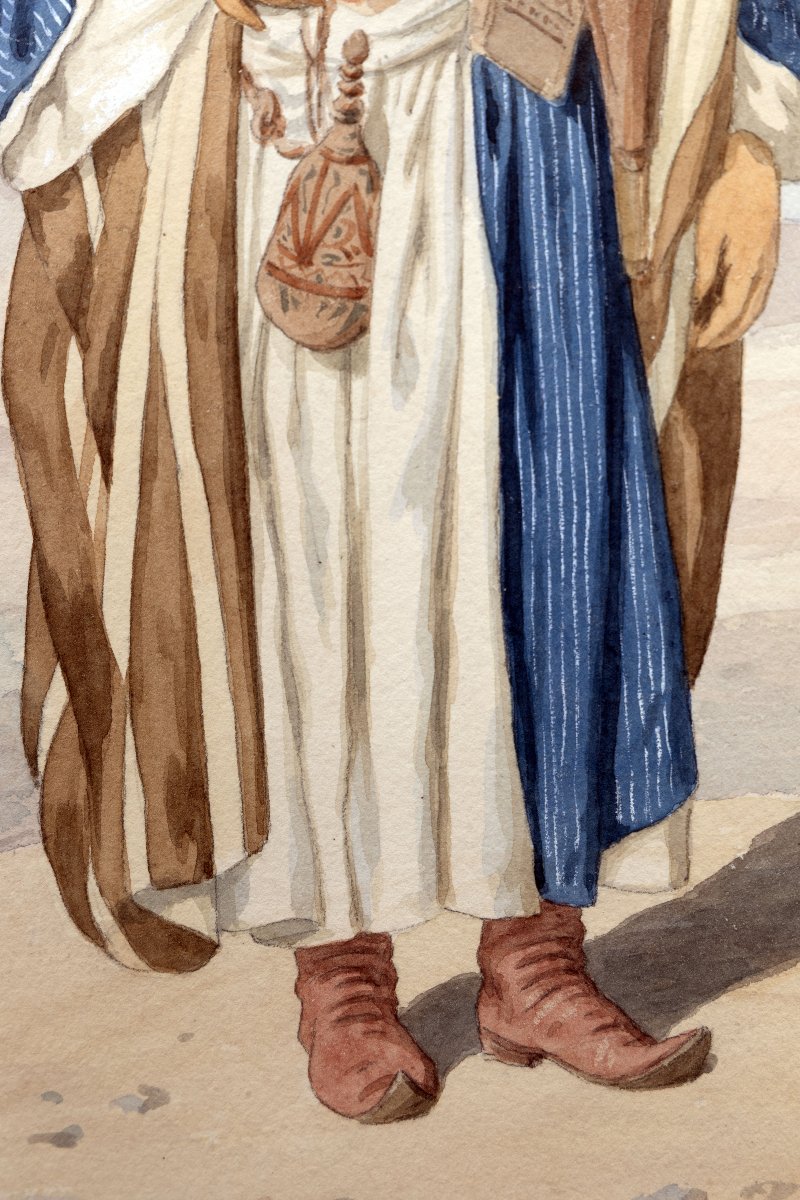
The main interest of the piece lies in the costume, painted with great care. The white, striped headscarf, held in place by a braided cord, with an orange panel falling over the shoulders. The large brown wool coat, the white striped tunic, the blue vest, and the blue pants. The wide belt embroidered with colorful motifs. Hanging from his waist are a decorated leather water bottle and a small pouch filled with cartridges. On his feet are red leather boots with pointed, upturned toes, similar to babouches—a common type of shoe in this part of the world.
This type of headdress is more commonly worn in the Near East and Egypt than in the Maghreb. The watercolor thus reflects the years the painter spent in Egypt, between 1860 and 1865, where he frequently sketched people he encountered on the street.
The colors are simple: browns, whites, and blues, with the veil providing the only touch of orange. The background—dunes and sky—is rendered with a few light brushstrokes, leaving the figure to take center stage.
Condition
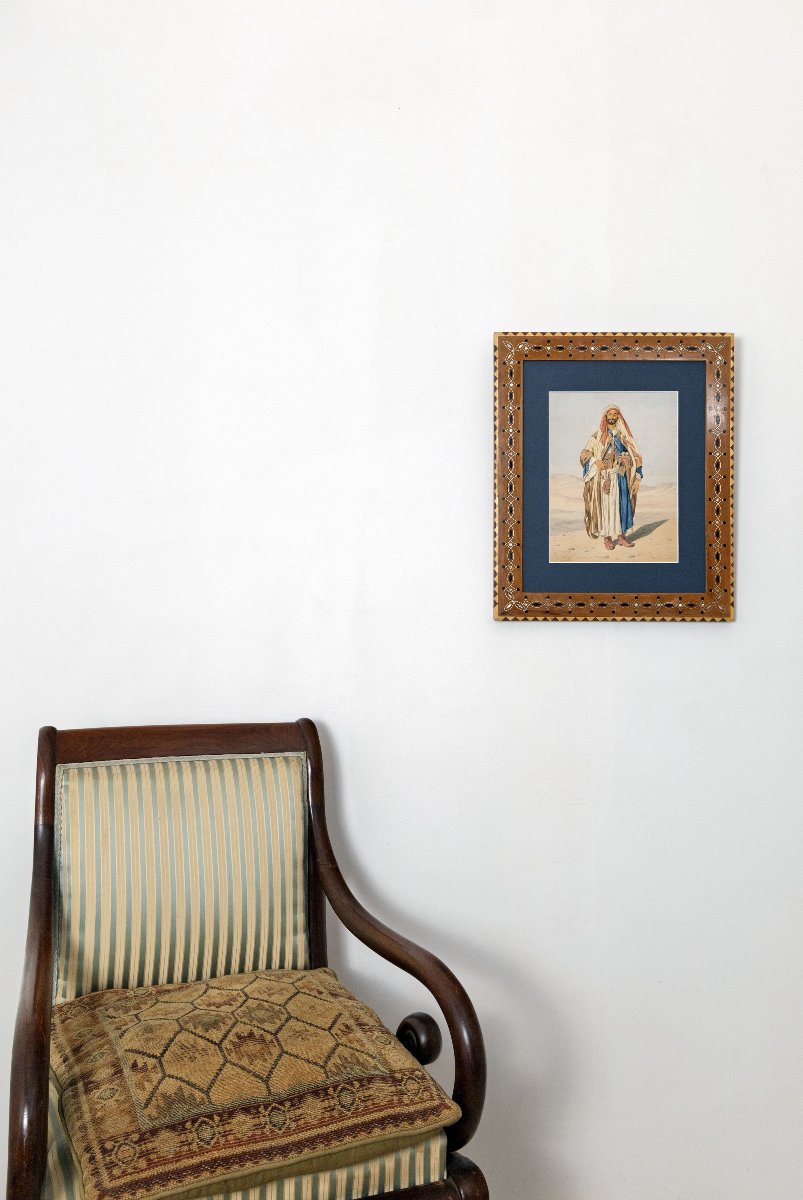
Very good condition. The paper is clean, with no foxing, and the colors have remained fresh. A few areas of the sky are slightly lighter than the rest: it is impossible to say whether this is an effect intended by the artist or a slight fading over time. This is not noticeable when the work is hung. The watercolor is mounted under glass, with a midnight blue mat that echoes the blue of the costume.
The Frame
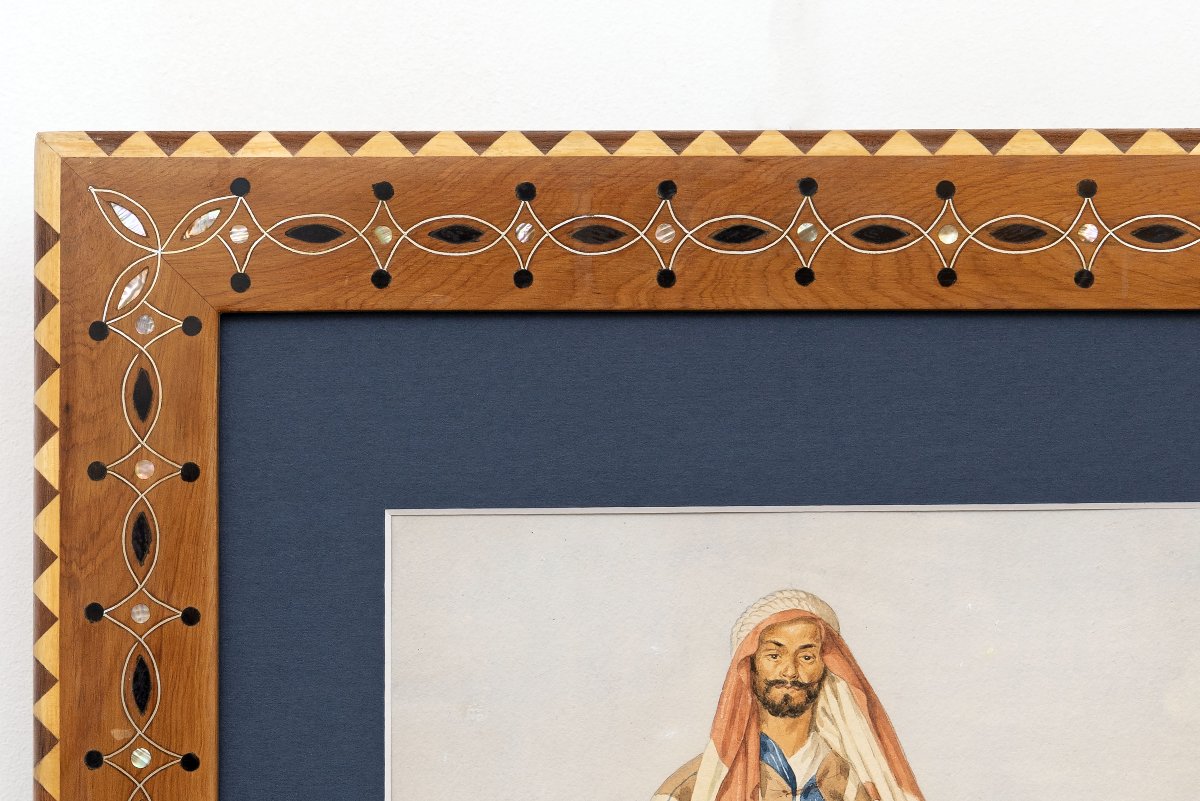
The frame deserves special attention. It was handcrafted by an artisan from Essaouira, Morocco, a city renowned for its woodworking and marquetry. The light-colored wood is inlaid with a traditional design of interlacing patterns, light-colored lines, mother-of-pearl inlays, and black elements, and the outer edge is accented by a frieze of alternating small triangles. The work is precise and very delicate, with each piece fitted by hand.
This is an expensive frame, which alone accounts for a significant portion of the set’s price, and there is nothing comparable to it in standard framing shops. It is in perfect condition and is particularly well-suited to the subject.
The Artist
Louis Émile Pinel de Grandchamp was born in Paris in 1820 and died in Beaune in 1894. He studied at the École des Beaux-Arts in Paris under Hippolyte Dubois and later Édouard Picot, and exhibited two portraits at the Salon at the age of eighteen. In 1849, he left for Constantinople as secretary to Sobi Pasha and remained there for several years: there, he painted portraits of most of the high-ranking officials of the Ottoman Empire and taught painting classes. During the Crimean War, he sent drawings to *L’Illustration* from the front lines. He then spent time in Egypt, followed by a stay in Tunis where the Bey awarded him a decoration, and then returned to Egypt until 1865—a total of fifteen years in the East. Upon his return to France, he exhibited street scenes, portraits, and interiors inspired by these travels at the Salon from 1866 to 1889. His works are held in several public collections.
Work on view at the gallery (07240)
Shipping: Please contact us for shipping rates within France and internationally.
“Bedouin in the Desert” — circa 1860–1865
Watercolor on paper
Signed lower left “E. de Grandchamp ”
28.8 x 21.2 cm (image size) — 49 x 41.2 cm (framed)
Very good condition
Contemporary handcrafted frame, wood inlaid and inlaid with mother-of-pearl, crafted in Essaouira (Morocco)
A man stands in the dunes, facing the viewer, motionless. His shadow cast on the sand indicates high noon.
The main interest of the piece lies in the costume, painted with great care. The white, striped headscarf, held in place by a braided cord, with an orange panel falling over the shoulders. The large brown wool coat, the white striped tunic, the blue vest, and the blue pants. The wide belt embroidered with colorful motifs. Hanging from his waist are a decorated leather water bottle and a small pouch filled with cartridges. On his feet are red leather boots with pointed, upturned toes, similar to babouches—a common type of shoe in this part of the world.
This type of headdress is more commonly worn in the Near East and Egypt than in the Maghreb. The watercolor thus reflects the years the painter spent in Egypt, between 1860 and 1865, where he frequently sketched people he encountered on the street.
The colors are simple: browns, whites, and blues, with the veil providing the only touch of orange. The background—dunes and sky—is rendered with a few light brushstrokes, leaving the figure to take center stage.
Condition
Very good condition. The paper is clean, with no foxing, and the colors have remained fresh. A few areas of the sky are slightly lighter than the rest: it is impossible to say whether this is an effect intended by the artist or a slight fading over time. This is not noticeable when the work is hung. The watercolor is mounted under glass, with a midnight blue mat that echoes the blue of the costume.
The Frame
The frame deserves special attention. It was handcrafted by an artisan from Essaouira, Morocco, a city renowned for its woodworking and marquetry. The light-colored wood is inlaid with a traditional design of interlacing patterns, light-colored lines, mother-of-pearl inlays, and black elements, and the outer edge is accented by a frieze of alternating small triangles. The work is precise and very delicate, with each piece fitted by hand.
This is an expensive frame, which alone accounts for a significant portion of the set’s price, and there is nothing comparable to it in standard framing shops. It is in perfect condition and is particularly well-suited to the subject.
The Artist
Louis Émile Pinel de Grandchamp was born in Paris in 1820 and died in Beaune in 1894. He studied at the École des Beaux-Arts in Paris under Hippolyte Dubois and later Édouard Picot, and exhibited two portraits at the Salon at the age of eighteen. In 1849, he left for Constantinople as secretary to Sobi Pasha and remained there for several years: there, he painted portraits of most of the high-ranking officials of the Ottoman Empire and taught painting classes. During the Crimean War, he sent drawings to *L’Illustration* from the front lines. He then spent time in Egypt, followed by a stay in Tunis where the Bey awarded him a decoration, and then returned to Egypt until 1865—a total of fifteen years in the East. Upon his return to France, he exhibited street scenes, portraits, and interiors inspired by these travels at the Salon from 1866 to 1889. His works are held in several public collections.
Work on view at the gallery (07240)
Shipping: Please contact us for shipping rates within France and internationally.
500 €
Period: 19th century
Style: Napoleon 3rd
Condition: Excellent condition
Material: Water color
Width: 21,2 cm à vue / 41,2 cm encadré
Height: 28,8 cm à vue / 49 cm encadré
Reference (ID): 1810725
Availability: In stock
Print