




Antoine Barbier – Pondshores In Bresse – Oil On Canvas – Signed
Artist: Barbier Antoine (1859 – 1948, France)
Antoine Barbier (1859–1948)
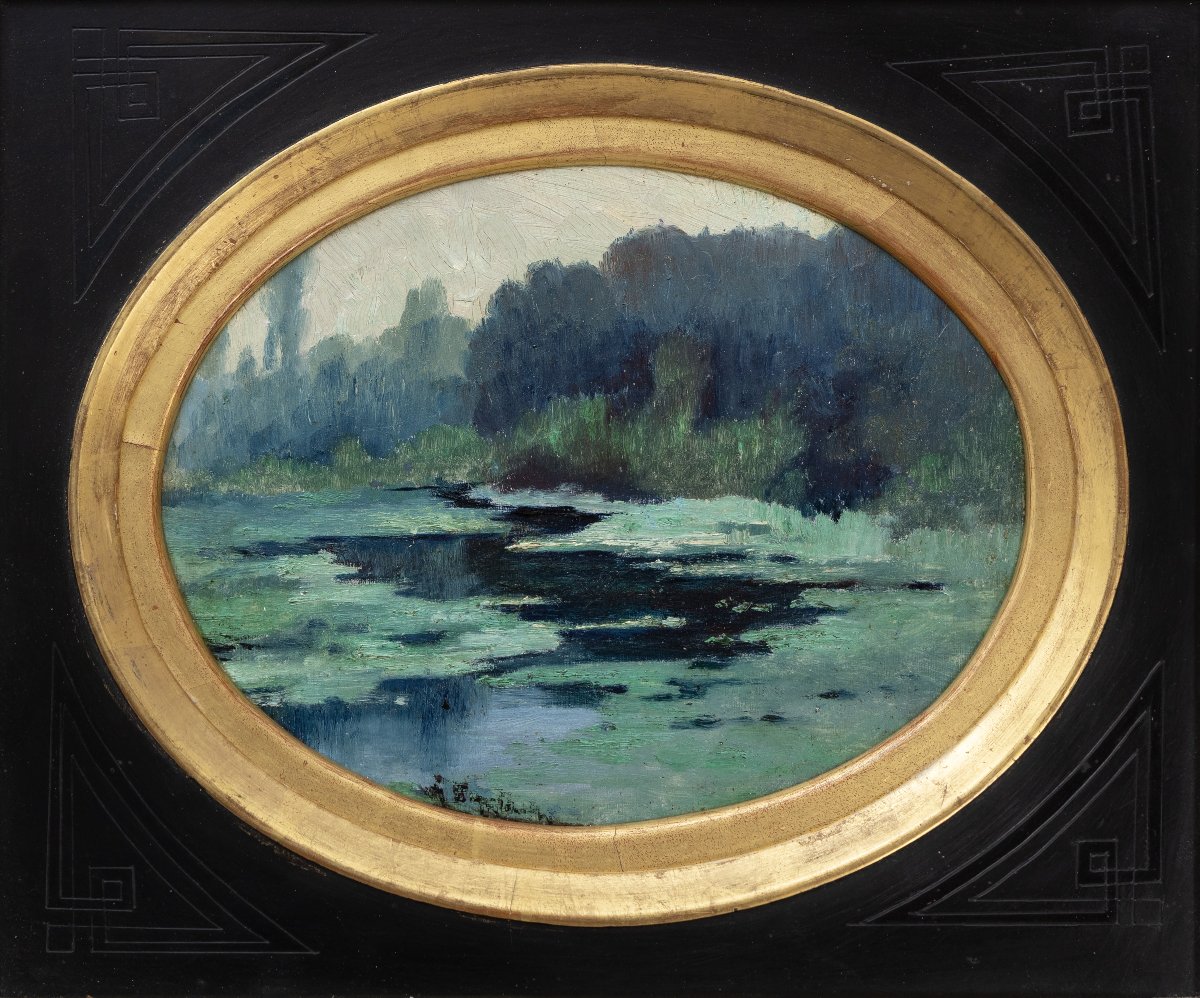
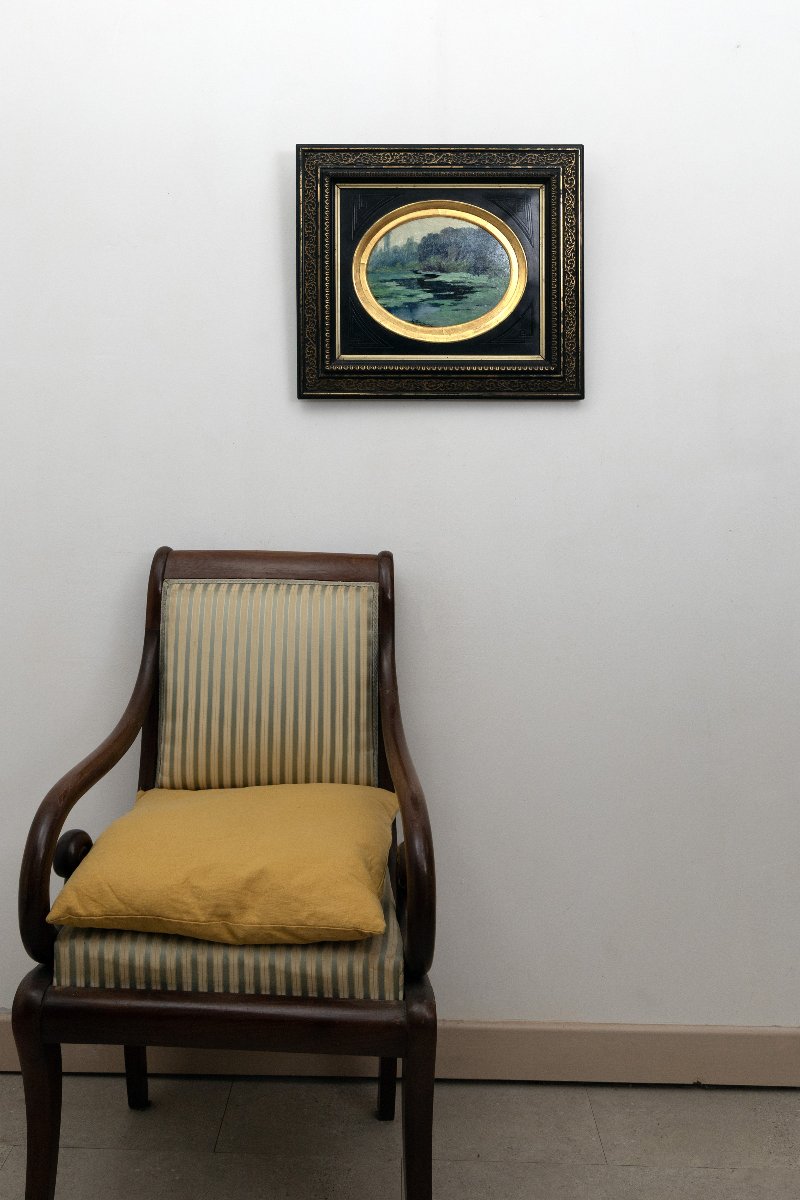
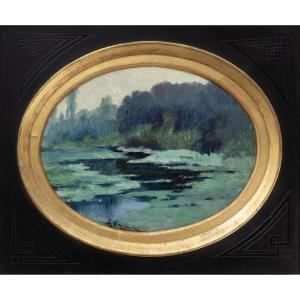
Shores of a Pond in Bresse
Oil on oval canvas, late 19th-century period frame
Canvas: 27.5 x 22 cm — Frame: 51.5 x 45.5 cm
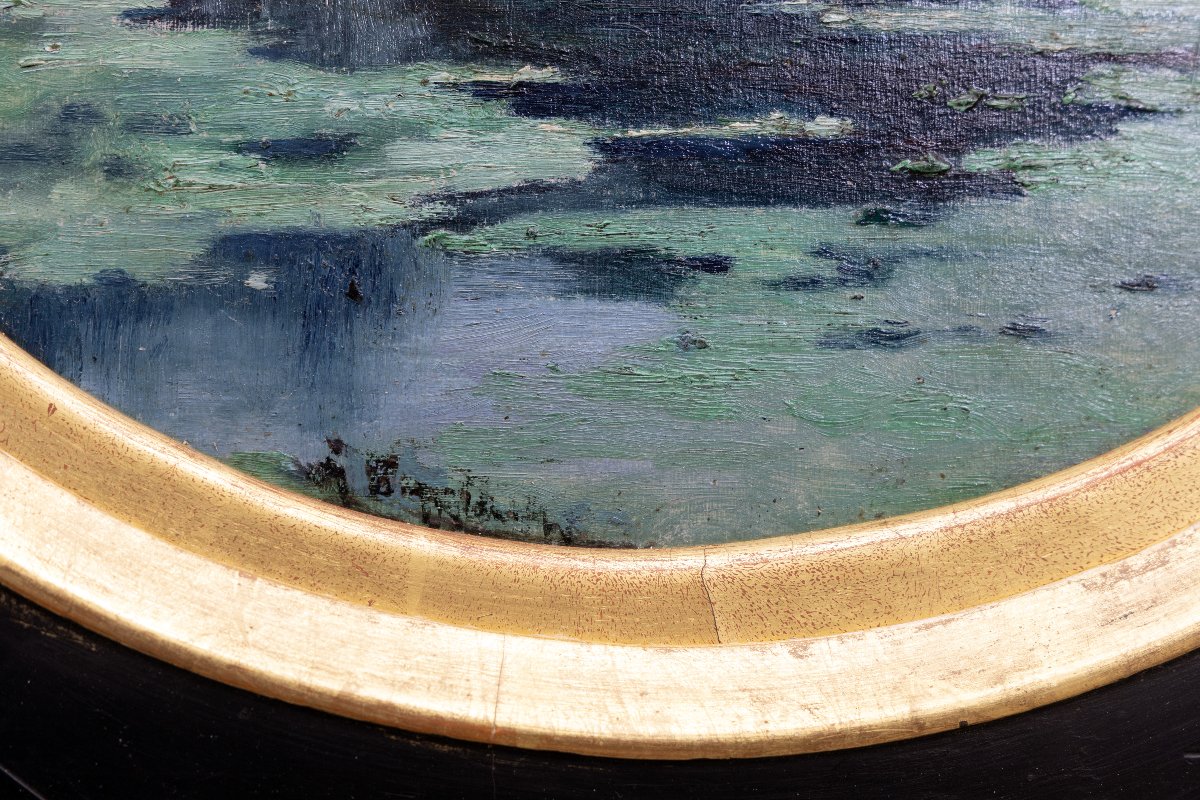
Signed lower center (signature partially erased, attribution on the back)
Very good condition
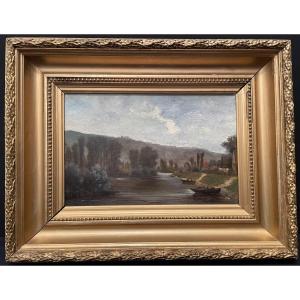
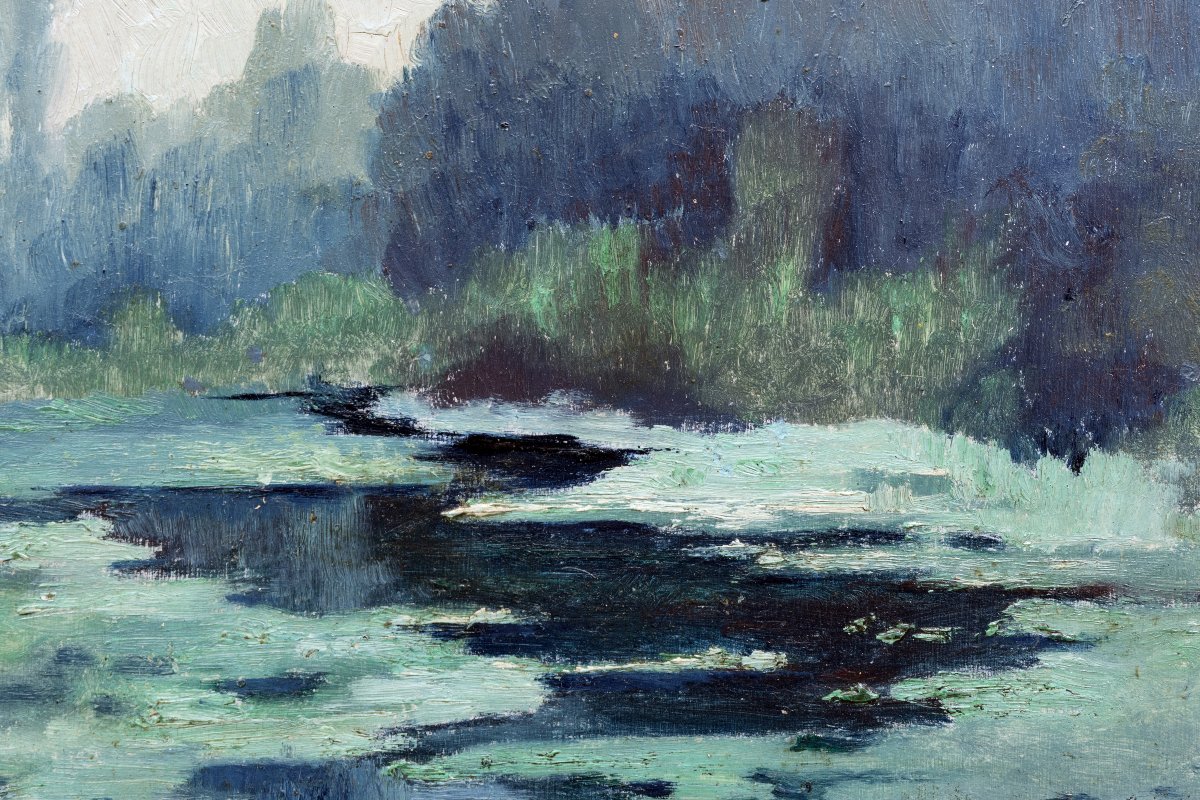
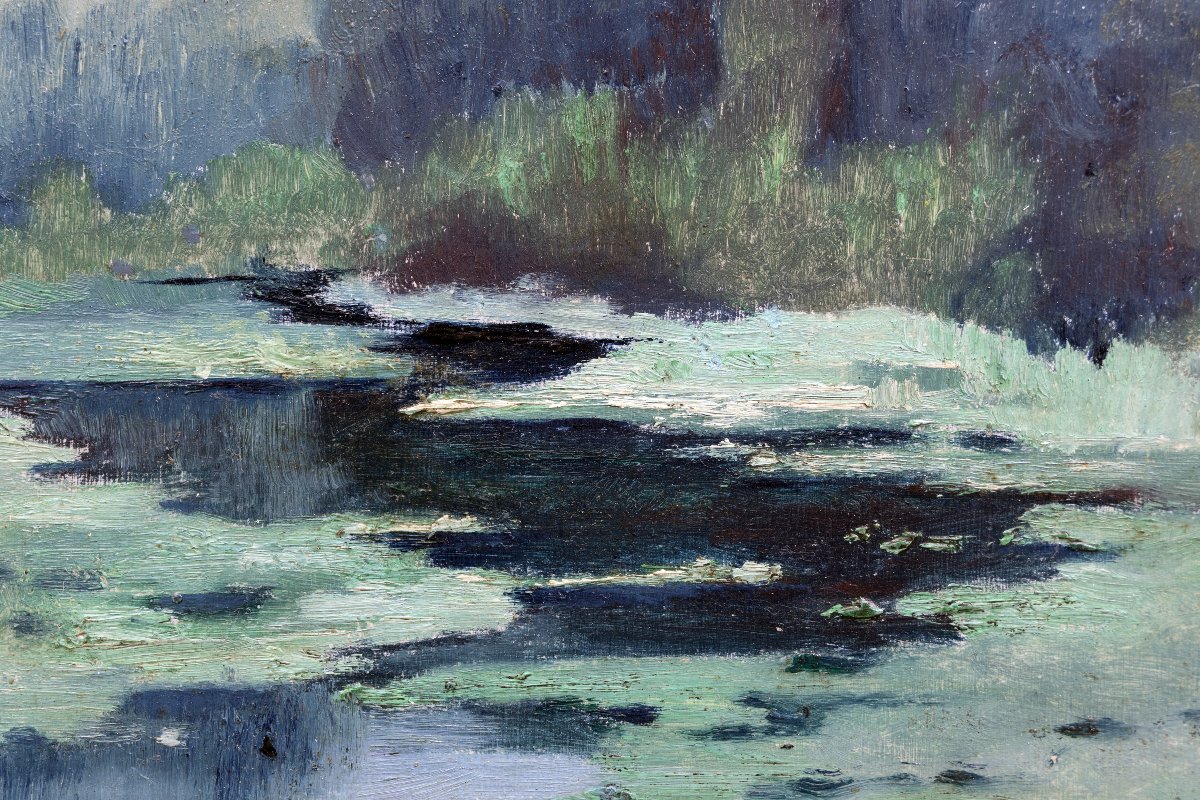
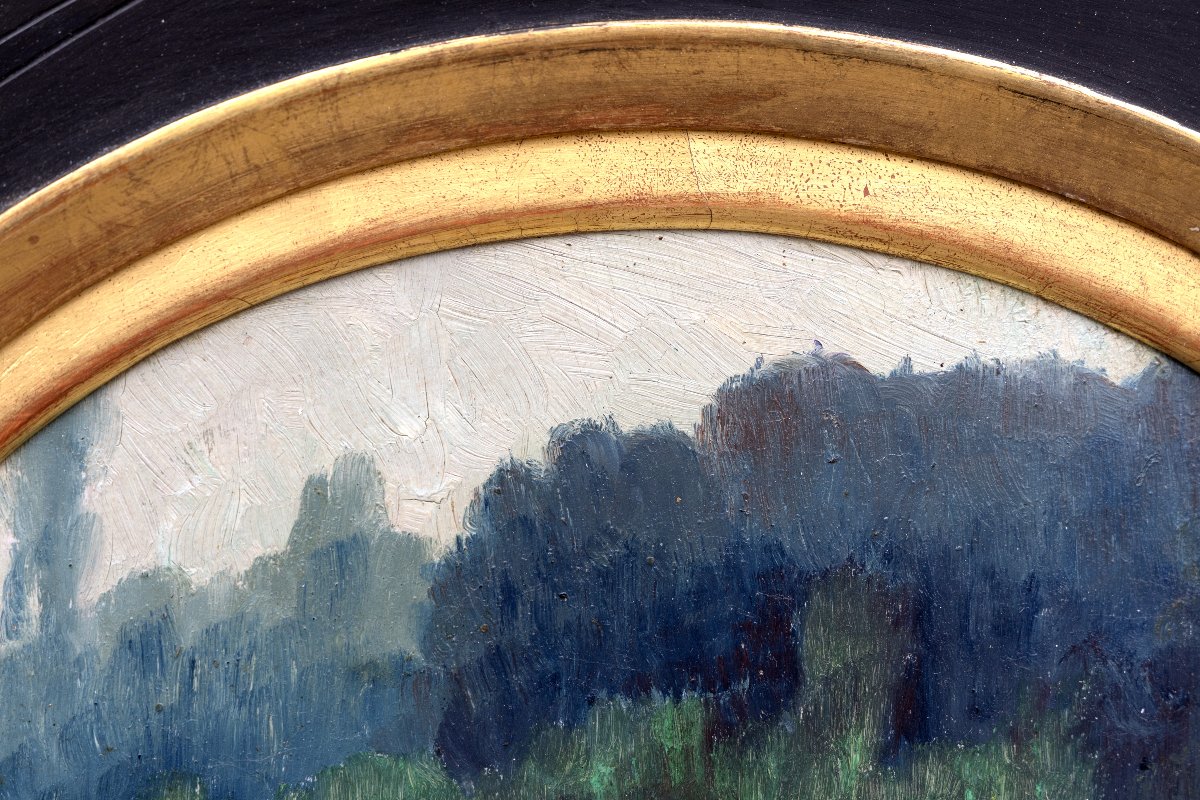
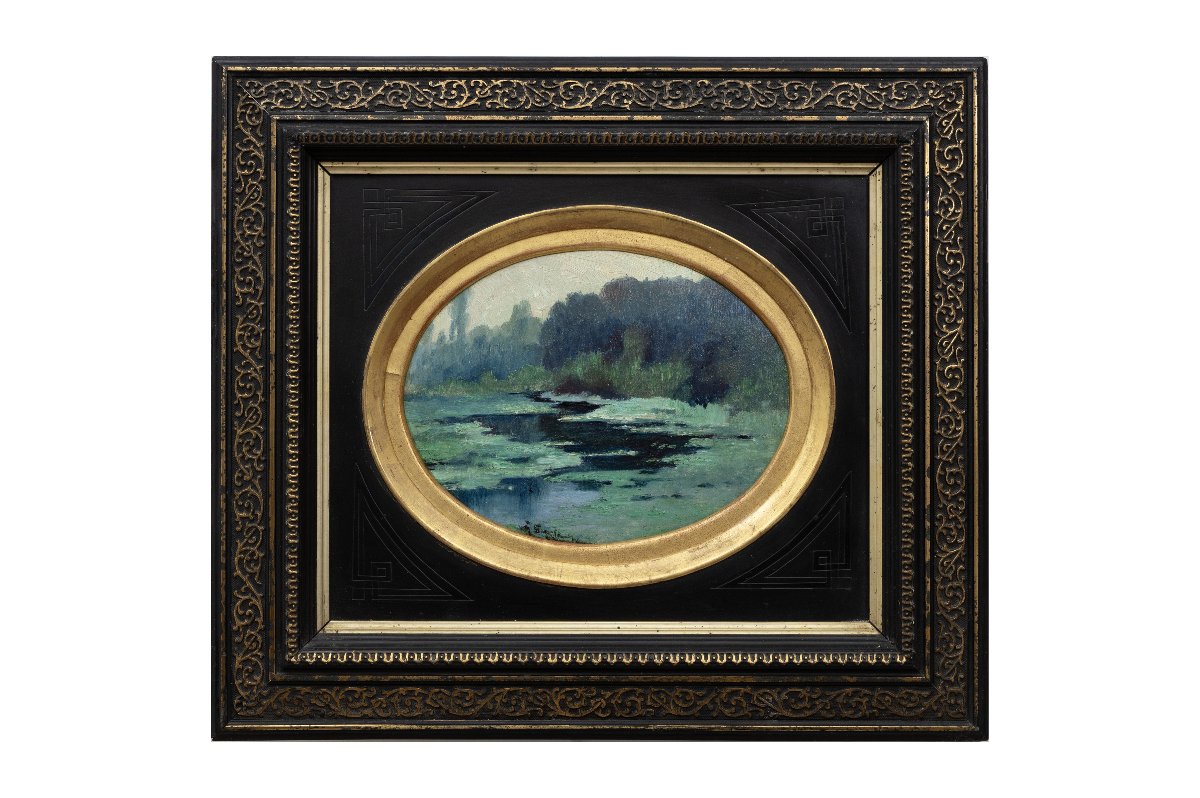
A pond under a cloudy sky, a shore lined with willows and poplars reflected in still water tinged with green and deep blue: this small oval canvas possesses the discreet gentleness of water landscapes painted from life, with no other ambition than to capture light and silence.
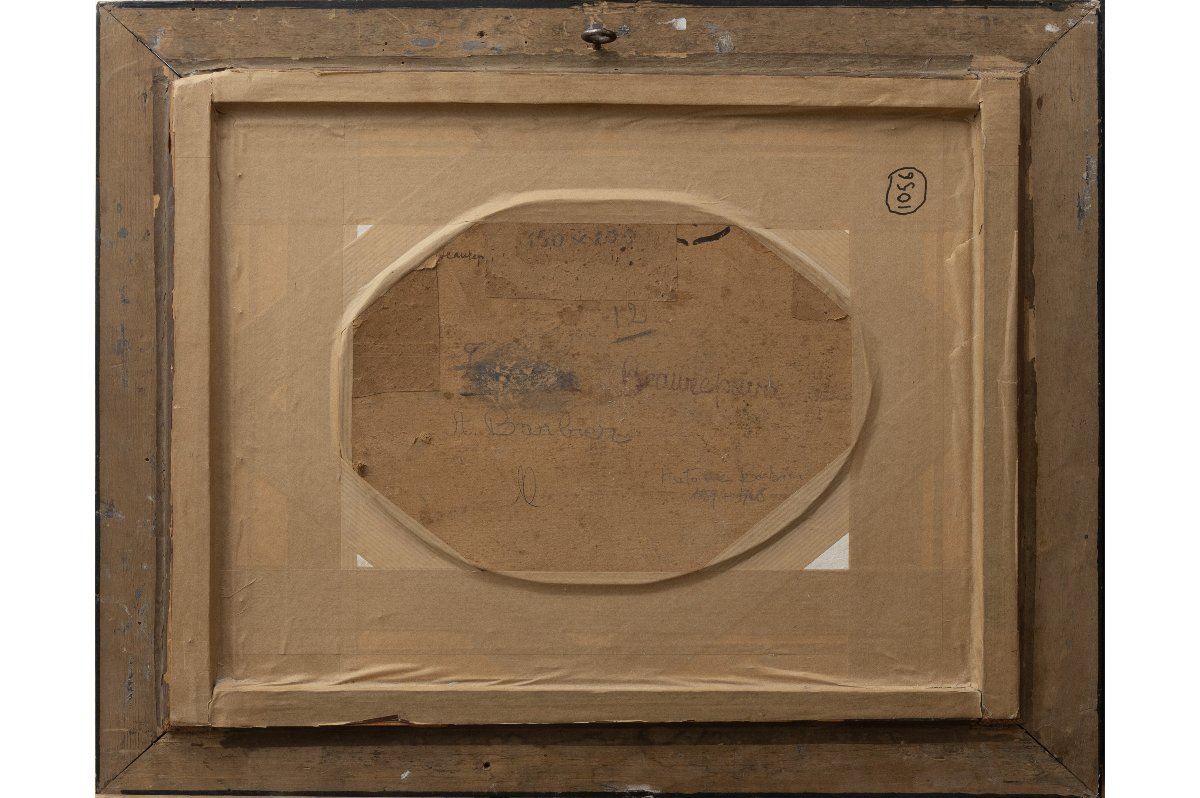
On the reverse, an old handwritten inscription attributes the work to Antoine Barbier (1859–1948) and mentions the location: “Beaurepaire.” The name likely refers to Beaurepaire-en-Bresse, a region of ponds and mists that perfectly matches the scene depicted here—a far cry from the Orientalist flights of fancy for which this traveling painter is best known, but entirely consistent with the more intimate style he adopted, once he returned to live near Lyon, to depict the landscapes of his region.
Condition and Frame
Good overall condition. The signature is very faint but consistent with the attribution on the reverse.
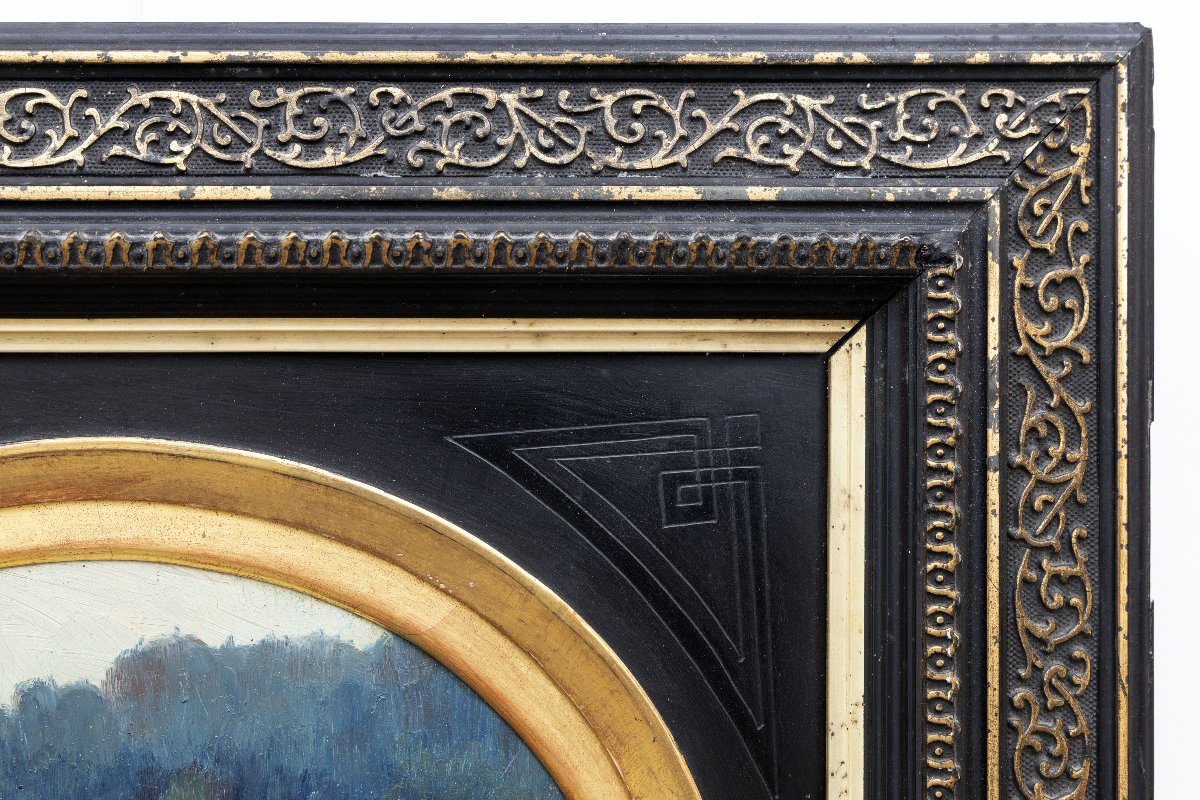
The painting is set in a beautiful late 19th-century frame, in a Japanese-inspired style, predominantly black and accented with gold. Surrounding the oval opening: a smooth gold border, followed by a wide, flat black band adorned at each corner with a geometric Greek key motif incised into the paint, discreet yet well-preserved. This is followed by a fluted black groove highlighted by a gold border, then, along the outer edge, a frieze of gold beads and spikes surmounted by a gold foliage scroll on a grainy black background. This type of frame, highly prized for small oval formats, is associated with the “late Napoleon III” style or the very early 20th century. The gilding shows normal wear and tear for its age (slight scuffing, a few chips on the outer band), without detracting from the decoration’s appearance.
The Artist
Antoine Barbier led one of the most romantic lives among the Lyon painters of his time. Born on May 10, 1859, in Saint-Symphorien-de-Lay, in the Loire region, as the eleventh child of a country doctor, he left France at the age of twelve to join his older brother in Algeria, who was a priest near Bône. He spent about a dozen years there, divided between military service and his first attempts at painting as a self-taught artist.
Upon his return to France around 1883, he held a series of jobs in Lyon—surveyor, bank clerk, salesman at the Grand Bazar—before setting off again, this time for Turkey, where he managed a vineyard and later taught. His love of travel and ornamentation then took him to Bulgaria: from 1887 to 1895, he served as official court painter to Prince (future Tsar) Ferdinand I, where he decorated the ceilings of the royal palace in Sofia, painted watercolor portraits of the princely family, and even composed poems for court festivities.
Returning to Lyon in 1895 after a stay in Paris—where he worked as an illustrator for the press and finally took formal painting lessons—he devoted himself fully to his art. He exhibited regularly at the Salon des Artistes Français—where he won a silver medal in 1925 before being exempted from competition—as well as at the Société Lyonnaise des Beaux-Arts, which awarded him its Grand Prix and its medal of honor. He became a prominent figure there, as well as at the Société Amicale des Peintres et Sculpteurs Français, where he chaired the Lyon chapter, and served on the board of the Académie des Sciences, Belles-Lettres et Arts de Lyon.
Primarily a watercolorist, Antoine Barbier also painted landscapes, cityscapes, seascapes, and still lifes in oil, in a gentle, post-Impressionist style. After returning to settle in his native region, he notably painted the murals at the Brotteaux train station in Lyon and, in 1945, created the decorative artwork for the church in Renage, Isère.
His works are now part of several public collections, including those of the Carnavalet Museum, as well as museums in Lyon, Saint-Étienne, Roanne, and Bordeaux, and in Cairo, Algiers, and Brussels. He passed away in Lyon on February 8, 1948, at the age of 89; a street in the 6th arrondissement now bears his name.
Work on view at the gallery (07240)
Shipping: Please contact us for shipping costs within France and internationally.
Shores of a Pond in Bresse
Oil on oval canvas, late 19th-century period frame
Canvas: 27.5 x 22 cm — Frame: 51.5 x 45.5 cm
Signed lower center (signature partially erased, attribution on the back)
Very good condition
A pond under a cloudy sky, a shore lined with willows and poplars reflected in still water tinged with green and deep blue: this small oval canvas possesses the discreet gentleness of water landscapes painted from life, with no other ambition than to capture light and silence.
On the reverse, an old handwritten inscription attributes the work to Antoine Barbier (1859–1948) and mentions the location: “Beaurepaire.” The name likely refers to Beaurepaire-en-Bresse, a region of ponds and mists that perfectly matches the scene depicted here—a far cry from the Orientalist flights of fancy for which this traveling painter is best known, but entirely consistent with the more intimate style he adopted, once he returned to live near Lyon, to depict the landscapes of his region.
Condition and Frame
Good overall condition. The signature is very faint but consistent with the attribution on the reverse.
The painting is set in a beautiful late 19th-century frame, in a Japanese-inspired style, predominantly black and accented with gold. Surrounding the oval opening: a smooth gold border, followed by a wide, flat black band adorned at each corner with a geometric Greek key motif incised into the paint, discreet yet well-preserved. This is followed by a fluted black groove highlighted by a gold border, then, along the outer edge, a frieze of gold beads and spikes surmounted by a gold foliage scroll on a grainy black background. This type of frame, highly prized for small oval formats, is associated with the “late Napoleon III” style or the very early 20th century. The gilding shows normal wear and tear for its age (slight scuffing, a few chips on the outer band), without detracting from the decoration’s appearance.
The Artist
Antoine Barbier led one of the most romantic lives among the Lyon painters of his time. Born on May 10, 1859, in Saint-Symphorien-de-Lay, in the Loire region, as the eleventh child of a country doctor, he left France at the age of twelve to join his older brother in Algeria, who was a priest near Bône. He spent about a dozen years there, divided between military service and his first attempts at painting as a self-taught artist.
Upon his return to France around 1883, he held a series of jobs in Lyon—surveyor, bank clerk, salesman at the Grand Bazar—before setting off again, this time for Turkey, where he managed a vineyard and later taught. His love of travel and ornamentation then took him to Bulgaria: from 1887 to 1895, he served as official court painter to Prince (future Tsar) Ferdinand I, where he decorated the ceilings of the royal palace in Sofia, painted watercolor portraits of the princely family, and even composed poems for court festivities.
Returning to Lyon in 1895 after a stay in Paris—where he worked as an illustrator for the press and finally took formal painting lessons—he devoted himself fully to his art. He exhibited regularly at the Salon des Artistes Français—where he won a silver medal in 1925 before being exempted from competition—as well as at the Société Lyonnaise des Beaux-Arts, which awarded him its Grand Prix and its medal of honor. He became a prominent figure there, as well as at the Société Amicale des Peintres et Sculpteurs Français, where he chaired the Lyon chapter, and served on the board of the Académie des Sciences, Belles-Lettres et Arts de Lyon.
Primarily a watercolorist, Antoine Barbier also painted landscapes, cityscapes, seascapes, and still lifes in oil, in a gentle, post-Impressionist style. After returning to settle in his native region, he notably painted the murals at the Brotteaux train station in Lyon and, in 1945, created the decorative artwork for the church in Renage, Isère.
His works are now part of several public collections, including those of the Carnavalet Museum, as well as museums in Lyon, Saint-Étienne, Roanne, and Bordeaux, and in Cairo, Algiers, and Brussels. He passed away in Lyon on February 8, 1948, at the age of 89; a street in the 6th arrondissement now bears his name.
Work on view at the gallery (07240)
Shipping: Please contact us for shipping costs within France and internationally.
400 €
Period: 19th century
Style: Napoleon 3rd
Condition: Excellent condition
Material: Oil painting
Width: 27,5 cm / 51,5 cm encadré
Height: 22 cm / 45,5 cm encadré
Reference (ID): 1799282
Availability: In stock
Print