


Jean Gaston Mantel – Beach Scene In Morocco – Gouache – Signed And Dated 1950
Artist: Mantel Jean Gaston (1914 – 1995, France)
Jean-Gaston MANTEL (1914–1995)
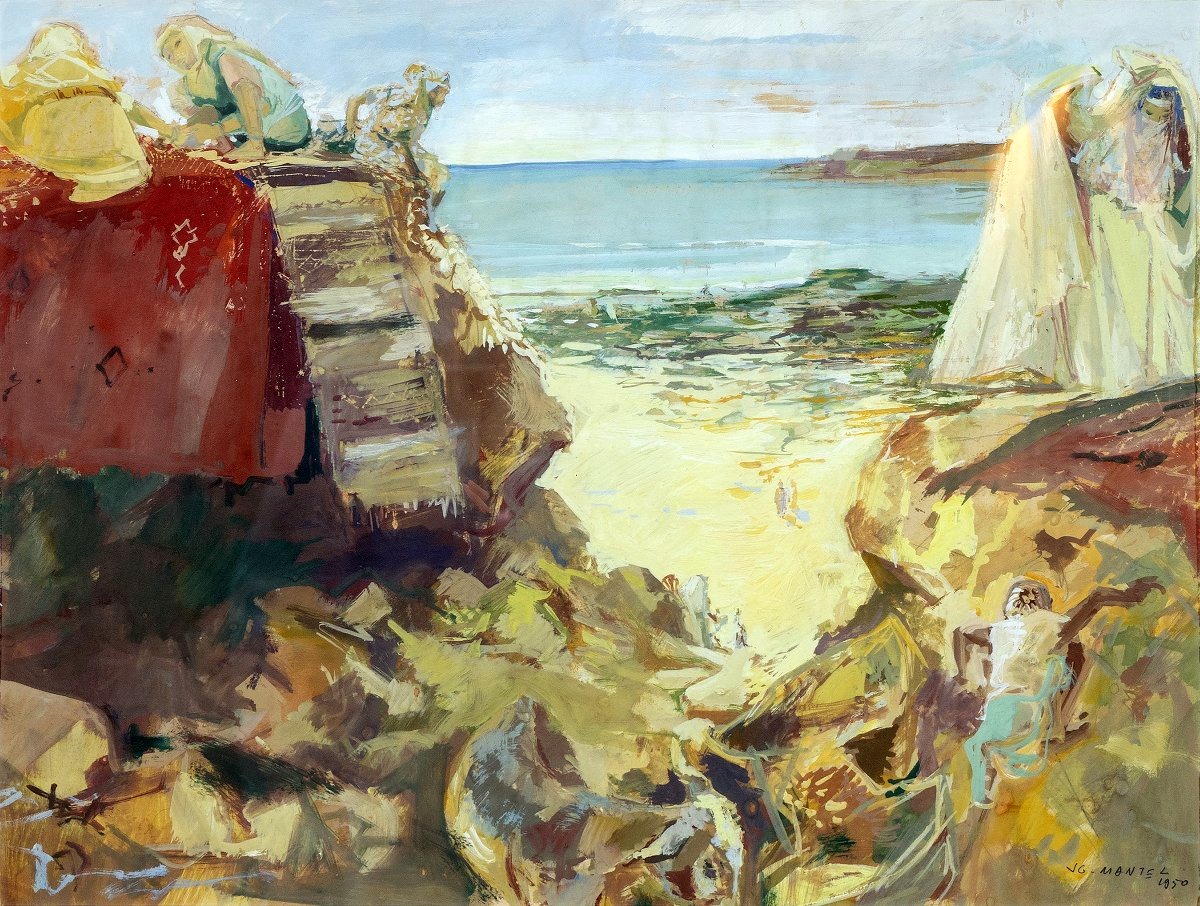
Beach Scene in Morocco, 1950
Gouache on paper
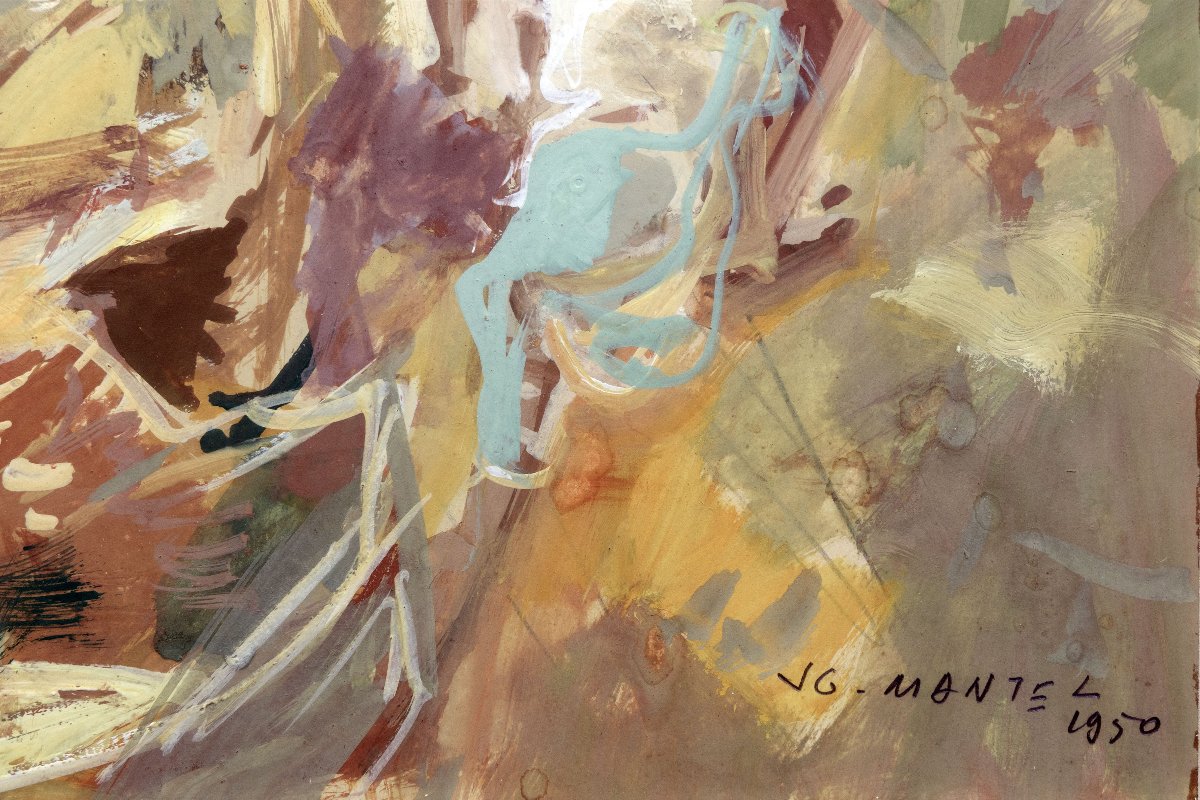
Signed and dated lower right “JG-MANTEL 1950” ”
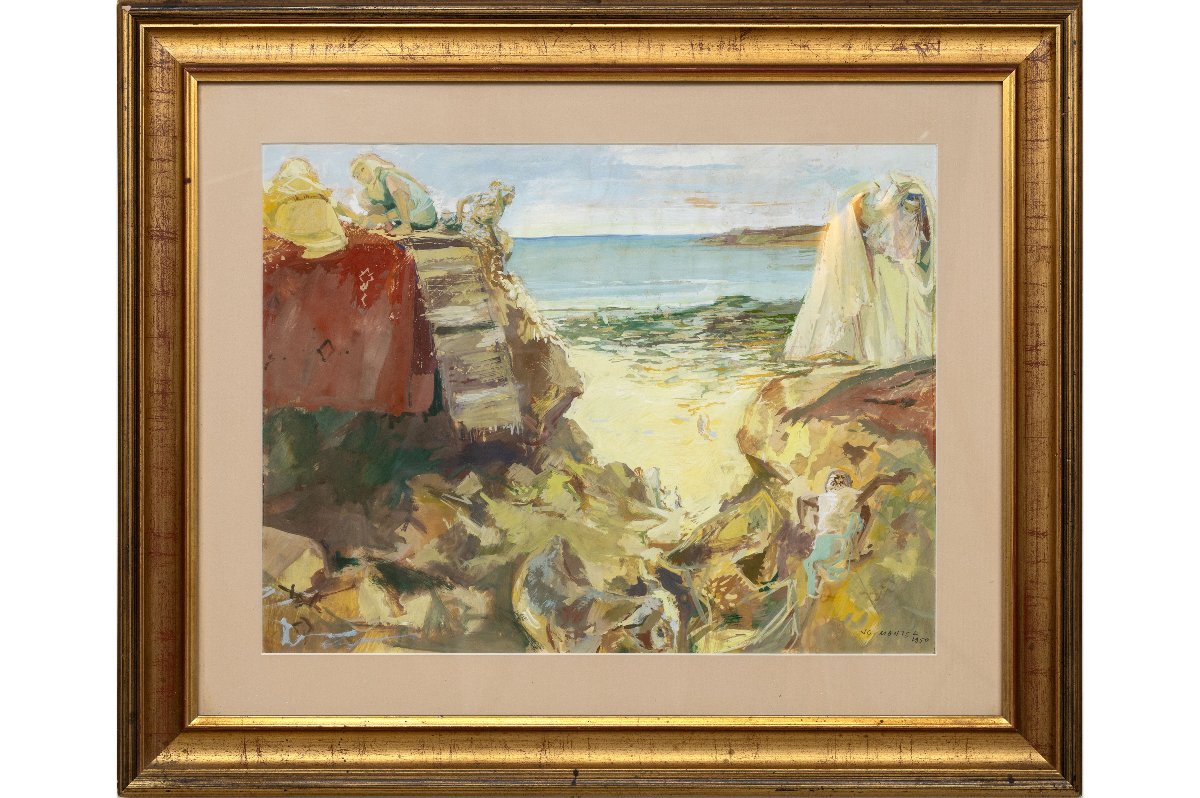
Dimensions: 52 x 39 cm (image only), 75 x 62 cm framed
Condition: good to very good. A few small, barely visible water stains in the sea and near the signature; old traces of glue on the right edge.
Frame: modern molded wood frame, gilded and patinated, with a beige mat
Where do we enter this painting?
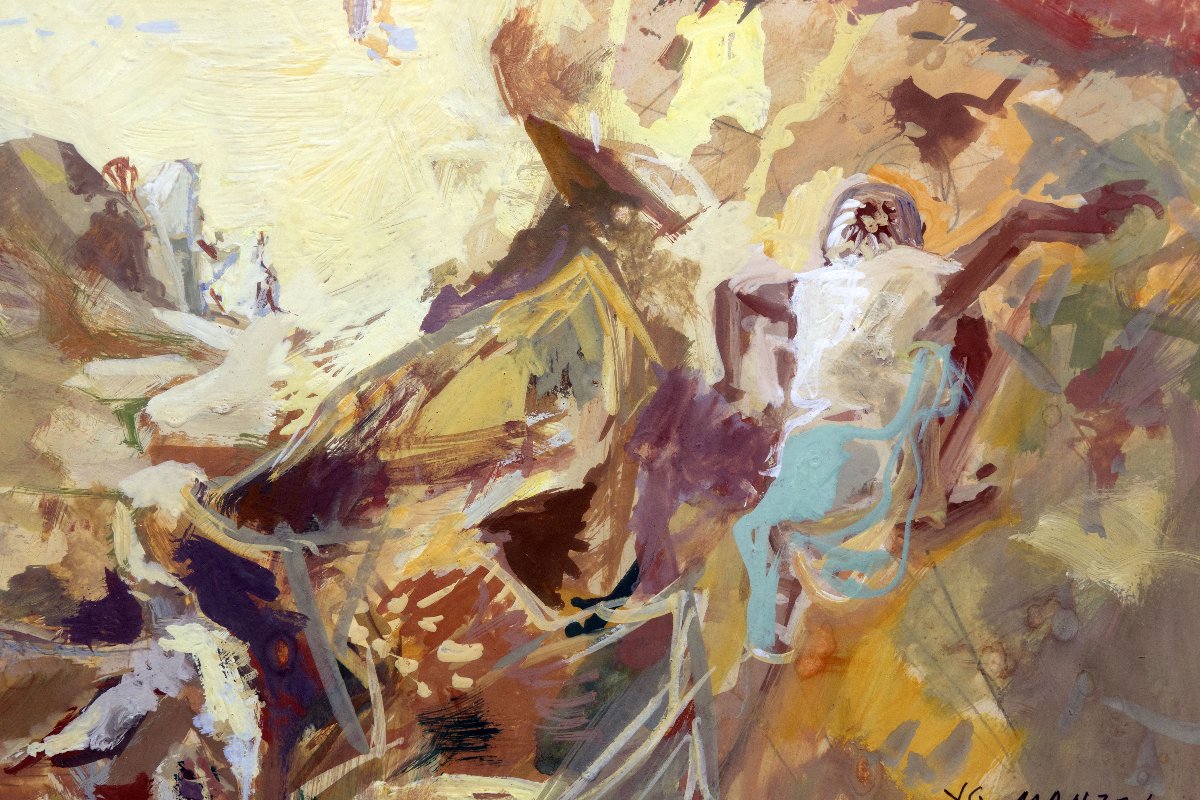
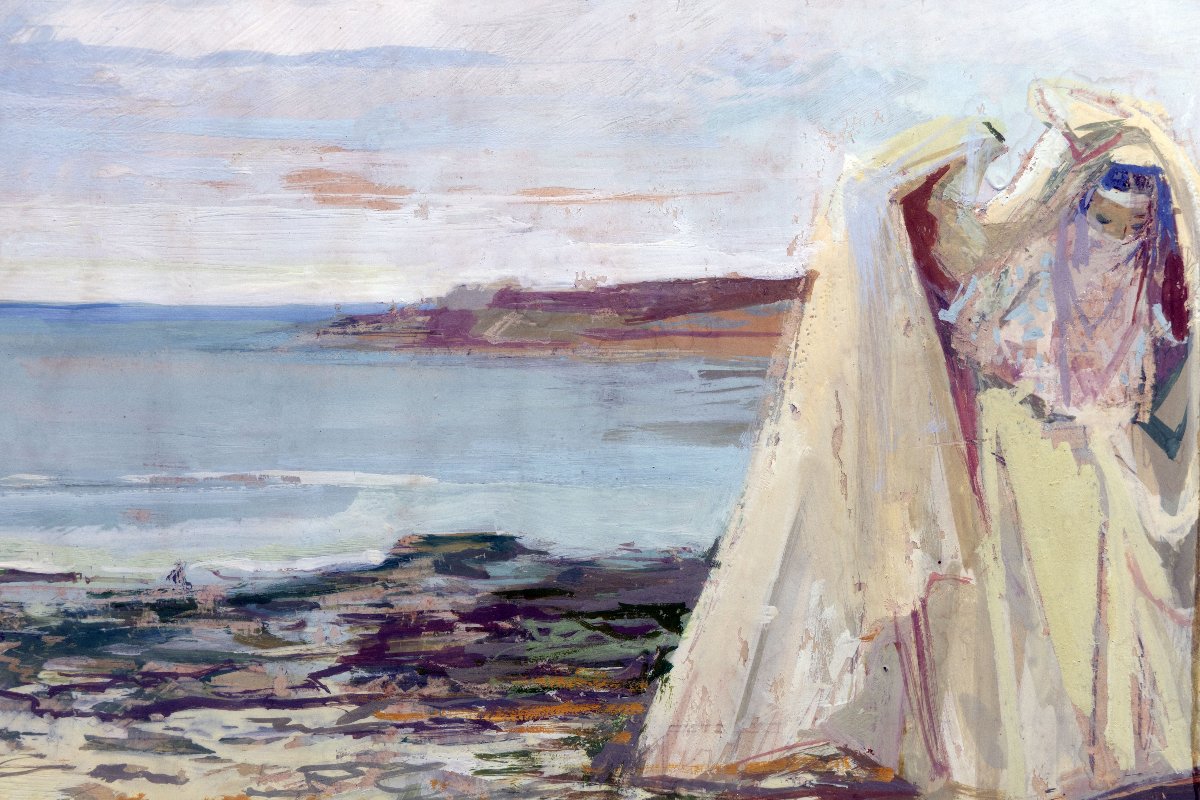
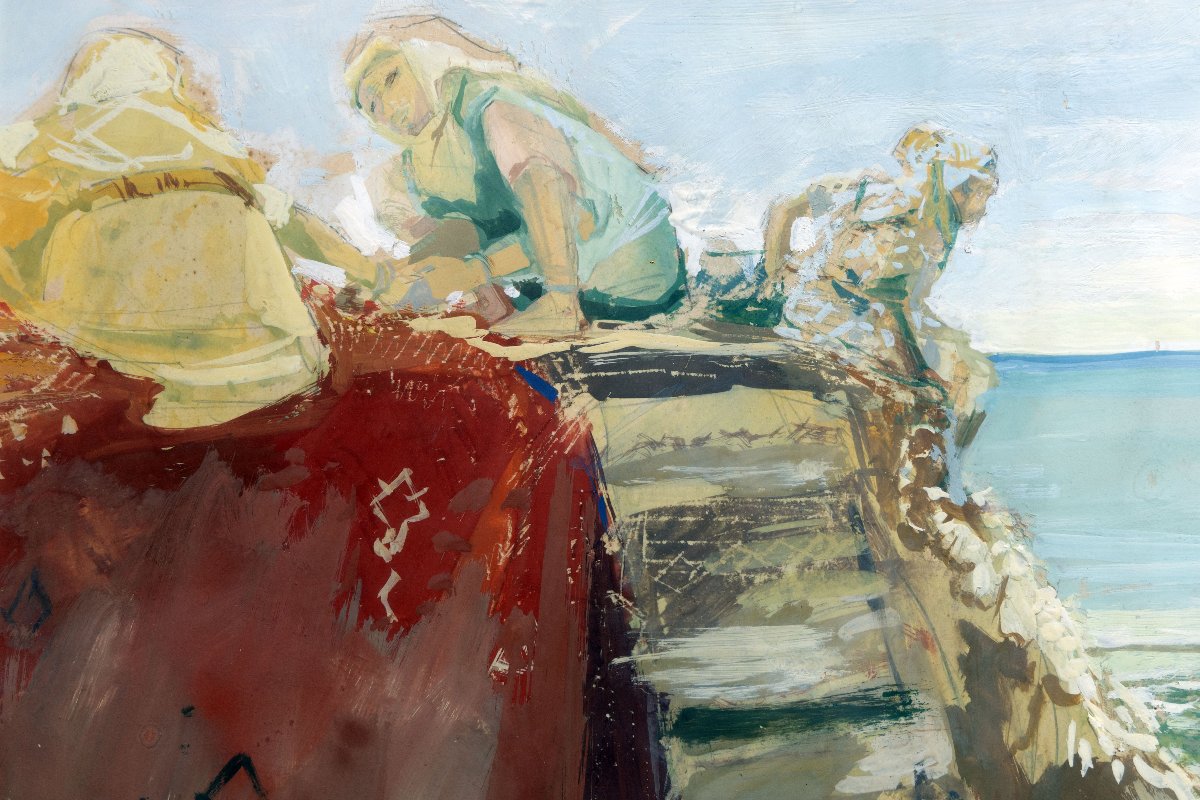
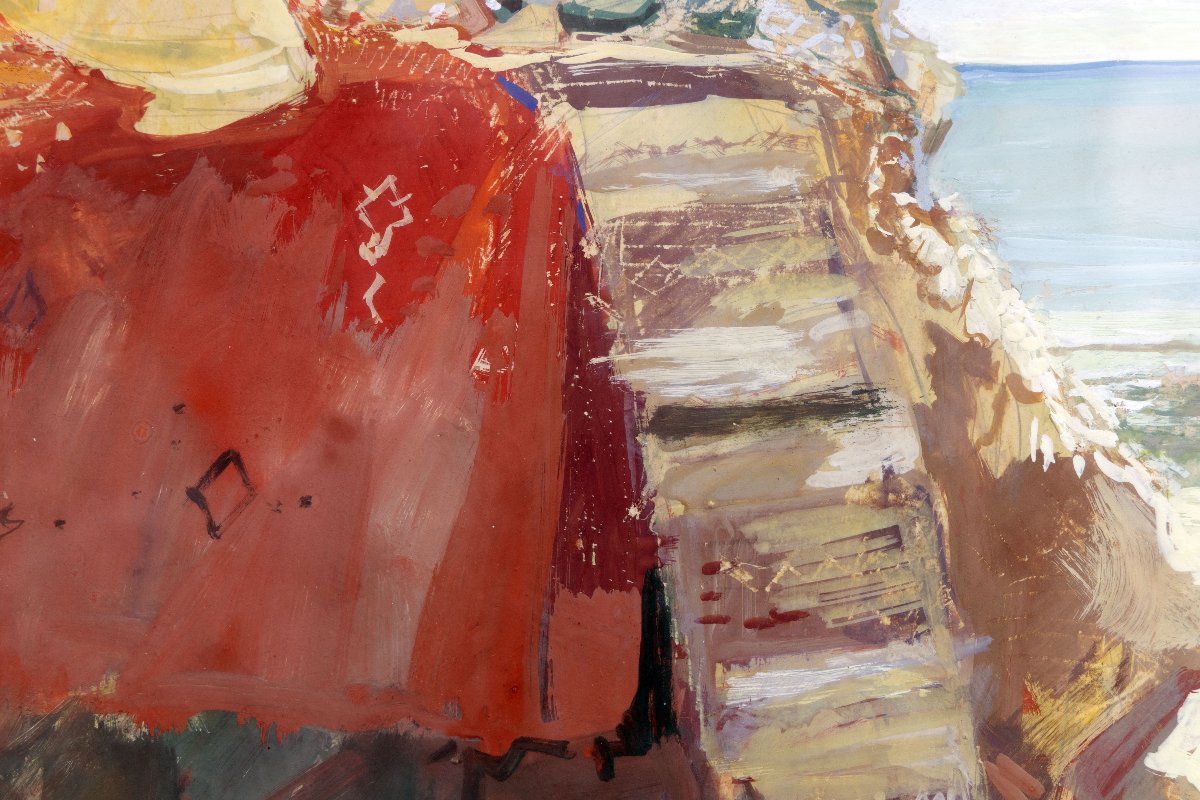
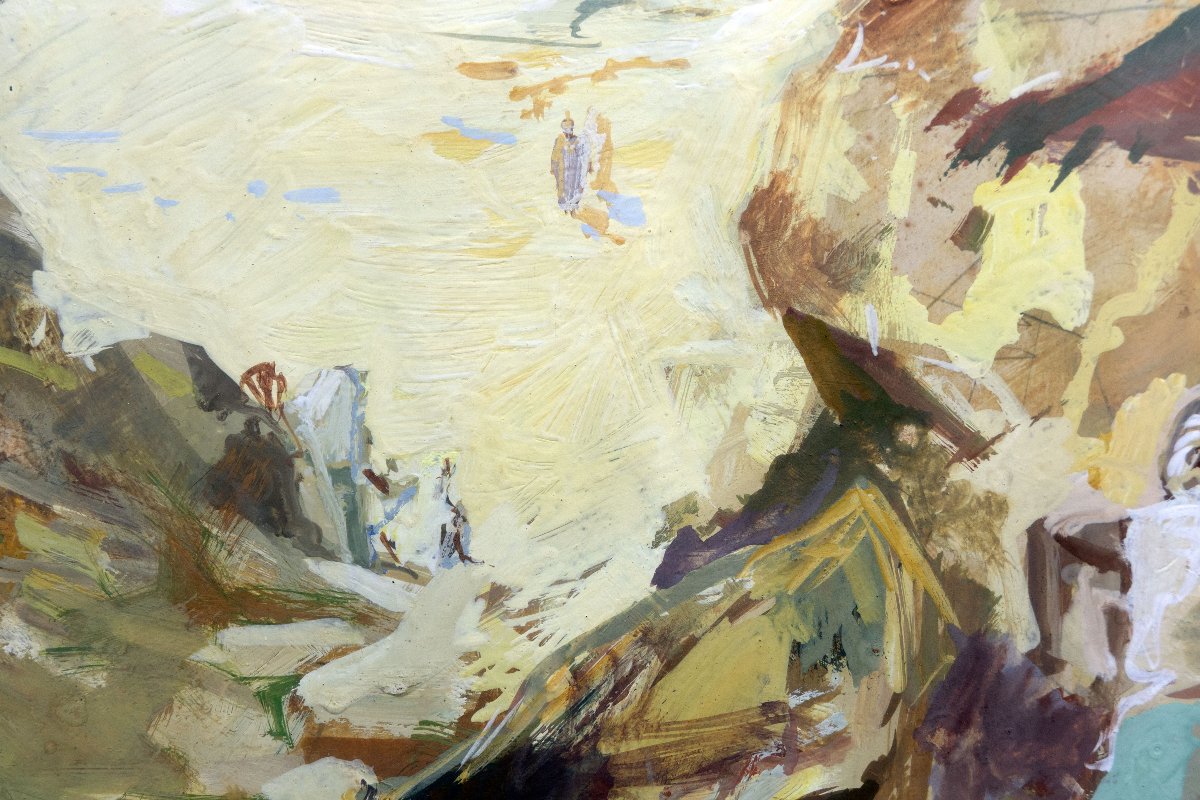
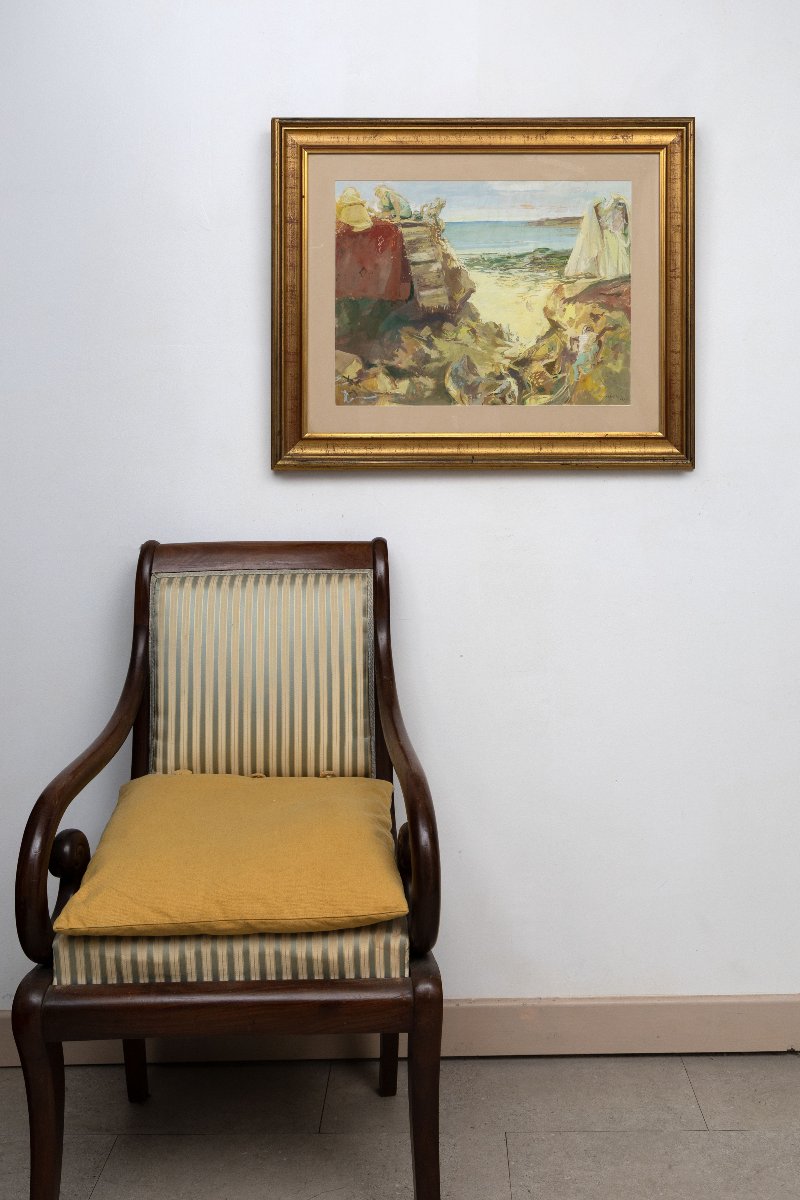
From the left, perhaps. At the very top of a large rock, two rugs have been draped side by side: a red one, adorned with Berber motifs, and another with light stripes that flows down the rock. Two young girls are seated there, leaning toward one another—one wrapped in yellow, the other in a green tunic. A little further away, a third figure stands right at the edge of the rock, just above the void. On the opposite side, to the right, two women wrapped in their white haikis form a large, luminous mass, almost sculpted. And right at the bottom, a child clings to the rocks as he climbs.
Between these two rock formations, a sandy path leads down to the sea. On the beach at low tide, a few tiny figures make their way among the seaweed-covered rocks toward the small headland that closes off the bay.
This is where it all unfolds. The women in white, though farther away, are much larger than the child in the foreground. The young girls, perched at the very top of the image, are cut off by the edge of the paper, and their companion seems ready to topple toward the beach. Mantel does not adhere to the scale of the figures; he deliberately distorts it. This was a habit of his, and here it creates a scene full of movement, where the eye constantly shifts from one group to another, from top to bottom, from the rocks to the sea.
The brushwork follows the same momentum. In the foreground, the gouache is applied quickly, in broad brushstrokes and lines that scratch the surface; further back, the sea and sky settle into pale, smooth blues. The ochres, reds, and whites vibrate in the bright summer light.
A work from 1950, from the artist’s finest period in Morocco: a free and modern take on a seaside scene.
The Artist
Born in Amiens in 1914 and died in Marseille in 1995, Jean-Gaston Mantel trained at the École des Beaux-Arts in Paris. In 1936, a prize from the Société nationale des Beaux-Arts enabled him to spend a year in Morocco. He settled in Rabat, in a studio reserved for prize winners in the heart of the Kasbah of the Oudayas, and worked in Meknes alongside Mattéo Brondy.
The following year, he secured a position as a drawing teacher in Rabat. The war brought him back to France, but he returned to Morocco as early as 1946 to teach at the Lycée Gouraud, and then, after independence, at the Lycée Descartes. He lived in Salé at the time, across from the Kasbah of the Oudayas, which he never tired of drawing.
Fantasias, moussems, Atlas dancers: he painted Morocco in celebration as well as in everyday life. He also created numerous posters for Moroccan tourism and large decorative panels, some of which were over ten meters long, for the Hilton Hotel in Rabat. His trademark was his unexpected perspectives: he viewed the scene from high above, soaring over horse-drawn carriages or positioning himself right in front of the horses’ nostrils.
Toward the end of his life, he settled in Villefranche-sur-Mer on the French Riviera, to which he also dedicated several works. His paintings now regularly appear in major Orientalist art auctions.
Work on view at the gallery (07240)
Shipping: Please contact us for shipping rates within France and internationally.
2 500 €
Period: 20th century
Style: Modern Art
Condition: Good condition
Material: Gouache
Width: 52 cm à vue, 75 cm encadrée
Height: 39 cm à vue, 62 cm encadrée
Reference (ID): 1844747
Availability: In stock
Print