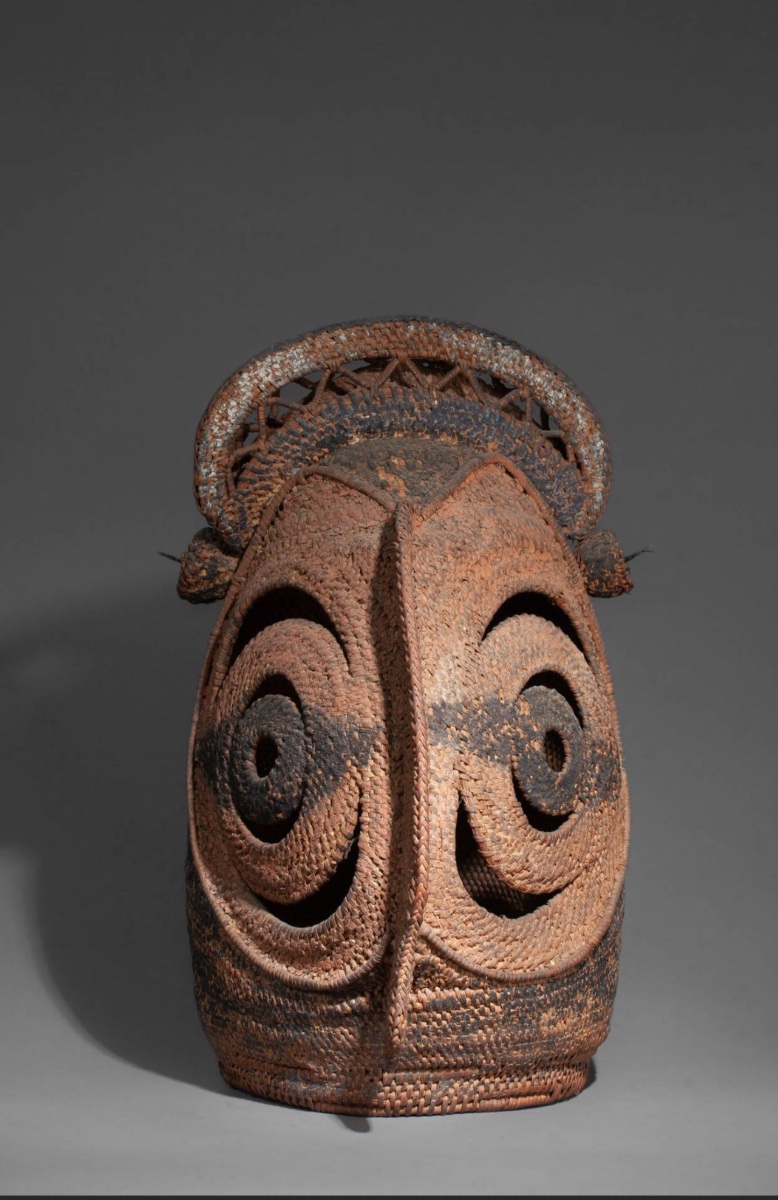
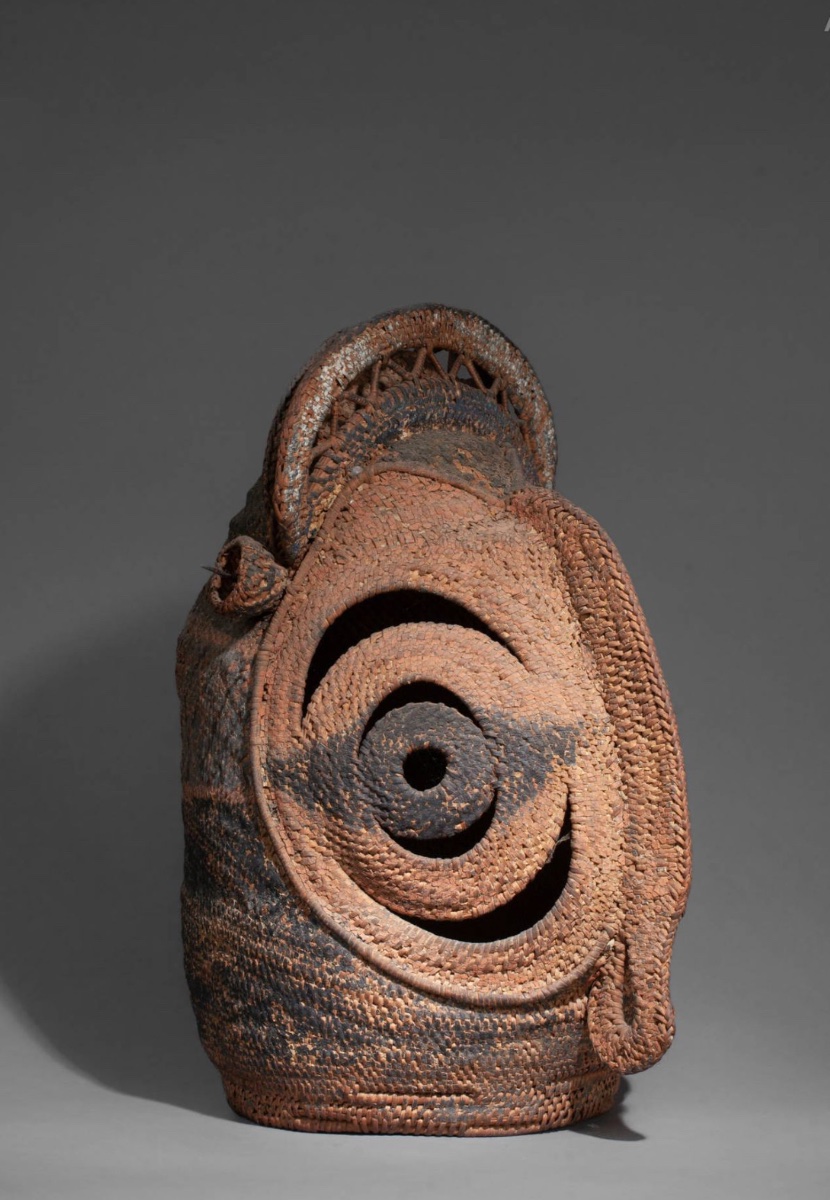


Baba (baapa) Mask, Abelam, Maprik-wosera Region, New Guinea. Francis Mazière
Baba (Baapa) Mask
Abelam people, Maprik–Wosera region, Eastern Sepik Valley, Papua New Guinea
Finely woven basketwork, natural pigments, cassowary feathers
Late 19th century – early 20th century (circa 1900–1930)
Height: 44 cm – Width: 30 cm – Depth: 33 cm
Former collection of Francis Mazière (1924–1994), French ethnologist, explorer, and writer.
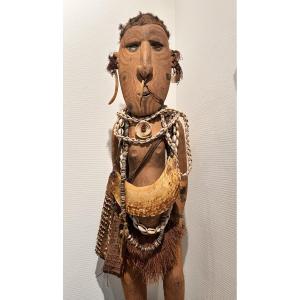
This remarkable Baba mask belongs to the ritual tradition of the Abelam people, one of the most prestigious groups in the Sepik Valley. Crafted using an extremely tight weaving technique, it demonstrates exceptional technical mastery that is rarely seen today in surviving examples.
The face is centered around two powerful, raised eyes, surrounded by openwork concentric circles characteristic of Abelam aesthetics. A prominent nasal ridge dominates a subtly hollowed-out mouth, while the top of the mask retains its crest adorned with cassowary feathers. The natural pigments, absorbed by the plant fibers, display an aged patina attesting to prolonged ritual use.
The Baba represent ancestral beings. According to traditions and ethnographic interpretations, they may evoke a stylized bird’s head or a pig—two figures imbued with strong symbolic significance in Abelam cosmology. This iconographic ambiguity is integral to their spiritual power.
Worn with a long skirt made of pandanus leaves, plant-based adornments, and necklaces of colorful fruits, the mask completely transformed its wearer, who then embodied a protective ancestor. It was used during major ancestor-worship ceremonies, yam festivals celebrating fertility, and male initiation rites. As the guardian of ritual prohibitions, it kept women, children, and the uninitiated away from sacred spaces, sometimes brandishing a spear to preserve the secrecy of the ceremonies.
Outside of times of celebration, the Baba masks were hung in the men’s ceremonial house (haus tambaran), above the hearth. The smoke helped protect the plant fibers from insects while contributing to the formation of the deep patina that is now highly sought after on antique specimens.
This piece exhibits all the characteristics of ancient Baba Abelam masks: exceptionally fine basketwork, dense construction, a strong frontal presence, ancient pigments, and remarkable craftsmanship. Its provenance—from the former collection of Francis Mazière, a leading figure in French ethnology and a pioneer in the recognition of the arts of Africa and Oceania—constitutes a historical and documentary asset of the highest order.
An iconic work of Abelam art, this mask offers a rare insight into the ritual traditions of the Sepik region prior to the profound cultural transformations of the 20th century.
Period: 20th century
Style: Tribal Art
Condition: En l'etat
Width: 30 cm
Diameter: 33 cm
Height: 44 cm
Reference (ID): 1798138
Availability: In stock