

18th-century Gentleman's Sword, Complete With A Suspension System And Belt Hook
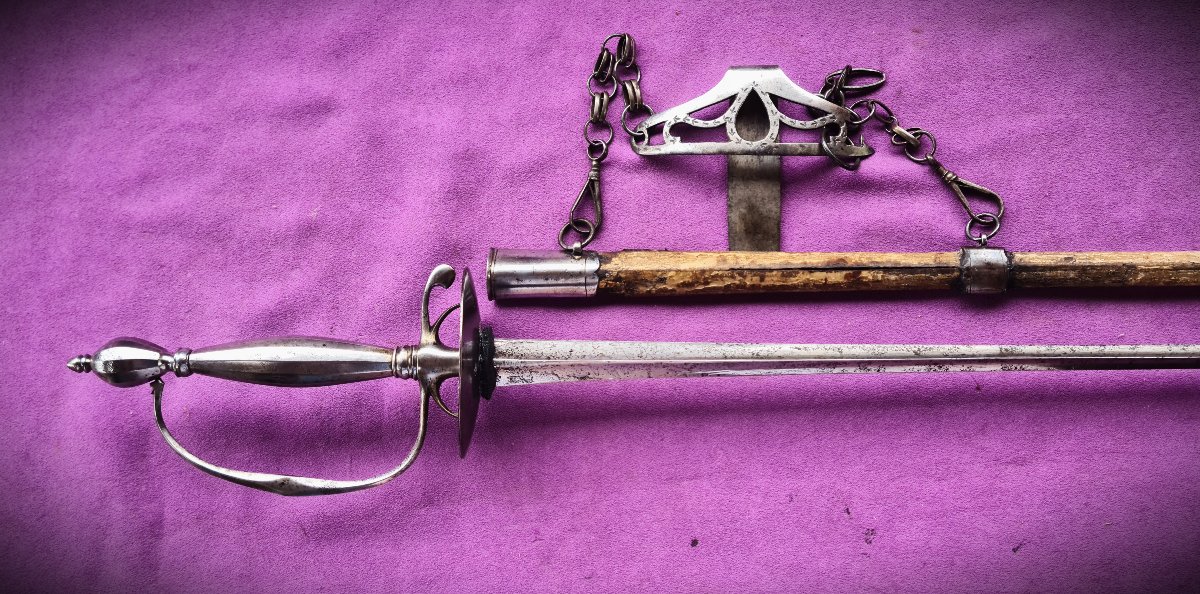
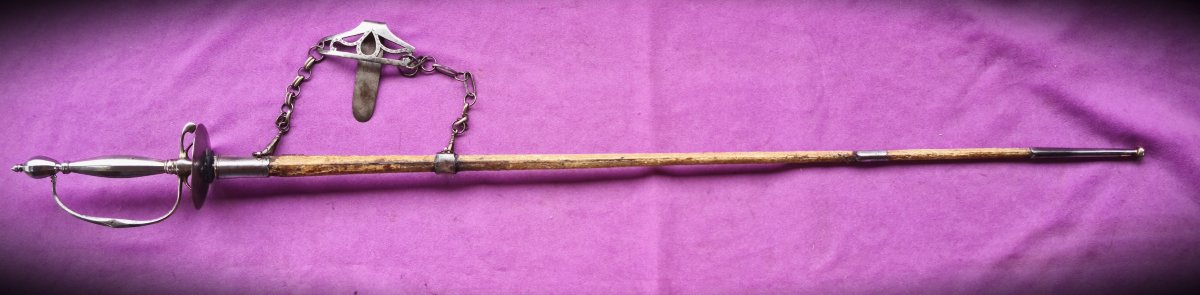
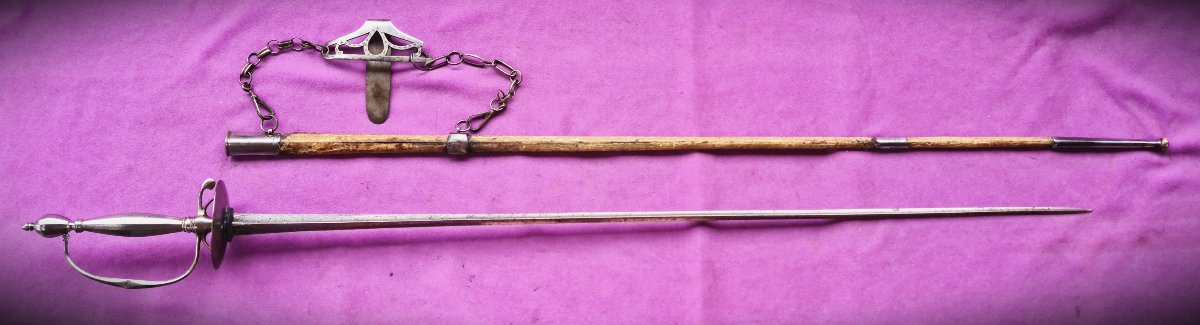
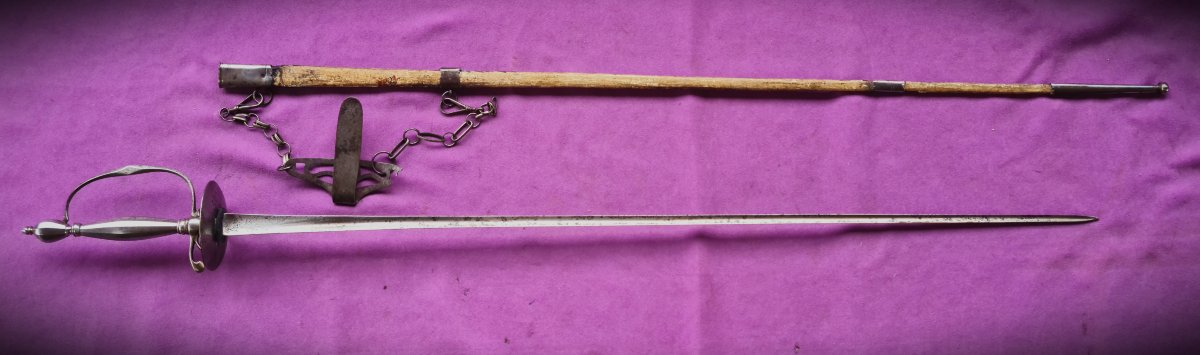
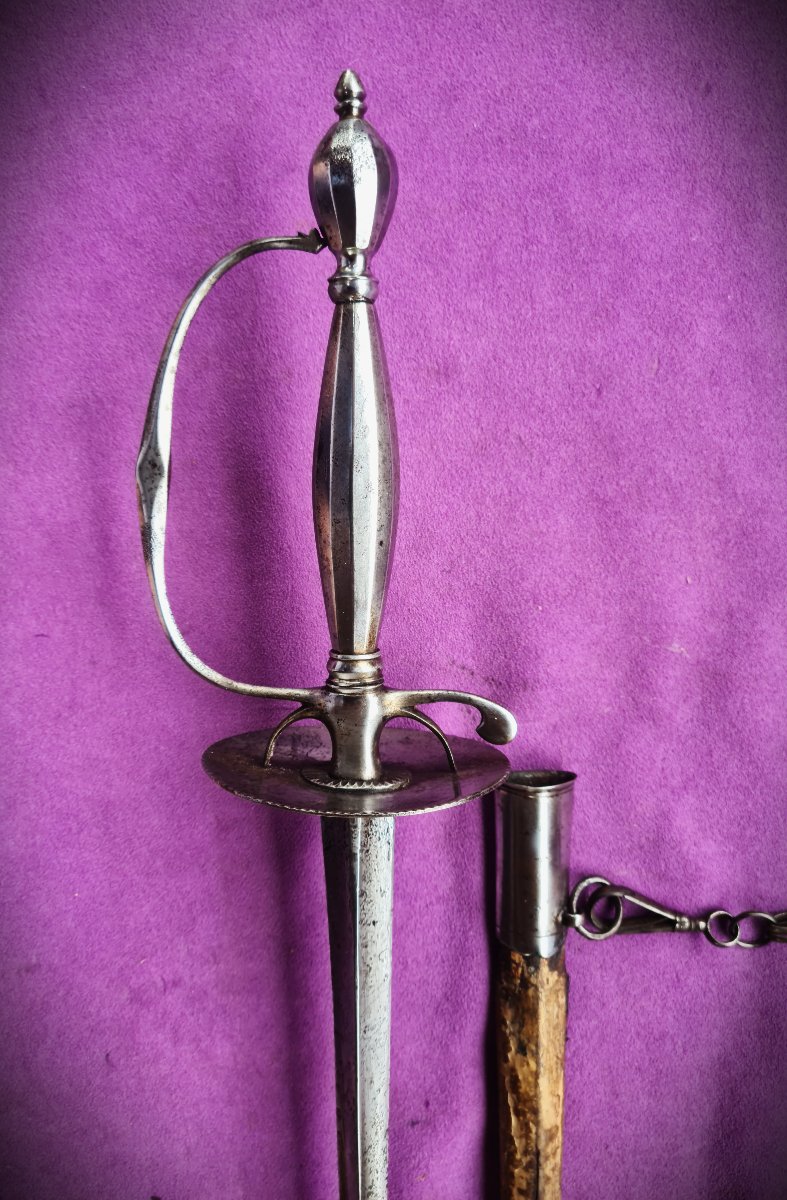
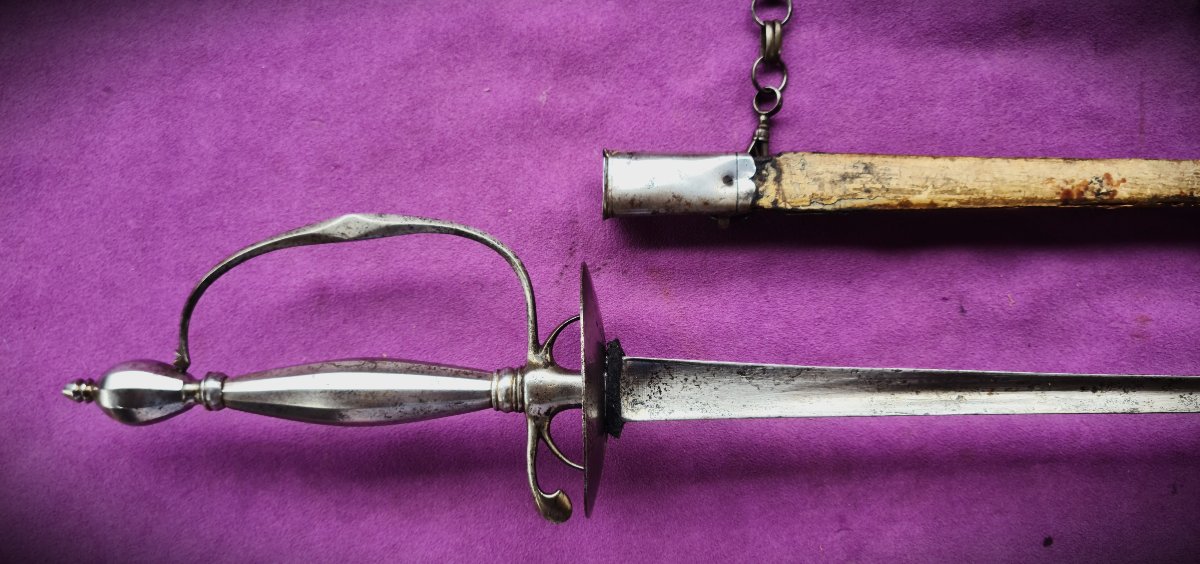
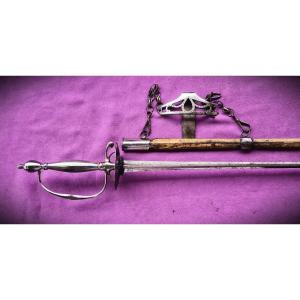
This is a gentleman’s sword known as a “court sword.” It is French and dates from the 18th century, around 1760. What makes this weapon particularly interesting is that it is absolutely complete, featuring not only its scabbard, but also its chain suspension system and even the belt hook known as a “verrouille.”
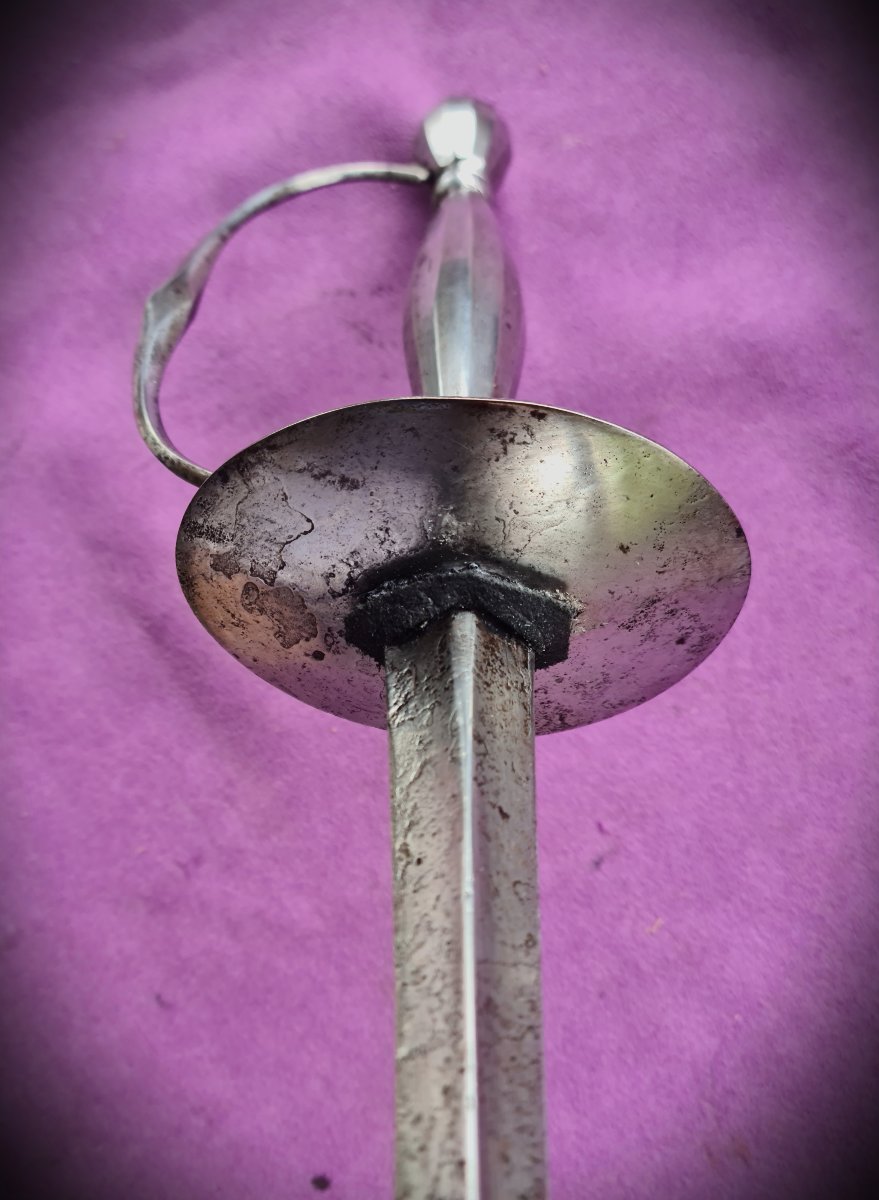
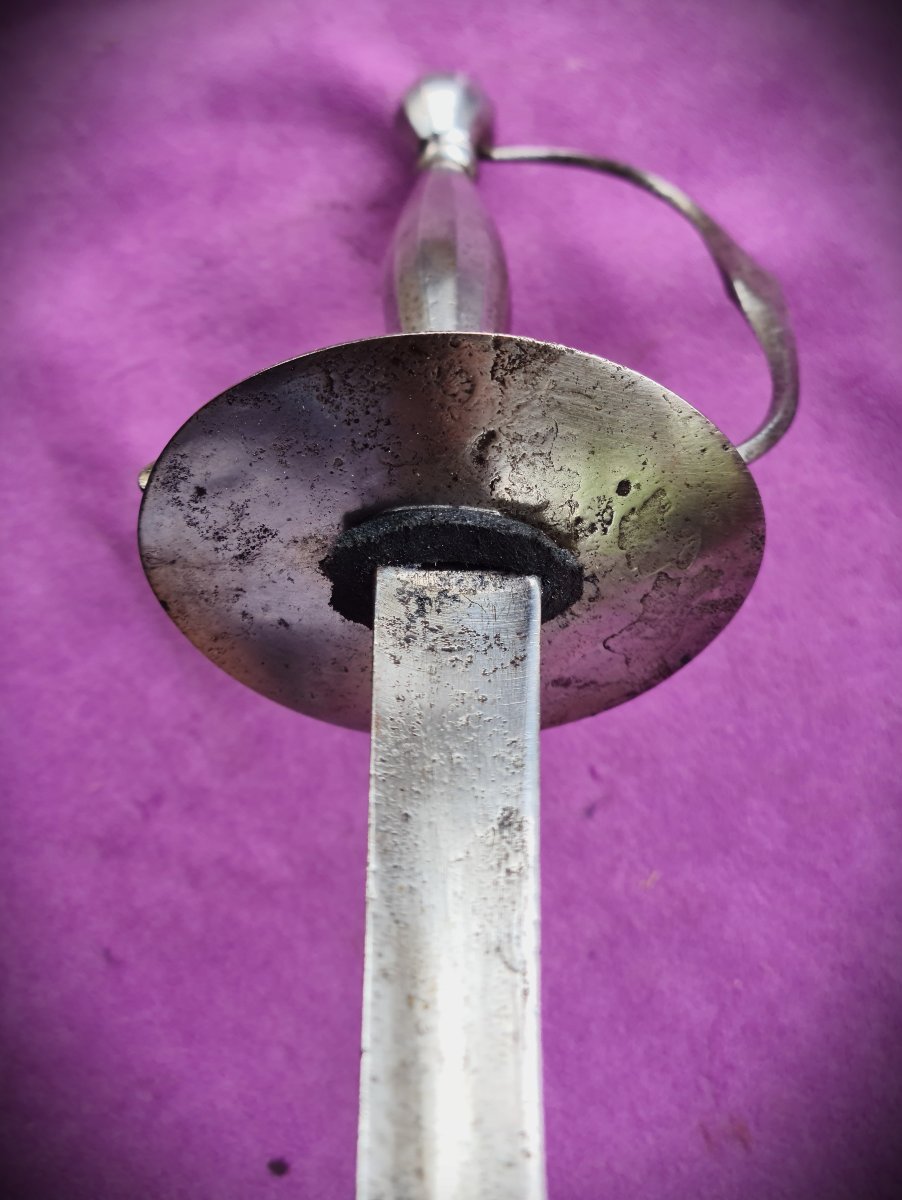
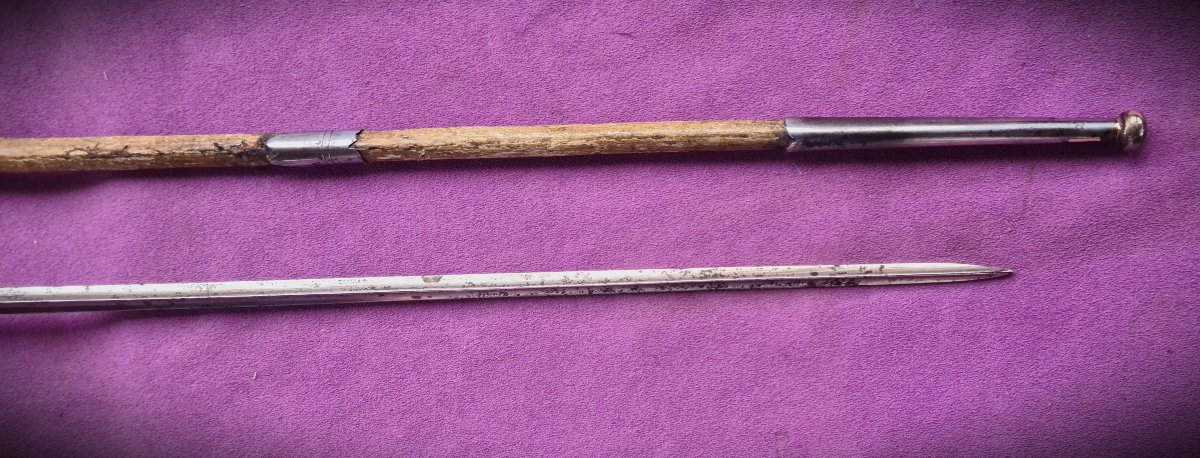
BLADE : It was most likely manufactured inSolingen. After a very short ricasso, it takes on a triangular cross-section with three hollow sides. The blade shows traces of oxidation in the recesses that could be improved by polishing.
Blade length = 74.5 cm, width at the ricasso 1.9cm, thickness at the ricasso = 7 mm
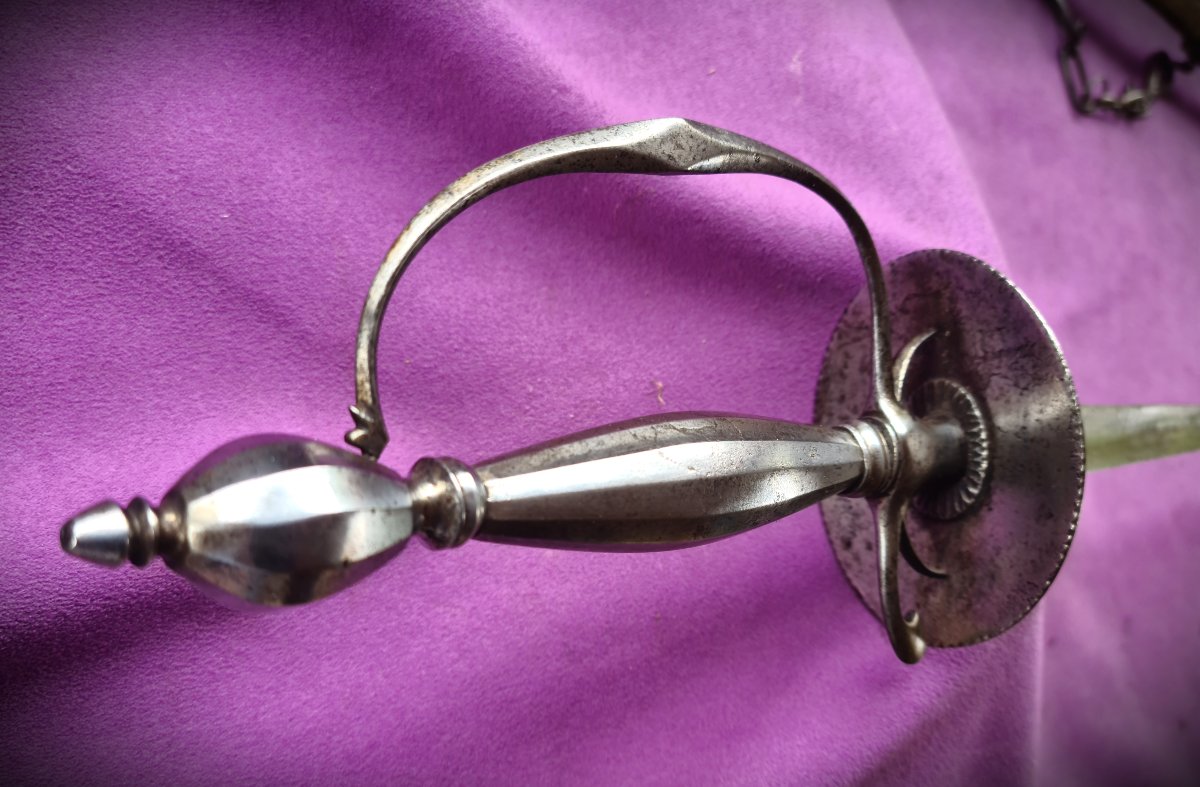
GUARD: It consists of an oval guard platemade of polished steel, the inner edge of which features a small serrated decoration. A steel ring, also serrated, connects to the central part of the guard, which on one side ends in a flattened quillon slightly curved toward the blade and on the other side forms the knuckle bow, which isattached to the pommel by a hook.
Two finger rings or "arms" known as “donkey’s steps” are attached to the guard plate. They are small in size, as was the norm in the second half of the 18thcentury.
POMMEL :It is shaped like an elongated bulb with 12 facets and ends in a small ,pointed button to which the blade tang is riveted.
TANG: It is made of polished steel, also with 12 facets, and ends on each side with polished steel ferrules.
The choice of 12 facets is, of course, no coincidence: it is richin symbolism—a number representing fulfillment—corresponding, for example,to the 12 apostles, but also to the 12 months of the year, the 12 gates of paradise, and many other interpretations as well.
SCABBARD : It is made of wood covered with parchment. All metal components are made of polished iron.The scabbard’s opening and the first intermediate section feature suspension rings. The second intermediate section is unusual; it may be an old reinforcement. The chape ends with a small rounded knob.
Note that the scabbard is slightly longer thanthe blade, which is very common; in the 19th century, it was customary when scabbards had become smallers by drying during the years to to offset the scabbard mouth toward the outside so that the blade would not come too deep inside the scabbard and so did not rub against it. This is also the case with this scabbard, where the metal mouth of scabbard has clearly been shifted outward by at least 2 cm.
SUSPENSION ELEMENTS : Polished steel belt hook with a small decorative pattern of bird footprints. Minor damage on the right edge. The suspensionchains are attached to the rings on the scabbard via carabiners.
This sword, typical of the second half of the 18th century, is a pleasing model in its simplicity; it can be seen as a welcome counterpoint to the excesses of decoration found found in the “Rococo” or “Rocaille” styles The asking price reflects the overall condition. Nothing loose in the mount.
Shipping contribution: France €30, Europe€40
Ref B-2440F2
BLADE : It was most likely manufactured inSolingen. After a very short ricasso, it takes on a triangular cross-section with three hollow sides. The blade shows traces of oxidation in the recesses that could be improved by polishing.
Blade length = 74.5 cm, width at the ricasso 1.9cm, thickness at the ricasso = 7 mm
GUARD: It consists of an oval guard platemade of polished steel, the inner edge of which features a small serrated decoration. A steel ring, also serrated, connects to the central part of the guard, which on one side ends in a flattened quillon slightly curved toward the blade and on the other side forms the knuckle bow, which isattached to the pommel by a hook.
Two finger rings or "arms" known as “donkey’s steps” are attached to the guard plate. They are small in size, as was the norm in the second half of the 18thcentury.
POMMEL :It is shaped like an elongated bulb with 12 facets and ends in a small ,pointed button to which the blade tang is riveted.
TANG: It is made of polished steel, also with 12 facets, and ends on each side with polished steel ferrules.
The choice of 12 facets is, of course, no coincidence: it is richin symbolism—a number representing fulfillment—corresponding, for example,to the 12 apostles, but also to the 12 months of the year, the 12 gates of paradise, and many other interpretations as well.
SCABBARD : It is made of wood covered with parchment. All metal components are made of polished iron.The scabbard’s opening and the first intermediate section feature suspension rings. The second intermediate section is unusual; it may be an old reinforcement. The chape ends with a small rounded knob.
Note that the scabbard is slightly longer thanthe blade, which is very common; in the 19th century, it was customary when scabbards had become smallers by drying during the years to to offset the scabbard mouth toward the outside so that the blade would not come too deep inside the scabbard and so did not rub against it. This is also the case with this scabbard, where the metal mouth of scabbard has clearly been shifted outward by at least 2 cm.
SUSPENSION ELEMENTS : Polished steel belt hook with a small decorative pattern of bird footprints. Minor damage on the right edge. The suspensionchains are attached to the rings on the scabbard via carabiners.
This sword, typical of the second half of the 18th century, is a pleasing model in its simplicity; it can be seen as a welcome counterpoint to the excesses of decoration found found in the “Rococo” or “Rocaille” styles The asking price reflects the overall condition. Nothing loose in the mount.
Shipping contribution: France €30, Europe€40
Ref B-2440F2
680 €
Period: 18th century
Style: Louis 15th - Transition
Condition: Good condition
Material: Other
Length: 99 cm
Reference (ID): 1790877
Availability: In stock
Print