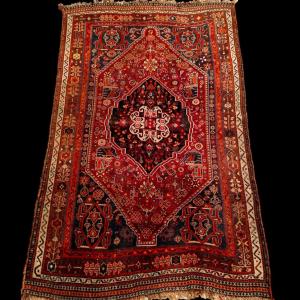
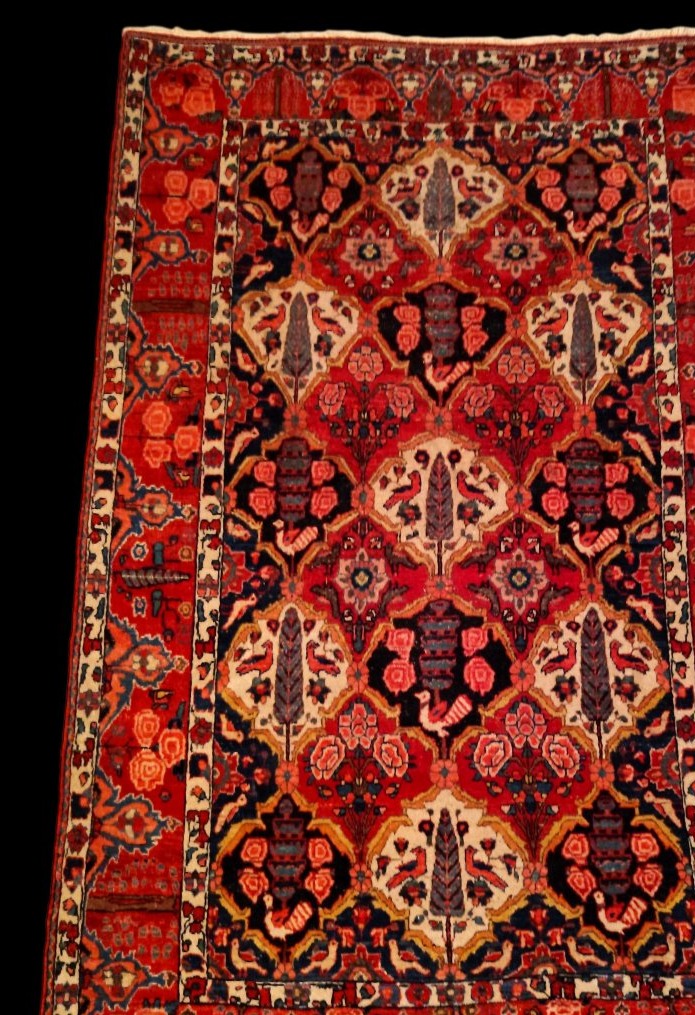
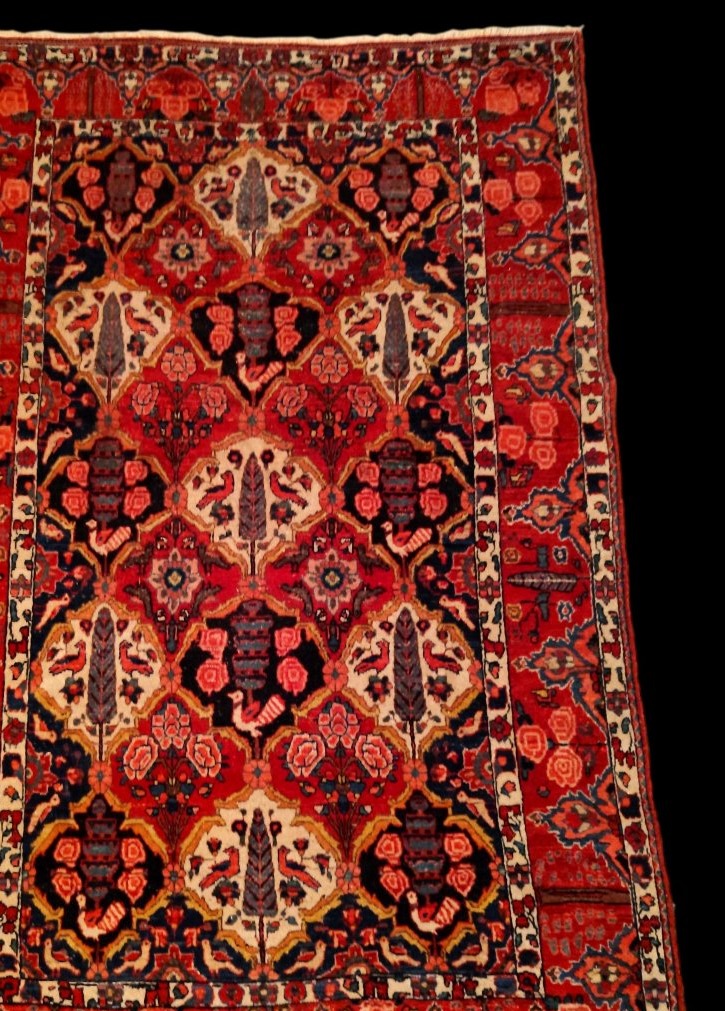
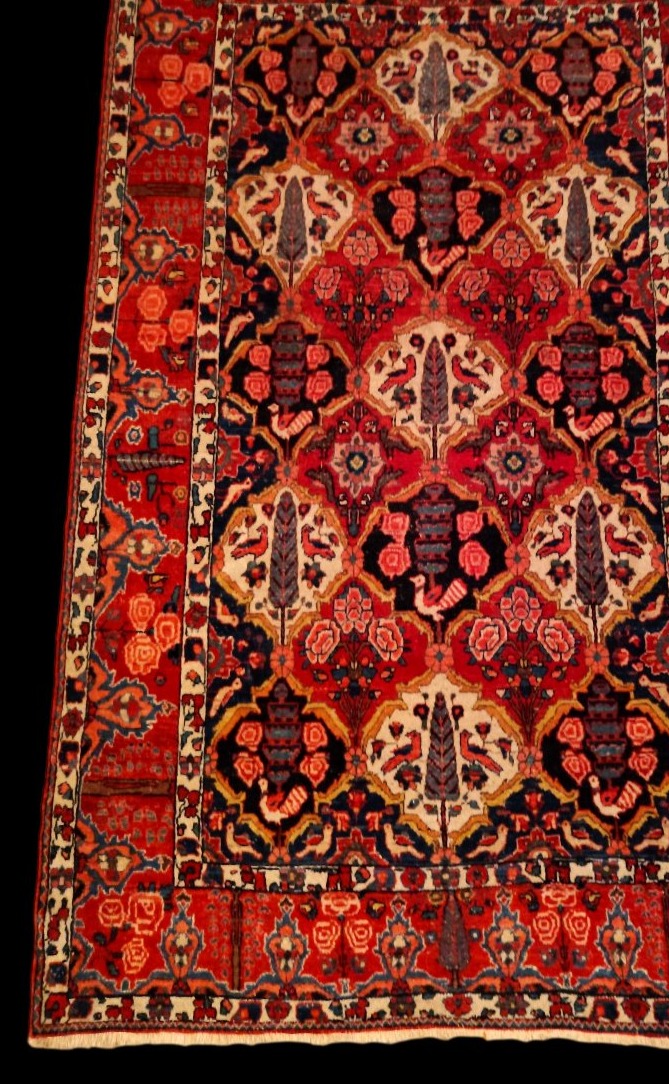
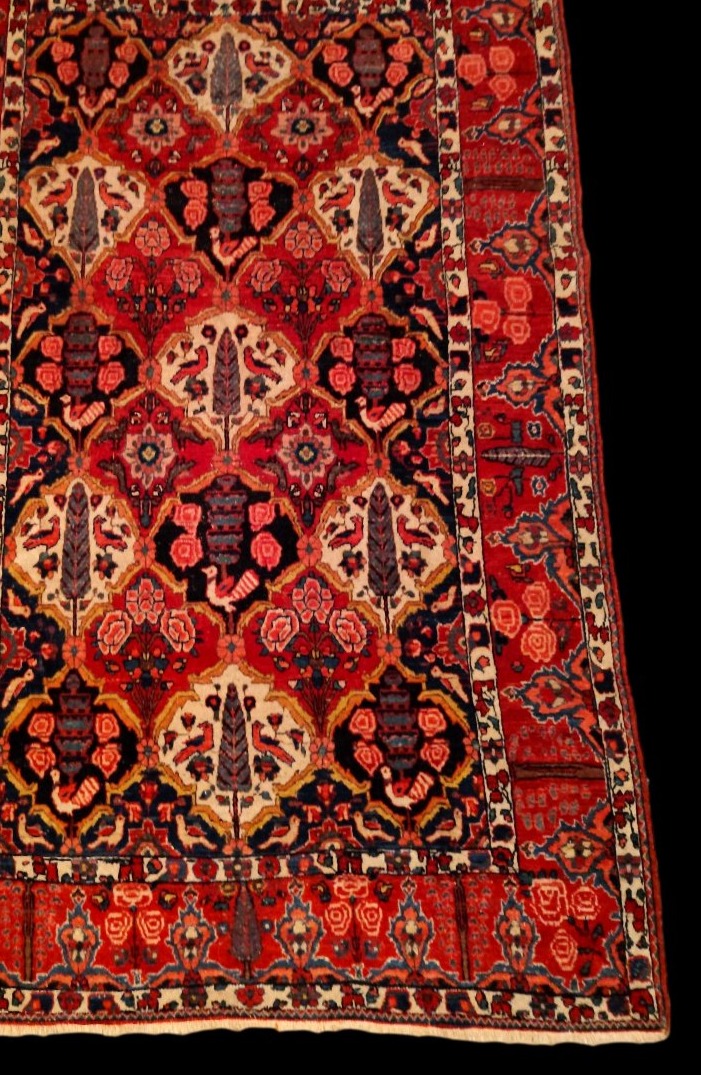


Bakhtiar "shotour" Rug, 145 X 215 Cm, Hand-knotted Wool, Iran, Qajar Dynasty, Late 19th Century
Artist: Art Kadjar
This antique Bakthiar rug is 145 cm wide and 215 cm long.
This rug is in very good condition and features fresh, vibrant colors.
Dating from the late 19th century or very early 20th century—1880–1900—
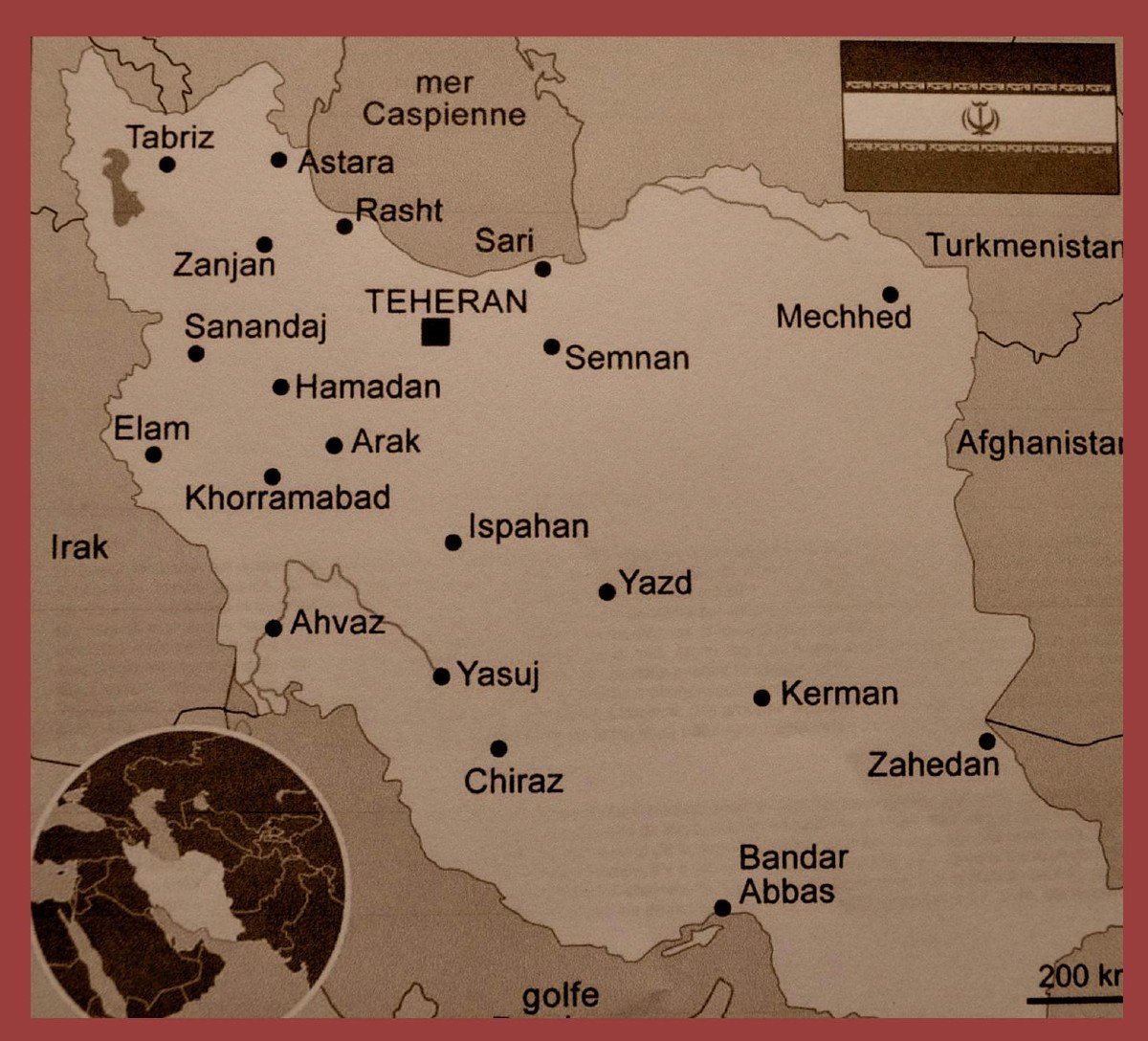
this piece originates from the Chahar Mahal (Shotour) region of Iran.
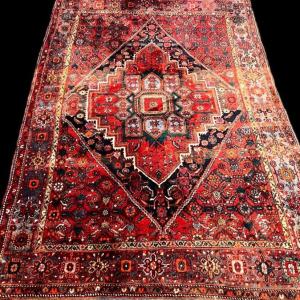
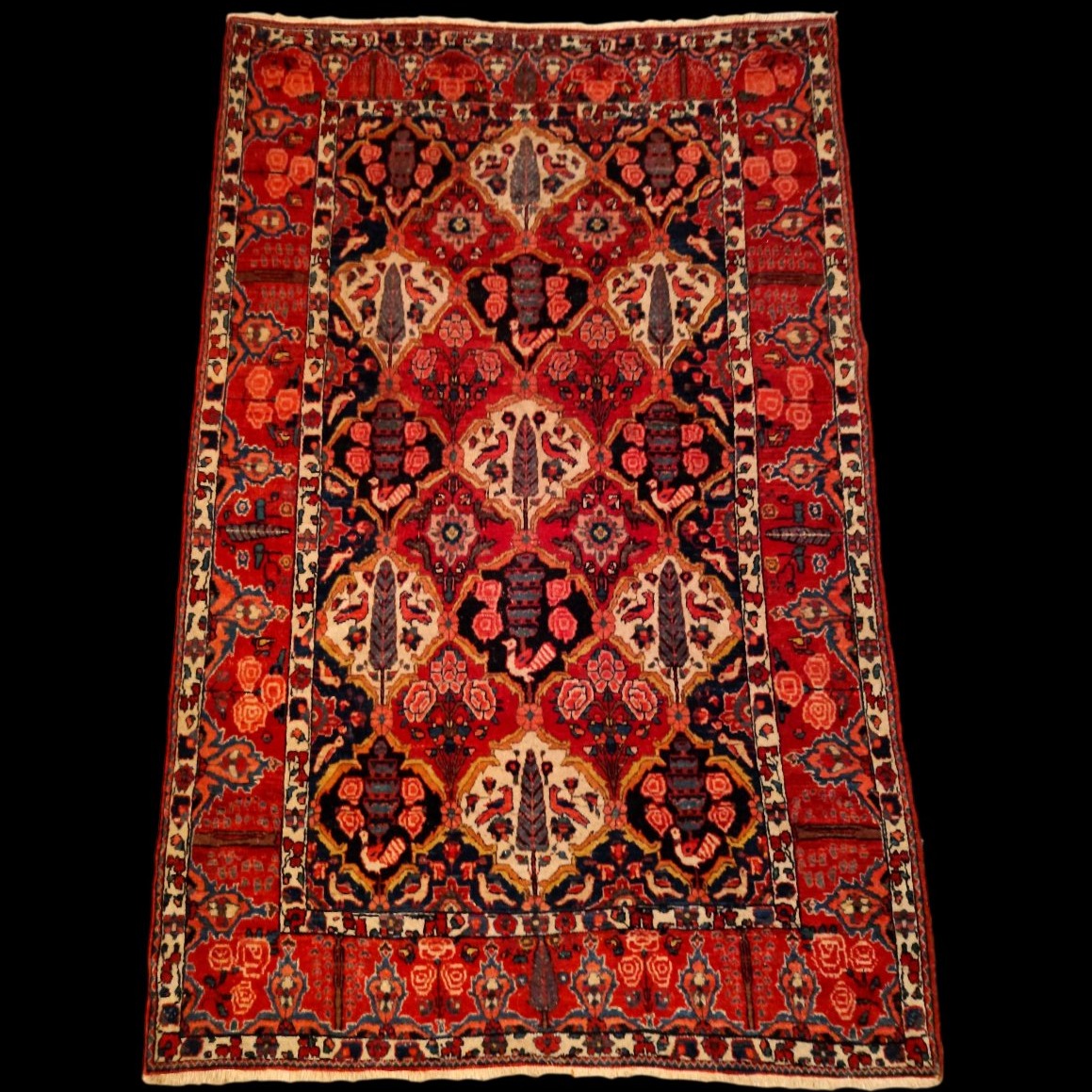
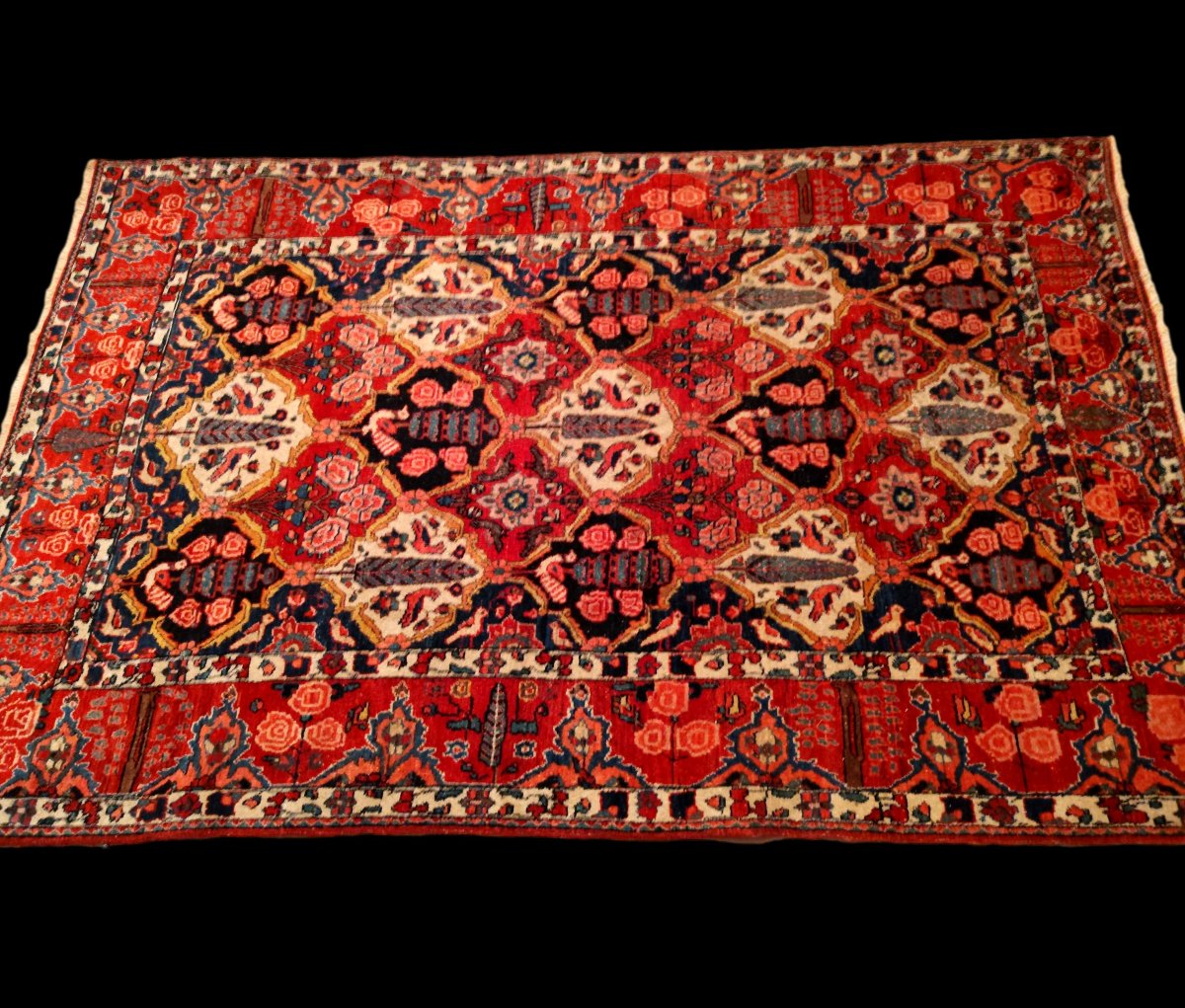
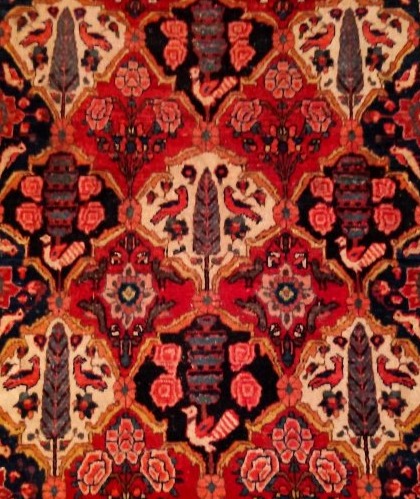
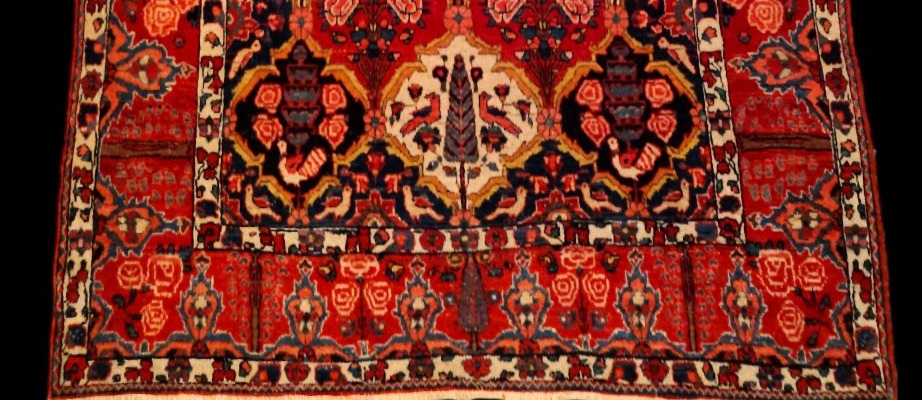
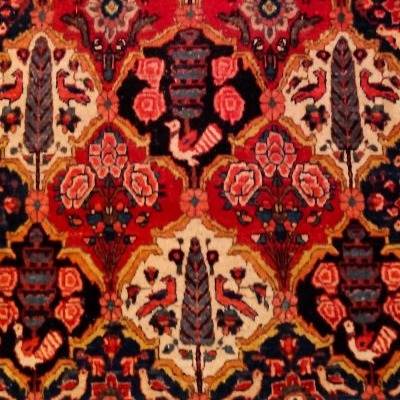
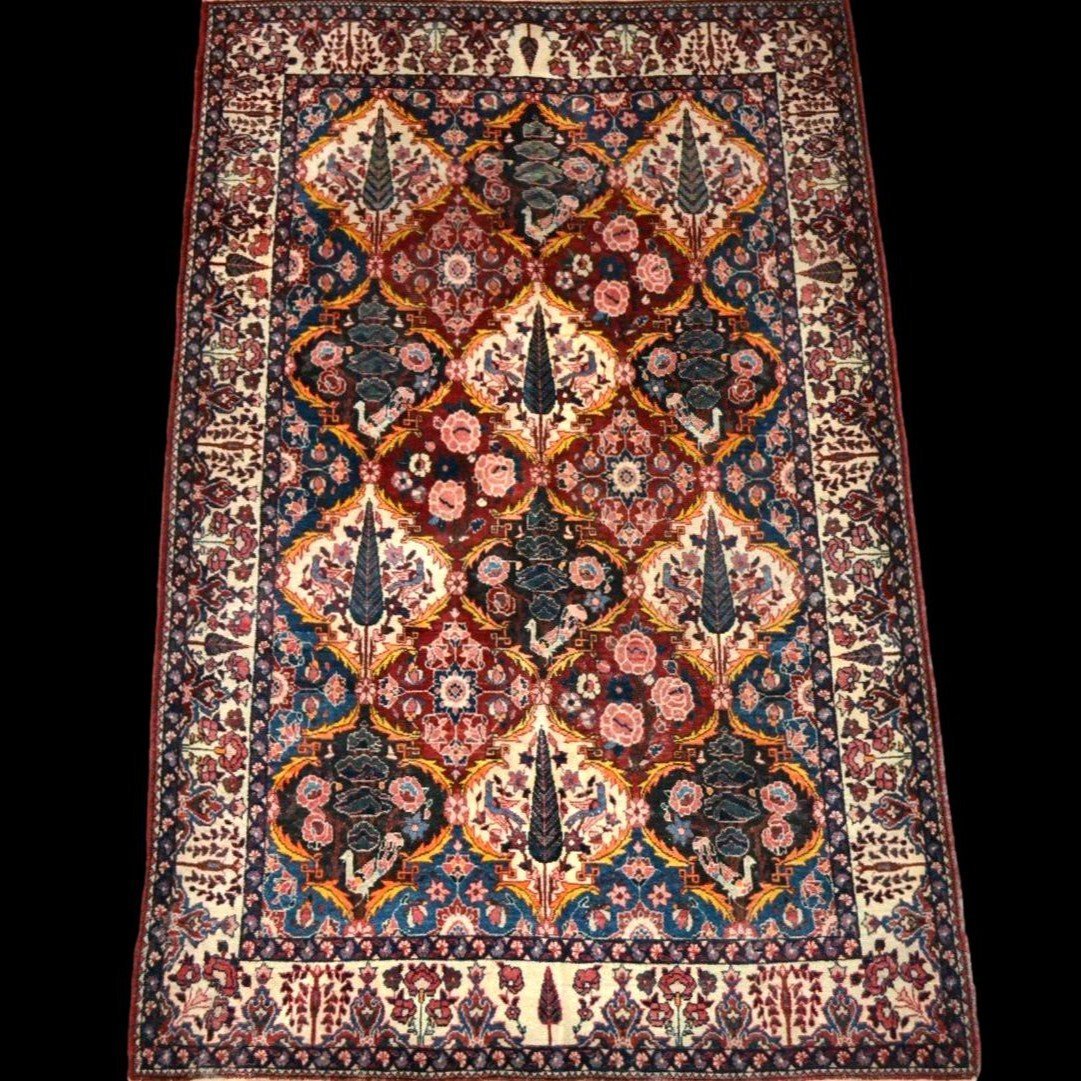
It is a Bakhtiar featuring medallions in the shape of adjoining rhombuses, edged with golden-yellow palm leaves.
Of particular note is the remarkable quality and execution of the border design.
This style is very different from the usual square or rectangular patterns that cover the entire field—a feature commonly found on certain Bakhtiar rugs—or the large, radiating rosettes typical of Tafresh rugs.
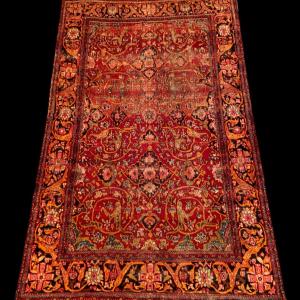
The lozenges are decorated with cypress trees, birds—peacocks and doves—and primarily roses; the colors are numerous and vibrant.
## The rose, the flower of passion, represents “the empire of roses,” Iran.
## The presence of cypress trees is an invitation to the garden, to paradise.
It symbolizes immortality, the evergreen tree, and the enduring nature of memory.
The Mainu Spentas cypress is linked to the ancient Zoroastrian religion.
It is believed to be associated with the light of the god Ormuzd and with Zoroaster; upon his death, it is carried to the highest peak of the mountain, where it is transformed.
Other legends describe it as the tallest cypress in the world, the cypress of paradise, planted by Zoroaster and Kashmar (Torchiz).
## The blue peacock is found in Persian culture.
- It is worth noting that Western iconography sometimes depicts the peacock drinking from the Eucharistic chalice.
- In the Middle East, it is depicted alone or on either side of the Tree of Life on prayer rugs: symbols of the incorruptible soul and thepsychic duality of humankind.
A cosmic symbol in Islam: when it spreads its tail, it represents either the universe, the full moon, or the sun at its zenith.
- A Sufi legend of the Golden Triangle, likely of Persian origin, states:
“God created the Spirit in the form of a peacock and showed it its own image in the mirror of the Divine Essence.
The peacock was seized with a reverent awe and let fall drops of sweat from which all other beings were created.
The spreading of the peacock’s tail symbolizes the cosmic unfolding of the Spirit.”
------------- It is therefore easy to understand the significance of each symbol on this type of rug.
The field consists of 15 lozenges, skillfully colored and knotted with great attention to symmetry.
This type of Bakthiar rug is not among the most common; it remains a style of so-called nomadic rug, using colors specific to their repertoire.
This rug is particularly well-crafted in its design and represents a transition between nomadic rugs and urban rugs.
These pieces are durable, knotted with very high-quality wool sourced from the mountains.
Despite their name and unlike various other types of rugs, Bakthiar rugs are not knotted by members of the Bakthiar tribe—the Bakhtiaris—but by another group that is now sedentary.
The Chahar Mahal region produces Bakthiar carpets as well as a lesser-known type, the Yalame, which are more recent in production but enjoy a very good reputation.
A beautiful artifact of 19th-century Persian culture, knotted during the Qajar dynasty.
## The Qajar Dynasty:
(Qājār, Qadjar, Qajar; Persian: قاجار) was a Turkmen dynasty that ruled Iran from 1786 to 1925.
This dynasty, which had been established on the shores of the Caspian Sea since the Mongol invasions, thus ruled Iran from 1789 until its deposition by parliament in 1925.
This rug, in fact, features particularly intricate detailing in its diagonal checkerboard pattern covering the field and the beauty of its border.
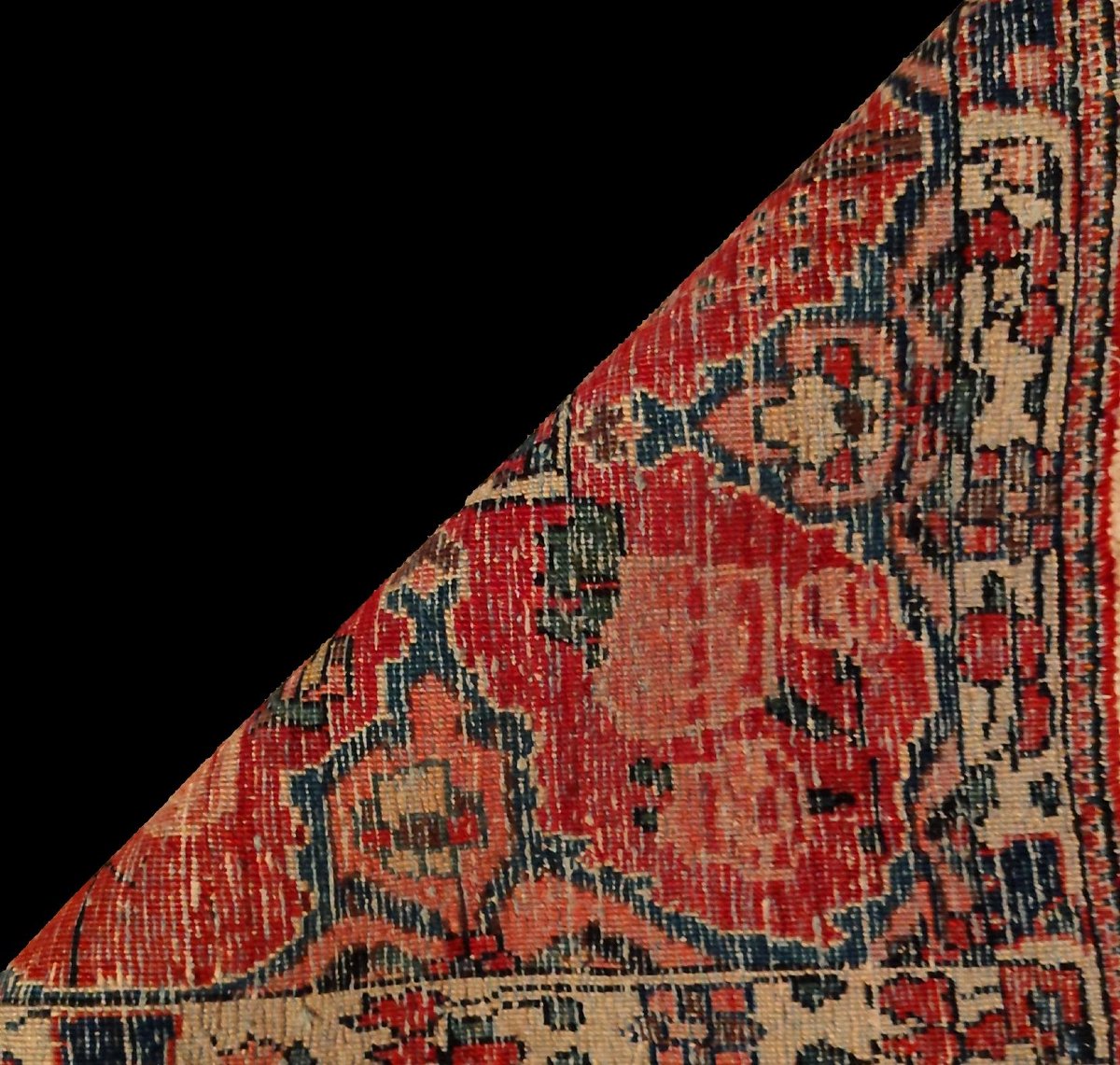
Very slight wear on a truly beautiful collector’s rug.
The double hems are impeccable; this is a finely woven rug, over a century old and of very high quality.
This rug has been professionally cleaned using eco-friendly methods.
Dimensions: Width: 145 cm (57") x Length: 215 cm (84")
FREE SHIPPING TO FRANCE 0€ / EUROPE 25€ / WORLD 50€
Detailed invoice serving as a certificate available upon request.
For more information, you can reach me at:
06 13 36 09 30, 7 days a week, or by email at winsteinprovence@gmail.com
. Thank you in advance.
www.winsteinprovence.com
(Note: Texts and photos by Winstein, all rights reserved)
This rug is in very good condition and features fresh, vibrant colors.
Dating from the late 19th century or very early 20th century—1880–1900—
this piece originates from the Chahar Mahal (Shotour) region of Iran.
It is a Bakhtiar featuring medallions in the shape of adjoining rhombuses, edged with golden-yellow palm leaves.
Of particular note is the remarkable quality and execution of the border design.
This style is very different from the usual square or rectangular patterns that cover the entire field—a feature commonly found on certain Bakhtiar rugs—or the large, radiating rosettes typical of Tafresh rugs.
The lozenges are decorated with cypress trees, birds—peacocks and doves—and primarily roses; the colors are numerous and vibrant.
## The rose, the flower of passion, represents “the empire of roses,” Iran.
## The presence of cypress trees is an invitation to the garden, to paradise.
It symbolizes immortality, the evergreen tree, and the enduring nature of memory.
The Mainu Spentas cypress is linked to the ancient Zoroastrian religion.
It is believed to be associated with the light of the god Ormuzd and with Zoroaster; upon his death, it is carried to the highest peak of the mountain, where it is transformed.
Other legends describe it as the tallest cypress in the world, the cypress of paradise, planted by Zoroaster and Kashmar (Torchiz).
## The blue peacock is found in Persian culture.
- It is worth noting that Western iconography sometimes depicts the peacock drinking from the Eucharistic chalice.
- In the Middle East, it is depicted alone or on either side of the Tree of Life on prayer rugs: symbols of the incorruptible soul and thepsychic duality of humankind.
A cosmic symbol in Islam: when it spreads its tail, it represents either the universe, the full moon, or the sun at its zenith.
- A Sufi legend of the Golden Triangle, likely of Persian origin, states:
“God created the Spirit in the form of a peacock and showed it its own image in the mirror of the Divine Essence.
The peacock was seized with a reverent awe and let fall drops of sweat from which all other beings were created.
The spreading of the peacock’s tail symbolizes the cosmic unfolding of the Spirit.”
------------- It is therefore easy to understand the significance of each symbol on this type of rug.
The field consists of 15 lozenges, skillfully colored and knotted with great attention to symmetry.
This type of Bakthiar rug is not among the most common; it remains a style of so-called nomadic rug, using colors specific to their repertoire.
This rug is particularly well-crafted in its design and represents a transition between nomadic rugs and urban rugs.
These pieces are durable, knotted with very high-quality wool sourced from the mountains.
Despite their name and unlike various other types of rugs, Bakthiar rugs are not knotted by members of the Bakthiar tribe—the Bakhtiaris—but by another group that is now sedentary.
The Chahar Mahal region produces Bakthiar carpets as well as a lesser-known type, the Yalame, which are more recent in production but enjoy a very good reputation.
A beautiful artifact of 19th-century Persian culture, knotted during the Qajar dynasty.
## The Qajar Dynasty:
(Qājār, Qadjar, Qajar; Persian: قاجار) was a Turkmen dynasty that ruled Iran from 1786 to 1925.
This dynasty, which had been established on the shores of the Caspian Sea since the Mongol invasions, thus ruled Iran from 1789 until its deposition by parliament in 1925.
This rug, in fact, features particularly intricate detailing in its diagonal checkerboard pattern covering the field and the beauty of its border.
Very slight wear on a truly beautiful collector’s rug.
The double hems are impeccable; this is a finely woven rug, over a century old and of very high quality.
This rug has been professionally cleaned using eco-friendly methods.
Dimensions: Width: 145 cm (57") x Length: 215 cm (84")
FREE SHIPPING TO FRANCE 0€ / EUROPE 25€ / WORLD 50€
Detailed invoice serving as a certificate available upon request.
For more information, you can reach me at:
06 13 36 09 30, 7 days a week, or by email at winsteinprovence@gmail.com
. Thank you in advance.
www.winsteinprovence.com
(Note: Texts and photos by Winstein, all rights reserved)
2 250 €
Period: 19th century
Style: Orientalism
Condition: Excellent condition
Material: Wool
Length: 215 cm - 84"
Width: 145 cm - 57"
Reference (ID): 1787085
Availability: In stock
Print